

The plan, initially launched in India, now spans over 170 countries, marking OpenAI’s fastest global expansion to date. The idea is to "expand access to ChatGPT’s most popular features and help more people use advanced AI in their daily life."
It's priced at $8 per month in the United States, but pricing may vary in other countries as it's been localized in some markets. The new plan joins OpenAI's other plans: ChatGPT Plus at $20 per month and ChatGPT Pro at $200 per month.
TL;DR
- ChatGPT Go, powered by GPT-5.2 Instant, is now available globally.
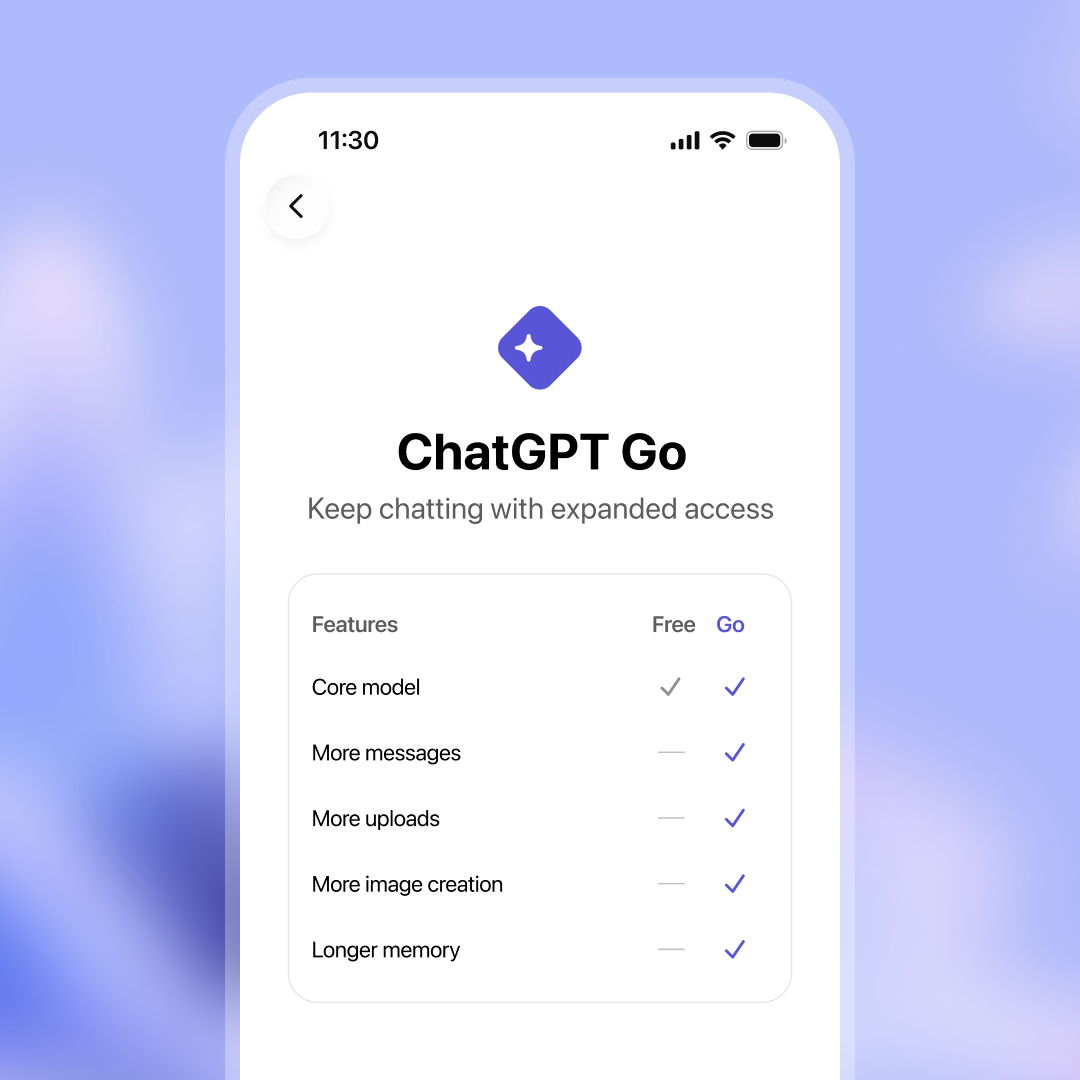
- The $8 monthly plan offers faster responses, longer memory, and higher usage limits.
- OpenAI will test advertisements in ChatGPT’s free and Go tiers to support affordable access.
- Premium plans, including Plus and Pro, remain ad-free.
The plan willl bring advanced AI access to users seeking more capability than the free tier offers, all while remaining cost-effective for students, freelancers, and small teams.
The plan provides users access to GPT-5.2 Instant, OpenAI’s fast, lightweight model optimized for real-time responses and image generation.
According to OpenAI, the new plan allows around ten times more messages, file uploads, and image creation than the free version, and supports expanded memory and context window for continuous conversations.
"In markets where Go has been available, we’ve seen strong adoption and regular everyday use for tasks like writing, learning, image creation, and problem-solving," read OpenAI's release. "This early momentum helped inform our decision to make ChatGPT Go available globally."
Meanwhile, the ChatGPT Plus plan comes with higher limits for messages, file uploads, memory, and context. This model works to enhance tasks that need deeper thinking, such as writing and editing documents, learning and research, or data analysis. It also comes with expanded access to its most advanced models, including GPT‑5.2 Thinking, OpenAI will bring users the flexibility to choose legacy models, as well as use its coding agent, Codex.
ChatGPT Pro brings in maximum memory and context, early previews of new new features, and full access to GPT‑5.2 Pro, OpenAI's most powerful model.
However, ChatGPT Go remains OpenAI's fastest growing plan and among the most affordable AI subscription globally. The expansion comes as generative AI (GenAI) adoption continues to surge across emerging economies, where cost has been a key barrier to entry.
Supporting Global Access Through Ads
In a move that reflects a shift in OpenAI’s business model, the company also announced plans to test advertisements within ChatGPT’s free and Go tiers. The tests will begin in the United States before expanding to other regions.
The ads will appear below responses and will be clearly marked as sponsored content, with OpenAI confirming they will not affect AI answers or recommendations. The company emphasized that user data and conversation logs will not be shared with advertisers, maintaining privacy standards consistent with its current policy.
OpenAI also confirmed that its Plus, Pro, Business, and Enterprise subscriptions will not include ads.
This approach mirrors a broader industry trend toward hybrid monetization, balancing subscription revenue with advertising to sustain infrastructure costs. OpenAI’s high operating expenses—estimated at tens of millions of dollars per month due to GPU usage—make scalable monetization essential.
Topics For More Insights
A Step Toward Sustainable AI Access
The launch of ChatGPT Go underscores OpenAI’s goal to democratize powerful AI tools while maintaining service quality. The model’s affordability is expected to drive growth in regions such as Southeast Asia, Africa, and Latin America, where the Plus plan was previously considered premium.
Industry observers suggest the combination of a low-cost plan and ad-supported tiers could help OpenAI expand its user base while offsetting compute costs.
With ChatGPT Go now available worldwide and ad tests on the horizon, OpenAI continues to balance innovation, accessibility, and long-term sustainability, ensuring that conversational AI remains within reach for a global audience.
