
OpenAI has launched ChatGPT Health, a new version of its AI assistant designed to help people understand their medical information, explore wellness questions, and prepare for doctor visits. The move marks OpenAI’s most significant step to date into healthcare technology and comes as millions of users already rely on AI tools for medical advice.
Here's what's new in this update.
TL; DR
- OpenAI has launched ChatGPT Health, a dedicated health and wellness interface within ChatGPT.
- Users can connect medical records and wellness apps for personalized insights.
- More than 40 million people use ChatGPT daily to search for health-related information.
- Health data will not be used for model training and remains encrypted.
- The feature is designed for informational and guidance purposes, not for diagnosis.
What Does ChatGPT Health Bring To The Table
The new feature introduces a dedicated “Health” tab within ChatGPT. This section allows users to securely connect personal health data, including information from apps such as Apple Health, MyFitnessPal, and Fitbit.
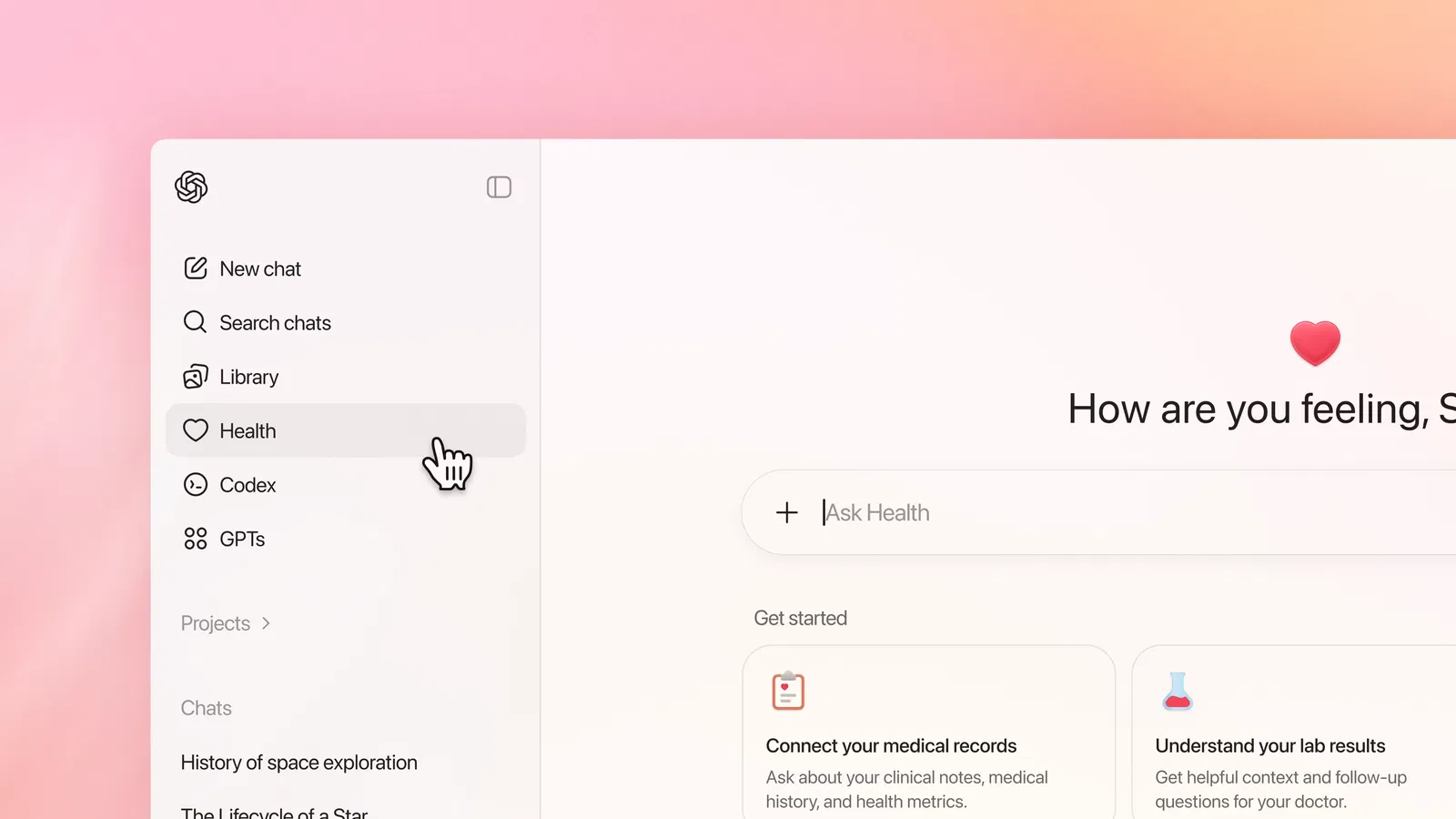
According to OpenAI, this data is fully encrypted and stored separately from other ChatGPT interactions. Importantly, health data is not used to train OpenAI’s general models, a step meant to address user concerns about privacy and data usage.
In its official announcement, OpenAI explained, “To keep your health information protected and secure, (ChatGPT) Health operates as a separate space with enhanced privacy to…” highlighting its focus on maintaining confidentiality and data safety across all health interactions.
ChatGPT Health is being rolled out gradually to select users in the United States and the United Kingdom through the web and iOS apps, with plans to extend to Android devices later in 2026.
A Surge In Health AI Queries
Health questions already dominate ChatGPT’s usage.
According to OpenAI, the platform processes over 230 million health and wellness queries each week, with more than 40 million daily users seeking guidance on medical or wellness topics. Many users turn to ChatGPT to interpret lab results, clarify insurance terms, or understand potential symptoms before visiting a doctor.
“More than 40 million weekly active users worldwide send healthcare-related queries to ChatGPT every day,” OpenAI’s team confirmed, reflecting the extent to which AI now plays a role in people’s health information journeys.
Industry analysts say this surge highlights a shift in consumer behavior from traditional web searches to conversational discovery.
Greg Yap, Partner at Menlo Ventures, noted, “Consumers have historically gone to Google to ask their health questions, and it is clear that they are now starting to shift those questions over to LLMs to capture that knowledge base through a more conversational discovery process.”
Topics For More Insights
Industry And Expert Reactions
OpenAI states that ChatGPT Health is not intended to diagnose or treat illnesses, but to help people interpret complex health information. The company collaborated with more than 260 physicians worldwide to help fine-tune health-related responses and ensure safety and accuracy.
A spokesperson for OpenAI explained, “Our goal is to help people make sense of their health information, not to diagnose or treat. Every design choice for ChatGPT Health was made with privacy, empathy, and safety in mind.”
Medical experts, however, caution against overreliance on generative AI in medical decision-making.
Independent research published on arXiv found that large language models vary in reliability across medical domains and, in some cases, may provide unsafe recommendations without context.
Healthcare professionals emphasize that tools like ChatGPT Health should be used as educational companions rather than clinical advisors.
Balancing Innovation And Safety
The launch also comes amid heightened scrutiny of AI’s impact on mental health.
Reports from Platformer and The Verge indicated that millions of AI interactions each month involve users showing signs of emotional distress or dependence. OpenAI has responded by strengthening its conversational safety systems and introducing protocols that encourage users to seek professional help when needed.
As OpenAI CEO Sam Altman said during an earlier briefing, “AI won’t replace doctors, but it can help people feel informed, prepared, and confident when talking to their doctors.”
His statement reflects the company’s broader view of AI as a supportive tool rather than a substitute for medical care.
Looking Ahead
The debut of ChatGPT Health positions OpenAI at the forefront of a rapidly expanding health AI market. While competitors like Google and Amazon are developing enterprise-focused solutions, OpenAI’s approach centers on consumer-driven empowerment with strict privacy controls.
With growing public interest in AI-powered wellness and diagnostic tools, the success of ChatGPT Health will depend on its ability to balance accessibility, accuracy, and ethical responsibility.
