
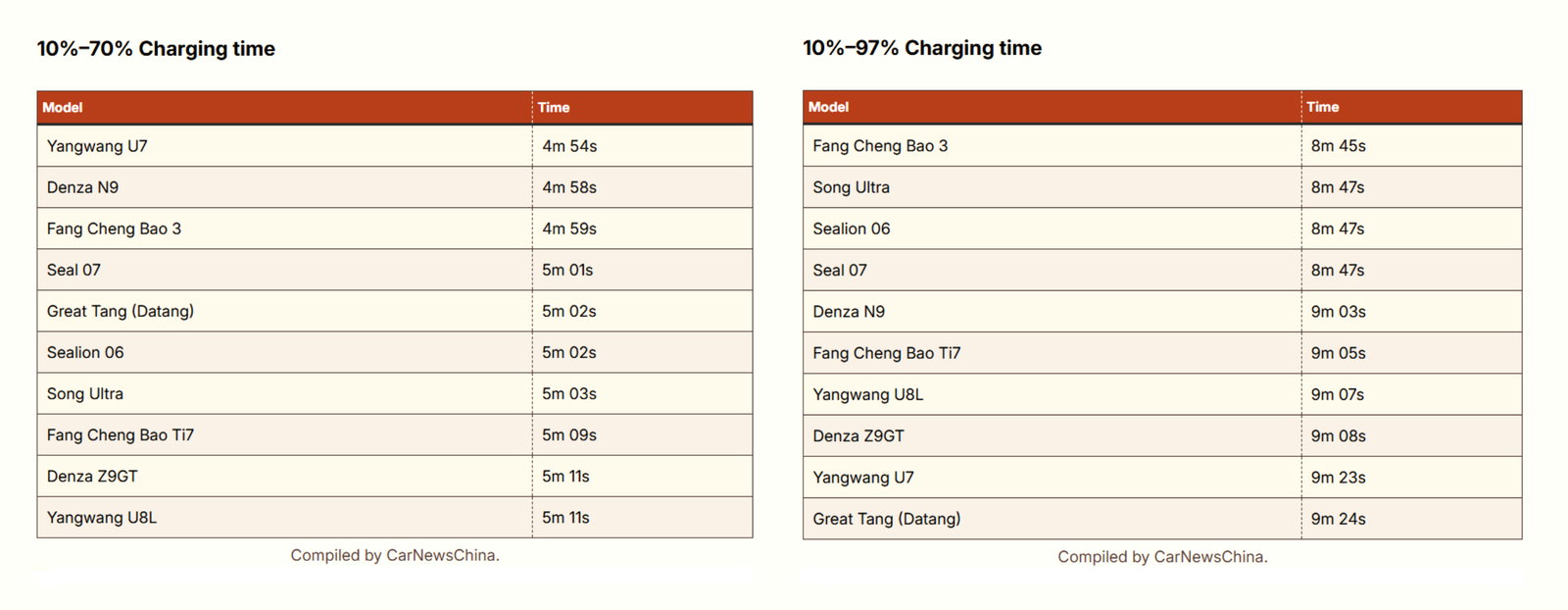
Under normal temperatures, the Blade Battery 2.0 can charge from 10% to 70% in five minutes. A full charge cycle from 10% to 97% takes around nine minutes, while reaching near full capacity from 70% to 100% requires only a few additional minutes.
The development could significantly reduce charging time concerns that often slow EV adoption.
TL;DR
- BYD introduced the Blade Battery 2.0 capable of charging from 10% to 70% in five minutes.
- The battery can reach 97% in nine minutes under standard conditions.
- It maintains fast charging even in extreme cold temperatures.
- BYD plans to deploy 20,000 Flash Charging stations to support the technology.
The company says the system maintains strong performance even in harsh weather conditions. Charging from 20% to 97% takes roughly 12 minutes at temperatures as low as -20°C, with similar performance recorded even at -30°C.
Such speeds rival fast charging technologies used in consumer electronics, such as smartphones, and could narrow one of the biggest performance gaps between electric vehicles and traditional internal combustion engines.
The new battery system will debut in the Yangwang U7, a full-size luxury sedan from BYD’s premium lineup.
Flash Charging Infrastructure Required For Maximum Performance
While the battery performance numbers are impressive, achieving the fastest charging speeds depends on specialized infrastructure.
Vehicles equipped with the Blade Battery 2.0 will only reach the five-minute charging window when connected to BYD’s proprietary Flash Charging stations. These chargers are capable of delivering up to 1.5 megawatts of power and operate at 1000V high voltage.
Each charging gun can deliver a maximum output of 1500 kW, enabling the battery to absorb energy quickly while maintaining stability even in extremely cold conditions.
The stations themselves feature a redesigned T-shaped layout that makes the charging gun easier to handle. The system also includes waterproof protection, a compact charging unit, and an overhead sliding rail that allows drivers to charge from greater distances without repositioning their vehicles.
The company also plans to label compatible vehicles with a unique tail badge to indicate they support flash charging.
BYD Plans 20,000 Flash Charging Stations To Support EV Expansion
To support the rollout of the new battery system, BYD is building a dedicated Flash Charging network.
The company plans to deploy 20,000 flash charging stations, including 18,000 installations that will operate through a station-within-a-station model. This approach integrates BYD’s technology into existing public charging infrastructure.
According to BYD CEO Wang Chuanfu, the strategy allows the company to expand rapidly while minimizing pressure on the power grid. The stations use energy storage batteries that are replenished through existing fast-charging networks, enabling the flash charging systems to deliver high power output when needed.
Wang said installation of the stations is “as simple as installing an air conditioner.”
BYD has already completed 4,239 charging stations during the first two months of the year, with the initial locations scheduled to begin operation immediately.
The company also plans to install 2,000 highway charging stations before the end of the year, covering roughly one-third of service areas and ensuring a flash charging station is available every 100 kilometers.
Topics For More Insights
Improved Battery Performance, Range And Safety Standards
Beyond charging speed, the Blade Battery 2.0 includes improvements in energy density, durability, and safety.
BYD says the battery achieves around 5% higher energy density compared to its predecessor while maintaining stricter safety standards and longer operating lifespan.
The technology also enables vehicles to travel longer distances between charges.
For example, the Denza Z9GT equipped with the new battery system can reach a driving range of up to 1036 kilometers on a single charge.
Combined with ultra-fast charging and expanded infrastructure, BYD’s latest battery technology signals a push to make electric vehicles more convenient for everyday drivers.
The move also highlights the growing competition in the global EV market, where battery innovation and charging infrastructure are increasingly becoming the defining factors for widespread adoption.
