

Apple is expanding its advertising business by bringing sponsored placements to Apple Maps in the U.S. and Canada later this summer. The rollout is part of Apple Business, a new platform that combines location management, device administration, business email and calendar, and other workplace tools into one offering.
TL;DR
- Apple Maps will begin showing clearly marked paid ads in the U.S. and Canada later this summer.
- The ads are tied to Apple Business, which launches April 14 in more than 200 countries and regions.
- Businesses will need a claimed Maps location to create campaigns, while existing Apple Ads advertisers and agencies can use Apple’s current ad tools with more customization.
- Apple says Maps ads will keep its privacy protections intact, while the move opens a fresh growth opportunity in Services and puts Apple into more direct competition for local ad dollars.
What Is Apple Launching?
Apple Business replaces Apple Business Connect, Apple Business Essentials, and Apple Business Manager with one platform that lets companies manage devices, set up work email and calendars, and manage their business presence across Apple services. Apple says existing business data, including claimed locations and place-card information, will migrate automatically when the new platform goes live.
For Maps specifically, Apple says businesses in the U.S. and Canada will be able to place local ads during key search and discovery moments later this summer. That move puts Apple into a category long dominated by Google, while also giving the company a new lever to deepen its services play.
How Apple Maps Ads Will Work?
Apple says ads will appear when users search in Maps and can show up at the top of search results as well as in a new Suggested Places experience. Ads will be clearly marked. Businesses will first need to claim their location on Maps, then create ads through Apple Business in what Apple describes as largely automation.
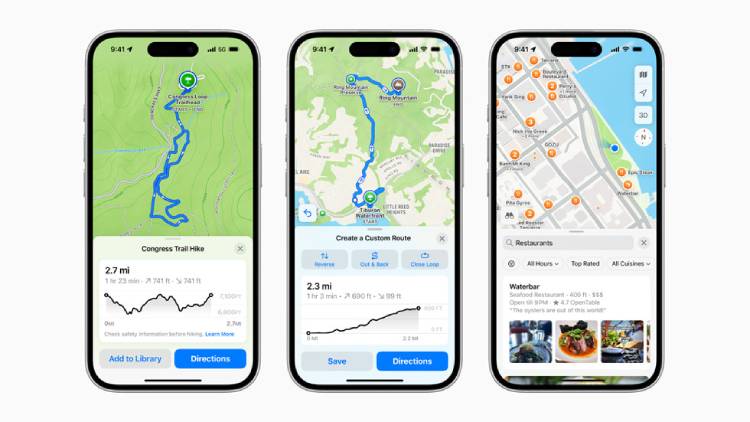
Apple plans to show only one ad in Maps search results. It also said the sponsored pin will carry a small blue halo and that ads in Suggested Places will be labeled, while advertisers will be able to upload photos, add promotional copy, and set a budget.
What Apple Executives Are Saying?
Susan Prescott, Apple’s Vice President of Enterprise and Education Marketing, called Apple Business “a significant leap forward,” as the company folded its business tools and new customer-reach features into one platform. That framing matters because Apple is positioning Maps ads as part of a broader business-services push, not just a standalone ad launch.
The revenue angle is also clear in Apple’s latest earnings commentary. CEO Tim Cook said Services posted “an all-time revenue record” and grew 14 percent year over year, underscoring why a local ad product inside Maps matters beyond simple discovery.
Topics for more insights:
The Numbers Behind Apple’s Push
Apple says Apple Business will launch on April 14 in more than 200 countries and regions. In its latest quarterly results, Apple also said its installed base now exceeds 2.5 billion active devices. Those figures show the scale of the ecosystem Apple is trying to monetize more efficiently through first-party business tools and local advertising.
That backdrop is important because Maps ads are arriving as Apple continues to lean on high-margin Services growth. Even without disclosing expected Maps ad revenue, the company is clearly extending its ad business deeper into a core utility app used across its global installed base.
Why This Matters?
This is more than a simple ad slot expansion. Apple is introducing advertising into one of its most widely used first-party utility apps while preserving the privacy language that defines much of its platform strategy. The company says a user’s location and ad interactions in Maps will not be tied to an Apple Account, and personal data stays on-device rather than being collected, stored, or shared with third parties.
The competitive angle is just as important. By bringing sponsored local discovery into Maps, Apple is moving closer to Google’s playbook while creating another pathway for businesses to pay for visibility inside its ecosystem. For advertisers, that means a new local search surface. For Apple, it means a fresh services monetization opportunity that fits neatly into its broader business platform ambitions.
