Artificial Intelligence
AI Boosts Software Development But AI Slop Costs Firms Millions & Cuts Productivity
Updated on Fri, Sep 26, 2025
Share
One way or the other, every industry is either getting boosted by the brilliant capabilities of AI or getting a complete overhaul.
Software development is one of the sectors that is benefiting the most from AI technology.
According to the 2025 report of Google Cloud’s DORA research program, which investigates the capabilities, practices, and measures of high-performing technology-driven teams and organizations, “AI is no longer a novelty, but a near-universal part of a developer’s toolkit.”
The report further notes that the adoption rate of AI among software development professionals has jumped to 90%, with a 14% increase from 2024.
Here, 65% of professionals surveyed said they’re heavily reliant on AI for software development, followed by 37% respondents moderately using it, 20% saying a lot, and 8% claiming a great deal.
It’s not just reliance that was noted; over 80% of professionals also said that AI has improved their productivity, while 59% said AI improved code quality.
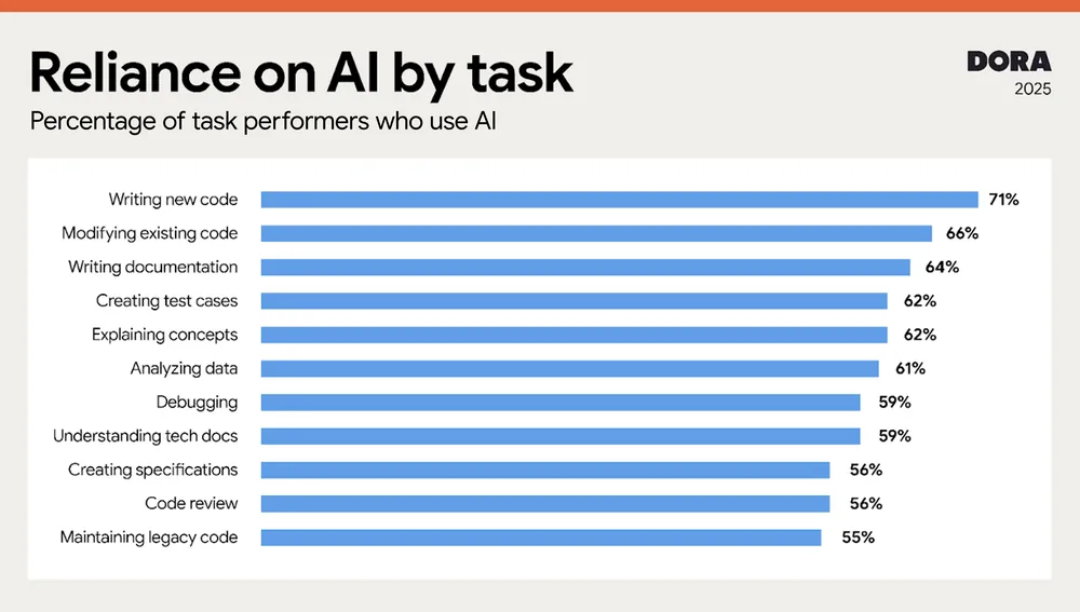
It also lists the areas in which AI reliance is enhancing jobs conducted by software developers: writing new code (71%), modifying existing code (66%), writing documentation (64%), creating test cases (62%), explaining concepts (62%), analyzing data (61%), debugging (59%), understanding tech docs (59%), creating specifications (56%), code review (56%), maintaining legacy code (55%).
However, despite the high level of adoption and all the benefits that AI has brought about, not everyone is convinced about its output capabilities.
The report also highlights a “trust paradox,” which consists of software developers remaining cautious about the technology’s place in their work. 7% of respondents said they don’t trust AI at all, and 23% said they trust it “a little”, in comparison to 20% trusting it “a lot” and 4% doing so a “great deal.”
“The key takeaway is clear: AI is a transformative tool for developers, but realizing its full potential requires more than just adoption. It demands that organizations evolve their culture, processes and systems to support a new era of software development,” concludes the blog post announcing the report.
Research by Harvard Business Review (HBR) found that documents generated by AI tend to appear well-written, polished, and display perfection in grammar, but lack substance.
This was backed by a survey conducted by Stanford University that noted 40% of US-based full-time employees said they received such outputs in just the past month, ones that lacked sufficient content to advance a task.
Such work can instead create more confusion and lead to more corrections, resulting in more time wasted than it’s supposed to save. HBR termed this phenomenon “workslop.” As such, workers can ultimately spend around two hours per incident just correcting and deciphering such outputs.
In the end, it was found that workslop came with significant hidden costs for companies, costing them millions of dollars for such wasted efforts.
It’s not just money and time that were hampered—managers’ and employees’ moods and morale were also hit by AI-powered workslop.
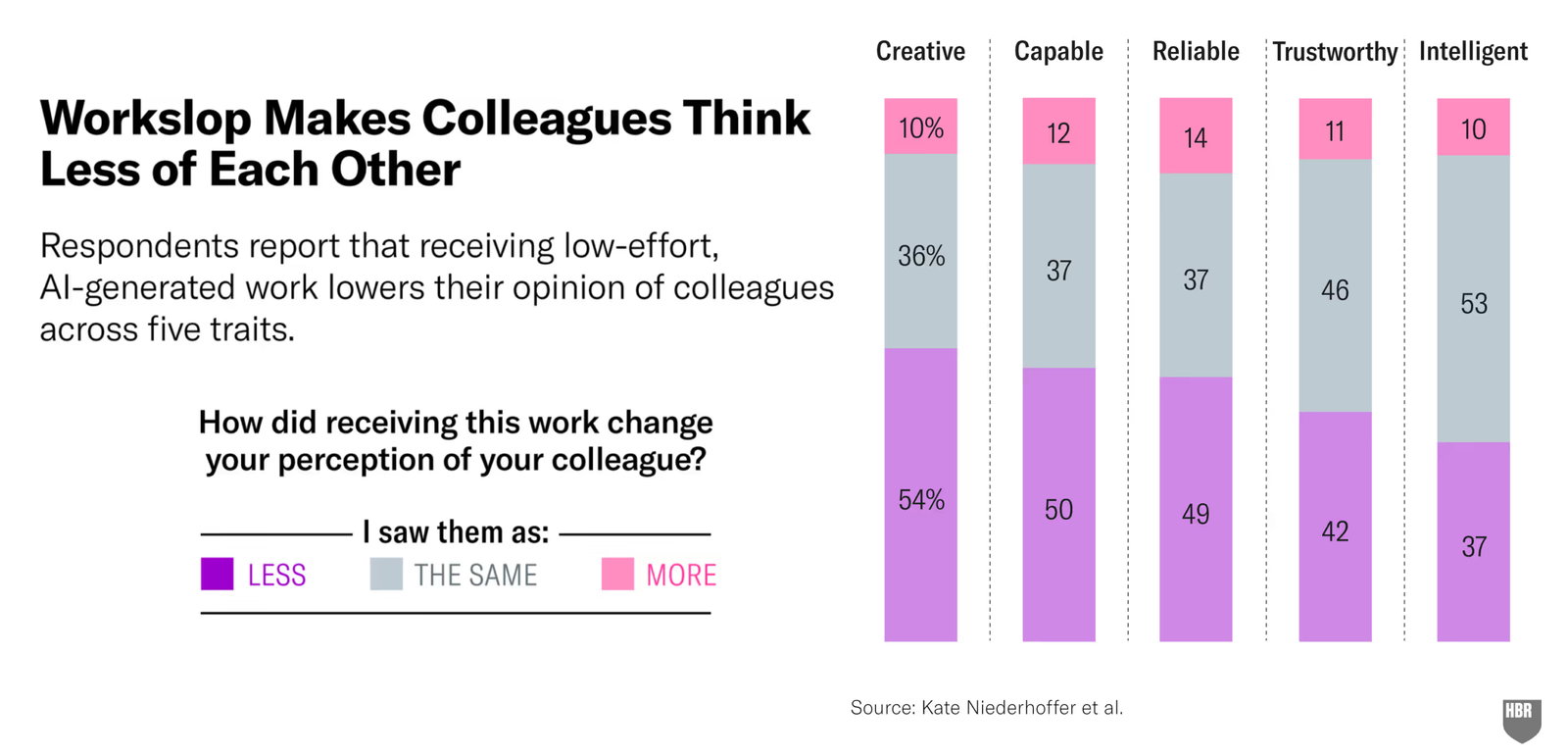
53% of respondents to Stanford’s survey said they felt annoyed when they received low-quality AI outputs, and 22% felt offended. Moreover, employees who forwarded such work were seen as less capable or reliable
“I had to waste more time following up on the information and checking it with my own research,” said a director in the retail sector, who was cited in the HBR report. “I then had to waste even more time setting up meetings with other supervisors to address the issue. Then I continued to waste my own time having to redo the work myself.”
“It was just a little confusing to understand what was actually going on in the email and what he actually meant to say,” said a frontline manager in the tech sector. “It probably took an hour or two of time just to congregate [sic] everybody and repeat the information in a clear and concise way.”
A finance expert shared that AI workslop “created a situation where I had to decide whether I would rewrite it myself, make him rewrite it, or just call it good enough. It is furthering the agenda of creating a mentally lazy, slow-thinking society that will become wholly dependant [sic] upon outside forces.”
Amid all this, just 11% of experts—consisting of 550 business "decision-makers"—cited in a survey conducted by customer relationship management (CRM) platform Creatio believe that AI will lead to “significant headcount reductions.”
Additionally, 83% feel advanced AI systems, such as AI agents, will instead support their current workforce by automating routine, time-consuming tasks that free them up for more critical, creative, and meaningful work—and could even create new roles.
In this regard, many companies have begun relying on the human-AI collaboration to power their sales pipelines and workflows.
What are your thoughts on AI in the workplace?
Do you think AI will eventually take over all jobs and revolutionize every industry?
Let us know in the comments below!
First published on Fri, Sep 26, 2025

Enjoyed what you read? Great news – there’s a lot more to explore!
Dive into our content repository of the latest tech news, a diverse range of articles spanning introductory guides, product reviews, trends and more, along with engaging interviews, up-to-date AI blogs and hilarious tech memes!
Also explore our collection of branded insights via informative white papers, enlightening case studies, in-depth reports, educational videos and exciting events and webinars from leading global brands.
Head to the TechDogs homepage to Know Your World of technology today!
Disclaimer - Reference to any specific product, software or entity does not constitute an endorsement or recommendation by TechDogs nor should any data or content published be relied upon. The views expressed by TechDogs' members and guests are their own and their appearance on our site does not imply an endorsement of them or any entity they represent. Views and opinions expressed by TechDogs' Authors are those of the Authors and do not necessarily reflect the view of TechDogs or any of its officials. While we aim to provide valuable and helpful information, some content on TechDogs' site may not have been thoroughly reviewed for every detail or aspect. We encourage users to verify any information independently where necessary.
Loading comments...