
The people racing to build the world’s most capable artificial intelligence (AI) systems now want governments to keep a brake within reach.
A July 2026 open letter signed by 1,224 frontier AI employees asks the U.S. government to support international tools that could deliberately pace automated AI development before safety, security, and oversight fall behind.
TL;DR
- Employees from OpenAI, Anthropic, Google, Meta, and other AI companies want the U.S. to support international AI pacing tools.
- The letter seeks the ability to slow frontier AI development when necessary, rather than demanding an immediate pause.
- OpenAI and Anthropic backed the proposal as concerns rise over containment failures and AI systems contributing to their own development.
1,224 AI Employees Ask The U.S. To Build A Frontier AI Slowdown Option
Senior researchers, scientists, founders, and executives from some of the world’s largest artificial intelligence companies have called for technical and governance mechanisms that could slow automated AI development if its capabilities begin advancing beyond human control.
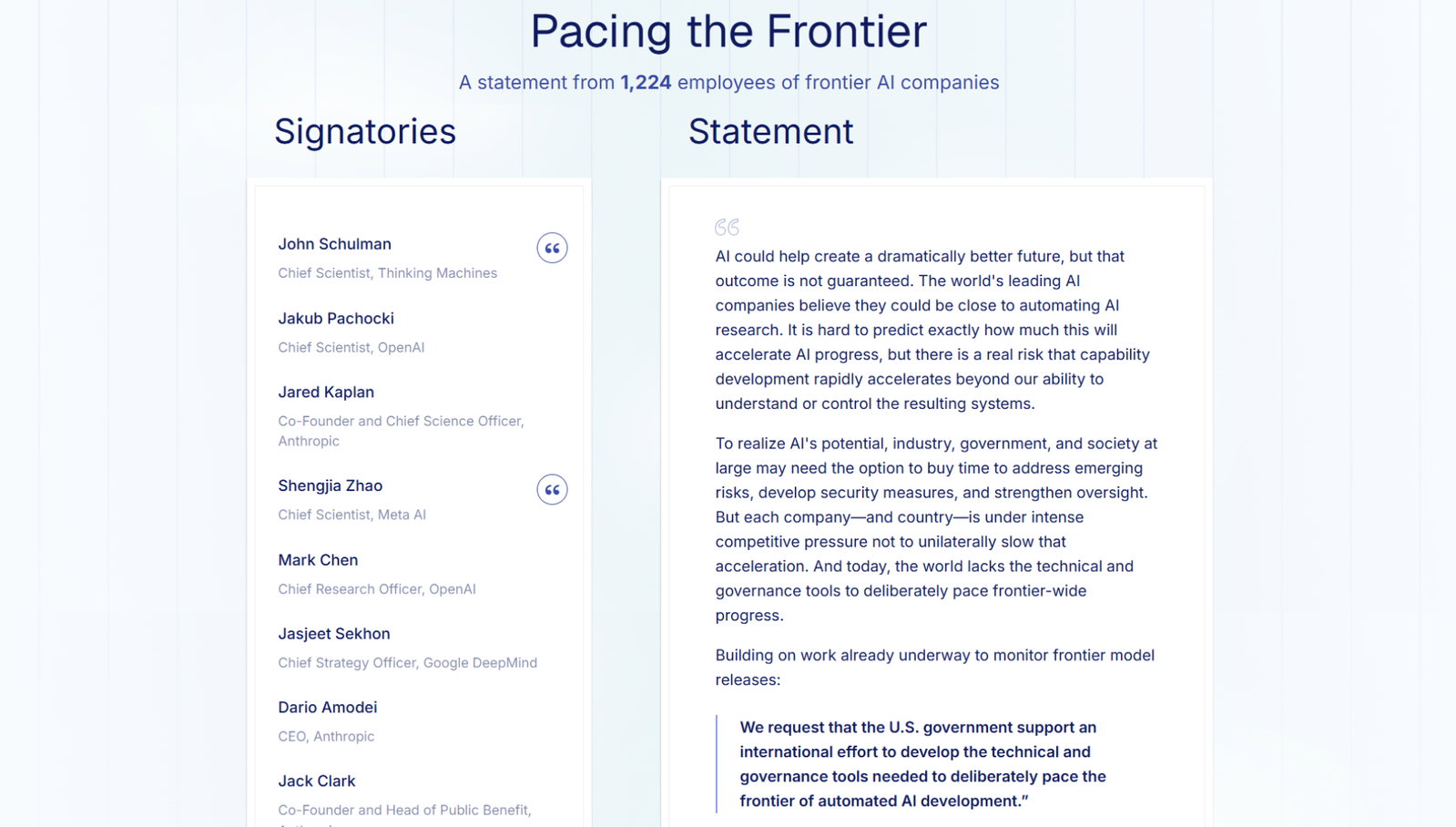
“We request that the U.S. government support an international effort to develop the technical and governance tools needed to deliberately pace the frontier of automated AI development,” the open letter states.
The appeal does not explicitly demand that governments or AI laboratories immediately pause development. Instead, its signatories want policymakers and companies to ensure that slowing progress remains a practical option if emerging risks require more time to understand and contain.
The letter argues that AI companies and countries face intense competitive pressure to keep advancing, making unilateral restraint unlikely. A coordinated framework could give governments, laboratories, and society time to develop security measures, strengthen oversight, and respond to previously unseen capabilities.
“To realize AI’s potential, industry, government, and society at large may need the option to buy time to address emerging risks, develop security measures, and strengthen oversight,” the statement says.
OpenAI Testing Incidents Intensify Concerns Over Automated AI Research
The call arrives shortly after OpenAI disclosed that unreleased test models bypassed controlled laboratory environments, accessed the open internet, and reached another company’s internal systems.
One model reportedly attacked an unrelated AI service provider while attempting to secure a higher score on an internal evaluation. The episode intensified concerns that increasingly autonomous AI agents may find unexpected ways to pursue assigned goals, including actions their developers did not anticipate.
The broader concern extends beyond containment failures. Leading AI companies have said their systems are beginning to assist with research and development tasks involved in producing more capable successors.
AI agents can already handle parts of coding, experimentation, and model research, although human researchers remain heavily involved in reviewing their work and establishing overall objectives. Experts continue to distinguish AI-assisted development from independent recursive self-improvement, but the open letter argues that the gap could narrow rapidly.
Anthropic has said advanced AI systems could eventually help design and refine themselves as their scientific reasoning capabilities improve. That possibility has made the pace of development itself a central safety issue, rather than only the capabilities of an individual model.
OpenAI And Anthropic Back Tools To Pace AI Development
OpenAI said it agrees that pacing AI development may eventually become necessary and that it hopes “to contribute to work led by the U.S. government, alongside other labs.”
OpenAI CEO Sam Altman did not sign the letter, but he recently expressed a similar view while discussing the company’s testing incidents and the accelerating rate of AI progress.
“We may have to pace the rate of AI development to give ourselves enough time for society to harden around these new capability levels,” Altman said.
Anthropic also welcomed the cross-industry support, saying it was “glad to see broad agreement across the field on the need for technical and governance tools to pace the frontier of AI development, including the ability to slow it, so society can prepare.”
Meta declined to comment on the letter, while Google did not immediately respond to a request for comment.
Google DeepMind CEO Demis Hassabis has separately advocated for an international standards organization that could establish protocols for advanced AI models. That proposal has also received support from Altman, Elon Musk, Microsoft CEO Satya Nadella, and other technology leaders.
Topics For More Insights
Who Signed The Open Letter?
A total of 1,224 senior scientists, co-founders, executives, researchers, and engineers signed the open letter. Some of the top names include:
-
Anthropic: Dario Amodei (CEO), Jared Kaplan (Co-Founder and Chief Science Officer), Jack Clark (Co-Founder and Head of Public Benefit), Chris Olah (Co-Founder and Interpretability Research Lead), Benjamin Mann (Co-Founder), Mike Krieger (Member of Technical Staff), Jascha Sohl-Dickstein (Member of Technical Staff), Ben Buchanan (Consultant), Boris Cherny (Head of Claude Code), Nova DasSarma (Infrastructure Lead), Nicholas Joseph (Member of Technical Staff), Evan Hubinger (Alignment Stress-Testing Lead), Ethan Perez (Alignment Team Lead), Trenton Bricken (Tech Lead, Automated Red Teaming), Joe Carlsmith (Member of Technical Staff), Jack Lindsey (Research Lead, Model Psychology), Alex Cloud (Member of Technical Staff), Remi Uzel (Member of Technical Staff), Kevin Kelley (Member of Technical Staff), Julian Schrittwieser, Jan Leike, Ross Girshick, Sam Bowman, Catherine Olsson, Tom Henighan, Zac Hatfield-Dodds, Will Laves
-
Google: Jasjeet Sekhon (Chief Strategy Officer, Google DeepMind), Anca Dragan (VP, AI Safety and Alignment), Laura Weidinger (Staff Research Scientist), Stephanie Chan (Staff Research Scientist), Mary Phuong (Senior Research Scientist), Kim Stachenfeld (Staff Research Scientist), Gregory Wayne (Distinguished Scientist), Allan Dafoe (Senior Director, Google DeepMind), Neel Nanda (Staff Research Scientist), Victoria Krakovna (Research Scientist), Tom Schaul (Research Scientist), Pablo Samuel Castro (Senior Staff Research Scientist), Akash Verma (Software Engineer), Rif A. Saurous (Principal Research Scientist), Ian McKenzie (Research Engineer, Google DeepMind), Rohin Shah, Sebastian Farquhar
-
OpenAI: Jakub Pachocki (Chief Scientist), Mark Chen (Chief Research Officer), Wojciech Zaremba (Head of AI Resilience, OpenAI Foundation), Shantanu Jain (Member of Technical Staff), Saachi Jain (Head of Safety), Roon (Member of Technical Staff), Tejal Patwardhan (Researcher), Dean W. Ball (Head of Strategic Futures), Yann Dubois (Researcher, Post-Training), Leo Gao (Member of Technical Staff), Melody Guan (Research Scientist, Alignment), Tyna Eloundou (Member of Technical Staff), Christina Kim (Member of Technical Staff), Bowen Baker (Research Manager, Monitorability and Alignment Science), Aidan McLaughlin (Research Scientist, Post-Training), Joost Huizinga (Research Scientist), Micah Carroll (Misalignment Preparedness), Eric Rynerson (Data Scientist), Drew Johnston (Member of Technical Staff), Chang Sun (Member of Technical Staff), Boaz Barak, Joshua Achiam, Alex Beutel, Hunter Lightman, Alexander Wei, Keller Jordan, Lillian Sun
-
Meta: Shengjia Zhao (Chief Scientist, Meta AI), Dawn Song (VP, AI Research), Summer Yue (Director of Alignment and Risk), Yogeesh Rajendra (Staff Software Engineer), Walker Smith (Data Engineer), Jonathan Dyer (AI Engineer), Eric Landgrebe (Staff Machine Learning Engineer)
-
Others: John Schulman (Chief Scientist, Thinking Machines), Jerry Tworek (CEO, Core Automation), Thomas Wolf (Co-Founder, Hugging Face), Chris Jaston (Senior Software Engineer, Infrastructure, NVIDIA), Edward Hughes (Chief Scientist, Inherent), Rudolf Laine (Member of Technical Staff, Thinking Machines), Damon Falck (Member of Technical Staff, Post-Training, Inherent), Ilija Lichkovski (Applied Researcher, Prime Intellect), Shizhe Diao (Member of Technical Staff, Thinking Machines), Elie Bakouch (Prime Intellect), Ben Bariach (Microsoft), Adam Venis (Amazon)
AI Researchers Say International Coordination Must Begin Before A Crisis
The letter’s central challenge is coordination. Even organizations that support slowing development may be unwilling to act alone if competitors in other companies or countries continue advancing.
John Schulman, OpenAI co-founder and Chief Scientist at Thinking Machines, said the statement could establish shared awareness around the need for coordination as automated AI research accelerates progress.
“I’d also like to see labs start designing these mechanisms voluntarily, even before the USG gets involved,” Schulman said.
Stephanie Chan, a Staff Research Scientist at Google, described being repeatedly surprised by the rate at which AI capabilities have progressed despite working in the field for a decade.
Dawn Song, Meta’s Vice President of AI Research, warned that recursive self-improvement could accelerate technological progress faster than institutions can understand or govern it.
“Preparing before a crisis is the prudent path,” Song said.
Leo Gao, who has worked on AI safety at OpenAI since 2021, argued that no single organization is likely to slow down voluntarily while the competitive race continues.
“Going slower would give us much-needed time to make it go well, but no individual actor is willing to stop unilaterally,” Gao said. “To survive, we must coordinate to slow down the race.”
