
 Featured
Artificial Intelligence
What Is Shadow AI? Risks And Solutions For Businesses
Share
TL;DR
-
Shadow AI is spreading quickly across workplaces as employees adopt AI tools faster than organizations can monitor or regulate them.
-
The biggest challenge is not just the technology itself, but the lack of visibility into how, where, and why it is being used.
-
Companies that rely only on restrictions may struggle, while those that provide secure, approved alternatives are more likely to succeed.
-
Managing shadow AI effectively requires a balanced approach built on governance, employee awareness, and responsible innovation.
-
Shadow AI usage is increasing rapidly, making it harder for organizations to track and control AI-driven workflows.

Introduction
Artificial intelligence is rapidly transforming the way we work, communicate, and make decisions, becoming an integral part of modern organizations. From automating routine tasks to generating insights in seconds, AI tools are empowering employees like never before.
However, alongside this surge in adoption, a quieter trend is emerging, one that operates outside formal systems and policies.
It is Shadow AI. This phenomenon involves employees using AI tools without official approval or oversight. While it often stems from a desire for efficiency and innovation, it also introduces hidden challenges around data security, compliance, and organizational control.
Understanding what Shadow AI is, how Shadow AI usage spreads, and the risks it introduces is critical for modern businesses.
What Is Shadow AI?
Shadow AI refers to the use of unauthorized AI tools, platforms, or models within an organization without IT approval or oversight.
The tools that are used without authorization typically include AI-based browser extensions, generative AI platforms, AI embedded in SaaS platforms, or external AI APIs embedded into internal systems.
Shadow AI is not considered malicious in most cases. This is because employees use tools to meet deadlines and enhance productivity. However, this behavior is riskier and expanding faster than organizations could realize.
According to the National Cybersecurity Alliance (NCA), more than one-third of employees admit sharing sensitive business data with AI solutions that are not authenticated to use within their organization. Since these tools function without an approved process, companies cannot track how their data is used, where it propagates, or how to protect it.
Unlike conventional data and business tools, AI systems can learn, retain, and reuse data, making unmanaged usage a big risk. This jeopardizes particularly cloud ecosystems where identities, data, and workloads are deeply interconnected.
Having defined Shadow AI, it is equally critical to examine the mechanisms through which it proliferates within organizational ecosystems. Often, it originates from subtle, well-intentioned deviations that evolve into ungoverned AI adoption.
This rise in shadow AI usage is one of the fastest-growing risks in enterprise environments today.
How Does Shadow AI Occur?
Shadow AI usage happens when employees use AI tools on their own, without IT approval or oversight. This might include using open tools like ChatGPT to brief and structure documents or depending on third-party AI plug-ins for development, design, or marketing.
These AI tools lie outside sanctioned channels; they aren’t authenticated by enterprise governance, security, or compliance controls.
Shadow AI often enters and expands with small unsupervised actions. For instance, an employee might input confidential data into a chatbot to draft a document. A team might use an open-source LLM API to develop internal tools without involving IT. Developers might embed GenAI options into pipelines or apps using services like OpenRouter or Hugging Face. Other employees might log into SaaS apps through personal accounts that host embedded AI features.
Such activities rarely go through security and compliance review. What makes this so common is the widespread accessibility of AI tools. Most of them are browser-based, SaaS-based, free, and integrated into existing systems.
Most businesses are yet to develop their governance approach. Hence, employees act before their official security guidelines come out. Especially when centralized IT teams are flexible.
AI tools often work on sensitive data. When used informally, they introduce hazards like regulatory violations, data leakage, or exposure to malicious sites.
With an understanding of how Shadow AI operates, it becomes essential to explore the underlying drivers that fuel its emergence.
What Causes Shadow AI?
Despite the security concerns, shadow AI is expanding across workplaces for multiple reasons. Since organizations are adopting digital transformation, they integrate AI solutions to reinforce decision-making and workflows.
The reasons mentioned below fuel the infiltration of unauthorized AI usage in organizations:
-
Accelerating Innovations
Shadow AI can boost a culture of innovation, allowing employees to experiment with new AI solutions without prior official approval. This agile approach leads to enhanced workflows and creative solutions, giving businesses a competitive advantage in a rapidly changing digital ecosystem, but at the cost of data compromise due to AI.
-
Optimizing Productivity
Employees often use AI tools to improve productivity without realizing the potential security and compliance risks, while an AI checker free can help review AI-generated text before sharing.
-
Streamlining Processes
Business teams can find ad hoc solutions immediately with AI tools available, instead of relying on slower, conventional methods. AI’s swift responsiveness can optimize operational efficiency and customer service.

Understanding the causes explains why it is gaining momentum so quickly across modern workplaces. To see why this trend demands distinct attention, it is important to look at how shadow AI differs from the more familiar concept of shadow IT.
Shadow IT Vs. Shadow AI
While shadow AI is often discussed as a new risk, it actually stems from a broader concept known as shadow IT. Understanding the difference between the two helps clarify why shadow AI is becoming a bigger concern for organizations.
| Aspect | Shadow IT | Shadow AI |
| Definition | Use of unauthorized hardware, software, or tools without IT approval | Use of unauthorized AI tools, platforms, or models without oversight |
| Scope | Broad (includes all types of tech like apps, cloud storage, devices) | Narrow (focused specifically on AI tools and use cases) |
| Common Examples | Unapproved project management tools, personal cloud storage, and SaaS apps | Using LLMs to generate reports, code, or insights without approval |
| Primary Driver | Need for faster or more convenient tools | Need for faster automation, insights, or content generation |
| Key Risks | Data leaks, compliance issues, and a lack of visibility | Data exposure to AI models, hallucinations, biased outputs, and poor decision-making |
| Data Concerns | Data stored in unknown or unmanaged systems | Sensitive data fed into AI models or external APIs |
| Decision Impact | Limited (mostly operational inefficiencies) | High (AI-generated outputs can influence business decisions) |
| Governance Challenge | Lack of centralized control over tools | Lack of control over both tools and AI-generated outcomes |
Shadow AI is not just an extension of shadow IT. It introduces a new layer of risk because it does not just store or process data but actively generates outputs that can influence decisions.
Shadow AI Examples
Shadow AI violates organizational boundaries in multiple ways, typically driven by the need for innovation and efficiency. These shadow AI examples show how unauthorized AI tools are already embedded in everyday workflows.
-
Data Analyzing ML Models
Employees use external machine learning models to detect and evaluate patterns within business data. Although these platforms yield valuable insights, the unauthenticated use of AI solutions can generate security discrepancies. For instance, analysts using predictive behavior models to learn customer behavior from entrepreneurial datasets might unknowingly expose sensitive business data in the process.
-
AI-Powered Chatbots
A customer service representative might answer a user query by fetching responses from chatbots instead of checking their organization’s approved material. This can cause false or inconsistent messaging, miscommunication with users, or security repercussions if the question contains sensitive business data.
-
Marketing Automation Software
Marketing teams optimize campaigns using AI tools to evaluate and check social media engagement and automate marketing efforts. Although AI platforms fetch enhanced marketing output, the lack of governance might cause noncompliance with data security standards, especially if customer data is mishandled.
-
Data Visualization Platforms
Business analysts use AI-backed data visualization platforms to generate line charts, heat maps, or bar graphs. These tools foster business intelligence by displaying complex insights in a simpler way to understand. However, feeding company data into unauthorized AI systems can lead to reporting inaccuracies or data credibility issues.
-
AI-Based Code Generation Tools
Developers may use external AI coding assistants to write, debug, or optimize code without organizational approval. While these tools can accelerate development, sharing proprietary source code or algorithms with unverified platforms can expose intellectual property and introduce security vulnerabilities.
These examples show that shadow AI is not a distant or theoretical issue, but something already woven into daily workflows. With that context in place, the focus can shift to how organizations can reduce their risks without slowing productivity or innovation.
How to Prevent Shadow AI?
Controlling shadow AI starts with making safe, approved AI tools easier to use than unofficial ones. Follow the strategies listed here:
-
Monitor Tools And Usage
Organizations learn about shadow AI utility only after anything is found suspicious. However, it’s possible to get much ahead of it. Start with browser extension logs, SaaS exploration tools, and endpoint data. Check API connections with external models, prompts entered in public LLMs, and the level of AI features in sanctioned apps. This helps form a baseline and enables security teams to keep things in control.
-
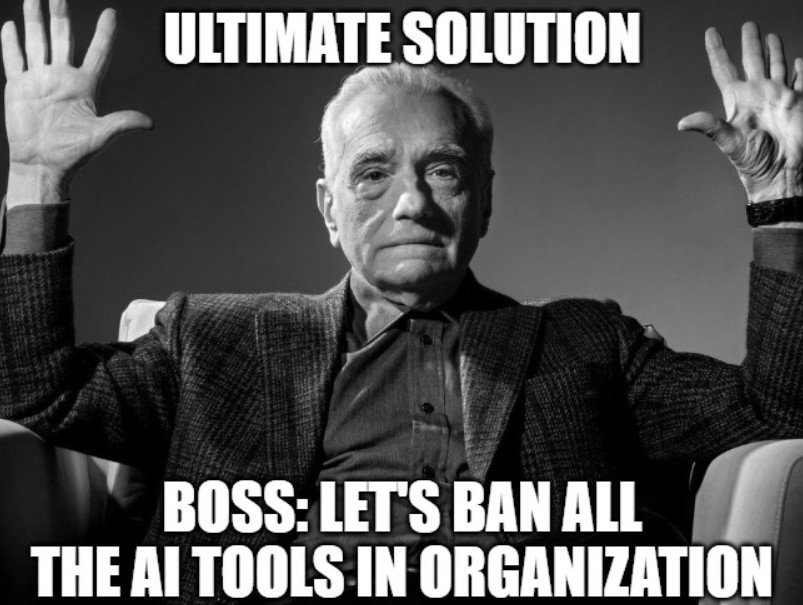
Don’t Adopt Blanket Bans
In the quest for safety, some organizations try to control risk by banning all AI applications. This approach generally backfires because employees often find and use tools less visibly. Emphasize enabling safer usage of AI tools. Specify clear regulations about what kind of data insights can be used, which tools are allowed, and what needs prior approval.
-
Learn From Shadow IT Governance
Shadow IT indicates that an enforcement-only approach does not work. You should offer safer internal alternatives, create lightweight approval processes, and let teams innovate without evading oversight.
-
Release Role-Based Permissions
In most organizations, a one-size-fits-all framework often crumbles. Specify GenAI permissions based on team, use cases, role, and functions. For instance, allow design teams to use specific image generation software under said conditions. Let developers use local LLMs only for prototyping and not to process customer data. This approach keeps the security policy applicable and acceptable.
-
Have A Structured Review Process
Employees will keep exploring new AI tools, no matter how stringent the security checks are. If you don’t have a system to assess or flag those tools, it becomes a problem. Develop a well-defined and simple process to request GenAI tools for regular reviews.
This doesn’t demand a full risk evaluation in place. All you need is a basic framework to capture utility, detect risks, and determine whether to restrict or approve the AI tool under review.
Conclusion
Shadow AI is not just a technology concern; it’s a trust and business leadership issue. When employees adopt unofficial AI platforms to work smarter and faster, companies must address this with secure alternatives, clear policies, and regular training instead of restricting usage right away.
The organizations that succeed will be those that adopt AI openly, regulate its usage responsibly, and create a business environment where innovation occurs but not at the cost of compromising security.
Frequently Asked Questions
How Does Shadow AI Increase Enterprise Risk Beyond Standard Unsanctioned Software Usage?
Shadow AI introduces model hallucination, data exposure, and unchecked third-party processing challenges that conventional shadow IT often does not.
Why Is Shadow AI Especially Challenging For Regulated Industries?
Shadow AI creates compliance voids by processing personal, confidential, or privileged data outside approved controls and audit structures. This increases the risk of violating domain-specific regulations, weakening defense, and compromising business data records.
What Is The Most Effective Long-Term Strategy To Reduce Shadow AI Without Slowing Innovation?
The best feasible approach is to combine clear usage guidelines, approved AI solutions, continuous employee training, and role-based access controls.
When leaders offer practical governance and secure alternatives, employees are less likely to turn to unauthorized AI usage.
Wed, Apr 22, 2026

Enjoyed what you've read so far? Great news - there's more to explore!
Stay up to date with the latest news, a vast collection of tech articles including introductory guides, product reviews, trends and more, thought-provoking interviews, hottest AI blogs and entertaining tech memes.
Plus, get access to branded insights such as informative white papers, intriguing case studies, in-depth reports, enlightening videos and exciting events and webinars from industry-leading global brands.
Dive into TechDogs' treasure trove today and Know Your World of technology!
Disclaimer - Reference to any specific product, software or entity does not constitute an endorsement or recommendation by TechDogs nor should any data or content published be relied upon. The views expressed by TechDogs' members and guests are their own and their appearance on our site does not imply an endorsement of them or any entity they represent. Views and opinions expressed by TechDogs' Authors are those of the Authors and do not necessarily reflect the view of TechDogs or any of its officials. While we aim to provide valuable and helpful information, some content on TechDogs' site may not have been thoroughly reviewed for every detail or aspect. We encourage users to verify any information independently where necessary.
Loading comments...