
Digital Marketing
What Is Account-Based Marketing (ABM)? A Beginner's Guide
Share
TL;DR
-
Account-based marketing (ABM) is a targeted B2B strategy that focuses marketing and sales efforts on high-value accounts rather than broad audiences.
-
Unlike inbound marketing, ABM prioritizes predefined target accounts through personalized campaigns and coordinated sales engagement.
-
ABM strategies typically follow three approaches: one-to-one, one-to-few, and one-to-many, depending on account value and personalization requirements.
-
Businesses use ABM platforms, CRM systems, and marketing automation tools to identify priority accounts, personalize outreach, and coordinate engagement.
-
ABM success is measured through account engagement, buying group coverage, pipeline generation, conversion rates, and revenue contribution.
Introduction
Imagine hosting an exclusive dinner for ten important business prospects instead of organizing a massive event for hundreds of unfamiliar attendees.
Rather than delivering the same presentation to everyone, you understand each guest's challenges, interests, and business goals. Naturally, your conversations become more relevant, and your chances of building meaningful relationships improve.
That's essentially the idea behind account-based marketing (ABM). Instead of reaching as many potential customers as possible, businesses focus their marketing efforts on a carefully selected group of high-value accounts.
Particularly popular in business-to-business (B2B) marketing, ABM helps organizations personalize their outreach, align sales and marketing teams, and develop stronger relationships with potential customers.
So, what is ABM, how does account-based marketing work, and why are businesses adopting this approach? Let's explore its fundamentals, benefits, strategies, and practical applications.
What Is Account-Based Marketing?
Account-based marketing is a targeted B2B marketing strategy in which businesses treat individual companies or groups of similar companies as distinct markets. Rather than targeting broad audiences, ABM focuses on organizations that closely match a company's ideal customer profile (ICP).
An ICP describes the characteristics of businesses most likely to benefit from a company's products or services, including industry, company size, revenue, location, and technological requirements.
For example, a cybersecurity company might target 50 financial institutions that require advanced threat protection instead of advertising its solutions to thousands of unrelated businesses. Marketing teams then develop personalized campaigns addressing each account's requirements, while sales teams engage relevant decision-makers.
The objective is to build meaningful relationships with accounts that offer strong revenue potential. Understanding this targeted approach becomes easier when compared with traditional marketing methods.
ABM Vs. Inbound Marketing: What's The Difference?
Both account-based marketing and inbound marketing aim to attract customers, but they approach the process differently.
Inbound marketing focuses on attracting potential customers through valuable content, search engine optimization, social media, and other channels. Interested prospects discover the business and gradually move through the sales funnel.
ABM, meanwhile, begins by identifying specific organizations the business wants to engage.
The major differences include:
| Factor | ABM | Inbound Marketing |
| Target audience |
Selected high-value accounts |
Broad audiences with relevant interests |
| Content approach |
Personalized for specific accounts |
Created for wider audience segments |
| Sales involvement |
Closely coordinated with marketing |
Often increases as leads progress |
| Primary objective |
Engage and convert priority accounts |
Attract, nurture, and convert leads |
| Success measurement |
Account engagement, pipeline, revenue |
Traffic, leads, conversions, revenue |
Importantly, ABM vs inbound marketing isn't necessarily an either-or decision. Businesses can use inbound marketing to generate awareness while applying ABM to engage strategically important accounts.
With this distinction established, let's understand how ABM works in practice.
How Does Account-Based Marketing Work?
ABM follows a coordinated process that connects account selection, personalized communication, and sales engagement.
It generally involves five stages.
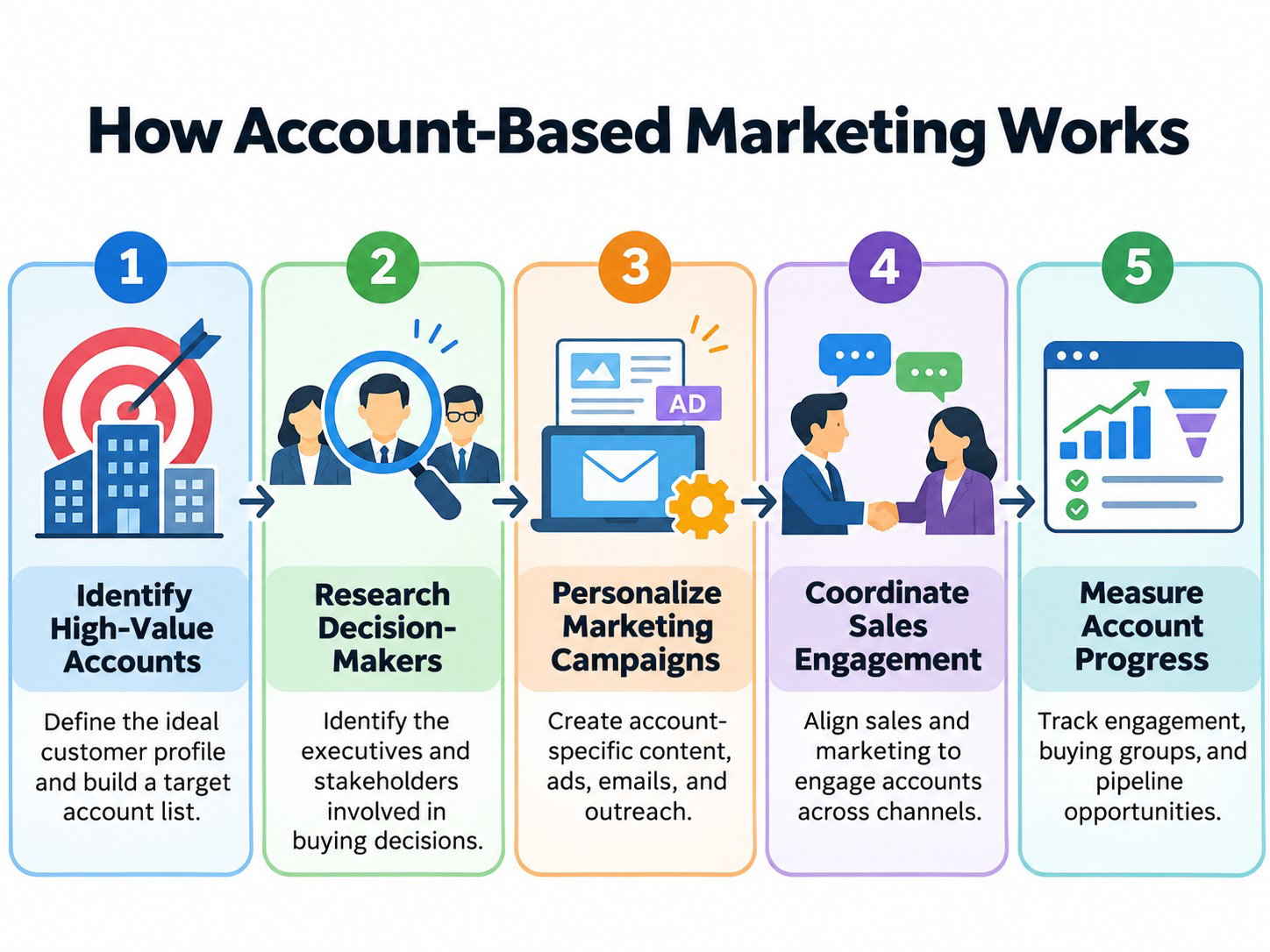
1. Identify High-Value Accounts
Businesses begin by defining their ideal customer profile and developing a target account list. Accounts are selected based on factors such as revenue potential, industry relevance, business challenges, and likelihood of purchasing.
2. Research Decision-Makers
Marketing and sales teams identify people influencing purchasing decisions within each account. These may include executives, department heads, technical evaluators, and procurement representatives. Understanding their responsibilities helps teams develop more relevant messages.
3. Personalize Marketing Campaigns
Businesses create account-specific content, advertising, emails, webinars, and outreach campaigns. For example, a cloud software provider might develop personalized resources addressing a prospective customer's infrastructure challenges.
4. Coordinate Sales Engagement
Sales and marketing teams align their communication across channels. Marketing activities build awareness and interest, while sales representatives develop relationships and address buying requirements.
5. Measure Account Progress
Finally, teams monitor engagement, identify active buying groups, and evaluate opportunities moving through the sales pipeline.
These insights help businesses improve targeting and optimize future campaigns.
However, following these steps requires choosing an approach that matches the organization's available resources.
What Are The Different Types Of ABM?
Account-based marketing generally follows three approaches, distinguished by the number of accounts targeted and the degree of personalization.
-
One-to-One ABM: Also called strategic ABM, this approach focuses on individual high-value accounts. Businesses develop highly personalized campaigns based on each organization's requirements.
-
One-to-Few ABM: This approach targets small groups of accounts sharing similar characteristics, such as industry, business challenges, or technology requirements. Campaigns balance personalization with scalability.
-
One-to-Many ABM: Also called programmatic ABM, this model uses marketing technology and account data to engage larger groups of relevant businesses through scalable personalization.
Choosing between these approaches depends on account value, sales complexity, campaign budgets, and team capacity.
What Are The Benefits Of Account-Based Marketing?
A well-planned ABM strategy can offer several advantages, particularly for businesses selling complex or high-value solutions.
-
Better Resource Allocation: Marketing budgets and sales efforts focus on accounts with stronger commercial potential.
-
Personalized Engagement: Campaigns address specific business challenges instead of relying on generic messaging.
-
Improved Sales Alignment: Sales and marketing teams collaborate around shared accounts, objectives, and performance indicators.
-
Stronger Customer Relationships: Consistent, relevant communication can support long-term relationships and expansion opportunities.
-
Clearer Revenue Attribution: Account-level tracking helps connect marketing activities with sales opportunities and revenue outcomes.
However, ABM also presents challenges, including extensive account research, coordination requirements, incomplete customer data, and longer sales cycles.
These considerations make strategic planning essential before launching campaigns.
How To Build An Effective ABM Strategy?
Businesses looking to implement account-based marketing should begin with a manageable approach rather than immediately targeting hundreds of companies.
First, define the ideal customer profile and establish clear objectives, such as generating qualified opportunities or expanding existing customer relationships.
Topics For More Insights
Next, work with sales teams to select priority accounts and identify relevant stakeholders.
Develop personalized content addressing their business challenges, then coordinate outreach across channels such as LinkedIn, email, targeted advertising, and webinars.
For ABM for small B2B teams, starting with 10 to 20 carefully selected accounts can make research and personalization more manageable.
Teams should establish regular reviews to monitor engagement and adjust campaigns based on account responses.
Technology can support this process, particularly as the number of accounts increases.
How To Measure ABM Success?
Measuring account-based marketing requires looking beyond traditional metrics such as website traffic and total lead volume.
Businesses should monitor:
-
Account Engagement: Interactions from target organizations across marketing and sales channels.
-
Buying Group Coverage: The number of relevant decision-makers reached within each account.
-
Pipeline Generation: The value of qualified sales opportunities created from targeted accounts.
-
Account Conversion Rate: The proportion of target accounts progressing into customers.
-
Revenue And Deal Velocity: Revenue generated, average deal size, and time required to close opportunities.
Tracking these indicators helps businesses evaluate campaign effectiveness and identify areas requiring improvement.
Conclusion
Account-based marketing offers B2B businesses a more focused approach to customer acquisition and relationship development.
By identifying high-value accounts, personalizing campaigns, and aligning sales and marketing efforts, organizations can concentrate resources where they have the greatest potential impact.
However, successful ABM depends on accurate targeting, relevant communication, coordinated execution, and continuous performance measurement. For businesses exploring this strategy, starting with a focused account list and refining campaigns through measurable results can provide a practical foundation for growth.
After all, effective marketing isn't always about reaching more people. Sometimes, it's about reaching the right people with the right message.
Frequently Asked Questions
How Does Intent Data Improve Account-Based Marketing Targeting?
Intent data helps businesses identify target accounts actively researching relevant products, technologies, or business challenges. By analyzing behavioral signals and engagement patterns, marketing teams can prioritize high-intent accounts, personalize outreach, and improve campaign timing.
How Can Businesses Measure The ROI Of Account-Based Marketing Campaigns?
Businesses can measure ABM ROI by comparing campaign investments against account-level revenue, pipeline contribution, customer acquisition costs, and deal velocity. Tracking these metrics alongside engagement and conversion rates helps evaluate profitability and optimize marketing investments.
How Can AI And Predictive Analytics Enhance Account-Based Marketing Strategies?
AI and predictive analytics help businesses identify high-value accounts, forecast purchase propensity, and uncover engagement opportunities. These technologies also support predictive lead scoring, dynamic audience segmentation, and personalized content recommendations, enabling more data-driven ABM campaigns.
Published on Fri, Nov 20, 2026

Liked what you read? That’s only the tip of the tech iceberg!
Explore our vast collection of tech articles including introductory guides, product reviews, trends and more, stay up to date with the latest news, relish thought-provoking interviews and the hottest AI blogs, and tickle your funny bone with hilarious tech memes!
Plus, get access to branded insights from industry-leading global brands through informative white papers, engaging case studies, in-depth reports, enlightening videos and exciting events and webinars.
Dive into TechDogs' treasure trove today and Know Your World of technology like never before!
Disclaimer - Reference to any specific product, software or entity does not constitute an endorsement or recommendation by TechDogs nor should any data or content published be relied upon. The views expressed by TechDogs' members and guests are their own and their appearance on our site does not imply an endorsement of them or any entity they represent. Views and opinions expressed by TechDogs' Authors are those of the Authors and do not necessarily reflect the view of TechDogs or any of its officials. While we aim to provide valuable and helpful information, some content on TechDogs' site may not have been thoroughly reviewed for every detail or aspect. We encourage users to verify any information independently where necessary.
Loading comments...