

E-commerce
Here's How Shopify AI Is Rethinking E-Commerce
Share
Overview
The 2009 romantic comedy Confessions of a Shopaholic introduces us to Rebecca Bloomwood, a smart, fashion-obsessed reporter from New York City who wants to work for a prestigious magazine.
There was only one problem: she owed a lot of money on credit cards. If you've seen the movie, you know that Rebecca likes to buy things (umm, shopaholic!) that she doesn't need because she is an impulsive shopper.
This is shown wonderfully in a famous scene: she sees a green scarf in a store window and is sure it will help her get a job and change her life.

The only hitch? Her credit cards are maxed out. She frantically swipes through a stack of cards, desperate to make it work. What follows is a mix of panic, desire, and denial as she’s not shopping with logic; she’s shopping with hope.
This kind of high-emotion, low-personalization shopping dominated the early 2000s, whether in stores or online. It was about catching people's attention, not meeting real needs. However, fast-forward to today and the world of shopping has evolved dramatically.
A lot has changed in the world of online shopping because of Shopify, and now its AI tools are making shopping more personalized to meet the real needs of each customer.
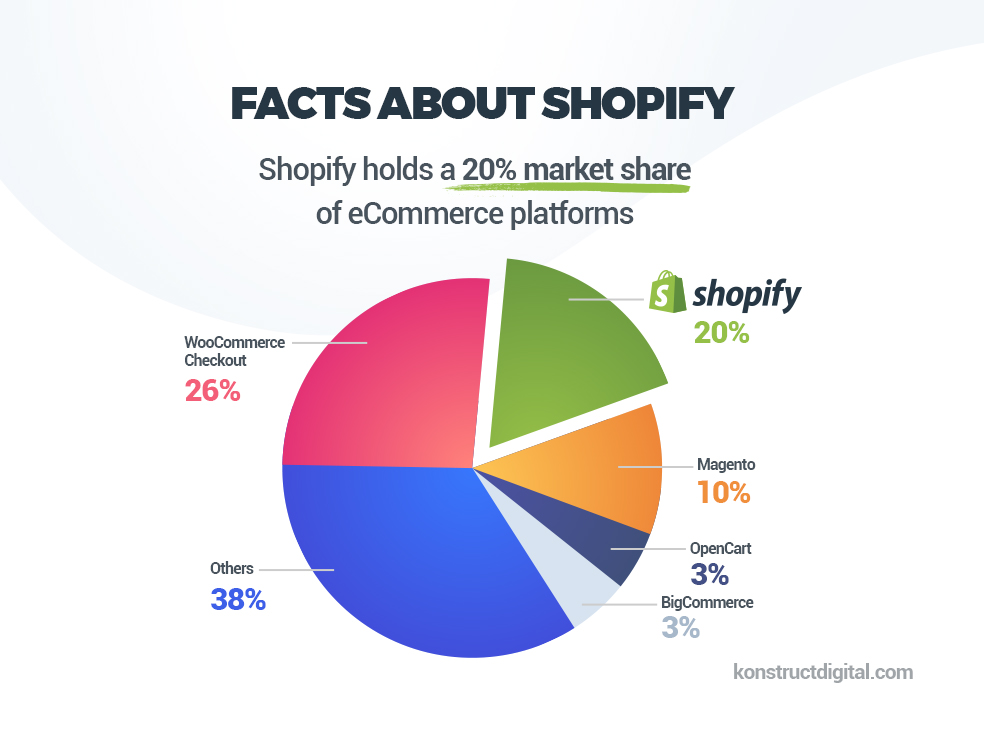
Shopify is leading the way for an e-commerce revolution with its AI tools right in the middle of it all. There is more than one tool in Shopify's AI suite that is meant to make things easier for sellers and customers, automating e-commerce and changing the way online businesses work.
In fact, Grand View Research reports that the global AI in retail market will reach USD 40.74 billion by 2030, showing a massive growth of 23.9% from 2022 to 2030. This is critical for Shopify and its users, as it shows how important it is for e-commerce businesses to adopt AI tools.
So, how exactly is Shopify using AI to make this happen? Let's get into it!
What Is Shopify AI?
Shopify AI is a suite of AI-powered tools designed to assist Shopify users in various aspects of their online store management. These tools leverage Artificial Intelligence (AI) to automate tasks, generate content, and provide personalized advice, ultimately helping entrepreneurs streamline their online business processes. By implementing Shopify AI tools, ecommerce and retail businesses can achieve robust AI-powered automation.

Here's a detailed look at the AI tools it includes:
-
Shopify Magic: Shopify Magic simplifies tasks like writing product descriptions and email subject lines, helping online stores be more productive.
-
Sidekick: Its AI assistant helps with planning and executing routine jobs automatically. Think of it as a business advisor you can reach at any time!
-
AI-powered chatbots: Shopify's AI chatbots bring 24/7 customer support, answering common questions and resolving issues, essential for delivering a personalized shopping experience.
You see, Shopify is putting a lot of money on AI, making it clear that it sees AI as an important part of its future.
All of this also highlights how Shopify AI fits into the bigger picture of ecommerce by giving businesses tools that help them compete in the market. It levels the playing field so even smaller businesses can access tools that only big businesses could use before. This will allow more entrepreneurs and startups to grow through AI automation.
So, let's look at how the ecommerce leader's AI tools can be used?
How Does Shopify's AI Help Users?
Shopify is tapping into AI's potential to help merchants streamline their processes, boost sales, and create seamless customer experiences. Let’s take a deeper look at how it's doing this:
1. Shopify Magic
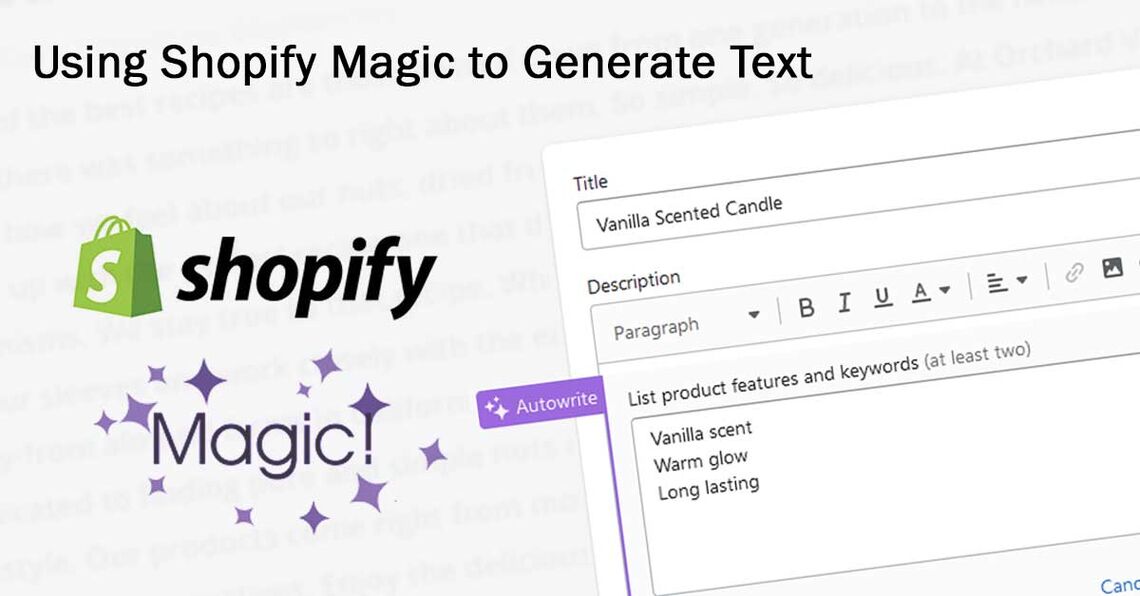
You can use Shopify’s “Shopify Magic” suite of tools to automate various parts of running an online store, making it especially powerful for shopify dropshipping. These include creating content, helping customers, and doing back-office work.
This can help users with:
-
Product Descriptions: No more staring at a blank screen, struggling to describe a product as Shopify Magic can whip up a description in seconds.
-
Email Subject Lines: Using this AI tool, you can write subject lines that get people's attention and get a lot of opens.
-
SEO Content: For better search engine rankings, the AI can design marketing material that is designed to be seen across the web.
Shopify's data shows that when sellers use AI to write product descriptions, their conversion rates go up by 20%. This highlights the potential of business growth through AI-driven e-commerce automation.
2. Sidekick AI Assistant
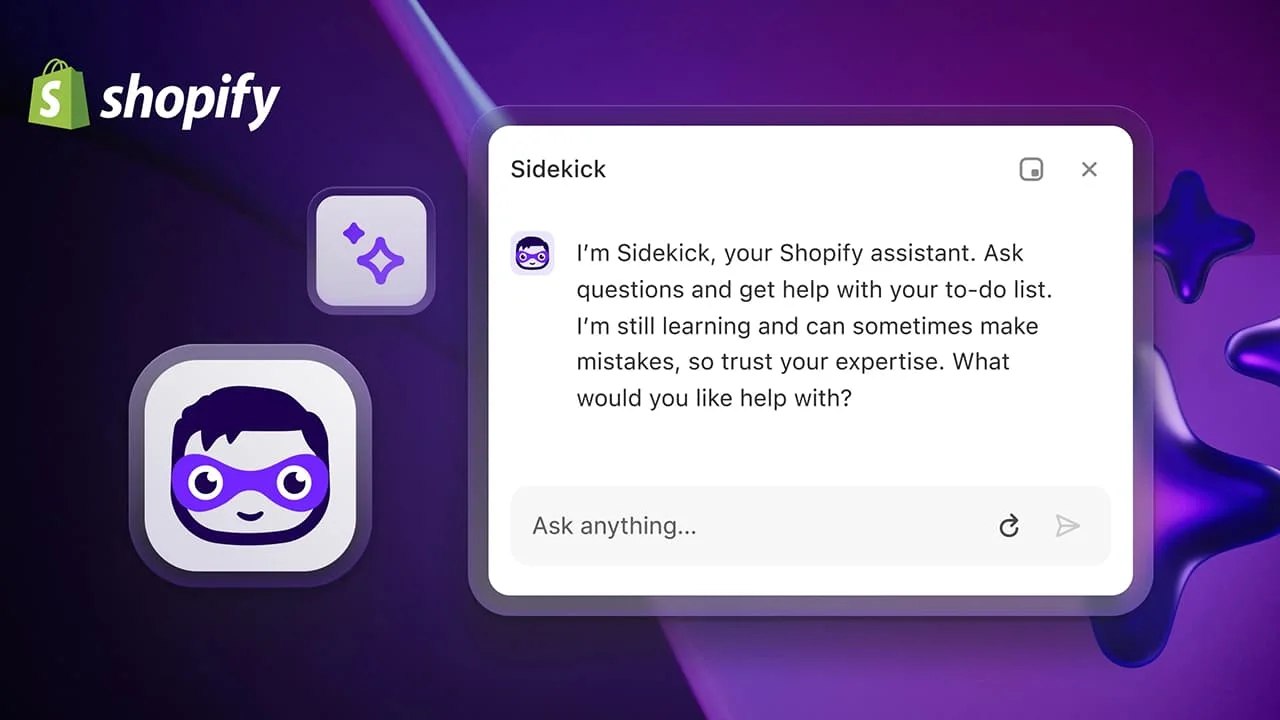
Sidekick offers strategic suggestions, helps with generating visual, and automates repetitive tasks. Shopify is also using its own AI tools, and you can also leverage it to make running a business easy as pie, but does it really help?
Here's how it contributes:
-
Strategic Suggestions: Sidekick looks at your data and gives you business improvement ideas based on what it finds.
-
Visual Generation: Need a quick image for a social media post? Sidekick can help instantly.
-
Task Automation: Automate routine tasks that eat up your time, such as order fulfillment and customer follow-up.
3. Integration With ChatGPT
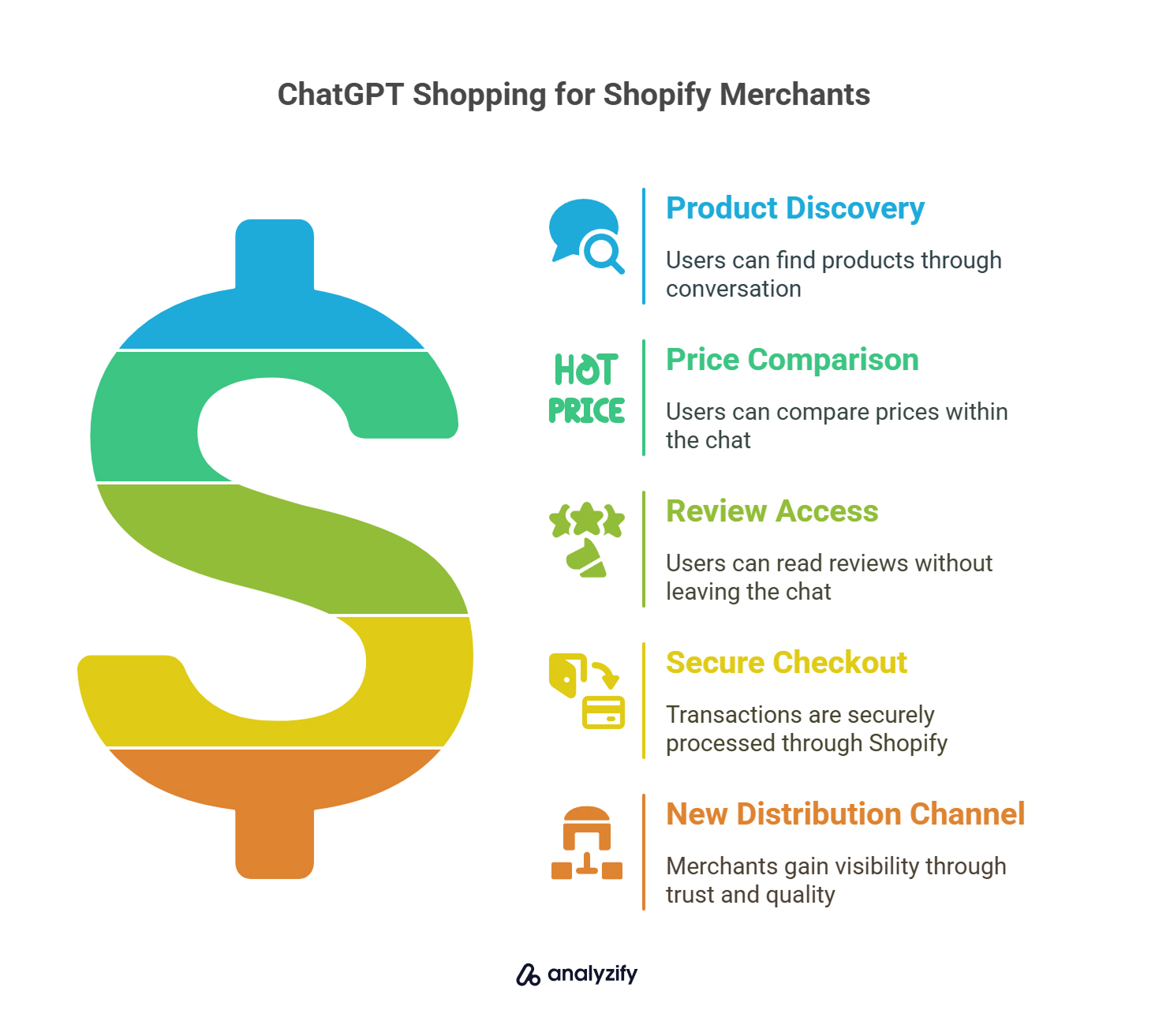
Shopify's integration with ChatGPT is all about making customer interactions smarter and more engaging. Making a chatbot for your store can help answer questions, make suggestions, and even close deals, while customers get a more personalized shopping experience.
A McKinsey study found that companies that using AI-powered chatbots for customer service were 25% more efficient and saved 25% in costs. This demonstrates the value of AI for online stores in improving customer service.
Here's how Shopify is helping:
-
Conversational Commerce: This lets customers shop and get help through AI-powered chat interfaces.
-
Smarter Customer Interactions: ChatGPT provides personalized recommendations and answers questions in real-time.
-
24/7 Availability: Since an AI chatbot never sleeps, it offers customer support around the clock -even if you're sleeping!
So, Shopify AI tools are being used in a variety of ways to help merchants save time, improve customer experiences, and scale their businesses. One major aspect that sets it apart is its focus on making shopping feel more personal. Rebecca approves!
Shopify isn't just adding AI to be innovative; it's making tools that will change the way sellers conduct business every day, as its commitment to e-commerce automation aims to revamp the e-commerce landscape.
So, what does all this mean for sellers on the ground? Let's talk about that next.
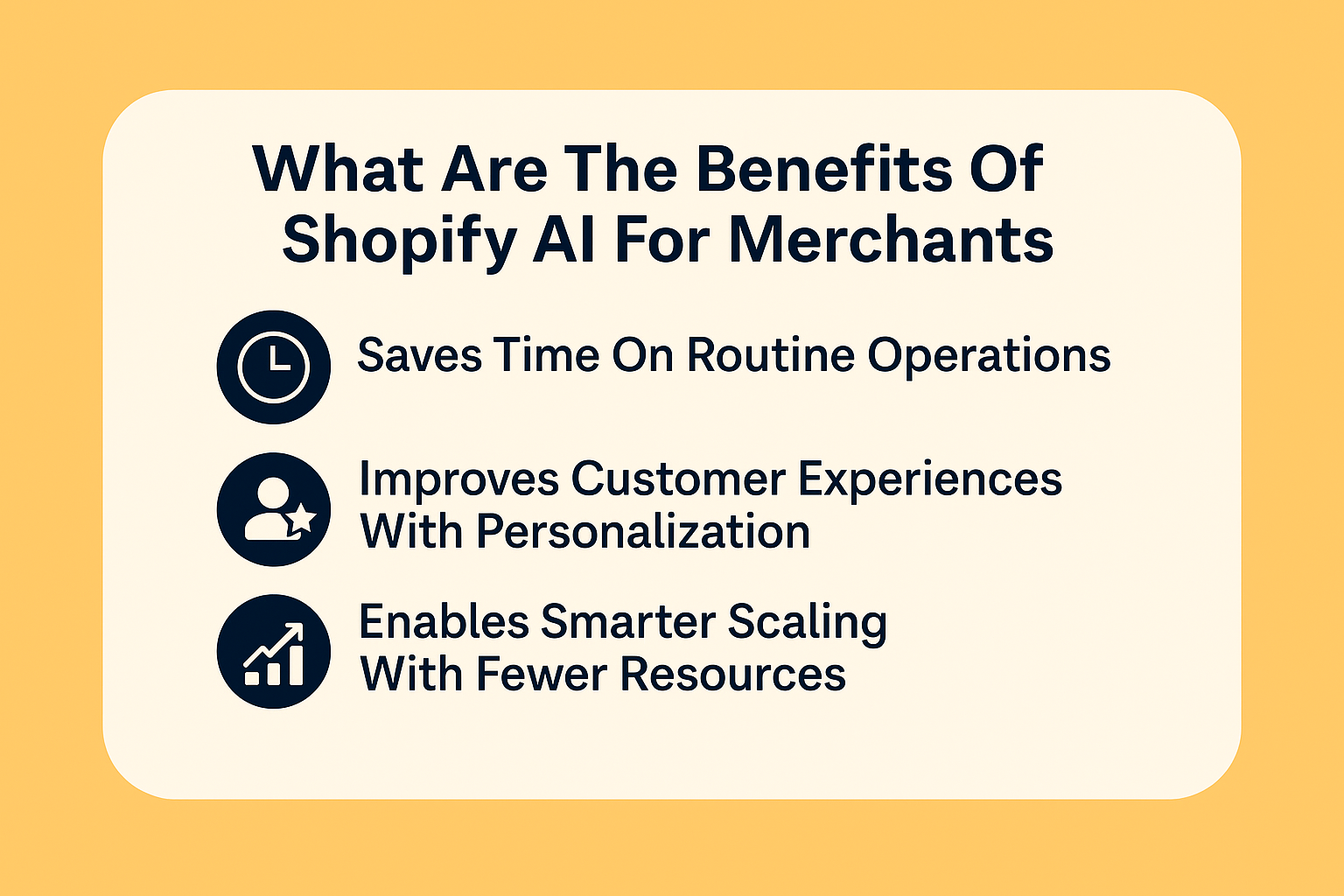
What Are The Benefits Of Shopify AI For Merchants?
Shopify AI is meant to make things easier for sellers by increasing their productivity and making shopping experiences better for customers. So, how does it do that?
Take a quick look at this breakdown of its benefits:
1. Saves Time On Routine Operations
Time is money, right? Shopify AI swoops in to automate those tedious, repetitive tasks that eat up your day. This e-commerce automation is crucial for saving time.
It helps with:
-
Automating product descriptions, so you can find the right words quickly.
-
Creating email subject lines that get more clicks and opens without hours spent on A/B testing.
-
Smart inventory management that lowers the risk of understocking or overstocking.
A Shopify study says that merchants who use automation tools powered by AI save 10 hours a week on average. That's time you can use to make your business better, come up with new goods, or just chill out. AI adoption for online shops is the direct cause of this increased efficiency!
2. Improves Customer Experiences With Personalization
Customers love feeling special, right? Well, Shopify AI helps you deliver personalized experiences that keep them coming back for more. How, you ask? By understanding their behavior and preferences, and then tailoring the shopping experience to match it, especially with conversational commerce.
It helps with:
-
Real-time product recommendations based on browsing history and previous interactions.
-
Personalized marketing campaigns that speak directly to individual customers.
-
24/7 AI-powered chatbots that provide instant support and tailored answers to questions.
As mentioned in a McKinsey study, personalization can reduce acquisition costs by as much as 50%, lift revenues by 5 to 15%, and increase the efficiency of marketing spend by 10 to 30%. This data underscores the importance of AI-powered personalized shopping experiences.
2. Enables Smarter Scaling With Fewer Resources
It can be hard to grow a business when you don't have enough tools. Yet, Shopify AI lets you get more done with less, thanks to its suite of AI tools.
Shopify AI tools help with:
-
Demand forecasting so you can anticipate future sales and adjust inventory accordingly With the help of advanced demand planning software, businesses can improve forecast accuracy, reduce stockouts, and optimize inventory levels more effectively.
-
Identifying new business opportunities and customer groups using AI-driven analytics and insights.
-
Automation of work processes so things run smoothly and require less human input.
In fact, Shopify's AI policy is simple: before hiring more people, you must prove that AI can't do the job. This shift means AI is now a key part of performance reviews and is expected to be used by everyone, from engineers to operations.
So, is Shopify AI worth the hype? It looks like it!
The AI tools change the game for merchants by saving time, making the customer experience better, and scaling more intelligently. It's clear that Shopify's AI tools have an extended effect.
So, what does this mean for Shopify's path forward? Let's discuss that next!
Future Outlook For Shopify AI
Shopify's AI roadmap seems to be about making things easier and more efficient for merchants as well as consumers. It's about deevloping automation that is smarter, personalization that goes deeper, and AI tools that can do more complicated jobs.
The use of AI tools in e-commerce will grow quickly, with a lot of room for growth and innovation!
Imagine a future where AI tools handle everything from product descriptions to customer service, freeing up merchants to focus on the bigger picture. It's not just about saving time but creating tailored experiences for customers and driving sales.
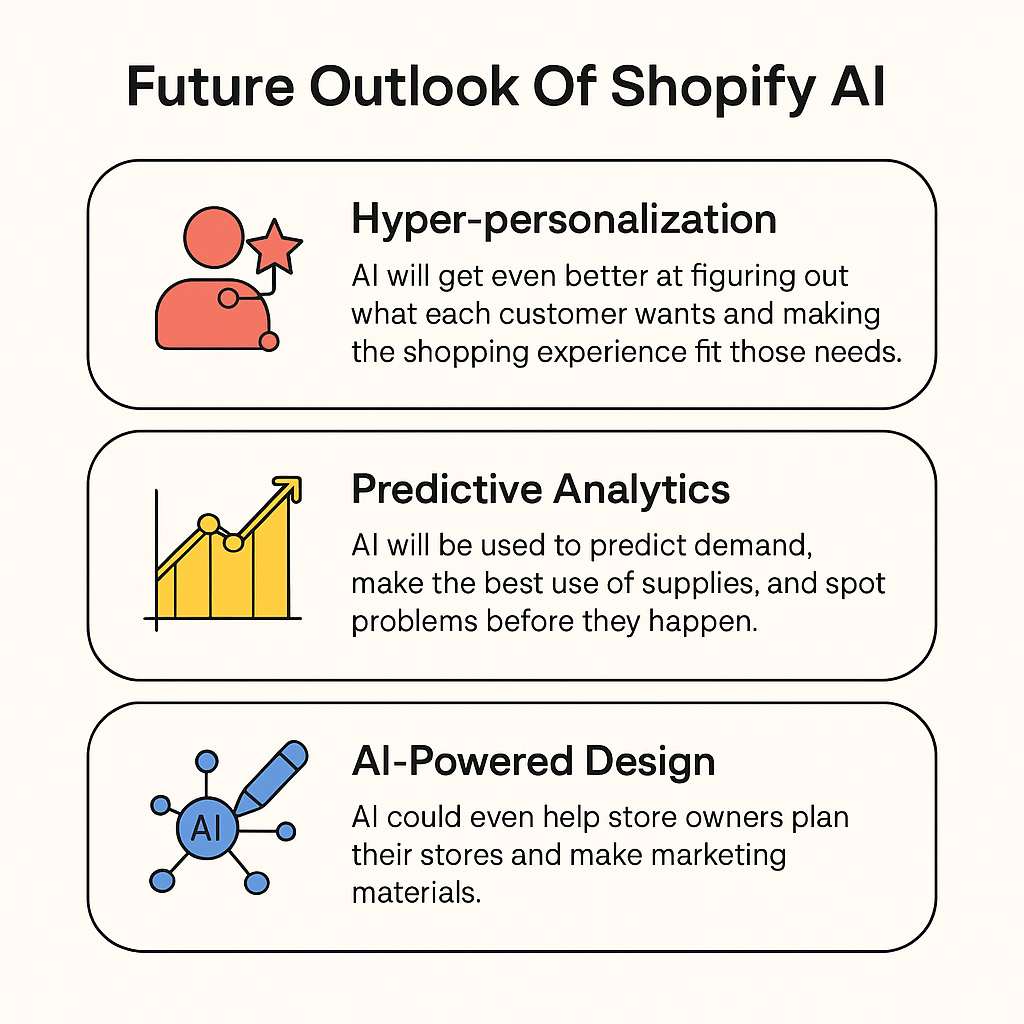
So, what exact trends is this roadmap based on?
-
Hyper-personalization: AI will get even better at figuring out what each customer wants and making the shopping experience fit those needs.
-
Predictive Analytics: AI will be used to predict demand, make the best use of supplies, and spot problems before they happen.
-
AI-Powered Design: AI could even help store owners create and plan their online stores' creatives, marketing materials, social media posts, etc.
It's clear that AI will play an increasingly important role in the future of e-commerce, and Shopify is positioning itself to be at the forefront of this revolution. The focus remains on AI for online stores and personalized shopping experience.
We can see that Shopify AI has a bright and full future ahead of it. As more tools and features come out, businesses can look forward to better ways to make online sales easier and more efficient. These steps will be taken because Shopify AI tools are still being improved.
If you want to stay updated on the latest trends and insights in technology, visit our website for more information!
Wrapping It Up!
So, Shopify is shaking things up in the e-commerce world with its AI tools, and it’s not just a passing trend. By making AI a key player in their operations, they’re setting the stage for how businesses will operate moving forward. The integration of Shopify AI tools is a total game-changer!
People who are in the game e-commerce game need to improve their AI skills right away, because it will soon be a must-have. Getting used to this change could mean the difference between thriving and just existing in the market, irrespective of the kind of business you run or how big your brand is.
For success in e-commerce, you need to adopt AI technology. We mean, if you can't beat the bots, you might as well join them!
Frequently Asked Questions
Does Shopify Have AI Builder?
Shopify doesn’t offer a standalone “AI Builder,” but it provides AI-powered features like Shopify Magic and Sidekick, which help merchants generate product descriptions, automate content, and manage tasks, effectively acting as built-in AI tools to enhance store operations. These features are part of the broader Shopify AI tools ecosystem.
Does Shopify Have A Chatbot?
Shopify doesn’t have a native chatbot, but it integrates seamlessly with chatbot apps like Tidio, Re:amaze, and Shopify Inbox, enabling businesses to automate customer support, handle FAQs, and deliver real-time assistance across web and social platforms. These integrations enhance the personalized shopping experience.
What Type Of People Use Shopify?
Shopify is used by a wide range of people—from solo entrepreneurs and small businesses to mid-sized brands and global enterprises. Whether it’s a dropshipping startup or a luxury label, Shopify supports anyone looking to build and scale an online store. The platform facilitates AI-driven business growth for all types of users.
Tue, May 13, 2025

Liked what you read? That’s only the tip of the tech iceberg!
Explore our vast collection of tech articles including introductory guides, product reviews, trends and more, stay up to date with the latest news, relish thought-provoking interviews and the hottest AI blogs, and tickle your funny bone with hilarious tech memes!
Plus, get access to branded insights from industry-leading global brands through informative white papers, engaging case studies, in-depth reports, enlightening videos and exciting events and webinars.
Dive into TechDogs' treasure trove today and Know Your World of technology like never before!
Disclaimer - Reference to any specific product, software or entity does not constitute an endorsement or recommendation by TechDogs nor should any data or content published be relied upon. The views expressed by TechDogs' members and guests are their own and their appearance on our site does not imply an endorsement of them or any entity they represent. Views and opinions expressed by TechDogs' Authors are those of the Authors and do not necessarily reflect the view of TechDogs or any of its officials. While we aim to provide valuable and helpful information, some content on TechDogs' site may not have been thoroughly reviewed for every detail or aspect. We encourage users to verify any information independently where necessary.
AI-Crafted, Human-Reviewed and Refined - The content above has been automatically generated by an AI language model and is intended for informational purposes only. While in-house experts research, fact-check, edit and proofread every piece, the accuracy, completeness, and timeliness of the information or inclusion of the latest developments or expert opinions isn't guaranteed. We recommend seeking qualified expertise or conducting further research to validate and supplement the information provided.
Loading comments...