
Artificial Intelligence
7 Ways Companies Use Conversational AI In Customer Service
Share
TL;DR
-
Conversational AI enables businesses to deliver 24/7 customer support through intelligent chatbots that understand natural language and customer intent.
-
AI customer support agents automate routine tasks such as order tracking, appointment scheduling, booking modifications, and account-related inquiries.
-
Voice AI agents simplify phone support by understanding spoken requests, resolving common issues, and transferring complex cases to human representatives.
-
Conversational AI improves support efficiency through intelligent query routing, real-time agent assistance, conversation summaries, and multilingual interactions.
-
Successful conversational AI implementation requires reliable system integrations, data security, performance monitoring, and a balance between automation and human support.
Introduction
Remember the movie Her, where Theodore develops an unusual connection with Samantha, an AI assistant capable of holding natural conversations, understanding emotions, and responding thoughtfully? While the film explores a futuristic relationship between humans and technology, its central idea of machines understanding human communication is becoming increasingly relevant in everyday business interactions.
Today, customers can ask questions, resolve issues, track orders, and receive assistance through AI-powered conversations. Businesses are adopting conversational AI in customer service to make these interactions faster, more accessible, and increasingly personalized.
Unlike traditional automated systems that follow predetermined scripts, conversational AI uses technologies such as natural language processing (NLP), machine learning, and generative AI to interpret requests and respond contextually.
So, how companies use conversational AI for customer service goes well beyond answering simple questions. Let's explore seven practical applications transforming customer support across industries.
1. Providing 24/7 Customer Support With AI Chatbots
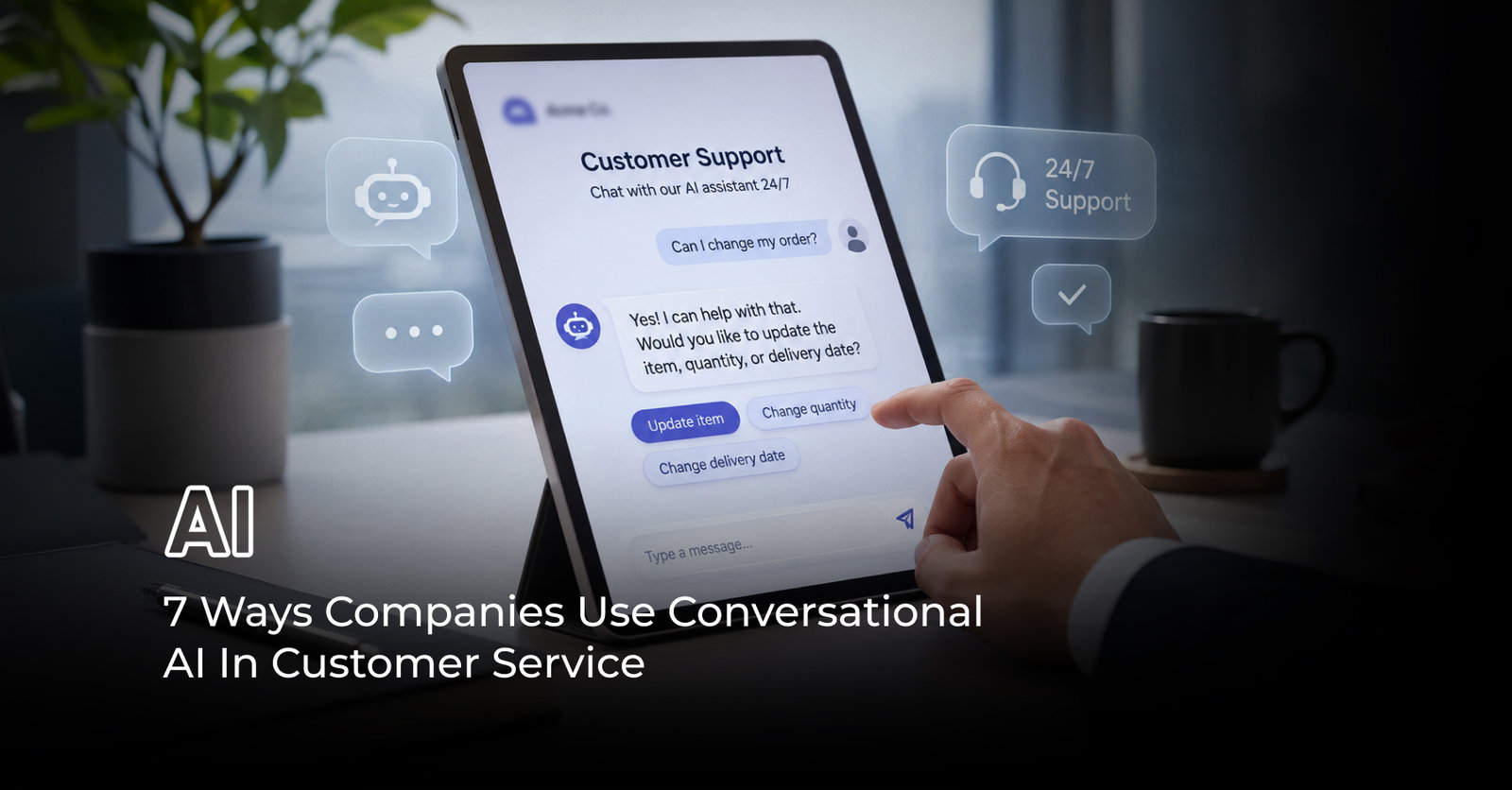
Customers rarely limit their questions to regular business hours. Whether they're checking a refund policy late at night or troubleshooting a product over the weekend, they expect assistance when they need it. AI chatbots help businesses provide round-the-clock support without requiring human agents to handle every interaction.
These systems can answer frequently asked questions, explain policies, troubleshoot common problems, and guide customers toward relevant information. For example, businesses using Intercom's Fin AI Agent can automate responses using their existing support knowledge and established workflows.
However, there's an important distinction when comparing chatbot vs conversational AI. Traditional rule-based chatbots generally follow predefined conversation paths, while conversational AI-powered systems can interpret more varied language, retain context, and manage follow-up questions. Modern AI chatbots are themselves an application of conversational AI.
This allows customers to receive more flexible assistance, although complicated or sensitive issues may still require human intervention.
Beyond answering questions, AI can also retrieve information customers would otherwise need to search for themselves.
2. Automating Order Tracking And Delivery Updates
Few customer questions are as common as "Where is my order?"
For e-commerce companies and logistics providers, handling thousands of order-related inquiries can overwhelm support teams, particularly during seasonal sales. Conversational AI simplifies these interactions by connecting customer conversations with order management and delivery systems.
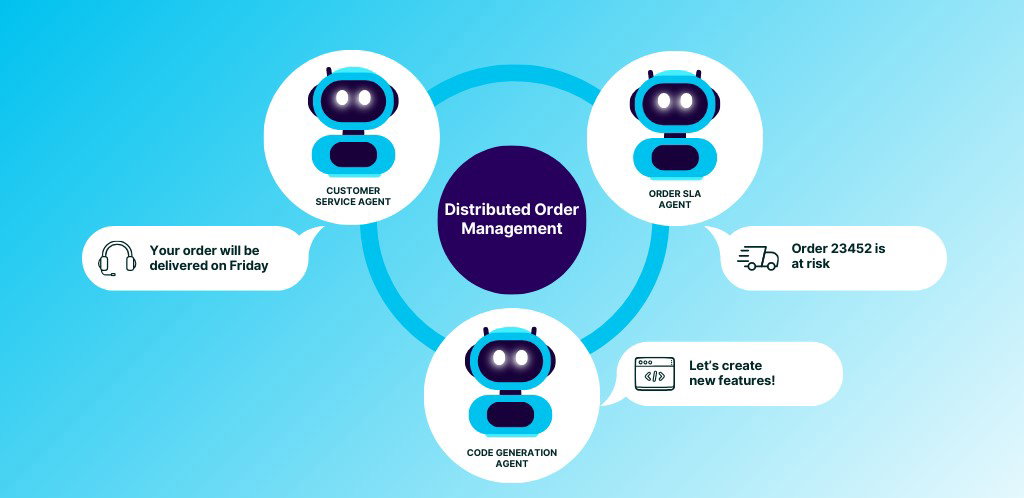
For instance, a customer can ask an AI assistant about a delayed package and receive its latest available delivery status. Depending on the integration, the assistant may also explain shipping delays or guide customers through available return options.
Instead of navigating multiple pages or waiting for a representative, customers can obtain relevant information through a single conversation. This application of AI customer service can reduce repetitive inquiries and improve response consistency.
While order tracking helps customers understand what's happening with their purchases, conversational AI can also help them complete everyday service requests.
3. Managing Appointments, Bookings, And Account Requests
Scheduling appointments or updating account information often involves repetitive administrative steps. Conversational AI can streamline these tasks by allowing customers to communicate their requirements in natural language.
Healthcare providers, for example, can use virtual assistants to help patients find available appointment slots, reschedule visits, and receive scheduling instructions.
Similarly, hospitality businesses can use conversational interfaces to assist with reservations, booking modifications, and general service inquiries. Some AI customer support agents can also connect with customer relationship management (CRM) platforms to retrieve relevant account information or initiate approved service workflows.
However, actions involving sensitive personal information, payments, or account changes require appropriate identity verification, access controls, and safeguards. By handling routine requests through conversation, businesses can reduce administrative workloads while keeping services accessible.
Of course, not every customer prefers typing messages. That's where conversational AI is making its presence felt in another familiar support channel.
4. Handling Phone Conversations With Voice AI Agents
Phone support remains essential, particularly when customers need immediate assistance or find explaining problems easier than typing. Traditional interactive voice response systems often require callers to navigate lengthy menus by pressing numbers.
Voice AI agents offer a more conversational alternative. Using speech recognition, natural language understanding, and speech synthesis, these systems can interpret spoken requests and respond verbally.
For example, Zendesk's voice AI capabilities support automated phone interactions, including identifying customer intent, handling supported requests, and transferring conversations to human representatives when necessary.
A customer calling about an incorrect bill could explain the issue directly instead of selecting options through multiple menus. Voice AI can also capture relevant conversation details before transferring the call, helping the receiving agent understand the situation.
Still, speech recognition errors, background noise, accents, and complex requests can affect performance. Reliable escalation mechanisms remain essential.
Interestingly, the ability to understand customer intent is equally valuable when deciding which human representative should handle an issue.
5. Routing Customer Queries To The Right Support Teams
Customer service departments receive requests ranging from billing questions and technical problems to complaints requiring specialized attention. Manually reviewing and categorizing every inquiry can create unnecessary delays.
Conversational AI helps businesses identify customer intent, classify incoming requests, and direct them toward appropriate support teams. For instance, a customer reporting repeated software crashes may need technical assistance, while someone disputing an invoice should reach the billing department.
AI-powered routing systems can distinguish these requirements based on message content, conversation history, and available customer information. Companies can also configure workflows to prioritize urgent cases or escalate unresolved complaints.
This approach helps reduce unnecessary transfers and prevents customers from repeatedly explaining their problems. However, accurate routing depends on well-defined support categories, reliable customer data, and continuous monitoring.
Once an inquiry reaches the appropriate representative, conversational AI can continue supporting the interaction behind the scenes.
6. Assisting Human Agents During Customer Conversations
One of the most practical benefits of AI in customer service is helping human representatives work more efficiently. Instead of replacing support agents, conversational AI can act as an intelligent assistant that retrieves information, suggests responses, and summarizes conversations.
Topics For More Insights
For example, Zendesk Copilot can assist customer service teams with suggested replies, relevant knowledge, and workflow guidance. During a complex technical support interaction, an AI assistant might retrieve troubleshooting instructions from an approved knowledge base.
After the conversation, it can generate a summary that helps maintain accurate support records and prepare for follow-up interactions.
These capabilities reduce repetitive administrative work and give representatives more time to focus on situations requiring judgment, empathy, and problem-solving. Nevertheless, AI-generated recommendations are not always accurate. Human agents should verify important information before communicating it to customers.
Beyond assisting individual conversations, businesses can use conversational AI to create more accessible support experiences across diverse customer groups.
7. Delivering Multilingual And Personalized Customer Assistance
Businesses serving international audiences often encounter customers with different language preferences, communication styles, and service expectations. Conversational AI can help organizations provide support across multiple languages without building a separate support team for every market.
For example, a travel company could deploy a multilingual virtual assistant to answer booking questions in English, Spanish, or French. With suitable CRM integration and customer permissions, conversational AI can also tailor responses using purchase history, service preferences, or previous interactions.
A returning customer asking about a subscription renewal, for instance, could receive information relevant to their existing plan rather than generic product details. Such conversational AI examples illustrate how businesses can make customer interactions more relevant and convenient.
However, companies must test language accuracy, protect customer information, and ensure AI-generated responses remain appropriate across different cultures and contexts.
How Can Businesses Implement Conversational AI?
Successful implementation begins with identifying customer service tasks that are repetitive, measurable, and suitable for automation. Businesses should start by reviewing common inquiries, available knowledge resources, and existing support workflows.
The next step involves selecting conversational AI tools that integrate with their CRM, helpdesk, communication channels, and relevant business systems.
Before deployment, organizations should establish data protection controls, define escalation procedures, and test responses against realistic customer scenarios. Monitoring resolution rates, customer satisfaction, response accuracy, and escalation patterns helps businesses evaluate whether automation is genuinely improving service quality.
A gradual rollout with continuous refinement is often more practical than automating every customer interaction immediately.
Conclusion
Conversational AI is changing how businesses approach customer service, from answering routine questions and tracking orders to supporting phone conversations and assisting human representatives.
Its greatest value lies in making support more responsive, accessible, and efficient while allowing teams to concentrate on interactions that require human expertise. However, meaningful results depend on reliable information, thoughtful implementation, data security, and effective escalation processes.
As conversational AI continues to evolve, businesses that balance intelligent automation with human support will be better positioned to deliver consistent and helpful customer experiences.
Frequently Asked Questions
How Can Businesses Measure The ROI Of Conversational AI In Customer Service?
Businesses can evaluate conversational AI ROI through metrics such as cost per resolution, first-contact resolution rate, customer satisfaction (CSAT), and average handling time. Comparing these indicators against pre-implementation benchmarks helps determine operational savings and improvements in service quality.
How Does Conversational AI Maintain Context Across Multiple Customer Service Channels?
Conversational AI uses CRM integrations, conversation histories, and contextual data management to maintain continuity across channels such as chat, email, and voice. When systems are properly integrated, customers can switch communication channels without repeatedly explaining their concerns.
What Are The Major Security And Compliance Challenges Of Deploying Conversational AI?
Key challenges include protecting personally identifiable information (PII), preventing unauthorized data access, and managing AI-generated misinformation. Businesses should implement encryption, role-based access controls, data retention policies, and regular audits to support compliance with applicable privacy regulations.
Published on Fri, Nov 20, 2026

Enjoyed what you've read so far? Great news - there's more to explore!
Stay up to date with the latest news, a vast collection of tech articles including introductory guides, product reviews, trends and more, thought-provoking interviews, hottest AI blogs and entertaining tech memes.
Plus, get access to branded insights such as informative white papers, intriguing case studies, in-depth reports, enlightening videos and exciting events and webinars from industry-leading global brands.
Dive into TechDogs' treasure trove today and Know Your World of technology!
Disclaimer - Reference to any specific product, software or entity does not constitute an endorsement or recommendation by TechDogs nor should any data or content published be relied upon. The views expressed by TechDogs' members and guests are their own and their appearance on our site does not imply an endorsement of them or any entity they represent. Views and opinions expressed by TechDogs' Authors are those of the Authors and do not necessarily reflect the view of TechDogs or any of its officials. While we aim to provide valuable and helpful information, some content on TechDogs' site may not have been thoroughly reviewed for every detail or aspect. We encourage users to verify any information independently where necessary.
Loading comments...