
Artificial Intelligence
5 Smart Ways To Use AI In Customer Service And Sales Operations
Share
TL;DR
-
AI can help sales teams qualify leads faster by identifying customer intent, behavior patterns, and buying readiness.
-
AI chatbots can support customers, answer common questions, handle pre-sales queries, and route complex issues to the right human agents.
-
CRM automation can reduce manual data entry, keep customer records updated, and give both sales and service teams better context.
-
Personalized recommendations and upselling can become more relevant when AI analyzes customer behavior, preferences, and past interactions.
-
Sentiment analysis can help teams understand customer emotions, spot dissatisfaction early, and improve future conversations.
-
The best results come when AI supports human teams instead of replacing the relationship-building skills that customers still value.
Introduction
Jordan Belfort was a true master of sales in The Wolf of Wall Street, a movie where the character was based on the real-life persona of the same name. Belfort’s confident charisma could convert even the cagiest of leads into continual customers.
A key trait that made him a brilliant salesman was that he knew how to talk to people. Not just what words to say but how to say them. He knew how simple, small gestures could influence people. He also understood that these relationships don’t die out once the transaction is completed. In fact, nurturing them with excellent customer service post-sales is key to upselling and retention.
Today’s businesses possess another weapon for this purpose, one that’s available to all of them all the time: Artificial intelligence (AI).
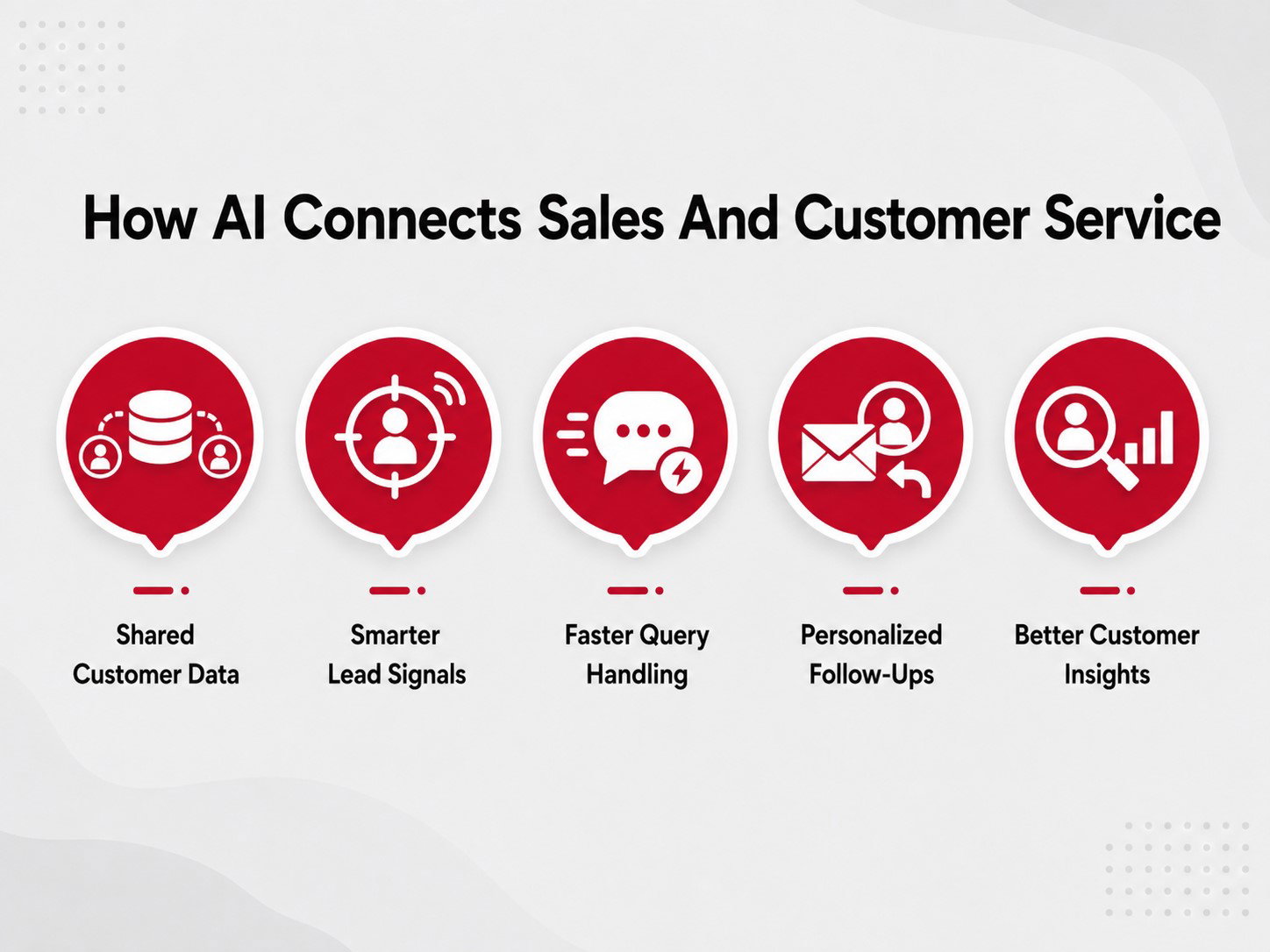
AI has changed how sales and customer service teams work by helping both teams do their jobs better, whether together or separately. Customer service teams can share useful customer insights that sales teams can act on, while sales teams can pass on clear customer details that help support teams deliver a more personalized customer experience.
However, this relationship only works well when both teams understand how to use AI in the right way and keep their efforts aligned. The question is not only how to use AI, but why it is becoming important across both domains.
Why Businesses Are Leaning Into AI For Customer Service And Sales Now
If someone were to study Belfort’s sales prowess, it would do them better to focus on why he did something more than just what he did one time.
For years, customer service and sales operated like two neighboring departments that waved at each other but didn’t really have deep and meaningful conversations. Sales teams focused on closing deals, while customer service teams handled questions, complaints, renewals, and post-purchase support.
That line is now much thinner.
A customer who contacts support or asks a chatbot about pricing may be ready for a sales conversation. A loyal customer leaving positive feedback may be open to add-ons. This is where AI in customer service and AI in sales operations begin to overlap. It helps teams spot these moments faster by analyzing conversations, CRM data, customer behavior, ticket history, and buying signals, giving humans better context before they speak, respond, recommend, or follow up.
This shift is happening fast: Cisco projects that by mid-2026, agentic AI will be involved in 56% of all customer support interactions. Meanwhile, McKinsey & Company noted in its State of AI in 2025 report that revenue growth from AI came mostly to marketing and sales departments, with 67% of companies (1,753 surveyed) seeing positive results. Nearly 50% also found improvements in customer satisfaction due to AI.
Numbers like that are hard for any sales or service leader to keep dismissing as experimental, especially if done smartly.
So, what are the smart ways in which AI can be used in customer service and sales operations? Dive in and find out!
5 Smart Ways To Use AI In Customer Service And Sales Operations
Using AI well is not about throwing a chatbot on your website and calling it innovation. It is about finding the parts of the customer journey where speed, context, personalization, and accuracy matter most.
The most useful AI customer service use cases and sales use cases often appear in the same places: lead handling, customer conversations, CRM updates, recommendations, and feedback analysis.
Lead Qualification And Customer Intent Detection
Every sales team wants more leads, but not every lead is ready to buy.
Some are casually browsing, some are comparing options, some are stuck with a product question, and some are ready to speak to a sales representative right away. The challenge is knowing who is who without making your team chase every name in the database.
AI can help by analyzing customer behavior across forms, website visits, emails, chat conversations, product usage, and CRM activity. It can identify patterns that suggest whether a prospect is just exploring or showing real buying intent.
This is one of the most powerful ways to use AI in sales because it helps teams prioritize the right people at the right time. Instead of relying only on manual lead scoring or gut feeling, sales teams can use AI to rank leads based on behavior, firmographic data, engagement history, and intent signals.
On the customer service side, a support agent may notice that a customer is asking repeated questions about advanced features. AI can flag that as a possible upsell opportunity or pass the insight to sales. Similarly, sales teams can pass helpful customer details to support so agents understand the customer’s needs before the first post-sale interaction.
This is also where businesses looking for the best ways to use AI as a sales function can begin. Lead qualification is direct, measurable, and easy to connect to pipeline outcomes.
Once AI helps identify who is interested, the next step is helping those customers get answers before they lose momentum.
AI Chatbots For Support And Pre-Sales Queries
AI chatbots have come a long way from the old “choose option one, two, or three” experience that made customers want to close the browser tab.
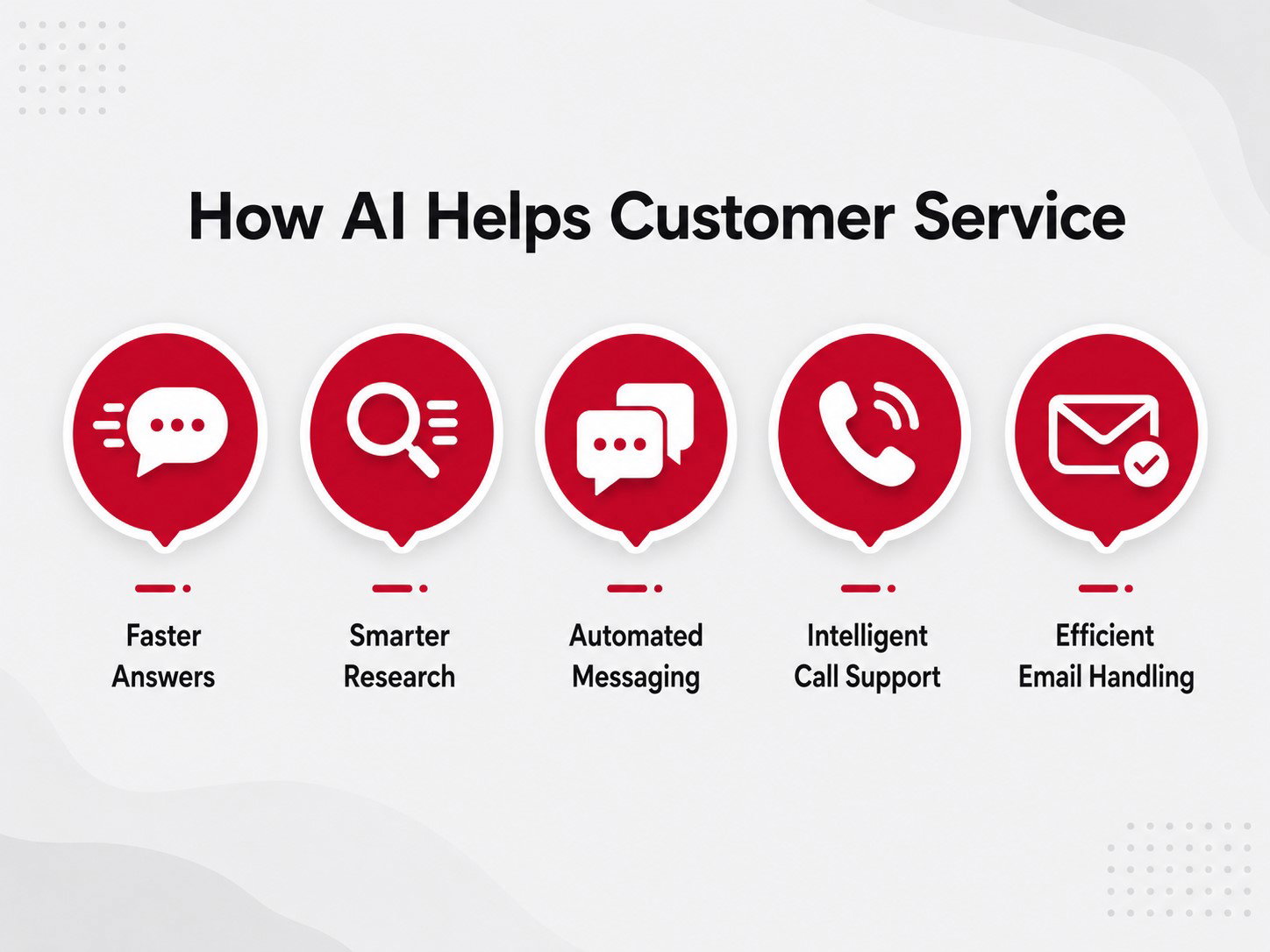
Modern chatbots can answer common questions, search knowledge bases, collect customer details, recommend resources, qualify leads, and route complex queries to human teams, while also handling FAQs, order updates, troubleshooting questions, appointment requests, and simple account issues. All while reducing wait times and answering questions outside regular business hours.
These are strong examples of AI in customer service because AI helps customers get faster responses, while businesses receive structured information that can be used for follow-up.
For sales, the same chatbot can answer pre-sales questions about pricing, product fit, integrations, demos, or use cases.
Here, the crossover is important. A visitor asking, “Does this tool integrate with our CRM?” may not think of themselves as a lead yet. However, that question signals interest. AI can capture the query, ask a few follow-up questions, qualify the account, and send the information to a sales representative. If the question is more technical, the chatbot can route it to support or a product specialist.
While chatbots embody the polite front desk of the digital business, always awake, always informed, the real trick is knowing when to stop the bot and bring in a human. AI chatbots should handle simple, repetitive, and information-heavy tasks. Human teams should handle sensitive complaints, complex negotiations, emotional situations, and high-value opportunities.
Of course, conversations are only useful if the information goes somewhere meaningful, which brings us to CRM automation.
CRM Automation And Customer Data Updates
A CRM is supposed to be the single source of truth for customer information. In reality, many CRMs become messy because people forget to update records, enter notes differently, skip fields, or leave important details buried in emails and call transcripts.
AI cleans up that mess.
With CRM automation, AI can log calls, summarize meetings, update contact details, track email interactions, create follow-up reminders, and pull key points from customer conversations. This saves sales and service teams from repetitive admin work and helps them focus on higher-value tasks.
This is where AI productivity tools for sales help executives ask for a summary of an account, recent customer issues, deal status, pending tasks, and next best actions without manually searching through multiple systems. Meanwhile, customer service agents can quickly see what was promised during the sales process, what product the customer purchased, and whether there are open opportunities or unresolved concerns.
Better data also improves collaboration. Sales teams can avoid making irrelevant pitches because they know what the customer has already discussed with support. Service teams can avoid asking repetitive questions because they can see the customer’s full history.
CRM automation also supports forecasting and reporting. When data is updated consistently, managers get a more accurate view of pipeline health, customer issues, recurring objections, and revenue opportunities. AI can then help identify which deals need attention, which customers may be at risk, and which accounts are most likely to expand.
Once the data is cleaner and easier to access, businesses can use it to make every recommendation feel more relevant.
Personalized Recommendations And Upselling
The best upsell does not feel like an upsell; it feels like good timing.
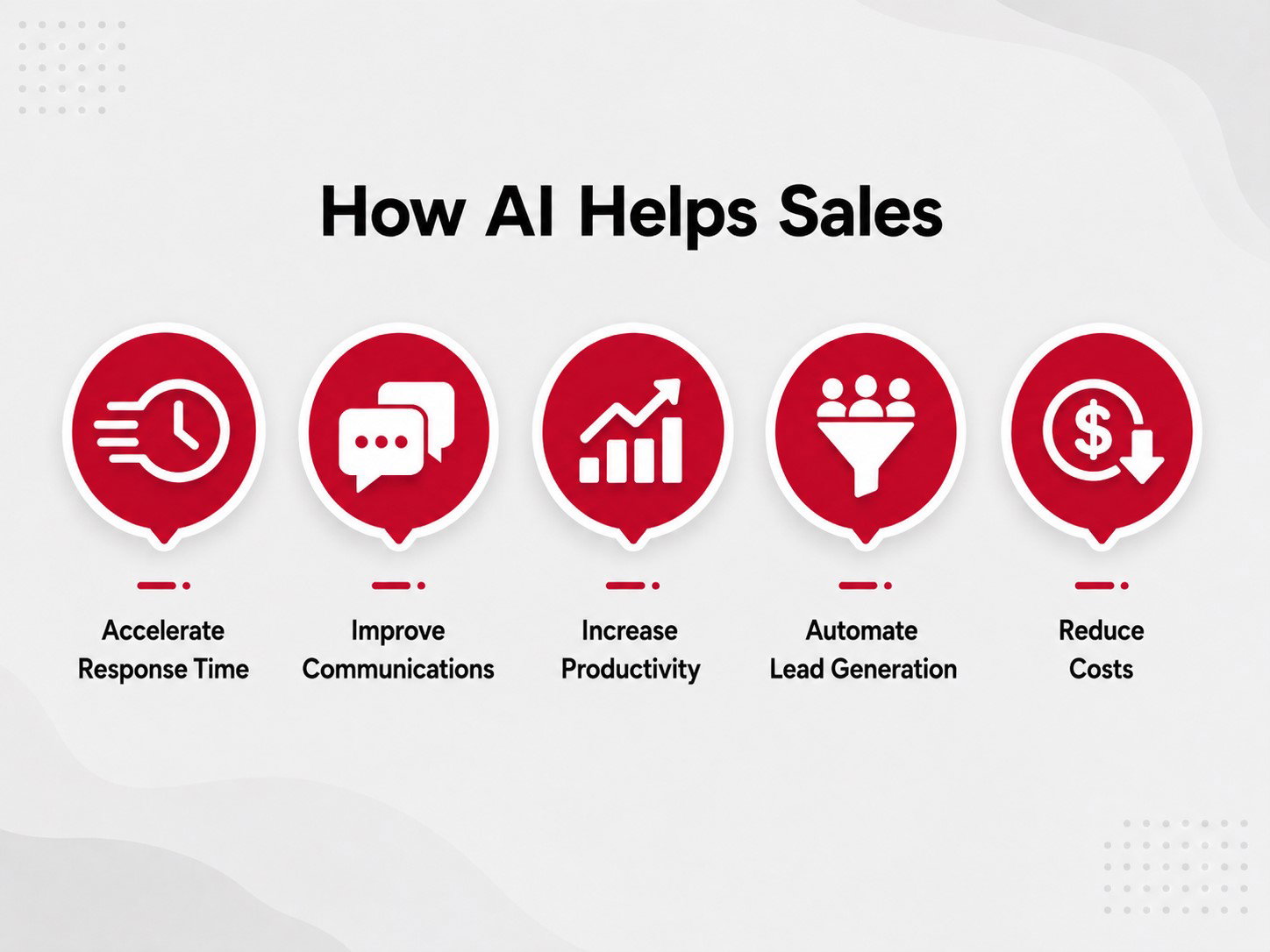
By analyzing customer behavior, purchase history, browsing activity, support interactions, usage patterns, and preferences, AI helps sales and service teams recommend the right product, plan, add-on, or resource at the right moment.
For example, a customer who frequently asks about storage limits may be a good fit for a higher plan. A customer who recently purchased one product may benefit from a complementary service. AI finds these patterns faster than a human team manually scanning every interaction.
These are among the clearest advantages of AI in customer service because personalization can improve both support quality and revenue outcomes. Support teams can suggest helpful guides, upgrades, or next steps based on the customer’s actual needs. Sales teams can use the same data to create more relevant outreach, proposals, and follow-ups.
GenAI (Generative Artificial Intelligence) can also help draft personalized emails, product recommendations, call scripts, and sales decks. However, human review is essential. Nobody wants to receive a message that sounds like it was written by a machine that only knows their job title and company name.
This is also one of the most effective ways to integrate GenAI into existing sales operations: use it to assist with personalization, not to fake personal attention. AI can draft, recommend, and summarize, while humans refine the message and add judgment.
So, can GenAI tools improve customer satisfaction? Yes, but only when they make customers feel understood rather than targeted. However, to understand whether customers actually feel understood, businesses need to listen beyond surface-level responses.
Sentiment Analysis And Customer Feedback Insights
Belfort built his entire career on reading a room; AI does something similar now.
Customers do not always say, “I am unhappy and may leave soon.” Sometimes, they say, “Fine, thanks,” while their tone, ticket history, review, or repeated complaints tell a different story. Sentiment analysis helps businesses detect those signals.
Using natural language processing, AI can analyze customer conversations, support tickets, call transcripts, reviews, surveys, emails, and social media comments to understand emotional tone and recurring themes, identifying frustration, confusion, satisfaction, urgency, or disappointment at scale.
Customer service teams get help with prioritizing tickets and escalating sensitive issues before they become bigger problems. A complaint with angry language, repeated follow-ups, and unresolved history should not sit in the same queue as a basic password reset. AI can flag the issue and help agents respond with more context.
For sales teams, sentiment analysis can reveal how prospects feel during the buying journey. Are they excited after a demo? Concerned about pricing? Confused about implementation? Comparing competitors? AI can surface these insights from calls, emails, and meeting notes, helping representatives adjust their approach.
Patterns in sentiment can also show whether customers love a feature, dislike a process, struggle with onboarding, or repeatedly ask for the same improvement. That feedback can influence sales messaging, product development, training, and customer success strategies.
Looking at the future of AI in customer service, sentiment analysis will likely become more proactive. Instead of only reviewing what happened, AI systems will increasingly help teams predict what may happen next.
It is a bit like giving businesses Belfort-level people-reading skills, minus the chaos, questionable ethics, and dramatic office speeches.
Topics For More Insights
Conclusion
AI hasn't replaced the instincts that made someone like Belfort effective; it's just made those instincts available to every service team executive and sales operative at once, helping them work together with better speed, context, and personalization. From lead qualification and chatbots to CRM automation, recommendations, and sentiment analysis, the smartest use cases focus on improving sales and customer relationships.
The real win is not replacing human teams but giving them sharper insights, faster workflows, and better timing across every customer interaction. Essentially, AI works best when it improves the relationship, not when it tries to replace it.
Frequently Asked Questions
What Should Businesses Watch Out For Before Using AI In Customer Service And Sales?
Businesses should check data quality, privacy rules, integration needs, and team readiness before implementing AI. If customer data is outdated or scattered across too many tools, AI may produce poor suggestions. Teams also need training so they know when to trust AI and when to use human judgment. Companies should also be transparent about automated interactions and create clear escalation paths for complex or sensitive issues. AI works best when the foundation is organized, secure, and supported by people who understand the workflow.
Can AI Fully Replace Customer Service Agents Or Sales Representatives?
AI can handle many repetitive tasks, but it should not fully replace human customer service agents or sales representatives. Customers still need empathy, negotiation, judgment, and creative problem-solving, especially in complex or emotional situations. AI is better suited for answering common questions, summarizing information, updating records, scoring leads, and recommending next steps. Human teams are still essential for building trust, handling exceptions, and making decisions that require context beyond the data.
How Can Small Businesses Start Using AI Without A Large Budget?
Small businesses can start with simple, practical tools instead of building complex AI systems from scratch. Good starting points include website chatbots, CRM automation, email drafting tools, meeting summaries, customer feedback analysis, and support ticket routing. The goal should be to save time on repetitive work and improve response quality. Small businesses should begin with one clear use case, measure the impact, and then expand gradually once the team understands what works best.
Fri, Jul 3, 2026

Enjoyed what you read? Great news – there’s a lot more to explore!
Dive into our content repository of the latest tech news, a diverse range of articles spanning introductory guides, product reviews, trends and more, along with engaging interviews, up-to-date AI blogs and hilarious tech memes!
Also explore our collection of branded insights via informative white papers, enlightening case studies, in-depth reports, educational videos and exciting events and webinars from leading global brands.
Head to the TechDogs homepage to Know Your World of technology today!
Disclaimer - Reference to any specific product, software or entity does not constitute an endorsement or recommendation by TechDogs nor should any data or content published be relied upon. The views expressed by TechDogs' members and guests are their own and their appearance on our site does not imply an endorsement of them or any entity they represent. Views and opinions expressed by TechDogs' Authors are those of the Authors and do not necessarily reflect the view of TechDogs or any of its officials. While we aim to provide valuable and helpful information, some content on TechDogs' site may not have been thoroughly reviewed for every detail or aspect. We encourage users to verify any information independently where necessary.
Loading comments...