
Marketing Solutions
Marketing Technology Trends Powering Smarter Campaigns In 2026
Share
TL;DR
-
Generative AI Creative Campaigns: 86% of advertisers are using or planning to use GenAI for video ad creative (IAB 2025). GenAI is projected to create 40% of all video ads by 2026. Marketers using AI tools report a 25.6% higher success rate (CoSchedule).
-
Privacy-First Marketing: 76% of marketing leaders say the cookieless shift has completely disrupted their digital advertising strategies (Gartner). 70% of consumers say they will pay more for brands they perceive as authentic (Zipdo). First-party data and consent-based targeting are now survival strategies.
-
Marketing Mix Modeling (MMM): 49% of marketers worldwide already use MMM (eMarketer), and 56% of US ad buyers increased their MMM focus in 2025. Google's Meridian and platforms like Sellforte, Cassandra, and Adobe Mix Modeler are leading the MMM modernization wave.
-
Agentic AI Martech: 79% of businesses have already adopted AI agents (PwC, April 2025), with 66% reporting measurable value. 88% plan to increase AI agent budgets in 2026. 50% of respondents believe their operating model will be unrecognizable in two years.
-
AR, VR, and MR Brand Experiences: Snapchat AR Lenses generate 5x higher active attention than other social platforms, with ads actively viewed 81% of the time they appear on screen (Amplified/OMD).
Introduction
In Ocean's Eleven, Danny Ocean doesn't walk into the Bellagio and improvise. He recruits a team where every specialist plays a distinct role: the strategist, the inside man, the tech expert, the distraction, and the whole operation only works because every piece executes in perfect coordination. Building a MarTech stack in 2026 works the same way. GenAI is the creative mastermind. Privacy-first tools are the inside man who knows which doors are locked. MMM is the strategist running the numbers. Agentic AI handles the execution layer. And immersive AR/VR/MR is the distraction that keeps the audience completely captivated. The heist only pays off when everything runs in sync.
Marketing is one of the fastest-moving sectors, with new strategies, experiments, and trends emerging every few days. As consumer demands change, new channels emerge, and market dynamics shift, marketers strive to stay at the forefront with effective, impactful campaigns.
Last year, the focus was on experimentation, optimization, and adoption of what worked best, especially amid the rise of AI marketing tools, omnichannel marketing, and visual and voice search. However, this created a fragmented landscape of tools, strategies, and channels.
In 2026, the theme is unification and orchestration: putting the right marketing technology in the right role in a connected ecosystem to create maximum impact. The global MarTech market grows from $669 billion in 2026 to $3.28 trillion by 2035 (Precedence Research), a trajectory that reflects not just tool adoption but a fundamental restructuring of how marketing operates as a business function.
Here are the latest MarTech trends shaping the industry in 2026.
Trend 1: Generative AI Will Drive Creative Campaigns And Marketing Automation
Over the past two years, Generative AI has evolved from a demo-like feature into a production engine automating marketing at scale. In 2026, marketers will leverage GenAI-powered tools for conceptualizing and creating copy, image, and video variants. With improved foundation models, enterprise-grade privacy guardrails, and tighter enterprise integrations, GenAI adoption is set to accelerate. Its biggest value-add: speed-to-market, cost reduction, and personalization across channels.
How Is The Industry Responding?
According to IAB's 2025 Video Ad Spend report, 86% of advertisers are already using or planning to use GenAI for video ads, and GenAI is projected to create 40% of all video ads by 2026. This aligns with SurveyMonkey's research, which suggests that 88% of marketers already use AI, with 93% generating content more quickly than with non-AI workflows.
The impact isn't limited to speed-to-market. A CoSchedule report finds that marketers using AI tools report a 25.6% higher success rate than those creating content without AI. As generative AI becomes the cornerstone of content creation, we're witnessing closer collaboration between GenAI providers and marketers, validated by David Cohen, CEO of the Interactive Advertising Bureau: "Marketers are increasingly looking for partners that not only provide access to GenAI solutions but also help them unlock its full strategic and creative potential."
The shift is clear: by mid-2026, the majority of online content is estimated to include AI-supported creation. The question for marketers is no longer whether to adopt GenAI but how to govern it, ensuring speed, quality, brand consistency, and compliance move together.
Challenges To Watch
As with any GenAI workflow, marketers must monitor models for bias and hallucination, while IP risks and production costs remain. Governance is crucial: marketing firms must draw a clear line between creativity and compliance, with transparency on AI-generated media becoming essential for consumers.
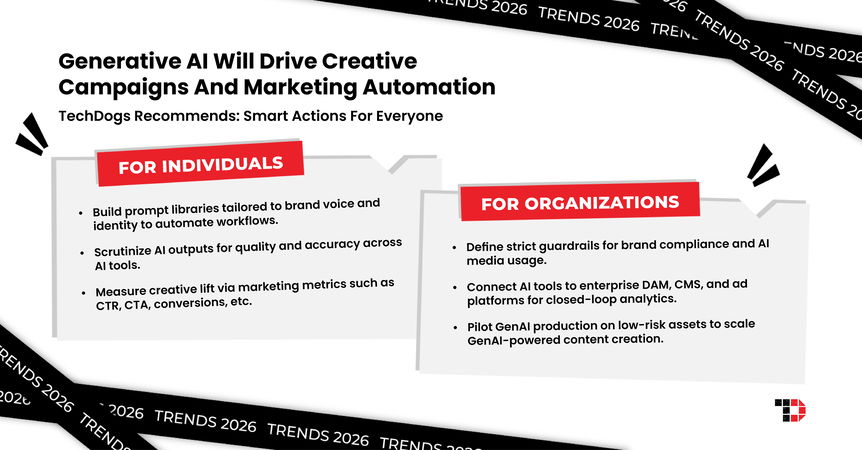
TechDogs Recommends: Smart Actions For Everyone
Trend 2: Privacy-First Marketing Will Be Key In A Post-Cookie Era
With third-party cookies now phased out, marketers have lost a key way to track users across online interactions. In 2026, this shift is reshaping how brands measure campaign performance and personalize customer experiences through consent, first-party information, and privacy-safe APIs. Marketers and brands must invest in consent and trust to enable tracking and targeting without compromising users' privacy. This sets the stage for more transparent and ethical marketing practices.
How Is The Industry Responding?
According to Gartner, 76% of marketing leaders report that the shift to cookieless advertising has completely disrupted their digital advertising strategies. Privacy-first marketing isn't optional in 2026; it is a survival strategy. Leading businesses such as The New York Times, Disney, NBCUniversal, and McDonald's are prioritizing first-party data to maintain relevance and reach in a cookieless landscape.
Marketers are now surveying the consumer landscape, building clean-room experiments, using server-side tracking, and deploying contextual creatives to maintain their understanding of consumer behavior. This is crucial: Zipdo reports that 86% of consumers believe authenticity is a key factor in deciding which brands to support. In comparison, 70% of consumers say they are willing to pay more for brands they perceive as authentic.
Roli Saxena, CEO at NextRoll, says: "As we navigate this shift, it's clear that the future of advertising hinges on building trust and delivering value without compromising privacy."
The reality is this: the pivot to privacy-first marketing is not primarily about compliance, it is about rebuilding trust with consumers who have grown wary of invisible tracking. Brands that lead with consent and transparency in 2026 will earn the first-party data relationships that power every other trend on this list.
Challenges To Watch
Privacy-first marketing techniques often result in fragmented signals and require closer attention to legal compliance. Without cross-team coordination, this fragmentation can lead to data silos and misalignment across marketing and sales channels.
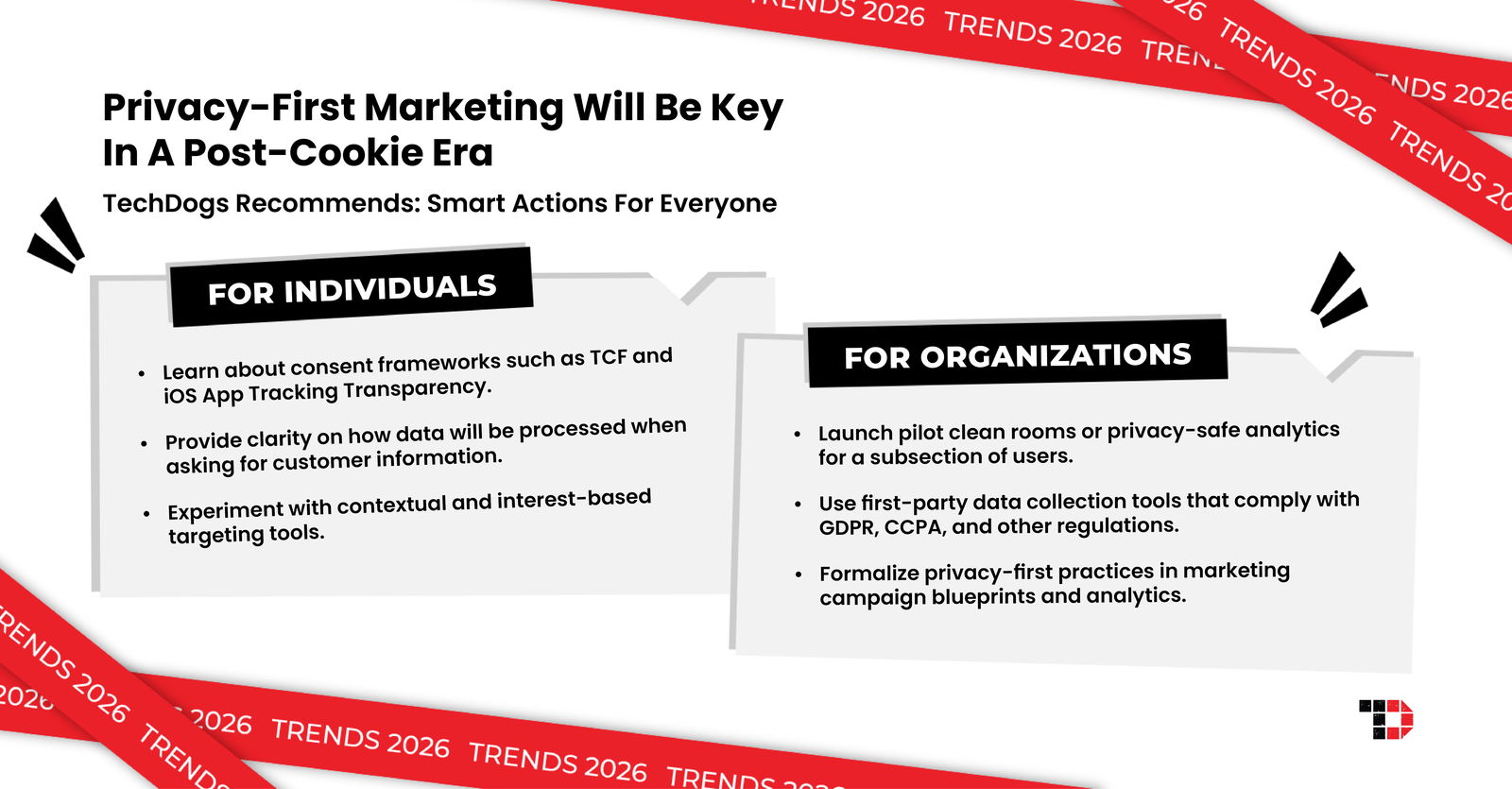
TechDogs Recommends: Smart Actions For Everyone
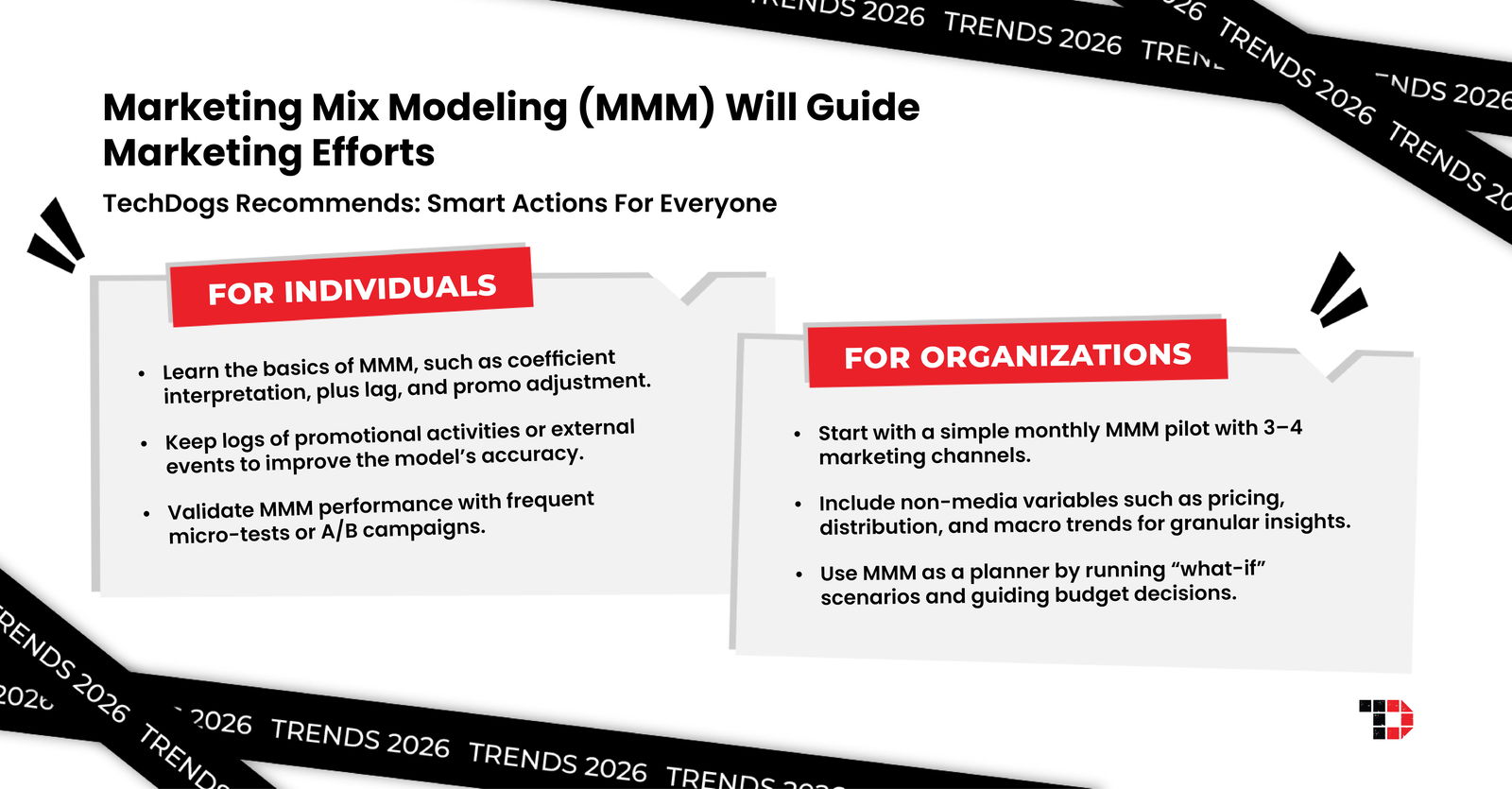
Trend 3: Marketing Mix Modeling (MMM) Will Guide Marketing Efforts
Who's to argue when marketing giant Google says Marketing Mix Modeling (MMM) is gaining traction? Although it has been around since the 1980s, this retro trend is making a comeback by analyzing historical data, macroeconomic movements, competitive dynamics, and even non-marketing factors to deliver tactical insights. In 2026, marketers will feed MMM with simulation-capable inputs and use it for budget planning, scenario modeling, and strategic decision-making.
How Is The Industry Responding?
MMM adoption is now mainstream. eMarketer notes that 49% of marketers worldwide already use MMM, and according to EMARKETER, data from the Interactive Advertising Bureau shows that 56% of US ad buyers increased their focus on MMM in 2025, a trend expected to continue in 2026 and beyond.
With Google Trends revealing growing interest in MMM as a planning discipline, Google has introduced Meridian, a tool similar to MMM, to help marketers understand the incremental impact of their online and offline campaigns by unifying disparate data into a single view.
Bounteous mentions in a July 2025 blog that MMM has re-emerged in "a critical capacity," especially for brands navigating fragmented data silos and privacy pressure from the demise of third-party cookies. The SaaS industry is also adapting, with platforms like Sellforte, Cassandra, and Adobe Mix Modeler leading the race.
Doug Brooks, EVP and Chief Client Officer at Marketing Management Analytics, predicted the trend at Google SuMMMit 2024, highlighting: "One of the key indicators that you have reached the tipping point of adoption on a marketing mix modeling solution is when the business questions shift from vendor-driven queries to user-initiated inquiries from cross-functional users. This demonstrates that they understand the models, believe in them, and recognize the opportunity."
What this means in practice: with 49% of marketers worldwide already using MMM and 56% of US ad buyers deepening their focus, MMM has moved from a specialist analytics exercise to a standard planning discipline. Organizations that invest in clean historical data and scenario simulation capabilities in 2026 will make budget decisions their competitors cannot match.
Challenges To Watch
The key challenge with MMM is its reliance on high-quality, validated historical data. If model insights are based on misattributed or outdated information, it raises the risk of poor decision-making. Frequent stakeholder validation is critical to MMM operations.
TechDogs Recommends: Smart Actions For Everyone
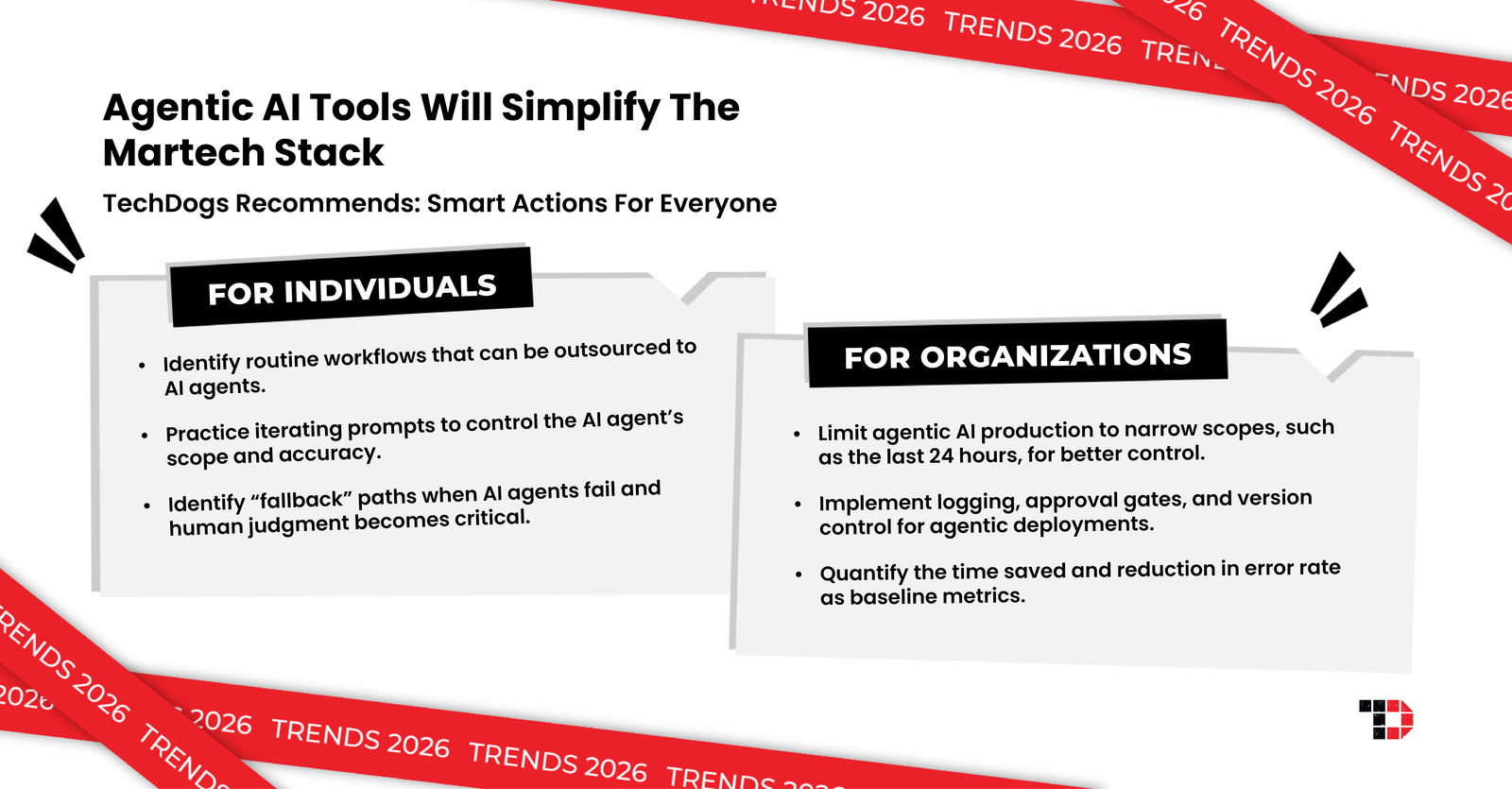
Trend 4: Agentic AI Tools Will Simplify The Martech Stack
In Ocean's Eleven, Basher Tarr is the technical specialist: he handles the systems no one else can crack, operates in the background while the rest of the team executes, and makes the impossible look seamless. In the MarTech stack of 2026, that role belongs to agentic AI. Agentic AI tools will empower marketers to choreograph complex workflows without manual effort, enabling autonomous bots to operate tools, manage workflows, and deliver predictable outcomes as martech sprawl continues to grow.
How Is The Industry Responding?
A PwC survey of 300 senior U.S. executives in April 2025 found that 79% of businesses have already adopted AI agents, with 66% reporting measurable value through increased productivity. The same survey reports that 88% of respondents say their team or business function plans to increase AI budgets in 2026, driven by the adoption of agentic AI.
Martech experts predict that workflows powered by AI agents will eliminate low-value, manual work while orchestration reduces friction between touchpoints. PwC's AI Agent Survey also shows that 50% of respondents believe their operating model will be unrecognizable in two years due to AI agent adoption, making 2026 a year of adjusting the entire stack around agentic AI at its core.
Jon Belkowitz, Senior Director of AI Product Management at Marketing Cloud, says: "As AI agents become increasingly powerful and capable of delivering highly personalized experiences, consumer engagement with the technology is expected to surge, creating a valuable new marketing channel for businesses."
The advantage is shifting to marketing teams that treat agentic AI as operational infrastructure, not as an experiment. With 50% of executives expecting their operating model to be unrecognizable within two years, the organizations that define their agent governance frameworks in 2026 will have a structural head start over those still piloting.
Challenges To Watch
A key challenge is driving employee adoption and empowering teams to leverage agents in ways that improve reliability. Occasional misfires by AI agents can cause reputational damage, while security risks, orchestration errors, and data quality issues remain real operational concerns.
TechDogs Recommends: Smart Actions For Everyone
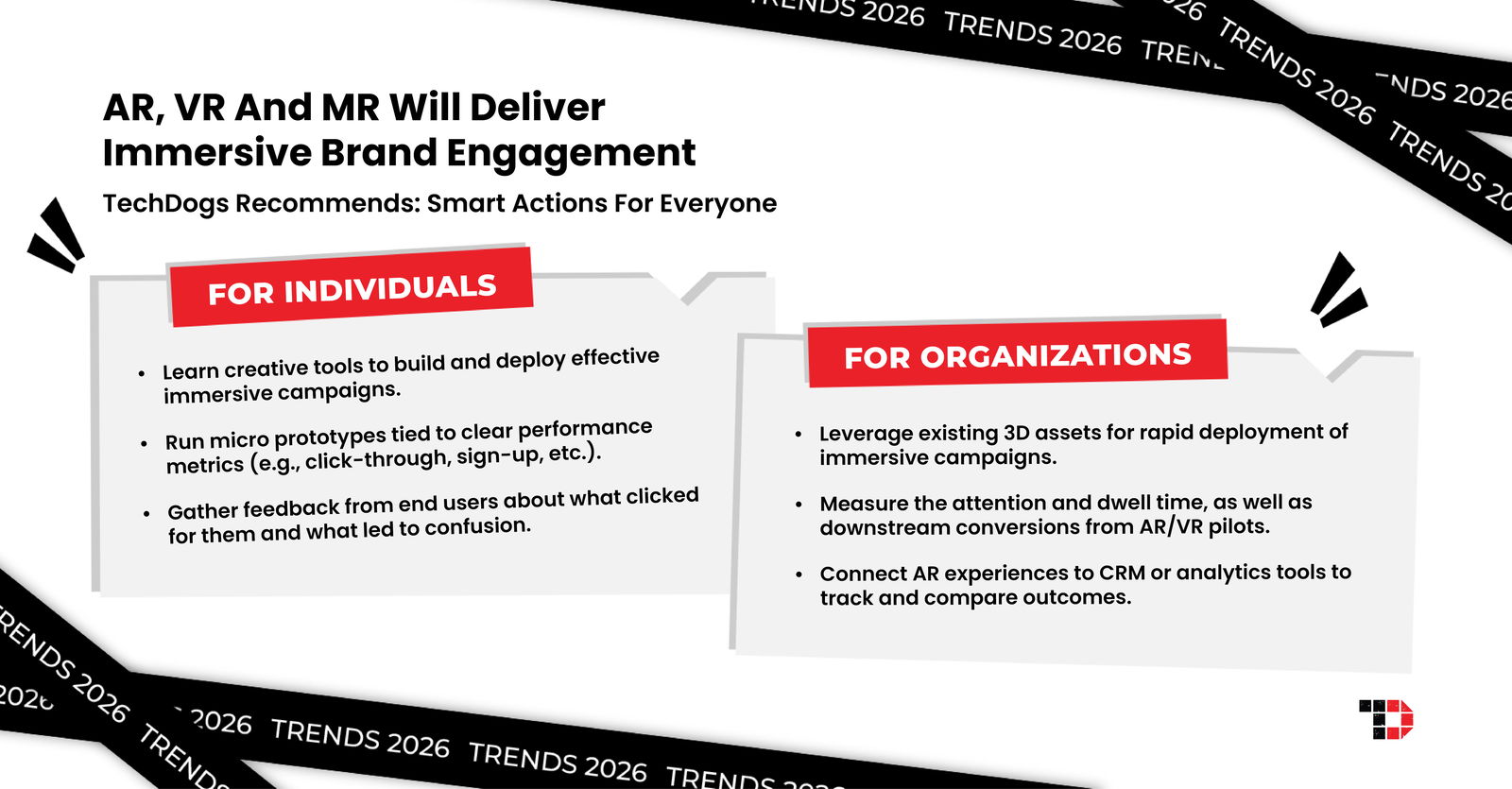
Trend 5: AR, VR, And MR Will Deliver Immersive Brand Engagement
Immersive technologies, augmented reality (AR), virtual reality (VR), and mixed reality (MR), are moving beyond gaming and entertainment into mainstream marketing. In 2026, marketers will use immersive brand experiences to engage customers in more interactive and memorable ways, leveraging embedded virtual try-ons, AR-based camera overlays, and immersive microsites. The aim: transform static campaigns into experiences that drive higher engagement, recall, and conversions.
How Is The Industry Responding?
The global Extended Reality (XR) market, encompassing AR, VR, and MR, is projected to reach approximately $362 billion by 2026, exhibiting a robust 57% CAGR from 2022. Driving this scale is adoption by major brands such as L'Oreal (personalized virtual try-ons), Skoda (Skodaverse digital AR showroom), and Balenciaga's Vision Pro (immersive fashion show), as well as AR/VR smart glasses from Ray-Ban, Meta, and Google.
Mobile devices are allowing marketers to deploy immersive campaigns with unprecedented ease, especially using popular platforms like Snapchat. Research by Amplified shows that Snapchat's AR Lenses encourage 5 times higher active attention than competing social media platforms, with ads being actively viewed 81% of the time they are on screen.
Hal Truax, Vice President at PCD Audio & Video, highlights: "Integrating XR, AR, and VR into the overall content strategy can transform passive, static viewing into interactive, engaging experiences. For example, an AR overlay on a digital sign might offer additional product information or interactive promotions, driving higher engagement."
The takeaway for marketers: immersive technology is not the future of brand engagement, it is the present. A 57% CAGR, 5x attention uplift from AR on Snapchat, and mainstream brand adoption from luxury to retail mean that the first-mover window is closing. The marketers who deploy strategically in 2026 will set the engagement benchmarks their competitors will have to meet in 2027.
Challenges To Watch
Key considerations include access to compatible hardware, production costs of immersive media assets, and the lack of an open standard. Marketers should pair immersive campaigns with clear CTAs and accessibility features; otherwise, consumers may perceive them as gimmicks.
TechDogs Recommends: Smart Actions For Everyone
Conclusion
At the end of Ocean's Eleven, the team walks out of the casino not because any single player was brilliant, but because every piece played its role at exactly the right moment. That is what a unified MarTech stack in 2026 looks like when it works: each layer doing its job, handing off to the next, with no friction between them.
Generative AI will deliver creativity at scale and speed. Privacy-first models will preserve consumer trust. MMM will provide clarity and strategic advantage. AI agents will simplify marketing orchestration. And immersive campaigns will deepen engagement and brand awareness.
Together, marketing technologies will converge to form a marketing engine that is efficient, accountable, and designed to delight consumers. Those who adopt these top trends in 2026 will make a lasting impact, not because they found a silver bullet, but because they learned to make every element of their stack work in sync.
Frequently Asked Questions
What Are The Top Marketing Technology Trends To Watch In 2026?
The top Marketing Technology trends of 2026 include the rise of generative AI for content and campaign automation, privacy-first marketing practices in a post-cookie era, renewed focus on marketing mix modeling for data-driven decisions, adoption of agentic AI tools to simplify complex workflows, and the expansion of AR, VR, and MR for immersive brand engagement.
How Will Generative AI And Agentic AI Shape Marketing Strategies In 2026?
Generative AI is rapidly becoming a cornerstone of marketing creativity by enabling faster content creation, personalization at scale, and cost savings. With 86% of advertisers already using or planning to use GenAI for video ad creative (IAB) and 88% of businesses planning to increase AI agent budgets (PwC), both technologies are crossing from experimentation into operational deployment, and 2026 is the year the gap between AI-enabled and AI-first marketing teams becomes visible in results.
Why Is Privacy-First Marketing Critical For Businesses In 2026?
With the phase-out of third-party cookies, brands have lost a long-standing method for tracking and targeting users, making privacy-first marketing an essential survival strategy. Businesses are shifting toward first-party data, consent-based interactions, and privacy-safe APIs to maintain relevance while protecting consumer trust. As Gartner reports 76% of marketing leaders already disrupted by the cookieless shift, organizations that invest in ethical data practices and privacy-compliant personalization will gain a competitive edge, because the trust they build with consumers is itself the new targeting signal.
Mon, Nov 3, 2025

Enjoyed what you read? Great news – there’s a lot more to explore!
Dive into our content repository of the latest tech news, a diverse range of articles spanning introductory guides, product reviews, trends and more, along with engaging interviews, up-to-date AI blogs and hilarious tech memes!
Also explore our collection of branded insights via informative white papers, enlightening case studies, in-depth reports, educational videos and exciting events and webinars from leading global brands.
Head to the TechDogs homepage to Know Your World of technology today!
Disclaimer - Reference to any specific product, software or entity does not constitute an endorsement or recommendation by TechDogs nor should any data or content published be relied upon. The views expressed by TechDogs' members and guests are their own and their appearance on our site does not imply an endorsement of them or any entity they represent. Views and opinions expressed by TechDogs' Authors are those of the Authors and do not necessarily reflect the view of TechDogs or any of its officials. While we aim to provide valuable and helpful information, some content on TechDogs' site may not have been thoroughly reviewed for every detail or aspect. We encourage users to verify any information independently where necessary.
Loading comments...