

Emerging Technology
Emerging Technology Trends Businesses Must Track In 2026
Share
TL;DR
-
Voice-Activated IoT: IoT-connected devices reached 22 billion in 2026, on a trajectory to exceed 40 billion by 2034. Voice AI is moving from smart speakers to industrial controls, healthcare, and financial authentication.
-
Humanoid Robots: Investments of $675M (Figure), $350M (Apptronik), and $109M (Fourier) are scaling development. Robot costs have dropped from $50-250K to $30-150K.
-
Autonomous Vehicles: Global AV sales are projected to reach 41 million units by 2029. Robotaxis are operating in Phoenix, San Francisco, and Austin under Level 4 autonomy frameworks.
-
Agentic AI: Gartner predicts 15% of everyday work decisions will be made autonomously by AI agents by 2028. A Deloitte survey found 3 in 4 companies plan to deploy agentic AI within two years.
-
Emerging Energy Technologies: Solar photovoltaic alone is projected to mitigate 11 gigatons of emissions annually.
Introduction
Black Mirror imagined all of this and made it terrifying. The voice that controls your home. The robot that replaces your job. The car that drives itself. The AI that makes decisions on your behalf. The energy grid that thinks. Every episode began with technology that was just one step ahead of the present. What the show got wrong was the ending. In 2026, these are not dystopian cautionary tales. They are the year's five most important technology trends, arriving with governance, investment, and real-world use cases attached.
Looking back at 2025, it was a year of steady progress when emerging technologies quietly matured and set the stage for what's to come. Generative AI scaled across enterprises, IoT improved with smarter, faster connections, and Agentic AI began anticipating needs, pointing toward a future of more autonomous technology. Quantum computing and autonomous vehicles gained momentum in 2025, accelerating research and testing for breakthroughs in 2026. Meanwhile, sustainable technology shifted from niche to key business priority.
In 2026, technology is taking a new path. Internet of Things (IoT), advanced robotics, autonomous vehicles, agentic AI, green tech, and more are converging to transform how businesses, cities, and people operate. These innovations are no longer experiments. They are deployments. Here are the five that define the year.
Trend 1: Voice-Activated IoT Devices Will Make Control Hands-Free And Instant
Once limited to smart speakers in homes, voice assistants have moved steadily into broader IoT applications over the past few years. Advances in natural language processing, multilingual support, and AI-driven contextual understanding have made voice commands far more accurate and intuitive. As industries recognized the value of hands-free control, from adjusting factory equipment to operating connected cars, voice-activated IoT has moved from novelty to necessity.
In 2026, voice-activated IoT devices are stepping up from simple "tell it what to do" tools to smarter, context-aware assistants. They can follow complex, multi-step instructions almost instantly due to ultra-fast 5G networks and edge processing. Banks and FinTech players are going further with voice biometrics, creating unique digital profiles of your voice to make authentication faster, easier, and more secure.
How Is The Industry Responding?
Connected devices have reached 22 billion in 2026, on a trajectory to exceed 40 billion by 2034, according to Statista data confirmed by multiple 2026 market trackers, with the global IoT market value surpassing $471 billion this year. Research shows this shift is enabling voice control to move from novelty to necessity across industries. Sonos's Voice Control, launched in 2022, has grown from handling simple tasks to managing Philips Hue lighting entirely hands-free. In healthcare, Cedars-Sinai's Aiva system, powered by Amazon Echo devices, enables 100+ patients to request help or adjust room settings with their voice, allowing nurses to focus on urgent care.
As Tejal Hartalkar, Senior Disruptive Tech Analyst at GlobalData, notes: "Voice AI is poised to become the primary interface for ambient computing, which refers to the seamless integration of technology into our surroundings, facilitating intuitive and effortless interactions with interconnected devices and services."
The shift is clear: voice-activated IoT is not a consumer convenience add-on. As edge processing and NLP maturity combine, it is becoming the default interaction layer for industrial, medical, and financial systems that previously required hands-on controls.
Challenges To Watch
Voice recognition still struggles with accents, background noise, and uncommon languages. For organizations, protecting data, stopping spoofing, and ensuring different IoT protocols work together smoothly remain significant problems that can slow adoption while negatively impacting system performance.
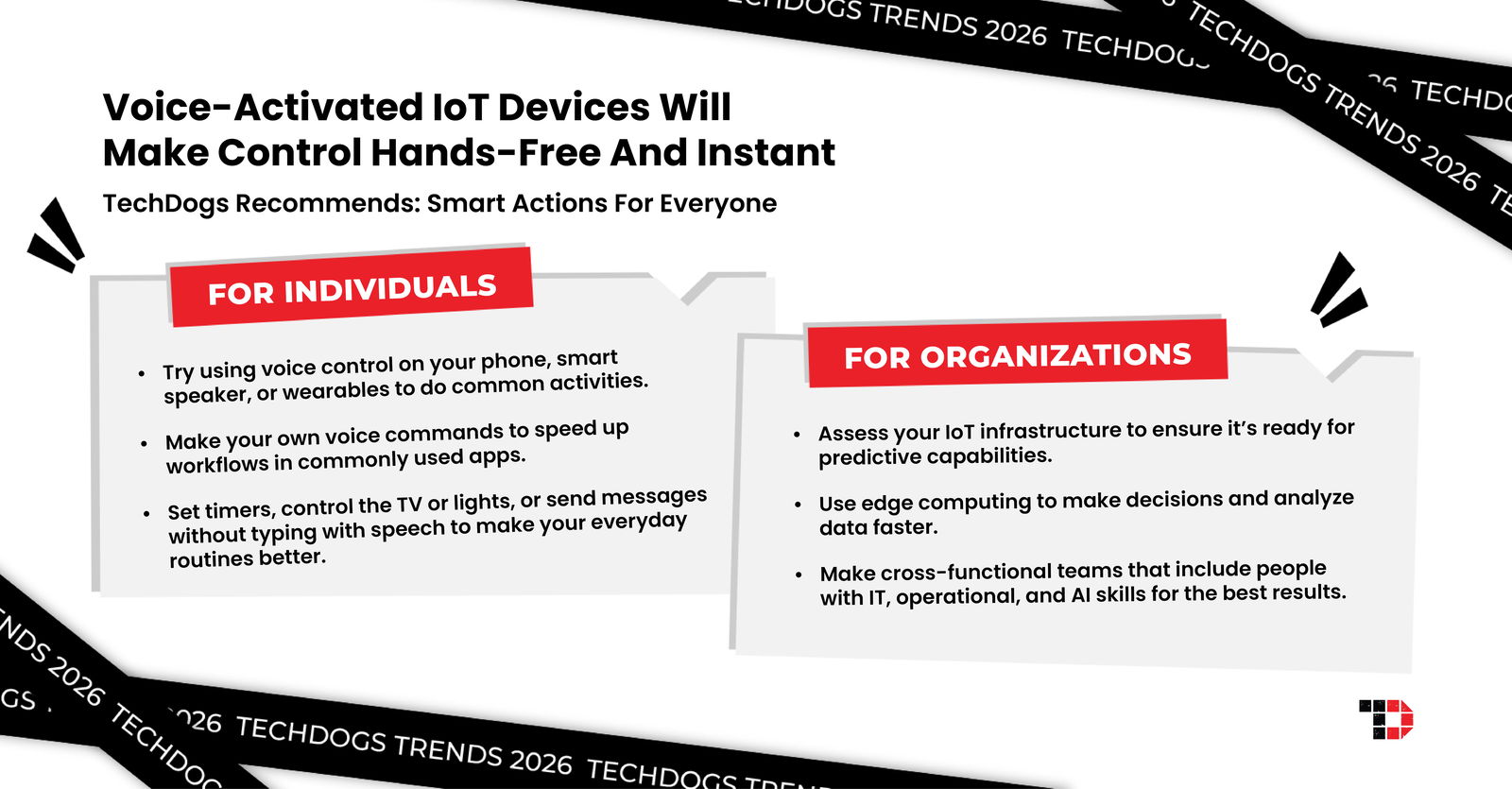
TechDogs Recommends: Smart Actions For Everyone
Trend 2: Humanoid Robots Will Move From Labs To Everyday Use
For decades, humanoid robots felt like something out of science fiction, intriguing but far from practical. That changed fast. Humanoids are getting better, more flexible, and most importantly, cheaper due to developments in AI, sensors, and energy efficiency. These robots are taking over risky, repetitive, and high-precision roles at a time when manufacturing, logistics, and healthcare face persistent labor shortages.
In 2026, humanoid robots are hitting a turning point. Huge investments, $675 million in Figure, $350 million in Apptronik, and $109 million in Fourier Intelligence, are accelerating development as per the latest research. Costs have dropped sharply, from $50,000-$250,000 per robot to just $30,000-$150,000. Tesla's Optimus is even preparing for mass production, aiming at tens of thousands of units, highlighting how humanoids are shifting from lab experiments to commercially viable solutions.
How Is The Industry Responding?
Robotics firms and investors are placing big bets on humanoid platforms. Tesla's Optimus aims for mainstream use by 2026, expected to cost around $20,000-$30,000. Major manufacturing giants like Ford and BMW, and logistics leaders like Amazon and GXO, are already testing humanoid robots in operations, targeting high-risk and labor-intensive tasks.
Deloitte predicts that the cumulative installed capacity of industrial robots will surpass 5 million units in 2025 and could reach 5.5 million globally by 2026, driven by AI integration and persistent labor shortages in developed economies.
NVIDIA's CEO Jensen Huang calls the robotics sector a "multitrillion-dollar opportunity," noting that foundational AI models for humanoid robots are being built to transform smart factories, warehouses, and autonomous vehicles.
What this means in practice: the humanoid robot is no longer a prototype curiosity. With falling costs, scaled investment, and AI models designed specifically for physical operation, 2026 marks the year robots begin moving from showcase floors to factory floors in volume.
Challenges To Watch
Even with all the excitement, there are still hurdles: high price tags, making robots flexible enough for real-life tasks, and ensuring they are safe to work alongside people. User acceptance remains a challenge, and large-scale deployment across diverse environments will not happen overnight.
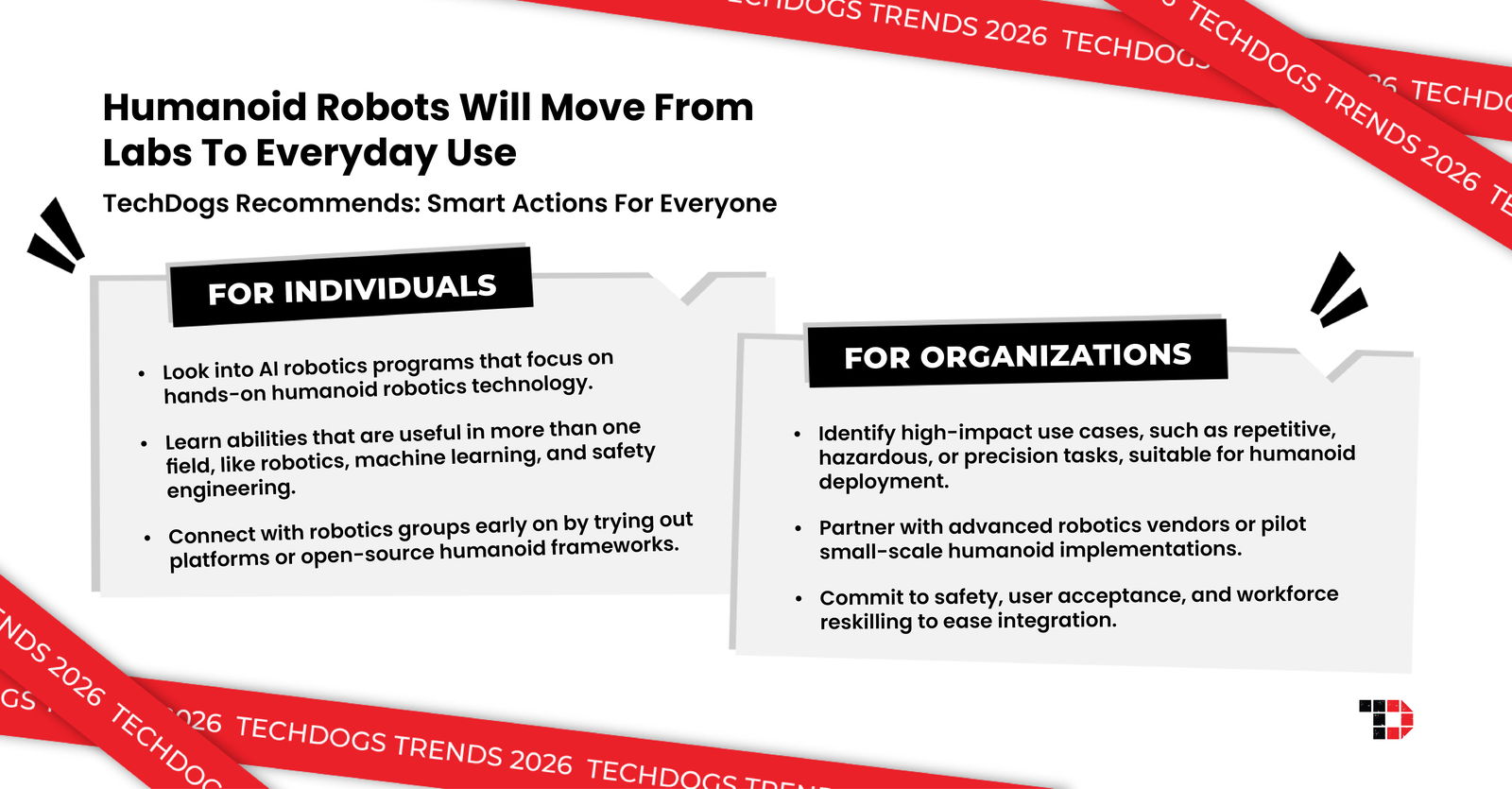
TechDogs Recommends: Smart Actions For Everyone
Trend 3: Autonomous Vehicles Will Shift From Pilots To Scaled Deployment
Autonomous vehicles (AVs), once thought of as futuristic experiments, are becoming more common. Self-driving vehicles, shuttles, and trucks are far more dependable now that AI, LiDAR, edge computing, and real-time mapping have all improved. As cities deal with traffic congestion and businesses deal with driver shortages, AVs are becoming practical for both transportation and logistics.
In 2026, AVs are making a major leap from limited pilots to wider deployment. Self-driving robotaxis are becoming a regular part of urban mobility, while autonomous trucks on highways promise faster deliveries and greater efficiency. This marks a turning point where self-driving cars move from being tested to being an important part of routine transportation systems.
Topics For More Insights
How Is The Industry Responding?
By 2029, global autonomous vehicle sales are projected to climb to around 41 million units, with further growth expected to reach nearly 58 million units by 2030. Phoenix, San Francisco, and Austin have designated geofenced zones with AV-friendly infrastructure to support Level 4 autonomous vehicles operating safely within well-mapped environments.
As Dr. K Subramanian, Senior Vice President at Ashok Leyland, noted: "Make the hardware simpler and apply simplicity to the software, which can then be updated over time. As an industry, we must ensure that ADAS doesn't complicate vehicle architecture but rather lays the foundation for simple, efficient autonomous technologies."
The advantage is shifting to cities and logistics operators that build AV-ready infrastructure now. Geofenced robotaxi zones today become the blueprint for open-road autonomy tomorrow, and the companies investing in testing infrastructure in 2026 will be first to scale when regulatory frameworks catch up.
Challenges To Watch
Even with rapid progress, there are still significant problems to solve. Real-world driving situations are unpredictable, regulations vary across regions, and the costs of advanced sensors remain high. Public trust in AV safety is still growing, and cybersecurity has become a critical concern that must be resolved to ensure the safety of autonomous vehicles.
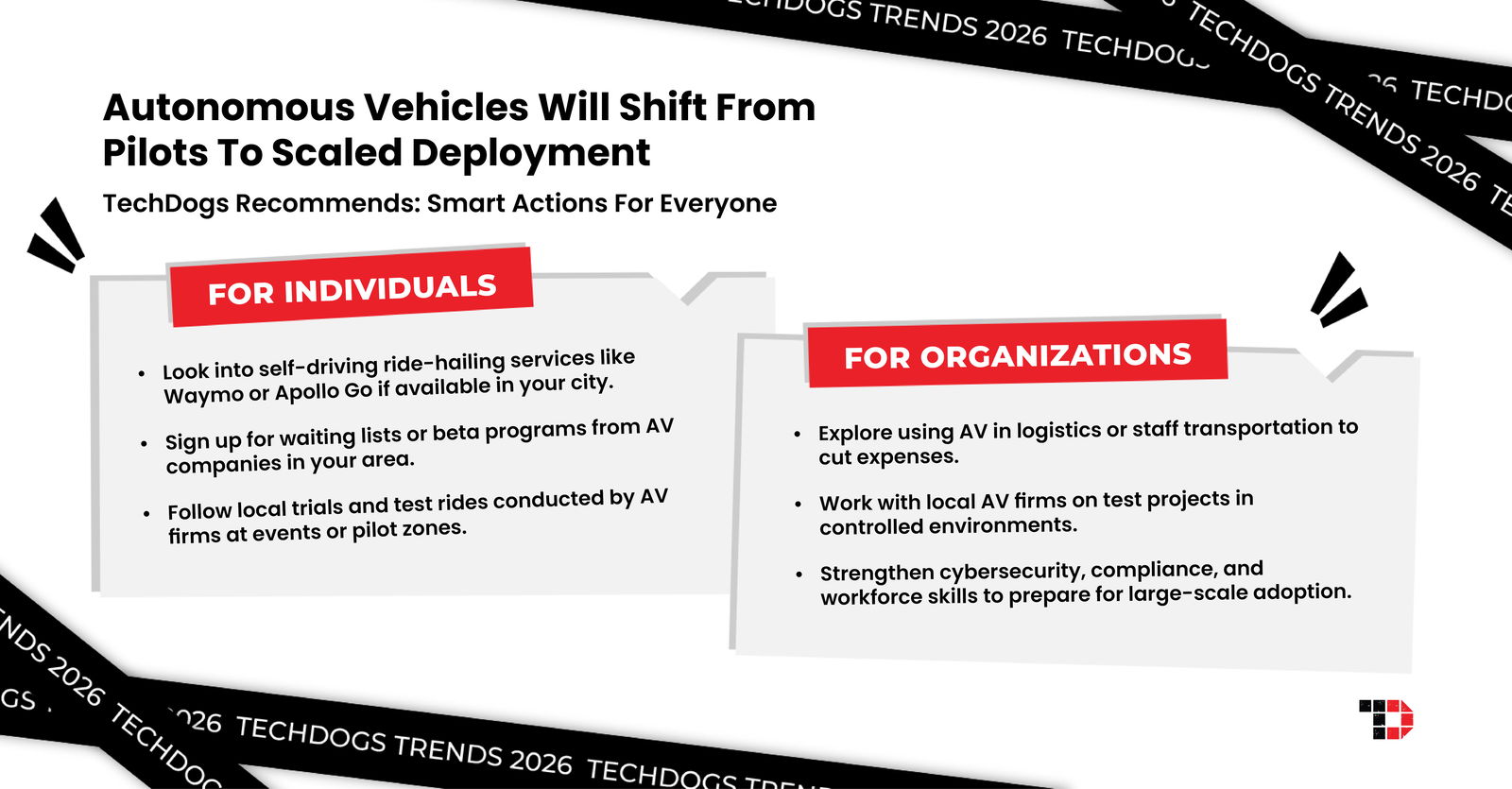
TechDogs Recommends: Smart Actions For Everyone
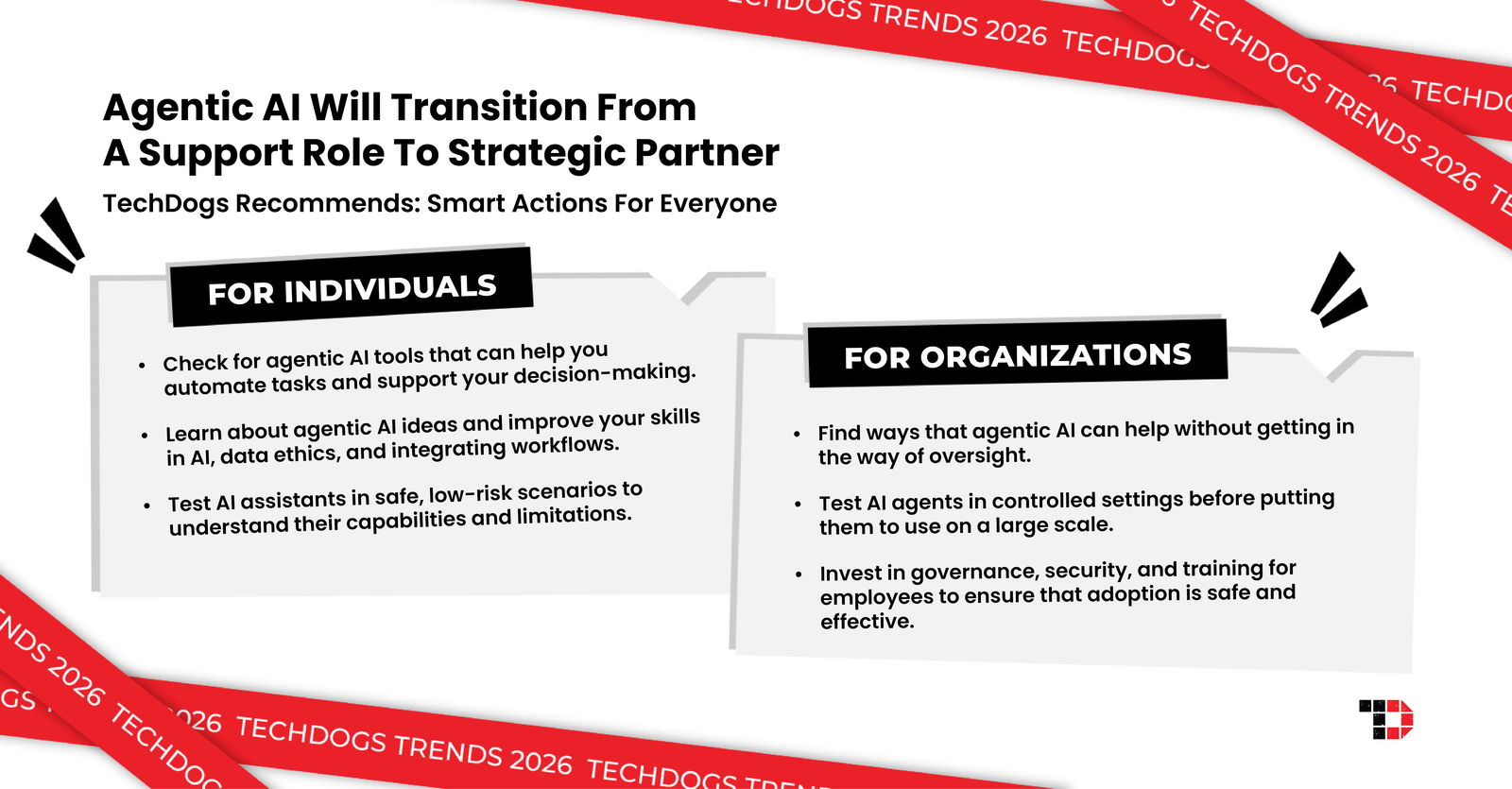
Trend 4: Agentic AI Will Transition From A Support Role To A Strategic Partner
Black Mirror's most unsettling episodes were always the ones where the AI didn't just answer, it acted. It planned. It executed. It optimized, without asking permission. In 2026, that premise is arriving in enterprise software, and the difference from the show's nightmare version is one word: governance.
So far, AI has acted as a supportive tool, answering queries, drafting content, or summarizing data. However, in 2026, Agentic AI is evolving into a strategic partner that doesn't just respond but proactively executes tasks, makes decisions, and drives outcomes. What is agentic AI? It refers to AI systems with long-term memory, reasoning abilities, and multi-step execution skills. Instead of just suggesting a marketing campaign, an agentic system could design, launch, monitor, and optimize it. Much like cloud computing transformed IT into a business enabler, Agentic AI will shift from assistant to core teammate.
How Is The Industry Responding?
Gartner predicts that by 2028, at least 15% of everyday work decisions will be made autonomously by agentic AI, rising from virtually 0% in 2024. Additionally, 33% of enterprise software applications will embed agentic AI by 2028, compared to less than 1% in 2024.
A separate Deloitte survey found that nearly 3 in 4 companies plan to deploy agentic AI within two years, a signal that the enterprise adoption curve for autonomous AI systems is steepening rapidly across manufacturing, logistics, and financial services.
As Deepak Singh, VP, Developer Agents and Experience, at AWS, explains: "We want AWS to be the place where everyone runs enterprise AI agents, and for AgentCore to be the way they do it. There is going to be a world that is going to be agentic, it is going to happen within the next few years, and AgentCore is going to be an accelerant to making this happen."
The reality is this: the Black Mirror version of agentic AI acts without constraints. The 2026 version acts within them. The organizations building governance frameworks, human-in-the-loop checkpoints, and transparent audit trails for their AI agents now are not slowing down adoption; they are making it sustainable.
Challenges To Watch
Seamlessly integrating AI systems with current processes is hard. AI bias, ethical challenges, and privacy risks raise real concerns. Over-reliance on AI insights can also weaken human decision-making, making human-in-the-loop strategies essential for responsible deployment.
TechDogs Recommends: Smart Actions For Everyone
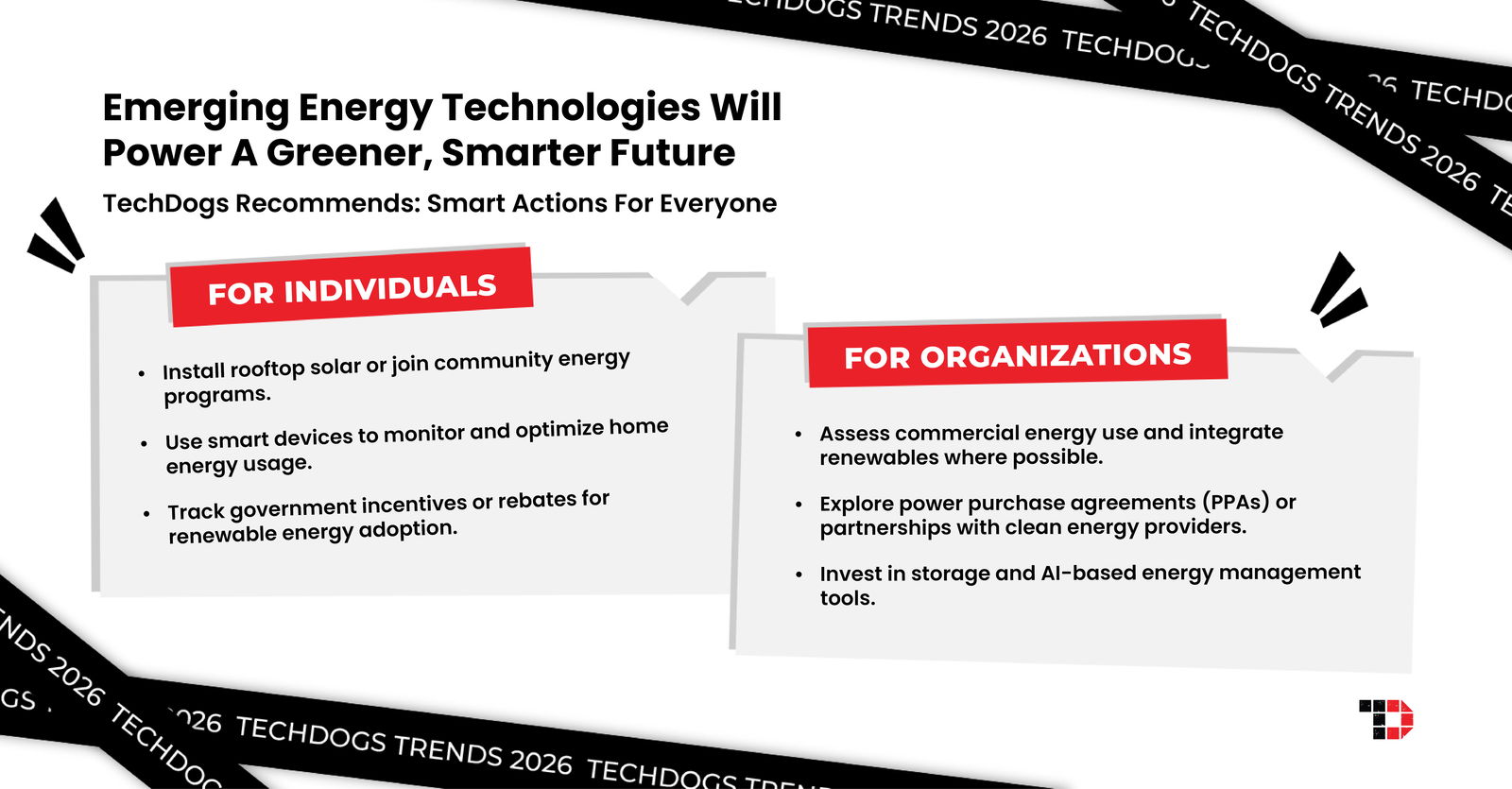
Trend 5: Emerging Energy Technologies Will Power A Greener, Smarter Future
The rise of AI data centers, autonomous systems, and large-scale cloud computing is driving unprecedented energy demand. Traditional grids and storage solutions have struggled to keep pace, creating an urgent need for smarter energy technologies. In 2026, innovations like solid-state batteries, advanced photovoltaics, AI-powered energy management, and decentralized microgrids are stepping in to balance supply and demand efficiently.
These technologies not only store and deliver energy more reliably, but they also optimize consumption in real time, reducing waste and cutting carbon footprints. Solid-state batteries offer higher energy density, faster charging, and improved safety compared to conventional lithium-ion solutions. Much like cloud computing transformed IT into a business enabler, these emerging energy technologies are turning electricity from a passive utility into the fuel that powers dynamic, data-driven ecosystems sustainably.
How Is The Industry Responding?
The solid-state battery (SSB) market stands at $2.3 billion in 2026 and is projected to reach $27.7 billion by 2035, growing at a 38% CAGR, according to Research Nester. IDTechEx projects the market will reach $9 billion by 2035 in a separate analysis. Automotive leader Stellantis and battery-maker Factorial Energy's Factorial Electrolyte System Technology (FEST) features fast-charging batteries capable of going from 15% to 90% charge in just 18 minutes, a significant advance for sustainable electric vehicles.
As Jarand Rystad, a former McKinsey & Company partner, mentioned on the scale of the energy transition: "Solar photovoltaic alone will mitigate 11 gigatons. Batteries and EVs separately are the next most important, at about 5.5 gigatons each. And CCUS (carbon capture, utilization and storage) also has the potential to mitigate 5.5 gigatons."
The takeaway for organizations: energy is no longer a passive cost center. With AI-managed grids, solid-state storage, and distributed solar now commercially viable, businesses that build smart energy infrastructure in 2026 will gain both a sustainability advantage and an operational resilience one, two priorities that used to require separate strategies.
Challenges To Watch
Solar and wind power can be inconsistent, and connecting them to the grid is complex. High initial costs, varying regulations across regions, and limited supply of key materials like lithium also make scaling renewable energy challenging.
TechDogs Recommends: Smart Actions For Everyone
Conclusion
2026 is proving that the same technologies, deployed with governance, investment, and practical use cases, can be genuinely useful. Voice IoT that assists nurses. Robots that take on hazardous factory work. Vehicles that navigate themselves while humans focus elsewhere. AI agents that execute within defined boundaries. Energy systems that think. The nightmare version and the useful version of these technologies differ by one variable: human oversight.
In 2026, we are starting to see technology step out of labs and into our daily lives. Hands-free IoT assistance, humanoid robots, self-driving autonomous mobility, embedded agentic AI, and smarter renewable energy are together shaping a smarter, greener, more efficient world. Harnessing these technologies wisely, whether at home or in the boardroom, can unlock a better way of living, working, and sharing.
The sci-fi headlines are here. The difference between Black Mirror and 2026 is that this time, we get to choose how the story ends.
Frequently Asked Questions
What Are The Top Emerging Technology Trends In 2026?
In 2026, key technology trends include voice-activated IoT, humanoid robots, autonomous vehicles, agentic AI, and advanced renewable energy solutions. These innovations are transforming daily life, business operations, and global industries, moving from pilots and prototypes to scaled, real-world deployment.
Which Industries Benefit Most From New Tech Trends?
Sectors like healthcare, finance, manufacturing, retail, and logistics gain the most from emerging technologies through automation, data insights, and improved customer experiences. However, digital transformation ensures that every industry, from education to entertainment, sees efficiency, innovation, and growth opportunities.
Do Emerging Technologies Create New Jobs?
Yes. Emerging technologies fuel job growth by creating roles in AI, data science, cybersecurity, robotics, renewable energy, and digital transformation. They also boost demand for future-ready skills, opening exciting career paths across industries.
Tue, Sep 16, 2025

Enjoyed what you read? Great news – there’s a lot more to explore!
Dive into our content repository of the latest tech news, a diverse range of articles spanning introductory guides, product reviews, trends and more, along with engaging interviews, up-to-date AI blogs and hilarious tech memes!
Also explore our collection of branded insights via informative white papers, enlightening case studies, in-depth reports, educational videos and exciting events and webinars from leading global brands.
Head to the TechDogs homepage to Know Your World of technology today!
Disclaimer - Reference to any specific product, software or entity does not constitute an endorsement or recommendation by TechDogs nor should any data or content published be relied upon. The views expressed by TechDogs' members and guests are their own and their appearance on our site does not imply an endorsement of them or any entity they represent. Views and opinions expressed by TechDogs' Authors are those of the Authors and do not necessarily reflect the view of TechDogs or any of its officials. While we aim to provide valuable and helpful information, some content on TechDogs' site may not have been thoroughly reviewed for every detail or aspect. We encourage users to verify any information independently where necessary.
Loading comments...