
Artificial Intelligence
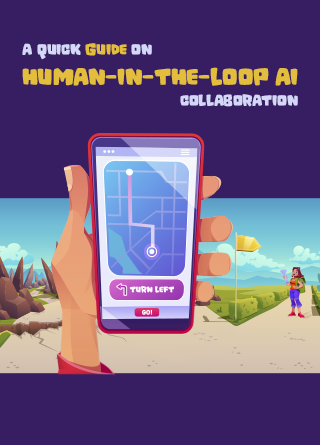
A Quick Guide On Human-In-The-Loop AI Collaboration
Share
Overview
The show unfolds almost like a computer adventure, displaying an arrow on different scenes where the audience must make a decision. The whole plot revolves around finding her destination or overcoming any hurdles. Dora would then congratulate us for trying while replying with the correct answer to encourage us.
Indeed, everything was fictional, but we were on our toes when she followed up with us.
Dora: Are you able to see the sloth behind me?
Us: Yes, we can! Look, it's right there!
Dora: Yey! You did it.
However, in today's world, where many things are automated, we need humans to make the right choice. AI may come up with many solutions, but only humans can choose the best one.
As we all know, AI handles the heavy lifting of data processing with initial analysis, but humans have to pitch in when the deciding factor and contextual understanding come into play.
In a way, humans become part of a loop when it comes to making decisions with AI. This is also called Human-in-the-Loop AI Collaboration. Read on to know everything about the same.
.png.aspx "TechDogs-\"A Quick Guide On Human-In-The-Loop AI Collaboration\"")
Who do you go to for solving your problems?
Friends, parents, Google, ChatGPT?
You may receive numerous solutions to your problems, but what works best is the approach you ultimately adopt. Human-in-the-Loop works exactly the same way.
Human-in-the-Loop AI Collaboration refers to the communication between technology (AI) and its users to achieve a specific result.
Before we overwhelm you with its complexity, let's get into the basics.
Understanding Human-in-the-Loop AI Collaboration
Human-in-the-Loop (HITL) is a model that integrates human insight into automated processes. This integration is important across various domains, including machine learning, autonomous systems and simulations.
It emphasizes the importance of human intervention in generating outcomes and leveraging decision-making frameworks. By incorporating human judgment, the HITL model ensures that automated systems remain strategically aligned with the complexities and implications of real-world situations.
Over the years, this approach has evolved, adopting different terminologies and characteristics tailored to the specific field of study. The idea has become fragmented into distinct domains, with each area focusing on a different aspect of collaboration.
Here's how it typically works:
-
Step 1: The AI model processes data and generates initial results or suggestions.
-
Step 2: Humans then review the outputs, providing feedback or making the outcome.
-
Step 3: In some instances, the AI learns from this human input to refine the model.
There are various benefits of this model. Let’s know how.
Benefits Of Human-In-The-Loop AI Collaboration
HITL enhances AI accuracy by deploying human thinking at crucial stages of the model lifecycle. Let’s look at the benefits.
-
Data Quality Assurance
Humans validate and refine training data, reducing biases and errors.
-
Model Feedback Loop
Experts refine AI outputs and provide real-time feedback for continuous improvement and breakthroughs.
-
Edge Case Handling
Human feedback enables AI to handle situations that are rare or ambiguous.
-
Adaptive Learning
HITL ensures that AI systems adapt to their environment and changing needs.
-
Improved Model Accuracy
The HITL approach can improve model accuracy by up to 25-40%.
-
Ethical AI Assurance
Human checks help ensure decisions made by AI are ethically sound.
-
Reduced Model Drift
Regular human intervention helps mitigate the risk of AI deviating from expected behavior.
-
Faster Model Deployment
With human guidance, training cycles are reduced, resulting in a more accurate model.

Now that we have understood the benefits of the HITL, it’s time to explore real-world examples of it. Let’s look at them so you can also leverage the HITL model.
Applications Of Human-in-the-Loop AI Collaboration
Below are some sectors where HITL is used:
-
Content Creation
A system that writes a blog post could use HITL to send the final draft to an editor for review, ensuring tone, truth, and brand consistency before it goes live.
-
Design Workflows
Even though generative design tools can give you tons of choices, it is still a graphic designer’s job to pick the best one and ensure that visual standards are met.
-
Healthcare
An AI model may suggest a diagnosis or highlight unusual lab results, but it is the doctor who makes the final decision, considering the patient's background, symptoms, and other factors that the model may not fully comprehend.
Apart from these sectors, it is also widely used by other sectors. Below is the table that showcases the real-world applications of it.
| Industry | Use Case Example | HITL Role |
| Autonomous Vehicles | Self-driving cars | Human drivers intervene in ambiguous situations. |
| Finance | Fraud detection systems | Analysts confirm suspicious transactions. |
| Customer Support | Chatbot augmentation | Agents take over when AI fails to resolve issues. |
| E-commerce | Product recommendation | Humans fine-tune based on customer feedback. |
| Manufacturing | Visual inspection systems | Operators validate AI-flagged defects. |
There is no doubt about the use of HITL across various sectors. However, to implement the HITL approach, several key points must be taken into consideration. Let’s look at them.
Points To Be Considered While Using The Human-In-The-Loop Approach
The use of any application can be both a boon and a bane; therefore, consider a few key points to avoid unnecessary friction.
Use HITL when: -
-
High-stakes Decisions
In domains such as finance, law, healthcare, or hiring, mistakes can have severe consequences. The human review adds crucial oversight and responsibility.
-
Confidence
When the system is unable to make a clear decision or indicates uncertainty, it serves as a cue to bring a human in to interpret, disambiguate, or guide the next steps.
-
Ethics
Subjective decisions (e.g., design, tone, fairness, inclusion) often require ethical reasoning or judgment that may be difficult to capture in rules or through training data.
Avoid HITL when: -
-
Accuracy
If the responses require a critical approach, such as fraud detection or autocomplete, then adding human input might slow things down unnecessarily.
-
Processes
Automation is sufficient for high-volume, routine tasks, such as form classification or inventory tagging. Henceforth, human input is not required.
-
Fallback Mechanisms
If an error recovery mechanism is already in place, then the likelihood of a false outcome is reduced, which is sufficient to avoid human involvement.
Since then, HITL has promised a future in which machines are not just tools but partners in completing complex tasks. You might be curious what this will lead to, right? Let’s peek into the future.
Future Of Human-In-The-Loop Collaboration
As we look to the future, it's quite clear that human oversight will become increasingly crucial in an increasingly automated world. The scope of HITL is witnessing a drastic technological evolution. This not only creates more scalable and guided AI but it also leads to the development of advanced models with high accuracy. So, when humans and AI collaborate, they eventually create a concept called co-intelligence.
HITL brings the best of both worlds, from fine-tuning the data to managing edge-case scenarios while ensuring fair decision-making. This approach creates the efficiency of machines and the judgment of humans. As the current trend of AI continues, the future is more likely to be one of human-AI collaboration rather than a human-versus-AI scenario.

Final Thoughts
So, remember how we used to help Dora find her way. The same teamwork now happens between AI and humans in a much more advanced world. No doubt, AI is becoming increasingly powerful, whether processing data or providing us with multiple options.
Ultimately, it's you who chooses what's appropriate. HITL is all about keeping human judgment at the heart of every smart system. This teamwork is already shaping smarter, safer, and more ethical outcomes, and it's only going to grow from here.
So, what are you waiting for? Are you in the loop?
Frequently Asked Questions
What Is Human-in-the-Loop (HITL) AI?
Human-in-the-Loop AI is a method where human judgment is integrated into AI systems to review, guide, or correct machine-generated outputs, ensuring better accuracy and context.
Where Is HITL Used In Real Life?
HITL is used in industries like healthcare (for diagnosis), autonomous driving (for safety overrides), finance (fraud detection), and design (refining creative outputs).
Why Is HITL Important In AI Development?
HITL ensures that AI decisions are ethical, accurate, and context-aware by involving humans in critical stages like data validation, feedback loops, and edge case resolution.
Wed, Jul 16, 2025

Liked what you read? That’s only the tip of the tech iceberg!
Explore our vast collection of tech articles including introductory guides, product reviews, trends and more, stay up to date with the latest news, relish thought-provoking interviews and the hottest AI blogs, and tickle your funny bone with hilarious tech memes!
Plus, get access to branded insights from industry-leading global brands through informative white papers, engaging case studies, in-depth reports, enlightening videos and exciting events and webinars.
Dive into TechDogs' treasure trove today and Know Your World of technology like never before!
Disclaimer - Reference to any specific product, software or entity does not constitute an endorsement or recommendation by TechDogs nor should any data or content published be relied upon. The views expressed by TechDogs' members and guests are their own and their appearance on our site does not imply an endorsement of them or any entity they represent. Views and opinions expressed by TechDogs' Authors are those of the Authors and do not necessarily reflect the view of TechDogs or any of its officials. While we aim to provide valuable and helpful information, some content on TechDogs' site may not have been thoroughly reviewed for every detail or aspect. We encourage users to verify any information independently where necessary.
Loading comments...