
Cloud
What Is A Neocloud? Key Benefits Of GPU-First Cloud Architecture
Share
TL;DR
As GPUs become central to training, fine-tuning, and inference, traditional cloud models are being joined by a more specialized alternative built specifically for accelerated AI workloads: the neocloud.
-
A neocloud is a specialized cloud platform designed primarily around GPU-intensive AI and high-performance computing workloads.
-
Neocloud GPU-first architecture combines dense accelerators, fast networking, high-throughput storage, and AI-focused orchestration.
-
GPU-as-a-Service lets organizations access powerful accelerators without buying, hosting, or maintaining the hardware themselves.
-
Key neocloud benefits include better GPU utilization, flexible capacity, faster AI workload execution, and deeper infrastructure control.
-
Neoclouds and hyperscalers serve different needs, making hybrid or multicloud strategies practical for many AI-driven enterprises.
Introduction
In the famous TV series The Bear, running a great kitchen is never just about having an exceptional chef. The knives have to be sharp, the stations organized, ingredients prepared at the right time, orders coordinated, equipment reliable, and every person in the kitchen working in sync.
One slow station can disrupt the entire service. What ultimately matters is not a single component, but how efficiently the whole system performs under pressure.
Something similar is happening behind today’s artificial intelligence boom.
For years, cloud computing succeeded because of its versatility. Organizations could rent computing power, expand storage, host applications, run databases, and tap into an enormous catalog of services without owning the physical infrastructure themselves.
The cloud became the technological equivalent of a multipurpose workspace, flexible enough to accommodate almost anything businesses wanted to build.
AI workloads, however, are putting that flexibility under a very different kind of pressure.
Training a large model, fine-tuning it on specialized data, or serving huge volumes of inference requests can involve hundreds or even thousands of accelerators working simultaneously.
Powerful GPUs are essential, but simply adding more of them does not guarantee better performance. They need high-bandwidth networks to exchange information quickly, storage systems capable of continuously feeding them data, sufficient power and cooling, intelligent scheduling, and software that can coordinate the entire environment without leaving expensive hardware waiting for work.
Much like a busy kitchen cannot succeed because it owns the best oven, modern AI infrastructure cannot depend on GPU horsepower alone. Every surrounding component has to be designed to keep those accelerators productive.
That realization is changing how cloud infrastructure itself is being built.
Rather than starting with a broad collection of general-purpose services and adding GPUs as another compute option, some providers are designing the environment around accelerated computing from the outset.
Compute, networking, storage, orchestration, and supporting software are engineered specifically for AI and other demanding high-performance workloads.
This specialized approach has given rise to a new category of cloud provider: the neocloud.
So, what is a neocloud, what makes its GPU-first architecture different from traditional cloud platforms, and why is it becoming increasingly relevant as AI workloads grow more demanding? The answer begins with understanding how specialization is reshaping the cloud beneath the AI applications we see on the surface.
What Is A Neocloud?
A neocloud is a specialized cloud provider that delivers infrastructure optimized for artificial intelligence, machine learning, high-performance computing, and other accelerator-intensive workloads.
Most neocloud platforms center their services on GPU-as-a service, or GPUaaS, allowing customers to rent GPU capacity without owning the physical hardware.
The word "neocloud" does not describe a single technical standard. Providers differ in scale, software, pricing, hardware, geographic reach, and managed services, but share an AI-first infrastructure strategy.
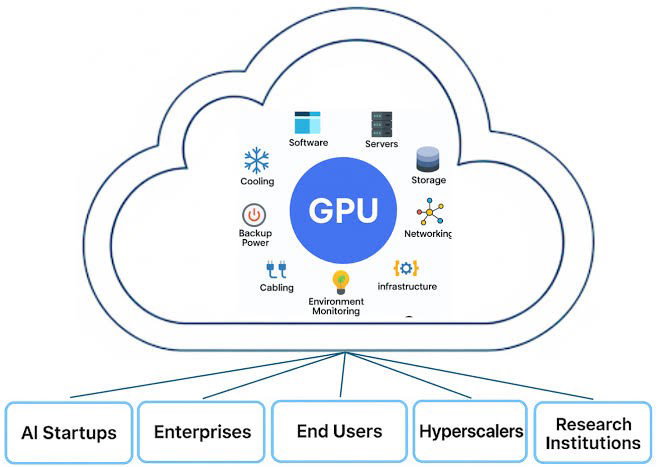
Traditional cloud environments were originally designed to support a broad range of workloads, including websites, databases, business applications, virtual machines, analytics, and storage. GPUs were later added to those environments as demand for accelerated computing grew.
A neocloud takes the opposite approach. Its architecture begins with the need for distributed GPU workloads and builds the surrounding compute, network, storage, cooling, orchestration, and observability layers accordingly.
This is why the term often appears alongside GPUaaS, although the two are not identical. GPUaaS describes a delivery model. Neocloud describes the broader type of cloud platform and the architecture supporting that model.
Understanding what a neocloud is also raises a bigger question: why did the cloud market need a more specialized model in the first place? The answer lies in how rapidly AI workloads began stretching the limits of general-purpose infrastructure.
Why Did Neoclouds Emerge?
The rise of generative AI changed the economics and engineering requirements of cloud infrastructure.
Modern AI workloads require enormous parallel compute. Large training jobs need GPUs to exchange data constantly, while production inference may need accelerators at unpredictable times. Buying enough hardware can require major capital investment, specialized facilities, and experienced teams.
GPU availability has also become a strategic concern. Organizations may need access to specific accelerator generations, large contiguous clusters, or dedicated capacity that is difficult to obtain quickly.
Neoclouds address that gap by concentrating investment on GPU density, cluster performance, networking, storage throughput, and AI software.
That focus leads directly to the defining characteristic of the model: GPU-first cloud architecture.
How Does Neocloud GPU-First Architecture Work?
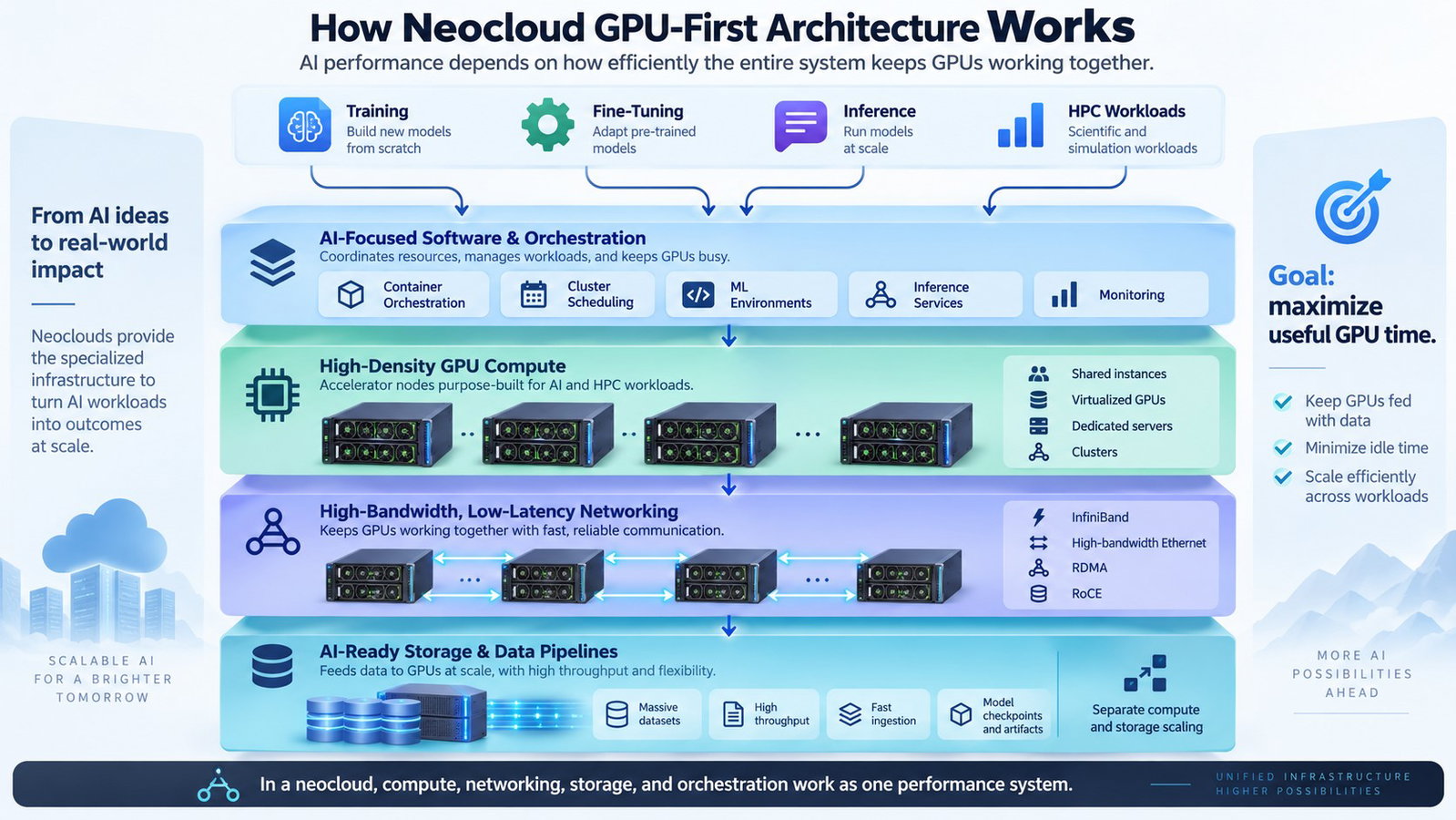
A GPU-first cloud is not simply a room filled with graphics processors. AI performance depends on how efficiently the entire system keeps those processors working together. The following functional segments explain it all:
-
High-Density GPU Compute
Neoclouds typically deploy servers containing multiple high-performance accelerators per node. Users may access shared instances, virtualized GPUs, dedicated servers, or entire clusters.
Bare-metal or minimally virtualized options can reduce infrastructure overhead and provide greater visibility into hardware topology. That matters for distributed training, where the placement of GPUs, CPUs, memory, and network interfaces can affect job performance.
For AI teams, the goal is not merely to secure GPU capacity. It is to maximize useful GPU time. -
High-Bandwidth, Low-Latency Networking
As AI models grow, networking becomes just as important as compute.
Distributed training divides work across many GPUs. Those accelerators repeatedly exchange parameters and synchronize progress. If the network is slow, congested, or inconsistent, expensive GPUs may spend time waiting instead of computing.
Neocloud GPU-first architecture therefore emphasizes high-speed fabrics, low-latency communication, and network designs optimized for heavy east-west traffic between servers. Technologies such as high-bandwidth Ethernet, InfiniBand, RDMA, and RoCE can help move data between nodes with less CPU involvement and lower latency.
The objective is simple: keep the cluster synchronized without making the network a bottleneck. -
AI-Ready Storage And Data Pipelines
GPUs cannot process data they cannot receive quickly enough.
Training pipelines may ingest massive datasets, feed them to compute clusters, write checkpoints, store model artifacts, and repeatedly access intermediate outputs. Storage therefore needs both capacity and throughput.
Neoclouds increasingly pair GPU infrastructure with high-performance object or file storage, fast data ingestion, and data pipeline tooling. Separating storage from compute can also allow each layer to scale according to workload demand rather than forcing customers to expand everything at once.
This is an important part of answering how GPU-first cloud architecture differs from traditional hyperscalers. The GPU, network, and storage layers are treated as one performance system rather than isolated infrastructure products. -
AI-Focused Software And Orchestration
Hardware is only useful when teams can deploy workloads onto it efficiently.
Neocloud platforms may provide container orchestration, cluster scheduling, preconfigured machine learning environments, inference services, monitoring, and tools for popular AI frameworks. Some are also moving into managed training, distributed inference, and developer platforms.
That software layer can reduce the operational friction involved in turning a large pool of GPUs into usable AI capacity.
The tightly integrated architecture explains how neoclouds keep GPU-heavy workloads running efficiently, but the next question is how businesses actually access that compute without owning the hardware themselves. That is where GPU-as-a-Service (GPUaaS) comes in.
What Is GPU-as-a-Service (GPUaaS)?
GPU-as-a-Service is a cloud consumption model that gives customers remote access to GPU compute on demand or through reserved capacity.
Instead of purchasing servers, networking equipment, data center space, power, and cooling, organizations rent the resources they need. Pricing can be hourly, per second, subscription-based, reserved for a fixed period, or tied to managed inference usage.
GPUaaS can be useful for teams with variable demand. A startup may need a large cluster during training but much less capacity between experiments, while an enterprise may need dedicated capacity for sustained inference.
By shifting some infrastructure spending from capital to operating expenditure, GPUaaS can lower the barrier to advanced AI. Cost efficiency still depends on utilization, data movement, storage, reservation terms, and operational effort.
That is why the benefits of a neocloud extend beyond the hourly price of a GPU.
What Are The Key Benefits Of A Neocloud?
The strongest neocloud key benefits come from specialization rather than sheer cloud breadth.
-
Faster Training And AI Workload Execution
Purpose-built networking, dense GPU clusters, and optimized data paths can reduce synchronization delays and improve job completion times. For large-scale training, even modest efficiency improvements can matter because every idle GPU represents expensive unused capacity.
-
Better GPU Utilization
Predictable networking and fewer noisy-neighbor effects can help keep accelerators busy. Higher utilization means organizations get more useful work from each GPU hour they purchase.
-
Access To Specialized Hardware
Neoclouds often compete by providing access to current or specialized accelerators and large GPU clusters. This can help teams expand capacity without waiting to build physical infrastructure themselves.
-
Flexible Capacity
On-demand, reserved, dedicated, and serverless models let organizations match infrastructure to different stages of the AI lifecycle. Experimentation can use elastic capacity, while stable production workloads may benefit from longer commitments.
-
Greater Infrastructure Visibility
Many neocloud environments expose more information about hardware topology and cluster configuration than highly abstracted general-purpose cloud services. Experienced AI infrastructure teams can use that visibility to tune distributed workloads more precisely.
-
Focused Cost Structure
Because neoclouds concentrate on accelerated computing, customers may avoid paying indirectly for a much broader platform they do not need. This does not automatically make every neocloud cheaper, but it can produce attractive economics for workloads dominated by GPU compute.
Together, these benefits explain why organizations evaluating AI infrastructure increasingly compare neocloud vs hyperscaler options rather than assuming every workload belongs to the same environment.
Neocloud Vs. Hyperscaler: What Is the Difference?
Both models provide cloud infrastructure, but their design priorities are different.
| Area | Neocloud | Hyperscaler |
| Primary focus | AI, GPU and HPC workloads | Broad enterprise and consumer cloud workloads |
| Compute design | GPU-first, often high-density | General-purpose with specialized GPU options |
| Service catalog | Focused | Extensive |
| Networking | Optimized for accelerator-to-accelerator traffic | Designed for many workload types |
| Infrastructure visibility | Often deeper | More abstracted |
| Geographic reach | Typically narrower | Usually extensive |
| Best fit | Training, fine-tuning, inference, HPC | Databases, applications, analytics, SaaS, global cloud platforms |
| Operating model | More infrastructure-oriented | Strong managed-service ecosystem |
So, how does GPU-first cloud architecture differ from traditional hyperscalers in practice?
A hyperscaler is designed to be a technology supermarket. It can provide compute, databases, identity, analytics, serverless functions, developer tools, content delivery, security services, and hundreds of other capabilities across many regions.
A neocloud is closer to a specialist performance provider. It invests heavily in making accelerated workloads run efficiently, even if its surrounding catalog is smaller.
Neither model is universally better. The distinction makes workload placement more important.
The comparison is only the starting point. Choosing a neocloud also means evaluating its cost, security, scalability, and operational fit.
What Should Businesses Consider Before Choosing A Neocloud?
Specialization brings advantages, but it also creates trade-offs.
First, organizations should evaluate geographic availability and data residency. Neoclouds may operate in fewer regions than hyperscalers, which can matter for regulated or latency-sensitive workloads.
Second, teams should calculate total cost rather than comparing GPU hourly rates alone. Storage, data transfer, networking, minimum commitments, utilization, support, and idle capacity can materially affect the final bill.
Topics For More Insights
Third, businesses need to examine security and compliance requirements. Sensitive training data and model weights require strong identity controls, segmentation, encryption, logging, resilience, and clear responsibility boundaries.
Fourth, operational expertise matters. Some neocloud services expose lower-level infrastructure controls precisely because advanced teams want that flexibility. Organizations that prefer heavily managed platforms may need additional skills or a provider offering more abstraction.
Finally, portability should remain part of the architecture. Containers, standard frameworks, consistent security policies, and well-designed data pipelines can make it easier to move workloads between neoclouds, hyperscalers, and on-premises environments as requirements change.
Once enterprises understand the practical considerations around cost, security, compliance, portability, and operational readiness, the next question is how the neocloud model itself may evolve as AI infrastructure demands continue to grow.
Where Does The Neocloud Model Go Next?
The neocloud market is likely to evolve beyond renting bare GPU servers.
As competition increases, infrastructure alone can become difficult to differentiate. Providers are therefore expanding upward into software, including training orchestration, inference platforms, observability, developer tooling, and industry-specific AI environments.
At the same time, the underlying infrastructure challenge is becoming more demanding. Larger models, multimodal AI, agentic systems, and high-volume inference increase pressure on networking, storage, power, cooling, and accelerator availability.

The result will likely be a more mature AI infrastructure ecosystem, with hyperscalers expanding accelerated computing, neoclouds deepening specialization, and enterprises distributing workloads across both.
Conclusion
A neocloud represents a shift from general-purpose cloud computing toward infrastructure built specifically for accelerated AI workloads.
Its defining feature is not simply access to GPUs. It is the combination of high-density compute, fast interconnects, AI-ready storage, workload orchestration, and flexible GPUaaS consumption models designed to keep expensive accelerators productive.
For organizations asking what is a neocloud, the most useful answer is therefore architectural: it is a cloud designed around AI compute rather than a traditional cloud with AI hardware added later.
The right choice between a neocloud vs hyperscaler depends on the workload. When training, fine-tuning, inference, or HPC performance dominates the requirement, a GPU-first platform can offer compelling advantages. When broad managed services, global reach, and integrated enterprise tooling matter more, hyperscalers remain difficult to replace.
For many businesses, the future will not be one cloud or the other. It will be using each where its architecture delivers the most value.
Frequently Asked Questions
How Do Neoclouds Improve GPU Utilization For Large-Scale AI Workloads?
Neoclouds improve GPU utilization by combining high-density accelerator clusters with low-latency networking, optimized storage pipelines, and workload-aware scheduling. This reduces idle time caused by data bottlenecks, communication delays, or poor resource placement, which is especially important during distributed AI training.
Can Enterprises Use Neoclouds Alongside Traditional Hyperscalers?
Yes. Many enterprises can use a hybrid or multicloud strategy where GPU-intensive workloads such as model training, fine-tuning, and inference run on neocloud infrastructure, while databases, identity services, analytics, and general-purpose applications remain with hyperscalers.
What Technical Factors Should Enterprises Evaluate Before Choosing A Neocloud Provider?
Enterprises should assess GPU availability, cluster topology, networking bandwidth, storage throughput, workload orchestration, data transfer costs, security controls, compliance coverage, geographic availability, and portability. Total cost should also account for utilization efficiency, reserved capacity terms, and operational overhead rather than GPU pricing alone.
Tue, Sep 22, 2026

Enjoyed what you've read so far? Great news - there's more to explore!
Stay up to date with the latest news, a vast collection of tech articles including introductory guides, product reviews, trends and more, thought-provoking interviews, hottest AI blogs and entertaining tech memes.
Plus, get access to branded insights such as informative white papers, intriguing case studies, in-depth reports, enlightening videos and exciting events and webinars from industry-leading global brands.
Dive into TechDogs' treasure trove today and Know Your World of technology!
Disclaimer - Reference to any specific product, software or entity does not constitute an endorsement or recommendation by TechDogs nor should any data or content published be relied upon. The views expressed by TechDogs' members and guests are their own and their appearance on our site does not imply an endorsement of them or any entity they represent. Views and opinions expressed by TechDogs' Authors are those of the Authors and do not necessarily reflect the view of TechDogs or any of its officials. While we aim to provide valuable and helpful information, some content on TechDogs' site may not have been thoroughly reviewed for every detail or aspect. We encourage users to verify any information independently where necessary.
Loading comments...