
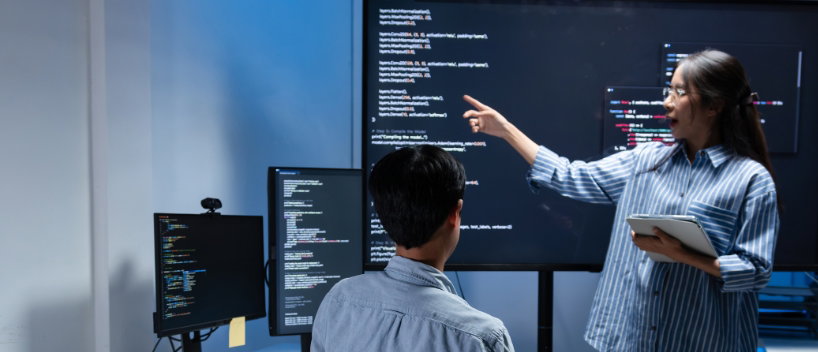

However, while AI beats human engineering capacity by an order of magnitude, vibe coding can hardly be deemed the magic cure for software delivery processes. Actually, it has thrown in a new layer of unprecedented problems that require a conceptually different operating model from AI-first software development teams.
What are “traditional” development teams?
In traditional custom software development services, developers manually write code line by line, make architectural decisions based on their acumen, and put the system to the test without AI in tow. Depending on the methodology and the project complexity, a traditional development team is made up of 5 to 9 tech experts, with each having pronounced ownership over a specific function or module.
The handoff between each team member is a structured process that fits into the bigger development workflow to make sure each element of the system can seamlessly integrate with each other.
What is vibe coding, and what vibe coding teams look like
Vibe coding workflow in its pure form is prompt-first, whereby developers, whether professional engineers or citizen developers, give natural language prompts to AI tools instead of writing code manually. Prompts act as specifications, breaking down the intent, behavior, and constraints of the system for AI.
Within this conversational loop, developers give in to the AI’s creative flow and have it generate code, tests, and even entire modules. Since most of the grunt work is taken over by AI tools, developers pitch in as orchestrators and coaches, steering the AI in the right direction of system requirements. Because of that, vibe coding teams tend to be lean, high-output squads of prompt engineers, reviewers, and integration leads.
Key differences between vibe coding teams and traditional development units
You can immediately see that those two take fundamentally different approaches to software development — and those differences echo in virtually every aspect of the SDLC.

In reality, the dichotomy between the two runs deeper than tech stacks, team SOPs, and development tools. It lies in the nature of the input and output — and the associated risks. Traditional development mandates teams to lead with a rigid blueprint and technical requirements, which are used to develop a perfectly predictable system, with each line of code being validated to the teeth.
Vibe coding is language- and vision-first, and it’s AI that throws a canvas around the user’s intent. And when AI calls the shots, the black box creeps into the very core of the software system.
Pros and cons of each approach
If we look closer at these two, both the conventional approach and vibe coding bring something to the developer’s table. Likewise, each comes with its trade-offs, which make them less or more adept at specific use cases.
Traditional approach to software development
With regular coding, things are more definite because developers know exactly how to marry each piece. So, the majority of benefits stem from the rigor:
-
High predictability
Programmers write the code step by step, so every component is designed, implemented, and validated with intent and a granular understanding of the greater architectural vision.
-
Full control and transparency
Since every component is built to rigid specs, hidden system behaviors are few and far between.
-
Pronounced architectural integrity
When it comes to human-built systems, nothing is random. Every design pattern, API, module, and naming convention is designed to play by the unified rules.
-
Clear ownership
With each developer having a distinct responsibility area, it’s easy to identify the breaking point when something goes awry.
-
Easier long-term maintenance
When developers know their way around the codebase, troubleshooting becomes a matter of tracing known logic, which makes upkeep and refactoring a more manageable process.
-
Slower velocity
As everything is built by hand, the output is capped by how fast the team can deliver.
-
Hard to scale output
If the team wants twice the number of features, they have to bring twice as many hands into the fold.
-
Process overhead
Handoffs, reviews, and other formal procedures run a tight ship, but oftentimes they might sap the team’s productivity.
-
Less room for experimentation
The team can’t just throw something together to crash-test it on the spot, because every new idea is subject to rigorous ideation, coding, and review cycles.
-
Higher cost of development
More developers, longer timelines, tooling, and coordination add up to the development cost.
Vibe coding
Although building on “vibes” gets a mixed bag of reactions and a lot of raised eyebrows from veteran devs, one can’t doubt that it can take builders places regardless of their tech background. Since individuals don’t need to get all nitty-gritty with the code, they can focus on other things, like innovation or higher-level architectural vision. Other pros of vibe coding include:
-
Erstwhile unimaginable development speed
AI can spit out code fast, so features and prototypes can be implemented at record speed.
-
High output with leaner teams
A squad of prompt engineers and reviewers can produce what would normally require an entire team of devs and tech experts.
-
Lower staffing costs
Since you need fewer developers for hands-on coding, vibe coding seems to be a budget-friendly option in terms of hiring.
-
Lower business risk
AI helps teams to spin up multiple concepts and ideas in one fell swoop and select the most fit option before heavy investment.
While vibe coding services allow for code creation without getting stuck in syntax and boilerplate, handing over the authority to the artificial intelligence and developing around AI’s hunch has its fair share of downsides. The main pitfalls and trade-offs behind vibe coding include:
-
Limited innovation ingenuity
Vibe coding tools draw upon what’s already been made before, so anything beyond scaffolding requires developers to babysit AI, which is impossible without hands-on, old-school developer experience.
-
The need for heavy context engineering
Poorly framed prompts can result in a build where changing a line of code breaks everything, and nothing works in tandem as it should.
-
Hidden behaviors and black boxes
Letting AI author code and modules without security and compliance guardrails in place is a surefire way to paper over slop-squatted packages, outdated libraries, and obscure API integrations.
-
Orchestration overhead
Professional vibe coding settings feature dozens of AI agents, which require teams to set up a solid infrastructure middleware to coordinate agent outputs, integration, testing, and review workflows.
Because of its probabilistic nature and inherent risks, vibe coding is quite limited in application, at least from the professional lens. That said, AI-powered tools can pick up the slack for updating project documentation or revamping software that runs on an outdated programming language. Also, vibe coding has become the go-to for MVP development, since it allows putting together a testable product version in 4-8 weeks instead of the usual 3 months.
Why full-on vibe coding is a mixed blessing
These days, AI-powered coding gets equally high marks from both non-technical users who want to build production apps and professional developers who bank on AI to handle “toil work”. However, while replacing experience with vision can be a great way of experimenting, deliberately betting your products on vibe coding is a shaky strategy.
AI can pick up vulnerabilities and slop from its training set
Generally, AI learns from a huge mix of code. Some of it may be good, but AI can also rehash insecure practices, outdated libraries, and even the output of vibe-coded models. Unless your AI-powered setup has built-in gates, strict access limitations, and a local deployment with isolated environments, AI’s feedback loop can pollute the datasets and undermine the infrastructure that powers software.
AI-generated code accelerates technical debt
At the very start, vibe coding tools can give builders a 100x productivity boost. But if not embedded into a calibrated engineering framework and without solid agent onboarding, AI will clog your pipelines with hard-to-maintain code once the codebase grows. In the end, you’ll be stuck trying to comprehend and debug the code that might be broken in ways you can’t even imagine.
The attack surface expands beyond traditional vectors
When code generation revolves around external context and natural language prompts, security measures extend far beyond firewalls around the codebase. Malicious input can creep into the model’s behavior through honeypot files, MCP instances, manipulative prompts, and legit-looking integrations, putting the entire system and the company’s data at risk. To avoid this doomsday scenario, builders have to compartmentalize everything that the model sees and remembers, including prompts, memory, and data sources.
Taking a hybrid approach might be a better way to roll
Instead of fixating on either, many software development teams are finding value in taking the best of both worlds. Vibe coding is a spectrum — and AI-assisted, spec-driven engineering with control, agent orchestration, and guardrails is the sweet spot that enables teams to use AI as a force multiplier without letting it freestyle into the deep end.
In practice, internalizing a hybrid approach that combines the strengths of both conventional coding and vibe coding requires companies to:
-
Embed established engineering standards that would help validate AI outputs
-
Adopt AI not as a standalone practice, but as a tool baked into existing pipelines, testing, and security practices
-
Apply orchestration, guardrails, and context engineering whenever AI is involved in the process
-
Keep critical systems and sensitive logic under human control
Conclusion
With vibe coding, much of the excitement stems from greenfield examples, like startups that can move fast and break things. For other companies and organizations with existing internal and external regulatory standards, security obligations, and operational dependencies, a pure-play AI-driven approach to software development may do more harm than good.
In high-stakes environments, the “vibe-but-verify” mindset is a much safer bet that allows teams to turbocharge their code generation with AI without taking its output at face value. Verification makes sure the code fits the company’s environment, passes compliance muster, and can be trusted.