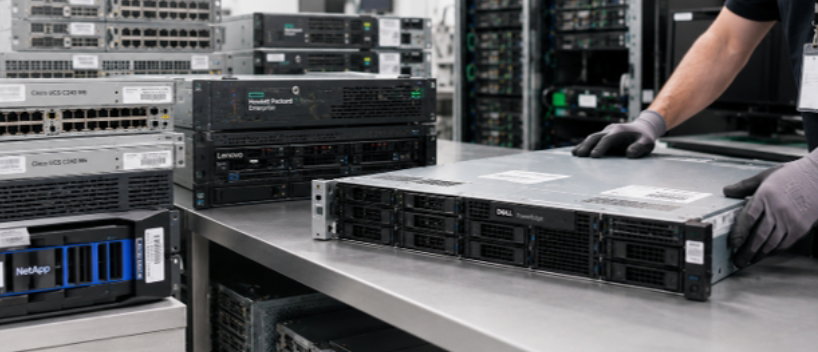

A decommissioned server can still contain customer records, admin credentials, financial data, system logs, or backup fragments after it leaves production.
The same applies to storage arrays, laptops, network equipment, and removable drives waiting for collection. These assets may no longer support live workloads, but they still need controlled handling, documented tracking, and verified sanitization before the organization can treat the risk as closed.
For enterprise teams, IT asset disposition is a compliance control. Once hardware leaves production without a documented process, the organization loses visibility over data-bearing equipment. That is why many organizations use an enterprise-grade ITAD provider to identify, track, sanitize, remarket, recycle, or destroy retired assets with verifiable documentation.
A decommissioned server may no longer appear in a monitoring dashboard, but its drives can still contain recoverable data. A storage system may be disconnected from the network, but still hold records from years of business activity. A router or switch may no longer be routing traffic, but stored configuration files can still reveal useful details about the environment.
The compliance problem begins when an organization loses visibility into the asset before it reaches final disposition.
That gap matters during audits, investigations, vendor reviews, and internal governance checks. Knowing that equipment was disposed of is not the same as knowing which assets were collected, who handled them, what data-bearing media was present, which sanitization method was used, and what happened afterward.
IBM’s 2025 Cost of a Data Breach Report reported a global average cost of USD 4.44 million per data breach. That figure does not mean every retired asset creates a breach. It does show why weak controls around sensitive data remain expensive when they fail.
Different assets require different sanitization methods. Some media can be cleared, some must be purged, and some should be physically destroyed, depending on the media type, data sensitivity, internal policy, and regulatory requirements. NIST SP 800-88 Rev. 1 is widely used because it frames sanitization around making data access infeasible for the level of risk involved.
A wipe is not a compliance program. A strong ITAD process should define how data-bearing assets are identified, handled, sanitized, or destroyed how exceptions are recorded; and what evidence is retained for audits, investigations, vendor reviews, or legal inquiries.
At enterprise scale, asset removal needs more than a pickup record. Teams need to know what left the facility, when it left, who received it, how it moved, how it was processed, and what final disposition was recorded.
Chain of custody connects the physical movement of assets to internal policy, supports serialized tracking, and creates a cleaner handoff between IT, procurement, facilities, security, and the external provider. It also reduces the familiar refresh-cycle problem where retired equipment sits between departments, and no one clearly owns the next step.
Retired assets can become a weak control point when the retirement process is treated as an afterthought.
ITAD risk is not only about data. Enterprise hardware also requires responsible disposition, as servers, storage arrays, networking equipment, laptops, and drives may contain components that can be reused, resold, recycled, or processed through approved recycling channels. If those assets are handled informally, the organization may lose visibility over both data-bearing equipment and the final destination of retired technology.
The World Health Organization reported that 62 million tonnes of e-waste were generated globally in 2022, while only 22.3 percent was documented as formally collected and recycled. For enterprises, the practical point is vendor governance. Responsible disposition gives the business a clearer record of where assets went, how they were processed, and whether the retirement process can be explained during procurement, sustainability, or internal compliance reviews.
Retired IT assets can still carry resale, reuse, parts, or recycling value. Servers, storage systems, networking equipment, and components may be worth recovering, but that value should not move outside the organization’s asset controls.
When equipment is valuable but unmanaged, it can sit in storage, move between departments, enter informal resale channels, or pass through vendors without enough oversight. A governed ITAD process gives the business a controlled route for inventory, assessment, sanitization, remarketing where appropriate, recycling where necessary, and final reporting.
Not every asset should be resold, and not every asset has meaningful residual value. Those decisions should be made through policy, documentation, and asset-level review, not informal judgment at the end of a refresh cycle.
The wrong ITAD provider can turn asset retirement into a compliance gap. A low pickup cost means little if the provider cannot document which assets were collected, how data-bearing media was handled, what sanitization method was used, and where each asset ended up.
Enterprise buyers should look for serialized asset tracking, a documented chain of custody, defined media sanitization procedures, final disposition reporting, and a clear separation among resale, reuse, recycling, and destruction paths. For data center projects, the provider must also manage larger volumes of assets without losing asset-level visibility.
ITAD provider selection is a risk-management decision. IT, procurement, security, compliance, and finance all need reliable records. A provider that cannot document the process does not reduce compliance risk. It only moves the risk outside the building.
Effective ITAD programs turn asset retirement into a controlled workflow. Assets are identified before removal, data-bearing media is handled according to policy, movement is tracked, disposition is documented, exceptions are recorded, and reports are retained.
That structure matters during infrastructure refreshes, office moves, data center consolidations, mergers, cloud migrations, and hardware upgrades. These projects already involve enough moving parts. Retired assets should not become the unmanaged final step where tracking weakens, data handling becomes unclear, and accountability disappears.
The right ITAD provider helps close the gap between active IT security and final asset disposition. The compliance value is not speed alone. It is the ability to show what happened to each asset, who handled it, how data-bearing media was addressed, and where the asset ultimately went.
The same applies to storage arrays, laptops, network equipment, and removable drives waiting for collection. These assets may no longer support live workloads, but they still need controlled handling, documented tracking, and verified sanitization before the organization can treat the risk as closed.
For enterprise teams, IT asset disposition is a compliance control. Once hardware leaves production without a documented process, the organization loses visibility over data-bearing equipment. That is why many organizations use an enterprise-grade ITAD provider to identify, track, sanitize, remarket, recycle, or destroy retired assets with verifiable documentation.
Retired Assets Still Carry Live Risk
A decommissioned server may no longer appear in a monitoring dashboard, but its drives can still contain recoverable data. A storage system may be disconnected from the network, but still hold records from years of business activity. A router or switch may no longer be routing traffic, but stored configuration files can still reveal useful details about the environment.
The compliance problem begins when an organization loses visibility into the asset before it reaches final disposition.
That gap matters during audits, investigations, vendor reviews, and internal governance checks. Knowing that equipment was disposed of is not the same as knowing which assets were collected, who handled them, what data-bearing media was present, which sanitization method was used, and what happened afterward.
IBM’s 2025 Cost of a Data Breach Report reported a global average cost of USD 4.44 million per data breach. That figure does not mean every retired asset creates a breach. It does show why weak controls around sensitive data remain expensive when they fail.
Data Sanitization Needs a Defined Standard
Different assets require different sanitization methods. Some media can be cleared, some must be purged, and some should be physically destroyed, depending on the media type, data sensitivity, internal policy, and regulatory requirements. NIST SP 800-88 Rev. 1 is widely used because it frames sanitization around making data access infeasible for the level of risk involved.
A wipe is not a compliance program. A strong ITAD process should define how data-bearing assets are identified, handled, sanitized, or destroyed how exceptions are recorded; and what evidence is retained for audits, investigations, vendor reviews, or legal inquiries.
Chain of Custody Turns Disposal Into Evidence
At enterprise scale, asset removal needs more than a pickup record. Teams need to know what left the facility, when it left, who received it, how it moved, how it was processed, and what final disposition was recorded.
Chain of custody connects the physical movement of assets to internal policy, supports serialized tracking, and creates a cleaner handoff between IT, procurement, facilities, security, and the external provider. It also reduces the familiar refresh-cycle problem where retired equipment sits between departments, and no one clearly owns the next step.
Retired assets can become a weak control point when the retirement process is treated as an afterthought.
Environmental Handling Also Affects Governance
ITAD risk is not only about data. Enterprise hardware also requires responsible disposition, as servers, storage arrays, networking equipment, laptops, and drives may contain components that can be reused, resold, recycled, or processed through approved recycling channels. If those assets are handled informally, the organization may lose visibility over both data-bearing equipment and the final destination of retired technology.
The World Health Organization reported that 62 million tonnes of e-waste were generated globally in 2022, while only 22.3 percent was documented as formally collected and recycled. For enterprises, the practical point is vendor governance. Responsible disposition gives the business a clearer record of where assets went, how they were processed, and whether the retirement process can be explained during procurement, sustainability, or internal compliance reviews.
Value Recovery Should Not Compromise Control
Retired IT assets can still carry resale, reuse, parts, or recycling value. Servers, storage systems, networking equipment, and components may be worth recovering, but that value should not move outside the organization’s asset controls.
When equipment is valuable but unmanaged, it can sit in storage, move between departments, enter informal resale channels, or pass through vendors without enough oversight. A governed ITAD process gives the business a controlled route for inventory, assessment, sanitization, remarketing where appropriate, recycling where necessary, and final reporting.
Not every asset should be resold, and not every asset has meaningful residual value. Those decisions should be made through policy, documentation, and asset-level review, not informal judgment at the end of a refresh cycle.
What Buyers Should Expect From an ITAD Provider
The wrong ITAD provider can turn asset retirement into a compliance gap. A low pickup cost means little if the provider cannot document which assets were collected, how data-bearing media was handled, what sanitization method was used, and where each asset ended up.
Enterprise buyers should look for serialized asset tracking, a documented chain of custody, defined media sanitization procedures, final disposition reporting, and a clear separation among resale, reuse, recycling, and destruction paths. For data center projects, the provider must also manage larger volumes of assets without losing asset-level visibility.
ITAD provider selection is a risk-management decision. IT, procurement, security, compliance, and finance all need reliable records. A provider that cannot document the process does not reduce compliance risk. It only moves the risk outside the building.
Compliance Improves When Asset Retirement Becomes Repeatable
Effective ITAD programs turn asset retirement into a controlled workflow. Assets are identified before removal, data-bearing media is handled according to policy, movement is tracked, disposition is documented, exceptions are recorded, and reports are retained.
That structure matters during infrastructure refreshes, office moves, data center consolidations, mergers, cloud migrations, and hardware upgrades. These projects already involve enough moving parts. Retired assets should not become the unmanaged final step where tracking weakens, data handling becomes unclear, and accountability disappears.
The right ITAD provider helps close the gap between active IT security and final asset disposition. The compliance value is not speed alone. It is the ability to show what happened to each asset, who handled it, how data-bearing media was addressed, and where the asset ultimately went.