
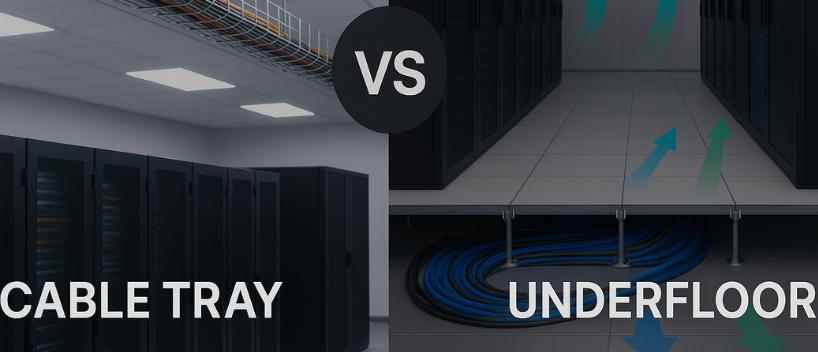

Data center managers now confront a major dilemma between overhead cable trays and underfloor pathways. Both alternatives have their benefits and difficulties, such as ease of installation and optimized airflow. Overhead trays and ladders make access easier and help structured wiring companies to set up the high-density cabling, with underfloor routes being able to be seamlessly incorporated with hot/cold aisle containment policies and CFD airflow models to maximize the cooling performance.
When you engage the services of established cable installation services as well as network installation services, you are assured that the infrastructure that you have in place will accommodate the future, reduce downtimes, and meet the seismic and safety requirements. In this guide, we will discuss how to make the right choice in your data center with the balance of airflow, maintenance, and technology needs.
Understanding Cable Pathways in Data Centers
Any contemporary data center depends on efficient cable management. The right cable pathway selection has implications for airflow, maintenance, and the entire performance of the system. Data center managers usually have to decide between overhead cable trays and underfloor systems, which are both advantageous in their own ways.
Cable Tray Systems
Cable tray systems have been a popular overhead cabling system used by cable installation companies and structured wiring companies. They are of different types, which include:
-
Ladder racks: Ideal for supporting heavy cables while allowing optimal airflow.
-
Wire baskets: Lightweight and flexible, perfect for dynamic installations.
-
Solid-bottom trays: Provide extra protection for sensitive cables in high-traffic areas.
The materials are usually steel, aluminum, or fiberglass, which provide durability and resistance to environmental conditions. Overhead tray systems are easily maintained and upgraded, and the technicians can access the cables very conveniently without causing any disturbance to the running of the business. In addition, they can be effectively used with hot/cold aisle containment strategies, offering adequate CFD airflow and minimizing cooling inefficiencies.
Underfloor Systems
Underfloor pathways are often found in older or refurbished data centers. These systems consist of:
-
Raised floors that ensure the plenum of cabling and cooling air.
-
Conduits and cable trays are installed under the floor.
Although this provides a clean and unobtrusive look, underfloor cabling must be planned carefully to prevent disturbances during the maintenance process. Installation of a network often requires consideration of seismic support, weight distribution, and effects on liquid cooling or other air flow strategies.
Finally, the decision to go overhead or underfloor is driven by the layout of your data center, cooling considerations, and long-term maintenance objectives. Reliability, scalability, and optimality are achieved with proper planning so that cable installation companies and IT teams can easily manage complex infrastructures.
Pros and Cons of Overhead Cable Trays
Modern-day data centers have adopted overhead cable trays that are popular, especially when dealing with cable installation companies or structured wiring companies that value efficiency and flexibility. The following is a more detailed examination of their strengths and weaknesses:
Pros
-
Accessibility
Network installation service teams can easily install, reroute, or upgrade cable without disturbing operations using overhead trays.
-
Airflow Efficiency
Overhead trays can help maintain a more effective hot/cold aisle containment, reduce obstruction by keeping cables off the floor, and enhance the airflow of CFD and the overall cooling.
-
Simplified Maintenance
When cables are laid over racks, troubleshooting, inspection, and upgrade are easier and safer, so that downtime is lessened.
-
Compatibility with Advanced Cooling
Overhead layouts are used in combination with liquid cooling systems to maintain the airflow routes.
-
Aesthetics
Uncovered cables can impact data center aesthetics.
-
Space Constraints
The height of the ceiling can prevent the installation of trays or further extension.
-
Structural Considerations
Overhead trays must be well supported through ladders or mounting structures, and they might be seismically braced where earthquakes occur.
Advantages of Underfloor Cable Management
In the planning of a contemporary data center, another decision that may influence the performance and the efficiency over time is the selection of the solutions of cable installation companies, including overhead trays or under-floor pathways. The underfloor cable management is another option that is in demand among institutions that want to have a clean, hidden, and efficient system.
Benefits of Underfloor Cable Management
-
Space Utilization
Underfloor systems use the plenum space below raised floors to provide more overhead space to install network services, e.g., lighting, fire suppression, and security. This is an effective utilization of space, resulting in a clutter-free environment that simplifies the process of structured layouts that can be adopted by structured wiring companies.
-
Cooling Efficiency
Underfloor air distribution systems are supported by underfloor pathways and are particularly significant in buildings that are based on hot/cold aisle containment. Airflow patterns are also optimized with fewer obstructions above the racks. Combined with CFD airflow simulation, underfloor cabling provides balanced cooling and also improves the performance of advanced cooling, such as liquid cooling.
-
Safety
Since cables are hidden in the raised floor, employees cannot experience the risks of tripping or unintentional damage. This provides a secure working environment, as well as safeguards mission-critical connections.
Considerations for Underfloor Pathways
-
Maintenance
The process of accessing cables may be complicated, contrary to overhead systems. Simple upgrades might require more time and effort when technicians have to remove heavy floor tiles during regular maintenance.
-
Seismic Concerns
Raised floors might not be the most suitable in earthquake-prone areas. The underfloor systems, in contrast to the overhead trays and ladders, which can be reinforced, present some risks in case seismic activity undermines the structural stability.
Comparative Analysis: Tray vs. Underfloor (Side-by-Side)
| Metric | Overhead / Tray / Ladder Systems | Underfloor / Raised Floor Pathways |
| Cooling / Airflow Efficiency (with hot/cold aisle containment) | Better airflow, no obstruction to CFD airflow models | May restrict airflow, challenging for hot/cold aisle containment |
| Initial Installation Cost | Moderate; cable installation companies prefer trays for faster deployment | Higher due to raised floor construction and structural needs |
| Maintenance & Accessibility | Easy cable tracing and structured wiring companies favor overhead trays | Harder to access; requires lifting tiles, increasing downtime |
| Flexibility & Scalability | Highly scalable; supports network installation services and rapid upgrades | Limited flexibility; reconfigurations are more complex |
| Seismic / Structural Considerations | Strong with ladders and seismic bracing options | Heavier load on the floor, potential seismic stability issues |
| Suitability with Liquid Cooling | Works well with liquid cooling, as airflow remains unobstructed | Risk of leaks spreading underfloor, affecting multiple systems |
| Risk of Obstructions (cables, debris) | Minimal; overhead trays avoid dust/debris accumulation | High, underfloor spaces can collect debris and block airflow |
Maintenance and Scalability: Pathway Longevity
Maintenance and scalability of your data center in the long term can either make or break your investment when you are planning paths to your data center. Cable installation companies, as well as structured wiring companies, have insisted that it is necessary to select a system that can be more accessible, reliable, and expandable in the future.
Overhead Systems
The overhead trays and ladders are easily visible and accessible. Due to the exposure of the cables over the racks, technicians are able to carry out network installation services without shutting down equipment or interfering with the routine activities. Airflow monitoring also becomes easier with regular checking, which is required through the application of cooling measures like hot/cold aisle containment, CFD airflow monitoring, and liquid cooling.
-
Easier Maintenance
Technicians are able to access cables without lifting floor tiles.
-
Scalability Built-In
Overhead systems make it simple to add or reroute cables as your data center grows.
-
Resilience
Effective seismic bracing enhances stability in the seismic-prone areas to safeguard the infrastructure and availability.
Underfloor Systems
Underfloor pathways, on the other hand, are usually preferred due to their clean appearance and space-saving property. Nevertheless, they may become problematic with the increase in facilities.
-
Maintenance Challenges
The floor panels would have to be lifted to obtain access, which may interfere with operations and airflow.
-
Scalability Limits
Future cabling expansion may be curtailed by the space available below raised floors.
-
Airflow Concerns
The lack of design will disrupt the cooling distribution, causing inefficiencies that will affect equipment life.
Making the Right Choice
However, the ideal solution is based on the priorities of the design of your data center: maintenance convenience, additional growth, seismic stability, or airflow optimization. By teaming up with professional cable installers, you are guaranteed that no matter which system you choose, overhead or underfloor, your system will be designed to handle the current load as well as the future scalability requirements.
Conclusion
Choosing between cable trays and underfloor pathways isn’t one-size-fits-all; it depends on your layout, cooling strategy, power density, and growth plans. The right choice balances airflow, hot/cold aisle containment, seismic stability, and long-term maintenance.