
Emerging Technology
Explore The World Of 3D Modelling Software
Share
Overview
Now that you’re back, think of all the objects you saw – from the pen-stand on your desk to the ergonomic mouse in your hand. All those things (and the hundred other things around you!) went through a design phase where they existed purely as digital models. These virtual models were thoroughly evaluated and tested before being put into production - that’s the norm for every single product now!
Naturally, there are several dedicated tools that help manufacturers and designers test the practicality and aesthetic of a new product before they invest thousands of dollars in prototyping and assembly. Not only manufacturing businesses but these tools are used by architects, artists, game developers, filmmakers and more!
Join us as we explore 3D Modeling Software – everything from its origins, working, application, types, future and more!
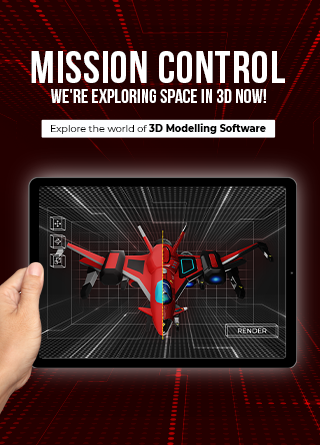
.png.aspx "TechDogs-\"Explore The World Of 3D Modelling Software\"-Mission Control We're Exploring Space In 3d Now!")
Most of the objects we interact with daily are three-dimensional, duh! Unless you’re one of those futuristic five-dimensional beings from Interstellar who created the space-time-gravity Tesseract! For us mortal beings, we’re here to talk about the dedicated tools that help us design and test 3D models of various products before physically rendering them. Yes, we’re talking about 3D Modeling Software!
This software provides the tools needed to create 3D models of a variety of things, whether for industrial or commercial purposes. It allows users to create, store and export finished models for rendering, as well as alter existing 3D models to save time and effort. Typical applications of 3D Modeling Software are seen in architectural designs, civil engineering, filmmaking and automobile designing. Let’s dive a little deeper to understand why!
Understanding 3D Modeling And Why We Need Software For It
3D modelling is a type of design that falls under the scope of Computer-Aided Design (CAD).
It is used to create a three-dimensional digital representation of any item using sophisticated software. These three-dimensional models are created with the help of CAD tools, commonly called 3D Modeling Software.
In addition to industrial and product design, these tools are used by artists, filmmakers and video game designers to render three-dimensional individuals, monsters, landscapes and fantasy objects – from Godzilla and Stuart Little to the alien landscapes in Avatar and characters in Lara Croft’s video game – everything was initially designed on 3D Modeling Software. Interesting, right?
Just like the graphics of Lara Croft: Tomb Raider video games, these tools have evolved considerably – let’s take a look!
Evolution And Origins Of 3D Modeling Software
Initially, technical drawings on sheets of paper were used to develop products – yes, the ol’ reliable pen and paper approach! Designers then transitioned from paper to digital models using Computer-Aided Design (CAD) software. This software mostly dealt with 2D shapes and was intended to reduce manual errors by introducing a more precise, measurable and accurate method of making technical drawings. CAD software soon evolved to help create accurate 3D designs.
Businesses today use the latest iteration of 3D modeling tools to design and digitally render products with precise dimensions. Here’s a brief timeline of the journey from paper to 3D Modeling Software –
-
3D design software was first developed in the 1960s by Ivan Sutherland (the father of computer graphics). He developed a primitive software called “Sketchpad” in 1961 that operated on TX-2 programmable computer at MIT.
-
By the 1970s, several companies had improved design software based on the users’ needs. Automated Drafting and Machining (ADAM), an automated design application, was developed in 1971 to be used on multiple systems simultaneously. #MultiTasking
-
After a decade, in 1981, IBM launched its first personal computer which led to the prevalent use of CAD software across the business landscape. Early adopters included the aerospace, automotive and engineering sectors.
-
In 1983, the world saw the launch of AutoCAD, a revolutionary 2D drafting tool – we mean, it’s still in use today and is one of the most well-known names in 3D modeling!
-
Then, in the 1990s, CAD software peaked as industries started making 3D Modeling Software the standard practice for designing products. (Fun fact: Adobe After Effects, a 3D Modeling Software released in 1993, received an Academy Award in 2019 for scientific and technical achievement!)
-
In 1995, SolidWorks, a 3D modeling CAD and CAE (computer-aided engineering) software was developed and launched at MIT. It is currently used by over 2 million people worldwide for designing!
Since then, 3D Modeling Software has grown to meet a wide range of demands and is now accessible on a variety of platforms, including PCs, laptops, desktops, tablets and even smartphones. What is it about the software, though, that makes it so valuable to businesses and designers?
The key is to understand how it works!
How Does 3D Modeling Software Work?

Well, 3D modeling isn’t that easy! However, 3D Modeling Software makes it a lot easier.
A 3D Modelling Software simply uses algorithms to manipulate points in virtual three-dimensional space. It creates shapes by joining a collection of these points. These shapes are then mapped onto a three-dimensional grid and connected to form polygonal forms, most often triangles (a process known as tessellation). As a result, a wide range of objects can be constructed using simple forms like triangles to complex high-polygon shapes. (A polygon is still essentially a triangle, or a group of triangles joined together to produce a more complicated shape.)
Manually creating 3D objects involves specifying and manipulating points on a 3D grid. However, models are sometimes also built automatically with the use of 3D scanners, which scan an existing physical model and generate a virtual model for it. We told you the software makes it easy!
Now, let’s take a look at the types of 3D Modeling Software.
What Are The Types Of 3D Modeling Software?
There are three primary types of 3D modeling (solid, wireframe and surface), which leads to three types of 3D Modeling Software –
-
Solid Modelling Software
is used to create simple three-dimensional objects. Here, solid shapes function as the basic building blocks, allowing users to add or remove material in blocks, based on their input. Solid modelling is relatively simple in terms of both complexity and computing power.
-
Wireframe Modelling Software
comes in handy when the design object is complicated and curved. Wireframe modelling gives the precision needed for more complicated forms at the cost of higher computational power, as solid modeling's building blocks are too simple for some designs.
-
Surface Modelling Software
is needed for industrial designs that demand smooth surfaces, precise proportions and a seamless interface with other designs. This necessitates advanced tools that use even more computer power but allow for the creation of shapes that would be impossible to produce with the other two tools.
Depending on the complexity of the object being designed and available computing resources, designers can choose one of the three 3D Modeling Software. Now, the question we have all been asking – what can the software design?
Read on to find out!
Who Uses 3D Modeling Software?
3D Modeling Software has limitless uses and can be leveraged by various businesses and domains for modeling purposes. However, here are some of the common applications that benefit from this software-
-
Filmmaking
This software is commonly used to create CGI (computer-generated imagery) characters, objects, environments, etc. for movies and commercials. Those incredible action sequences in Marvel movies and surreal worlds in sci-fi TV series would have been impossible without this tool!
-
Video Game Development
Another use is to render entire 3D visual components of video games, including characters’ faces, imaginary structures and even entire cityscapes!
-
Architecture Design
One of the most common applications of 3D Modeling Software is to create interactive renderings of buildings, floors, facades and structures before construction.
-
Engineering
As an all-encompassing field, this software is used to model engineering designs to help simulate the working and identify any potential issues before production begins.
We’re sure there are several other domains where this software is relied on, however, we want to move on to the most exciting aspect – the future of 3D Modeling Software!
What Does The Future Of 3D Modeling Software Look Like?

That’s how it looks…
The 3D Modeling Software of the future will improve on the biggest drawback of 3D modeling today – its low resolution. According to current technological trends, the resolution of 3D models will improve substantially, providing users with a more realistic experience. Another projected innovation is the use of 3D modeling in the healthcare business, with biotechnology companies working on creating 3D representations of human organs. Transplant organs, in particular, will be custom designed on 3D modeling tools to improve surgery results. What's more, 3D Modelling Software will easily interface with Augmented Reality and Virtual Reality applications, allowing users to create more intricate models and interact with them on a whole new level.
Conclusion
A 3D Modeling Software allows designers to explore more alternatives during the design process by assisting them in making revisions quickly and efficiently. Furthermore, too many resources are expended after manufacturing to uncover flawed designs and quality issues. 3D Modeling Software allows businesses to save significant resources by testing all conceivable scenarios before finalizing a design.
The importance of 3D Modeling Software cannot be understated! It helps designers, artists and innovators bring forth their ideas in a visual format and assists businesses by letting them visualize items before they hit the production line. As we like to say, if it can be designed, it can be produced!
Frequently Asked Questions
What is 3D Modeling Software, and why is it essential?
3D Modeling Software refers to specialized tools used to create digital representations of objects or environments in three dimensions. These software solutions are crucial for various industries, including architecture, engineering, filmmaking, and product design. They enable users to visualize and manipulate objects in a virtual space, facilitating the design and testing of products before physical production. By offering a range of tools for creating, modifying, and rendering 3D models, this software streamlines the design process and enhances creativity and efficiency.
How does 3D Modeling Software work?
3D Modeling Software utilizes algorithms to manipulate points in virtual three-dimensional space, creating shapes by connecting these points. These shapes are then mapped onto a three-dimensional grid and connected to form polygonal forms, typically triangles. Users can manually create 3D objects by specifying and manipulating points on a 3D grid, or utilize 3D scanners to generate virtual models from existing physical objects. The software simplifies the complex process of 3D modeling, making it accessible to a wide range of users, from artists to engineers.
What are the common types of 3D Modeling Software and their applications?
There are three primary types of 3D modeling software: solid modeling, wireframe modeling, and surface modeling. Solid modeling software is ideal for creating simple three-dimensional objects, while wireframe modeling is suited for complex designs with curved surfaces. Surface modeling software is used for industrial designs requiring smooth surfaces and precise proportions. These software solutions find applications across various industries, including filmmaking, video game development, architecture, and engineering. They are instrumental in creating CGI for movies, rendering video game environments, visualizing architectural designs, and simulating engineering models.
Tue, Jul 26, 2022

Enjoyed what you've read so far? Great news - there's more to explore!
Stay up to date with the latest news, a vast collection of tech articles including introductory guides, product reviews, trends and more, thought-provoking interviews, hottest AI blogs and entertaining tech memes.
Plus, get access to branded insights such as informative white papers, intriguing case studies, in-depth reports, enlightening videos and exciting events and webinars from industry-leading global brands.
Dive into TechDogs' treasure trove today and Know Your World of technology!
Disclaimer - Reference to any specific product, software or entity does not constitute an endorsement or recommendation by TechDogs nor should any data or content published be relied upon. The views expressed by TechDogs' members and guests are their own and their appearance on our site does not imply an endorsement of them or any entity they represent. Views and opinions expressed by TechDogs' Authors are those of the Authors and do not necessarily reflect the view of TechDogs or any of its officials. While we aim to provide valuable and helpful information, some content on TechDogs' site may not have been thoroughly reviewed for every detail or aspect. We encourage users to verify any information independently where necessary.
Loading comments...