
Cyber Security
WhatsApp Begins Beta Rollout Of Scam Alert To Flag Potential Fraud Messages
Updated on Thu, Aug 13, 2026
Share
WhatsApp has begun a limited beta rollout of Scam Alert, an optional security feature that uses an on-device machine learning model to identify potentially fraudulent messages from unknown contacts without sending message content to Meta for classification.
TL;DR
- WhatsApp's new Scam Alert scans incoming messages from non-contacts for patterns associated with scams.
- Classification happens entirely on the user's device, and messages are not automatically reported to WhatsApp or Meta.
- Users who receive an alert can block, report, continue the conversation, or mark the chat as trusted.
- The feature is currently available through a limited beta rollout.
Meta has shared an early technical overview of Scam Alert, which is designed to help WhatsApp users recognize suspicious messages while preserving the platform's end-to-end encryption protections.
The feature is optional. Once enabled, WhatsApp downloads a machine learning model directly to the user's device, where it analyzes incoming messages from people who are not saved as contacts.
The model looks for conversational structures and linguistic signals associated with known scams, based on patterns from scam conversations that users previously reported to WhatsApp.
How WhatsApp Scam Alert Works
If the on-device model determines that an incoming message is likely to be a scam attempt, WhatsApp displays a warning inside the conversation. The warning is visible only to the recipient and not to the person who sent the message.
Users can then choose to block or report the sender, ignore the warning and continue chatting, or mark the conversation as trusted if they believe the system made a mistake. Once marked as trusted, Scam Alert will remove the warning and stop flagging that particular chat.
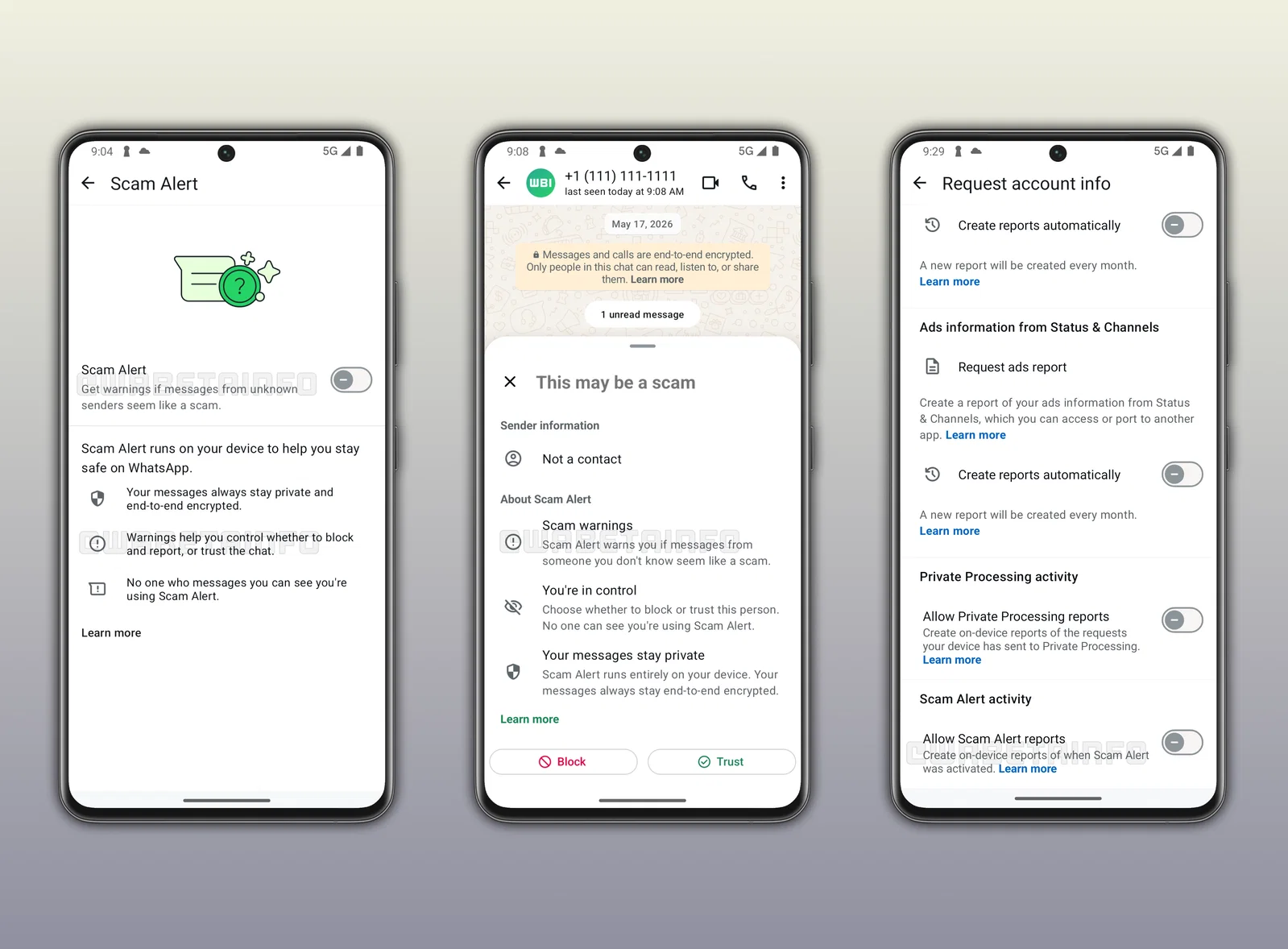
Users who mark a chat as trusted can also voluntarily share the last five received messages with WhatsApp to help improve Scam Alert's accuracy. Message sharing does not happen automatically.
Meta said, “No message content leaves the device for classification,” adding that the detection itself is not automatically reported to WhatsApp, Meta, or another party.
Topics For More Insights
WhatsApp Says Scam Detection Stays On The Device
Privacy is a central part of how the feature has been designed.
All Scam Alert inference takes place on the user's device. WhatsApp says it receives only anonymous, aggregated information needed to assess performance, such as approximate counts of warnings and the actions users take after receiving them.
Those metrics are processed through a confidential computing system and use differential privacy before aggregate information becomes available to Meta or WhatsApp. The company says individual device metrics are not readable by Meta, WhatsApp, or parties outside the protected processing environment.
Meta is also adding mechanisms intended to make the system independently verifiable. Every model version is recorded on a public transparency ledger, while security researchers can examine model weights to check that the models are built specifically for scam detection.
Users can also access Scam Alert activity information showing which messages were analyzed, whether a message was flagged and which model version was used.
WhatsApp Continues Its Crackdown On Scams
Scam Alert adds to WhatsApp's existing efforts to stop fraudulent activity on its platform.
In 2025, Meta said WhatsApp had removed more than 6.8 million accounts linked to criminal scam centers during the first six months of that year. The company also introduced protections designed to warn people about suspicious groups and other interactions involving unknown users.
Scam Alert expands that approach by examining the content of potentially suspicious messages locally rather than relying only on account or behavioral signals.
However, a warning does not necessarily mean that a message is fraudulent. Meta describes the system as probabilistic, meaning users will still have to decide whether to trust, block, or report the sender.
What Happens Next?
WhatsApp is currently making Scam Alert available through a limited beta rather than releasing it to all users.
The company says it will continue testing the feature with its Bug Bounty community and security researchers before making it broadly available. Meta has not provided a confirmed date for a wider production rollout.
For users who do receive access, the feature adds another layer of protection against scam messages while keeping the actual classification process on their phones.
First published on Thu, Aug 13, 2026

Liked what you read? That’s only the tip of the tech iceberg!
Explore our vast collection of tech articles including introductory guides, product reviews, trends and more, stay up to date with the latest news, relish thought-provoking interviews and the hottest AI blogs, and tickle your funny bone with hilarious tech memes!
Plus, get access to branded insights from industry-leading global brands through informative white papers, engaging case studies, in-depth reports, enlightening videos and exciting events and webinars.
Dive into TechDogs' treasure trove today and Know Your World of technology like never before!
Disclaimer - Reference to any specific product, software or entity does not constitute an endorsement or recommendation by TechDogs nor should any data or content published be relied upon. The views expressed by TechDogs' members and guests are their own and their appearance on our site does not imply an endorsement of them or any entity they represent. Views and opinions expressed by TechDogs' Authors are those of the Authors and do not necessarily reflect the view of TechDogs or any of its officials. While we aim to provide valuable and helpful information, some content on TechDogs' site may not have been thoroughly reviewed for every detail or aspect. We encourage users to verify any information independently where necessary.
Loading comments...