OpenAI has entered the physical hardware market, although not with the screenless AI companion many expected. Its first release is Codex Micro, a compact $230 control pad designed to help developers supervise and direct multiple Codex coding agents.
Created in collaboration with specialty keyboard maker Work Louder, the limited-run device connects OpenAI’s agentic coding software to dedicated keys, RGB status indicators, a joystick and a reasoning-level dial.
TL;DR
- OpenAI launched Codex Micro, a $230 programmable mechanical keypad built with Work Louder.
- Its illuminated Agent Keys display whether Codex agents are thinking, running, waiting or finished.
- Developers can trigger workflows, access common commands and adjust an agent’s reasoning level using physical controls.
- The limited-edition device is already listed as out of stock.
OpenAI’s First Hardware Product Is Built For Codex
OpenAI described Codex Micro as a “command center for agentic work,” giving users a physical interface for managing AI coding agents.
According to OpenAI, the device is formally named the kbd-1.0-codex-micro and is designed to keep active agent chats accessible while showing what individual agents are doing through live RGB feedback. It also allows developers to assign frequently used Codex actions to tactile controls.
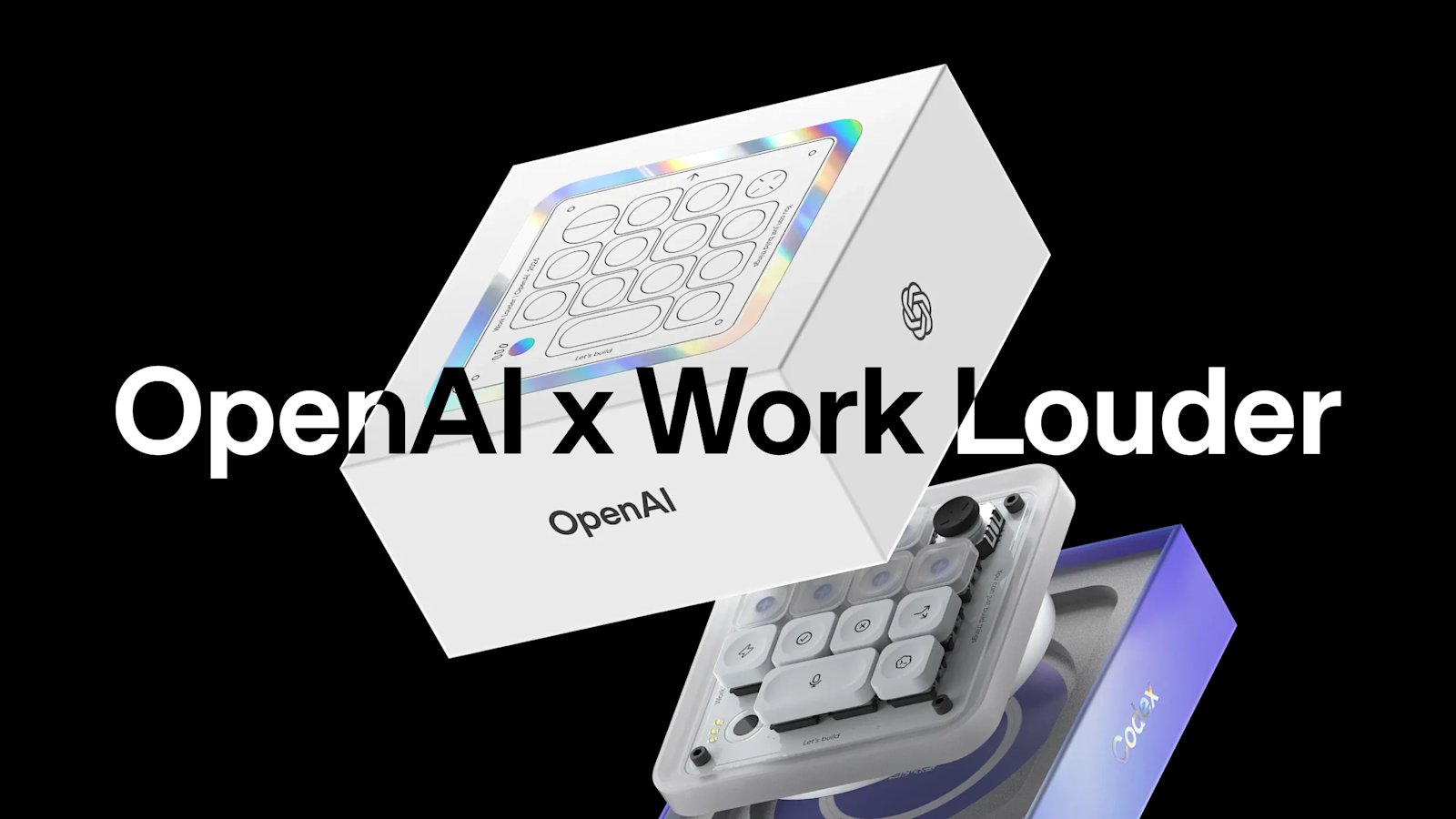
The Codex Micro features 13 mechanical switches, one touch sensor, a rotary encoder and a planar joystick. It supports Bluetooth and USB-C connections, works with Mac and Windows devices and integrates with ChatGPT Codex and Work Louder Input software.
OpenAI is offering clicky and silent switch options, while the package includes a Creator Micro control pad, a USB-C cable and a Codex icon keyset containing 32 additional keycaps. The company has priced the device at $230, although the official store currently marks it as out of stock.
What Can OpenAI’s Codex Micro Do?
The illuminated Agent Keys provide live status information for Codex agents. OpenAI says users can identify whether an agent is “thinking, running, waiting, or done” without switching between conversations.
Its joystick can launch common Codex workflows, including reviewing a pull request, debugging an error or refactoring code. Dedicated Command Keys can also be configured for actions such as accepting or rejecting changes, activating push-to-talk and opening a new conversation.
Perhaps its most unusual feature is the reasoning dial. Developers can rotate it to change the reasoning level assigned to a task, keeping processing lighter for simpler jobs or increasing it when a request requires more extensive analysis.
“Stay fast for simple tasks, or crank it up when the work calls for heavier thinking,” OpenAI said on the product page.
OpenAI told TechCrunch that Codex Micro is a limited-run collaboration, suggesting the product is closer to a specialist developer accessory than a mass-market hardware launch. TechCrunch characterized it as OpenAI’s formal entry into hardware, while Mashable and CNET similarly highlighted the unexpected nature of the release, given the wider anticipation surrounding OpenAI’s future consumer device plans.
Why Is OpenAI Turning Codex Into A Physical Workspace?
The launch reflects OpenAI’s wider attempt to position Codex as a command center for handling several AI agents simultaneously.
When OpenAI introduced the Codex desktop application in February 2026, it said developers were increasingly orchestrating multiple agents across projects, running tasks in parallel and supervising work that could continue for hours, days or weeks.
Topics for more insights:
OpenAI later expanded Codex to mobile devices, reporting in May 2026 that more than 4 million people were using the coding agent every week. The mobile experience allows users to monitor threads, approve commands, review outputs and redirect active work remotely.
Codex Micro brings that supervision model onto the desk. It may not be the transformative AI companion some consumers were anticipating, but it signals how OpenAI sees physical controls fitting into increasingly agent-driven software workflows.
