
Artificial Intelligence
New York City Bans AI In Schools For Students Through Eighth Grade
Updated on Thu, Sep 3, 2026
Share
New York City Public Schools is imposing a one-year moratorium on student-facing generative artificial intelligence for students from 2-K through eighth grade, affecting nearly 600,000 students during the 2026-27 school year. High school students will still get limited, supervised access to approved AI tools.
TL;DR
- Student-facing generative AI will be barred from grades 2-K through 8 for the 2026-27 school year.
- Nearly 600,000 students, around two-thirds of the school system, will be affected.
- High schoolers will get AI literacy classes and access to five approved pilot programs.
- NYC is also tightening screen-time rules and restricting how teachers can use AI.
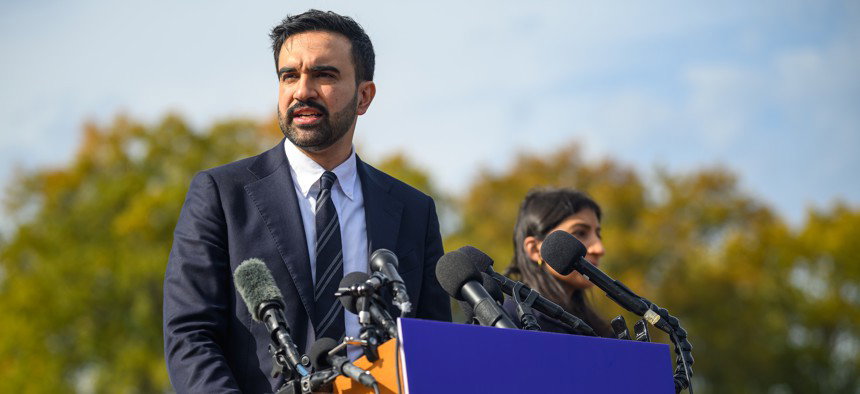
New York City Mayor Zohran Mamdani and Schools Chancellor Kamar Samuels announced the policy on September 2, introducing what city officials describe as the broadest student-facing generative AI moratorium in the United States.
Reuters reported that the move affects roughly 600,000 elementary and middle school students and represents one of the most restrictive AI policies adopted by a major US school district. New York City operates the country's largest public school system.
“Children need teachers and human connection in order to learn and grow,” Mamdani said while announcing the policy.
The mayor said younger students need opportunities to work through difficult problems themselves instead of immediately outsourcing the process to technology. Chancellor Samuels echoed that position, saying the administration believes “innovation does not mean more technology.”
What Does New York City's AI Moratorium Cover?
For the 2026-27 school year, student-facing generative AI software will not be permitted for students in grades 2-K through 8.
The Washington Post reported that AI functionality will also be disabled in more than 38 technology platforms previously available to students. If those AI components cannot be removed, the school district plans to stop using the affected software.
The Guardian reported that AI companion chatbots offering emotional or psychological support will be prohibited across all grades. DW similarly reported that the restriction covers companion chatbots throughout the school system, rather than only elementary and middle schools.
However, the restrictions contain accessibility exemptions. Students with disabilities and English Language Learners will retain access to necessary technologies, including tools required under Individualized Education Programs and 504 Plans.
High School Students Will Get Limited AI Access
Rather than completely removing generative AI from high schools, NYC Public Schools will allow limited and supervised use.
Five AI-related pilots have been approved for grades 9 through 12: Quill, Edia, Brisk Teaching, Playlab and Intel AI-Ready Schools. Students participating in career-readiness programs may also use approved AI tools under teacher supervision.
The city says the pilots could reach a maximum of 50,000 high school students, representing around 5% of the public school population.
All high school students will also be required to complete two 45-minute AI literacy modules covering subjects including how AI works, data privacy, bias, appropriate school use and the risks of overreliance on the technology.
The New York Times reported that the approach attempts to balance restrictions for younger children with controlled exposure for older students who are increasingly likely to encounter AI in higher education and the workplace.
NYC Also Tightens Screen Time And Teacher AI Rules
The AI moratorium is part of a wider technology policy that also limits individual screen use.
Students through second grade will have no routine one-to-one screen time, while the city recommends no more than 30 minutes per day for grades three through five and 45 minutes for grades six through eight. Teacher-led computer, tablet and smart-board use for group instruction can continue.
Teachers and school staff will also be permitted to continue using AI for instructional planning and operational work. However, NYC Public Schools says AI cannot be used for grading, behavior monitoring, placement, promotion, graduation or other decisions about students.
Not Everyone Thinks The Moratorium Goes Far Enough
The restrictions follow pressure from parents and education advocates who had pushed the city to adopt a two-year AI moratorium.
Topics for more insights:
The Washington Post and The New York Times reported that some campaigners remain concerned about exceptions in the policy and whether one school year will provide enough time to assess the educational effects of generative AI.
DW reported that United Federation of Teachers President Michael Mulgrew said the policy “leaves many questions unanswered,” particularly around safeguards for technology purchased and used by the school system.
The policy itself is not permanent. A new Technology in Schools Coalition consisting of students, educators, parents, elected officials, advocates, unions and experts will evaluate the restrictions and AI pilots during the school year, with recommendations expected in April 2027.
First published on Thu, Sep 3, 2026

Enjoyed what you've read so far? Great news - there's more to explore!
Stay up to date with the latest news, a vast collection of tech articles including introductory guides, product reviews, trends and more, thought-provoking interviews, hottest AI blogs and entertaining tech memes.
Plus, get access to branded insights such as informative white papers, intriguing case studies, in-depth reports, enlightening videos and exciting events and webinars from industry-leading global brands.
Dive into TechDogs' treasure trove today and Know Your World of technology!
Disclaimer - Reference to any specific product, software or entity does not constitute an endorsement or recommendation by TechDogs nor should any data or content published be relied upon. The views expressed by TechDogs' members and guests are their own and their appearance on our site does not imply an endorsement of them or any entity they represent. Views and opinions expressed by TechDogs' Authors are those of the Authors and do not necessarily reflect the view of TechDogs or any of its officials. While we aim to provide valuable and helpful information, some content on TechDogs' site may not have been thoroughly reviewed for every detail or aspect. We encourage users to verify any information independently where necessary.
Loading comments...