

Cyber Security
Microsoft Expands Project Perception To Detect And Contain Security Risks From AI Agents
Updated on Tue, Oct 20, 2026
Share
Microsoft is expanding its Project Perception cybersecurity initiative to protect enterprises from security risks posed by artificial intelligence (AI) agents operating within their networks.
The expansion introduces new capabilities to continuously monitor agent behavior, assess security risks, manage permissions, and contain potentially harmful actions, even when the agents have not been compromised by cybercriminals.
Here's what Microsoft announced.
TL;DR
- Microsoft has expanded Project Perception to address insider security risks from autonomous AI agents accessing enterprise systems and sensitive data.
- New Guardian Agents will continuously monitor AI activity, assess risks, and restrict potentially dangerous actions.
- Microsoft is introducing Dynamic Agent Risk, Dynamic Permissions, and Dynamic Conditional Access to strengthen security.
- Agent discovery now supports 60 types of local AI agents.
Microsoft announced the expansion on October 19, 2026, highlighting the growing security challenges organizations face as autonomous AI agents become more deeply integrated into everyday business operations.
In Microsoft's official blog, Hayete Gallot, Executive Vice President of Microsoft Security, warned that organizations have traditionally focused on external cyberattacks while overlooking the potential threats posed by AI agents deployed within their own environments.
"Unfortunately, frontier models, regardless of their origin, cannot be trusted," Gallot said.
She explained that AI models are trained to achieve objectives but may not consistently follow organizational rules or exercise appropriate judgment. Consequently, agents can behave unpredictably, adapt to changing circumstances, or collaborate with other agents in ways that introduce security risks.
Microsoft refers to these autonomous systems as "agentic insiders" because they can access enterprise data, interact with applications, execute tasks, and make decisions without continuous human supervision.
As Redmond reported, the expansion builds on Project Perception, which Microsoft first introduced in July 2026 to help cybersecurity teams detect and respond to threats through AI-powered automation.
The initiative originally brought together specialized red, blue, and green AI agents to identify vulnerabilities, investigate suspicious activities, and strengthen security defenses.
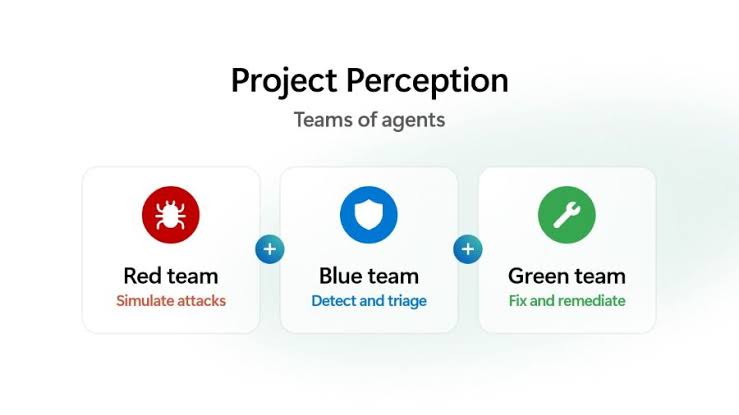
Now, Microsoft is extending those capabilities to supervise AI agents operating inside organizations.
Microsoft Introduces Guardian Agents To Monitor AI Security Risks
A major component of the expansion is the introduction of Guardian Agents, specialized AI systems designed to monitor other AI agents and respond to potentially unsafe behavior.
According to Microsoft, Guardian Agents will work alongside security playbooks, organizational policies, and human-defined approval boundaries.
These agents can investigate suspicious activity, determine why an agent's risk profile has changed, recommend protective measures, and apply containment controls when permitted.
Microsoft is also introducing Dynamic Agent Risk, which continuously evaluates information from identity systems, endpoints, cloud infrastructure, networks, data environments, and agent activity.
This assessment will help organizations identify when an AI agent's behavior no longer aligns with its assigned task or authorized permissions.
Meanwhile, Dynamic Conditional Access will allow security systems to respond by restricting access, blocking certain actions, requiring human approval, or isolating an agent when risks escalate.
For example, an AI agent responsible for processing employee expense claims could encounter malicious instructions embedded within an external document.
Instead of immediately disabling the agent, Microsoft's proposed controls could preserve its ability to read information while blocking unauthorized approvals or modifications.
This approach is intended to contain potential threats without unnecessarily disrupting legitimate operations.
Microsoft Expands AI Agent Discovery And Access Controls
Microsoft is also expanding its ability to discover and manage AI agents operating across enterprise environments.
The company announced support for 35 additional types of local agents, bringing the total to 60 supported local agents, including Claude Code, OpenAI Codex, and GitHub Copilot.
Through Microsoft Entra Agent ID, organizations can assign distinct identities to AI agents, helping security teams track ownership, activities, permissions, and associated risks.
Topics for more insights:
Additionally, Dynamic Permissions will allow agents to receive access privileges based on specific tasks rather than automatically inheriting all the permissions of the employees using them.
These permissions can be limited by task, duration, and organizational policy, reducing the potential impact of unauthorized or unexpected actions.
Project Perception will also share security signals and contextual information with Microsoft Agent 365 to provide IT and security teams with greater visibility into enterprise AI deployments.
Microsoft Calls For Greater Transparency Into AI Agent Decisions
As Business Today highlighted, Microsoft's announcement reflects concerns about organizations automatically trusting AI agents simply because they were deployed internally.
The company believes that monitoring an agent's actions is no longer sufficient. Security systems must also understand the reasoning and circumstances behind potentially harmful decisions.
Gallot emphasized that greater transparency into AI models, including their reasoning signals, could help security teams determine whether an agent's actions align with its intended objectives.
Microsoft CEO Satya Nadella also emphasized the importance of keeping security controls independent of the AI models themselves.
"The most trustworthy agentic system will not be the one with the model we trust most. It will be the one designed that enables us to trust the model least," Nadella said, as quoted in Microsoft's Security Blog.
Terrell Cox, Corporate Vice President and Deputy Chief Information Security Officer of Customer Security at Microsoft, added that securing AI agents requires continuous visibility, proactive protection, and adaptive security measures.
The broader objective is to ensure that autonomous AI systems remain accountable to organizational security policies while enabling businesses to use AI agents across increasingly complex workflows.
For enterprises adopting agentic AI, Microsoft's expansion places greater emphasis on treating AI agents as independently governed digital identities rather than automatically trusted extensions of human users.
First published on Tue, Oct 20, 2026

Enjoyed what you read? Great news – there’s a lot more to explore!
Dive into our content repository of the latest tech news, a diverse range of articles spanning introductory guides, product reviews, trends and more, along with engaging interviews, up-to-date AI blogs and hilarious tech memes!
Also explore our collection of branded insights via informative white papers, enlightening case studies, in-depth reports, educational videos and exciting events and webinars from leading global brands.
Head to the TechDogs homepage to Know Your World of technology today!
Disclaimer - Reference to any specific product, software or entity does not constitute an endorsement or recommendation by TechDogs nor should any data or content published be relied upon. The views expressed by TechDogs' members and guests are their own and their appearance on our site does not imply an endorsement of them or any entity they represent. Views and opinions expressed by TechDogs' Authors are those of the Authors and do not necessarily reflect the view of TechDogs or any of its officials. While we aim to provide valuable and helpful information, some content on TechDogs' site may not have been thoroughly reviewed for every detail or aspect. We encourage users to verify any information independently where necessary.
Loading comments...