
Meta is reportedly preparing to begin manufacturing a new custom artificial intelligence chip in September 2026, as the Facebook and Instagram parent accelerates plans to double its computing capacity to 14 gigawatts in 2027.
The chip, code-named Iris, forms part of Meta’s rapidly expanding Meta Training and Inference Accelerator portfolio. The move could help the company control infrastructure costs, deploy hardware optimized for its own workloads and reduce some of its dependence on external chipmakers.
TL;DR
- Meta reportedly plans to begin manufacturing its Iris AI chip in September 2026.
- The company aims to deploy 7 gigawatts of computing infrastructure in 2026 and double total capacity to 14 gigawatts in 2027.
- Iris was co-developed with Broadcom and will reportedly be manufactured by TSMC.
- The chip will supplement, rather than immediately replace, GPUs purchased from NVIDIA and AMD.
Meta’s Iris AI Chip Heads For Production
According to an internal memo reviewed by Reuters, Meta completed testing of Iris in around six weeks without identifying any major issues. The company reportedly plans to move the processor into manufacturing in September. Meta declined to comment on the production timeline.
Iris is expected to be part of a four-generation MTIA project designed internally by Meta, with Broadcom supporting chip design and Taiwan Semiconductor Manufacturing Company handling manufacturing.
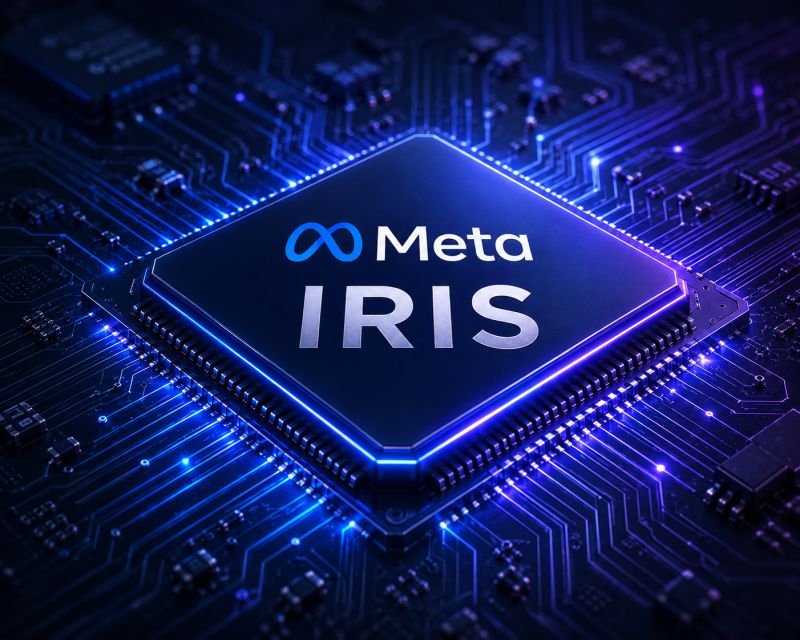
The chip is intended to power AI systems used across Meta’s platforms, including the ranking, recommendation and generative AI workloads behind Facebook and Instagram.
Meta already operates hundreds of thousands of MTIA processors across its infrastructure. The company officially outlined four newer generations in March, named MTIA 300, MTIA 400, MTIA 450 and MTIA 500.
MTIA 300 is already in production for ranking and recommendation training, while MTIA 400 has completed laboratory testing and is scheduled for deployment in Meta’s data centers. MTIA 450 and MTIA 500 are expected to focus heavily on generative AI inference and enter mass deployment during 2027.
Meta said the progression from MTIA 300 to MTIA 500 will increase high-bandwidth memory performance by 4.5 times and compute performance by 25 times.
The company is also targeting a much faster development cycle than the wider semiconductor industry, releasing a new custom processor roughly every six months instead of waiting one or two years between generations.
Meta And Broadcom Expand Their AI Silicon Partnership
Meta formally expanded its partnership with Broadcom in April 2026, covering processor design, advanced packaging and networking. The initial agreement includes more than one gigawatt of custom silicon deployment and is expected to expand into a multi-gigawatt rollout.
“Meta is partnering with Broadcom across chip design, packaging, and networking to build out the massive computing foundation we need to deliver personal superintelligence to billions of people,” said Meta founder and CEO Mark Zuckerberg.
“As we roll out more than 1GW of our custom silicon to start and then multiple gigawatts over time, this partnership will give us greater performance and efficiency for everything we’re building,” Zuckerberg added.
Meta Targets 14GW Of Computing Capacity
Meta reportedly plans to deploy 7 gigawatts of computing infrastructure during 2026. The internal memo said the company added 1 gigawatt during the first half of the year and expects to install another 5.5 gigawatts by year-end.
The company then plans to double total capacity to 14 gigawatts in 2027.
Meta could spend as much as $145 billion on AI infrastructure this year, while securing multi-year supply agreements for critical components. Reuters reported that these include memory chips from Samsung Electronics, flash storage from Sandisk and fiber-optic equipment from Sumitomo Electric.
Topics for more insights:
Iris will not eliminate Meta’s use of NVIDIA and AMD GPUs. Instead, it is expected to supplement commercial processors with hardware tailored to Meta’s own systems.
Still, custom silicon could give Meta greater control over performance, deployment schedules and long-term costs as AI infrastructure becomes one of the technology sector’s largest investment battlegrounds.
