
Regulatory Technology (RegTech)
McDonald's Sued Over Alleged AI-Powered Menu Price-Fixing Across US Franchises
Updated on Thu, Oct 8, 2026
Share
McDonald's is facing a proposed nationwide class-action lawsuit alleging that it used an artificial intelligence (AI) powered pricing system to coordinate menu prices across its US restaurants, potentially violating antitrust laws and causing customers to pay higher prices.
The lawsuit claims that the fast-food giant relied on confidential sales data and machine-learning algorithms to generate pricing recommendations for independently operated franchises. McDonald's has denied the allegations, maintaining that franchise owners independently determine menu prices.
TL;DR
- McDonald's faces a proposed nationwide class-action lawsuit filed on October 2, 2026, accusing it of using AI-powered tools to coordinate menu prices.
- The complaint alleges that confidential pricing and sales data from nearly 14,000 US restaurants influenced pricing recommendations.
- McDonald's denies fixing prices, saying its AI tools only provide optional recommendations.
- The plaintiff seeks damages and an order stopping the alleged anticompetitive practices.
McDonald's Accused Of Using AI To Coordinate Menu Prices
According to a Reuters report, the lawsuit was filed in the US District Court for the Northern District of Illinois by Michael Thomas, a resident of DeKalb, Illinois, who is seeking to represent potentially millions of McDonald's customers across the country.
The complaint alleges that McDonald's operated a centralized pricing system that uses machine-learning algorithms to analyze millions of daily transactions across its nearly 14,000 US restaurants.
Approximately 95% of these restaurants are independently owned and operated by franchisees, who are supposed to make their own menu pricing decisions.
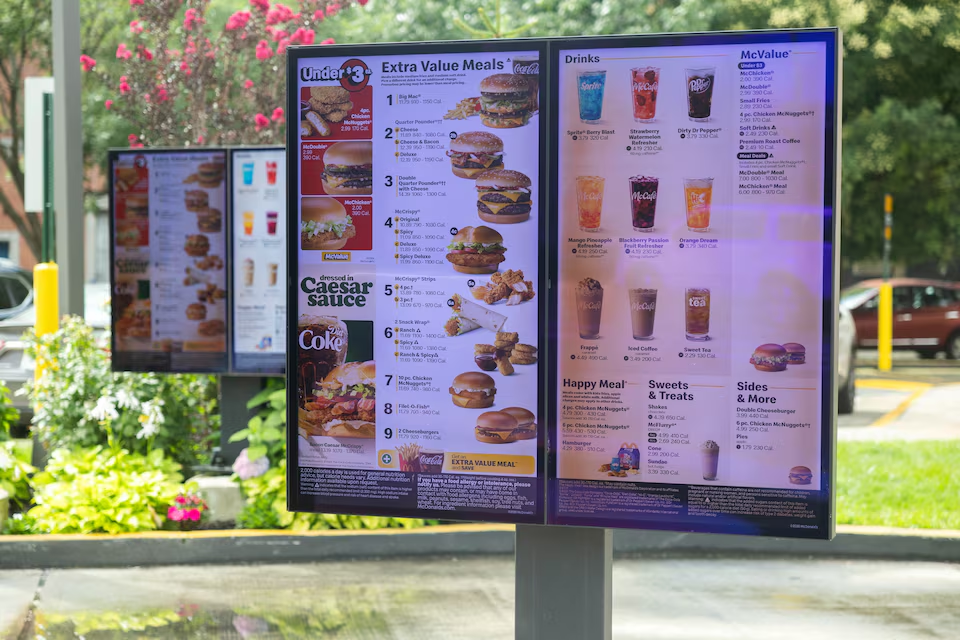
However, the lawsuit claims that McDonald's pricing engine uses confidential sales information from competing restaurants to generate price recommendations, potentially undermining competition between independently operated locations.
According to the complaint, the system has been operating since at least 2019 and uses nonpublic data to estimate how much customers at individual restaurants are willing to pay.
The lawsuit also alleges that McDonald's pressured franchisees to adopt its pricing recommendations and, beginning in January 2026, required franchisees to use company-approved pricing consultants and tools.
Furthermore, the filing claims that McDonald's monitors deviations from recommended prices and can use franchisees' compliance with company policies when evaluating restaurant renewals or expansion opportunities.
The allegations raise questions about whether independently owned businesses can use a centralized algorithm trained on competitors' confidential information without violating antitrust laws.
McDonald's Denies AI Sets Menu Prices
McDonald's has strongly rejected the allegations.
In a statement published recently, titled "Separating Fact from Fiction: AI Does Not Set Prices at McDonald's," the company clarified that its pricing recommendation technology does not automatically set, change, or determine menu prices for individual customers.
"AI does not set the price of a Big Mac or any other menu item," McDonald's said.
The company explained that its technology provides restaurant-specific pricing recommendations based on factors including local market conditions, competition, customer demand, and operating costs.
McDonald's also denied using dynamic pricing, which can involve changing prices in real time based on factors such as demand or customer behavior.
According to The Guardian's report, a McDonald's spokesperson said the complaint was "filled with inaccuracies" and that the company would vigorously defend itself.
"Optional tools are available to franchisees to help them make the best decisions for their businesses and customers, but these tools do not automate, coordinate or fix pricing in any way," the spokesperson added.
McDonald's maintains that franchisees remain responsible for deciding which recommendations to follow and what customers ultimately pay.
Lawsuit Raises Concerns Over AI Pricing And Rising Food Costs
The lawsuit comes amid growing scrutiny of how businesses use AI and algorithms to recommend prices.
According to The Guardian, McDonald's previously disclosed that its average menu prices increased approximately 40% between 2019 and 2024.
However, that increase does not independently establish that the company's AI pricing recommendations caused the higher prices or violated competition laws.
The complaint also references an $18 Big Mac meal sold at a Connecticut McDonald's restaurant in 2023, an incident that attracted attention over the company's pricing practices.
The plaintiff, Michael Thomas, reportedly noticed varying prices for the same McDonald's items at restaurants near his home in Illinois.
Topics for more insights:
Meanwhile, the lawsuit's broader allegation is that a common pricing engine using competitors' nonpublic information could reduce pricing competition, even when franchisees operate as separate businesses.
This distinction is important because the legal controversy is not simply about whether AI helps businesses recommend prices. It concerns whether shared confidential data and coordinated pricing practices could constitute an unlawful agreement between competitors.
Reuters noted that similar lawsuits have challenged algorithm-based pricing practices in industries including hotel accommodation and apartment rentals.
What Happens Next For McDonald's?
The proposed class action seeks monetary damages for affected customers and an injunction against the alleged anticompetitive practices.
The complaint brings claims under the federal Sherman Antitrust Act and Illinois laws, arguing that consumers paid more than they would have in a genuinely competitive market.
However, the allegations remain contested, and the filing of a lawsuit does not establish that McDonald's engaged in illegal price-fixing.
Whether the case proceeds as a nationwide class action will depend on further court proceedings.
For now, the case places McDonald's AI-assisted pricing practices under legal scrutiny and highlights a broader question for businesses adopting machine-learning technologies: where does data-driven pricing advice end and unlawful coordination between competitors begin?
First published on Thu, Oct 8, 2026

Enjoyed what you read? Great news – there’s a lot more to explore!
Dive into our content repository of the latest tech news, a diverse range of articles spanning introductory guides, product reviews, trends and more, along with engaging interviews, up-to-date AI blogs and hilarious tech memes!
Also explore our collection of branded insights via informative white papers, enlightening case studies, in-depth reports, educational videos and exciting events and webinars from leading global brands.
Head to the TechDogs homepage to Know Your World of technology today!
Disclaimer - Reference to any specific product, software or entity does not constitute an endorsement or recommendation by TechDogs nor should any data or content published be relied upon. The views expressed by TechDogs' members and guests are their own and their appearance on our site does not imply an endorsement of them or any entity they represent. Views and opinions expressed by TechDogs' Authors are those of the Authors and do not necessarily reflect the view of TechDogs or any of its officials. While we aim to provide valuable and helpful information, some content on TechDogs' site may not have been thoroughly reviewed for every detail or aspect. We encourage users to verify any information independently where necessary.
Loading comments...