
Automation
How AI And Automation Are Reshaping Fast-Food Chains
Share
TL;DR
-
Voice AI can shorten drive-thru service, but customization errors still require employee intervention.
-
Smart kitchen display systems route orders, prioritize preparation, and replace error-prone paper tickets.
-
Machine learning forecasts demand using sales, weather, promotions, events, and time-of-day data.
-
Chipotle, Wendy’s, McDonald’s, Wingstop, and Yum! Brands show how chains are testing specialized automation.
-
Intouch Insight found AI-enabled lanes averaged 3 minutes 53 seconds, yet accuracy trailed conventional lanes at 83% versus 87%.
Introduction
In The Bear, one delayed ticket can turn a kitchen into a pressure cooker. A quick-service restaurant (QSR) faces the same problem at industrial scale: drive-thru orders, app purchases, delivery requests, kitchen timing, staffing, and inventory must move together across hundreds or thousands of locations.
That explains why fast-food artificial intelligence is moving beyond novelty chatbots. The US restaurant industry is projected to generate $1.55 trillion in sales in 2026 while operators continue seeking technology that improves productivity and guest connections.
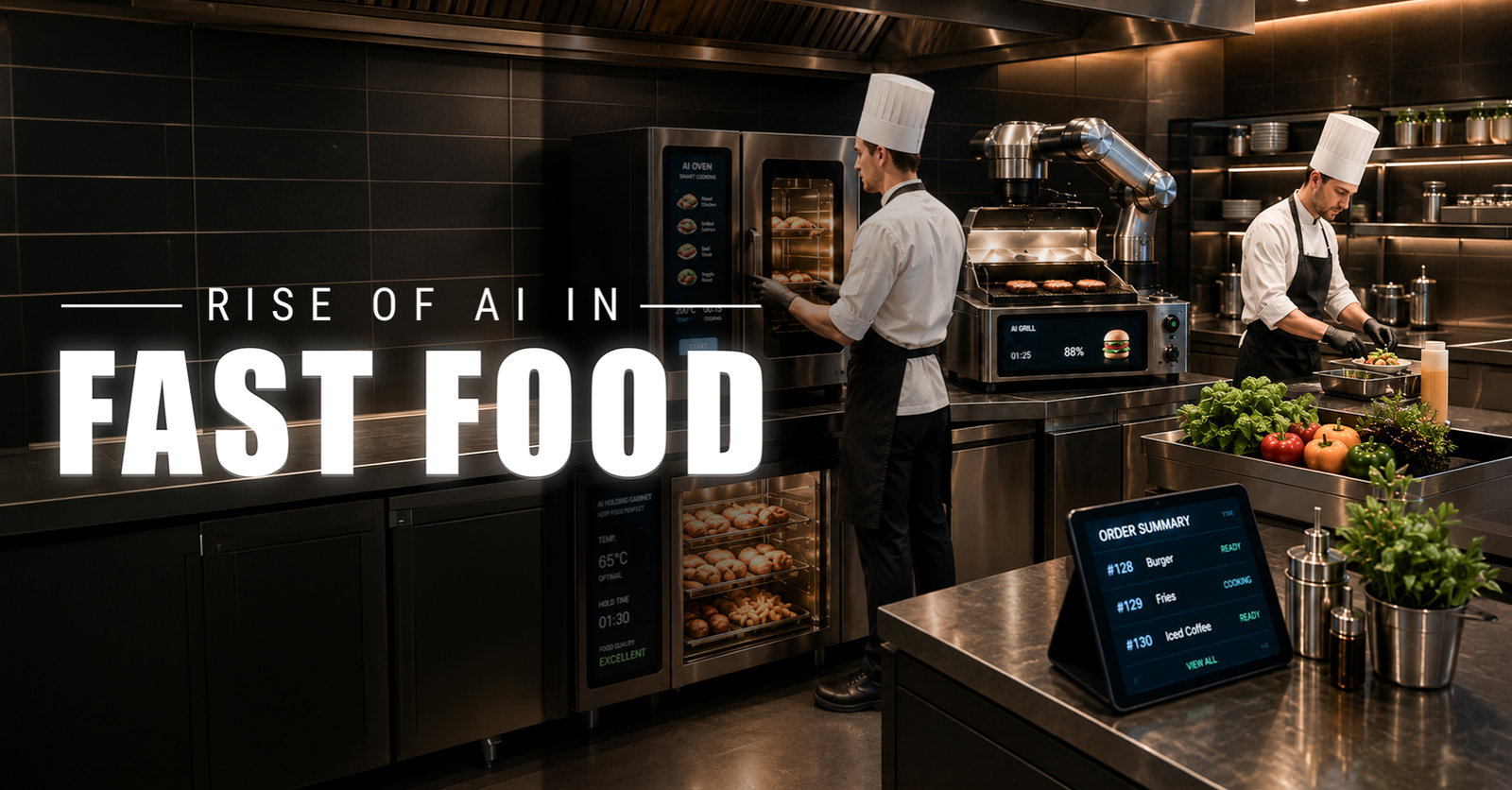
AI in fast food chains is increasingly being used to predict demand, sequence orders, check accuracy, guide employees, and automate repetitive preparation. The goal is not a robot-only restaurant. It is a faster operation where fewer mistakes travel from the speaker box to the pickup window.
What Does Fast Food Artificial Intelligence Actually Mean?
Fast food automation is often discussed as though every screen and robot is AI. They are not the same.
A digital point-of-sale system records an order. Automation sends that order to the correct station. Artificial Intelligence (AI) and Machine Learning (ML) add prediction or adaptation, such as estimating demand, understanding speech, identifying a missing item, or changing preparation priorities.
This distinction matters because a smart kitchen is usually a connected stack rather than one futuristic machine:
-
Digital systems capture orders from counters, kiosks, apps, and delivery platforms.
-
Automation routes tasks, updates order status, and controls repeatable equipment.
-
AI and ML forecast demand, interpret language, detect patterns, and recommend actions.
-
Employees manage exceptions, food quality, safety, and hospitality.
AI automation in fast food chain environments works best when these layers share reliable data. A clever model cannot repair an outdated point-of-sale system, inconsistent menu data, or a kitchen screen that crews cannot use during a rush.
How Is AI Currently Being Used In Fast Food Drive-Thru?
The clearest customer-facing example is voice ordering. Wendy’s says FreshAI expanded beyond its initial two-state pilot, processes tens of thousands of orders daily, and uses Google Cloud language models to handle customized requests.
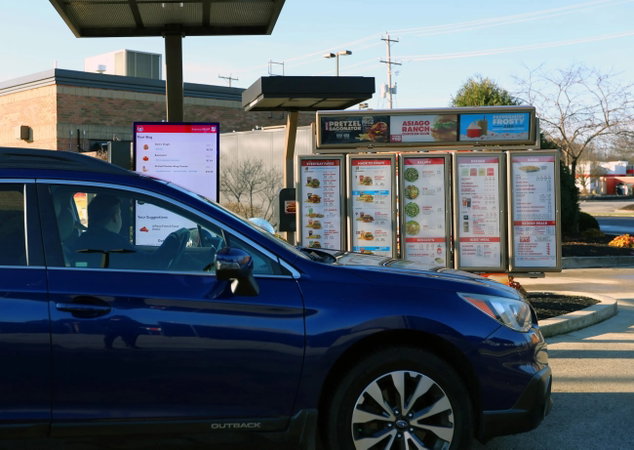
Yum! Brands has also piloted voice agents, computer vision, and restaurant analytics at Taco Bell and Pizza Hut while announcing a broader program targeting 500 restaurants across its brands.
The appeal is straightforward. An AI fast food drive-thru system can take orders consistently, suggest add-ons, support multiple languages, and free employees to prepare food or resolve customer issues.
However, current performance supports a hybrid model. Intouch Insight’s 2025 study of 120 AI-enabled orders found that voice AI reduced service time to 3 minutes 53 seconds from a 4-minute 15-second average. Accuracy was lower at 83% versus 87% in conventional lanes, mainly because of customizations. When employees intervened, accuracy rose to 95%.
Sarah Beckett, Vice President of Sales and Marketing at Intouch Insight, captured the shift: “The drive-thru is no longer just about speed. It has evolved into a digital fulfillment hub.”
Inside The Smart Kitchen: From Display Systems To Cobots
The more consequential change may be happening behind the counter. Smart kitchen display systems replace paper tickets with real-time screens connected to the point-of-sale system. They route items to the correct station, show modifications, track elapsed time, and coordinate dine-in, drive-thru, mobile, and delivery orders.
Machine learning can make those displays more useful by forecasting incoming demand and changing production priorities. Wingstop’s Smart Kitchen, presented during a 2025 investor demonstration, reportedly used more than 100 data points to predict demand in 15-minute intervals. The company said test locations cut average fulfillment time from roughly 20 minutes to about 10 minutes.
Physical automation is becoming more task-specific too. Chipotle’s Autocado prototype cuts, cores, and peels an avocado in about 26 seconds before employees mash it by hand.
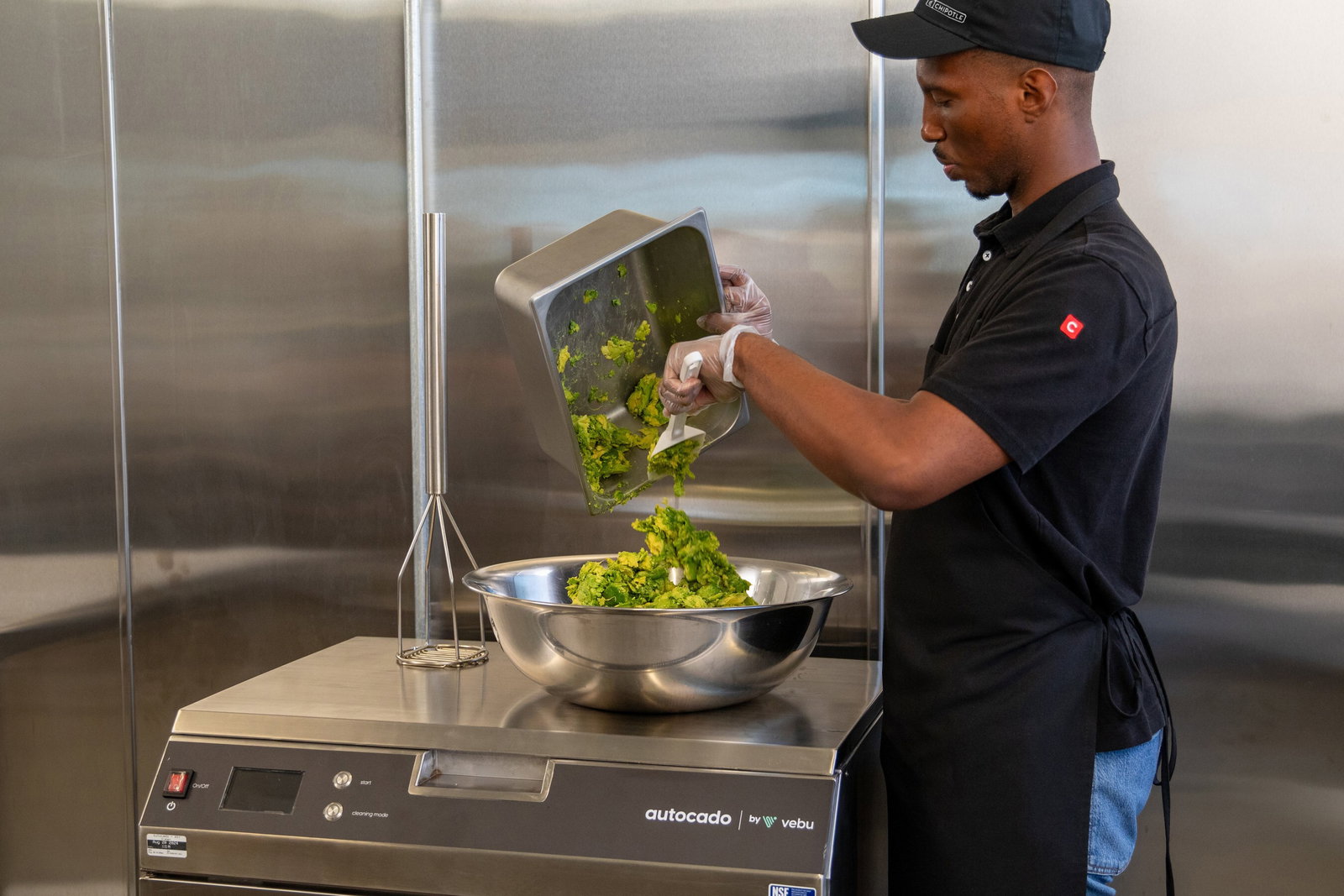
Its Augmented Makeline builds digital bowls and salads, which represented about 65% of Chipotle’s digital orders when the system entered restaurant testing.
These examples reveal the practical direction of AI in the QSR industry. Chains are automating narrow, repetitive bottlenecks rather than attempting to replace an entire kitchen crew.
What Is The Role Of Machine Learning In QSR Operations?
The role of machine learning in QSR operations is to turn historical and live data into better short-term decisions.
Demand models can combine previous sales with weather, holidays, promotions, nearby events, and time of day to estimate what customers will order. Kitchens can prepare the right quantity earlier, reduce stockouts, and avoid cooking excess food. Similar models can estimate pickup times, recommend staffing levels, identify equipment anomalies, and personalize app offers.
McDonald’s illustrates how this intelligence depends on infrastructure. Its Google-developed Restaurant Platform Edge was live in hundreds of US restaurants by August 2025, creating a foundation for AI and Internet of Things-enabled kitchens. The company also deployed AI-powered Accuracy Scales across thousands of restaurants in 12 markets to compare an order’s expected and actual weight and flag possible missing items.
The valuable output is not a prediction alone. It is an operational action delivered early enough for a manager or employee to use it.
QSR AI Automation Trends Still Face A Reality Check
The biggest QSR AI automation trends point toward connected platforms, specialized robots, computer vision, and employee assistants. The strongest deployments solve a measurable problem, integrate with existing workflows, and allow a person to take over quickly.
Failures usually begin when chains automate a visible interaction before fixing the systems underneath it. McDonald’s ended its IBM drive-thru voice pilot in 2024 after testing the technology at selected restaurants since 2021. The decision showed that brand scale cannot compensate for inconsistent speech recognition or weak order accuracy.
Privacy, cybersecurity, biased speech recognition, equipment downtime, and employee surveillance also require clear limits. A system listening to orders or analyzing camera feeds needs defined data-retention rules, restricted access, and a transparent process for handling errors.
There is also a labor nuance. Automation may remove tasks such as repetitive order entry or ingredient preparation, but the National Restaurant Association still expects the industry to add approximately 100,000 jobs in 2026. That does not eliminate displacement concerns. It suggests the near-term contest is less “people versus robots” and more about which chains redesign work without damaging service.
Conclusion
AI and automation are reshaping fast food chains by connecting the drive-thru, kitchen, inventory, and workforce into one responsive operation. The best systems do not chase science-fiction autonomy. They shorten queues, catch missing items, forecast demand, and remove repetitive friction while employees handle judgment and hospitality.
In other words, the winning smart kitchen will not turn The Bear into The Terminator. It will keep the rush from becoming chaos and give the people inside a better chance to deliver speed, accuracy, and a meal worth returning for.
Frequently Asked Questions
Can Small Fast-Food Chains Use AI And Automation?
Yes. Smaller chains can adopt cloud-based ordering tools, demand forecasting software, smart kitchen display systems, and automated inventory platforms without investing in expensive robots. The best approach is to begin with one measurable problem, such as reducing wait times, food waste, or order errors.
Will AI Completely Replace Fast Food Employees?
AI is more likely to change restaurant jobs than eliminate every role. Automated systems can handle repetitive tasks, while employees continue managing food quality, customer service, unusual requests, equipment issues, and situations requiring judgment.
How Can Fast Food Chains Measure The Success Of AI?
Chains can compare performance before and after deployment using metrics such as order accuracy, drive-thru time, food waste, labor productivity, equipment downtime, customer satisfaction, and average order value. The technology should deliver measurable improvements rather than simply add another operating cost.
Thu, Aug 13, 2026

Enjoyed what you've read so far? Great news - there's more to explore!
Stay up to date with the latest news, a vast collection of tech articles including introductory guides, product reviews, trends and more, thought-provoking interviews, hottest AI blogs and entertaining tech memes.
Plus, get access to branded insights such as informative white papers, intriguing case studies, in-depth reports, enlightening videos and exciting events and webinars from industry-leading global brands.
Dive into TechDogs' treasure trove today and Know Your World of technology!
Disclaimer - Reference to any specific product, software or entity does not constitute an endorsement or recommendation by TechDogs nor should any data or content published be relied upon. The views expressed by TechDogs' members and guests are their own and their appearance on our site does not imply an endorsement of them or any entity they represent. Views and opinions expressed by TechDogs' Authors are those of the Authors and do not necessarily reflect the view of TechDogs or any of its officials. While we aim to provide valuable and helpful information, some content on TechDogs' site may not have been thoroughly reviewed for every detail or aspect. We encourage users to verify any information independently where necessary.
Loading comments...