
Manufacturing Technology
Huawei’s New Headlights Can Project Movies, Live Sports & Navigation Cues
Updated on Mon, May 4, 2026
Share
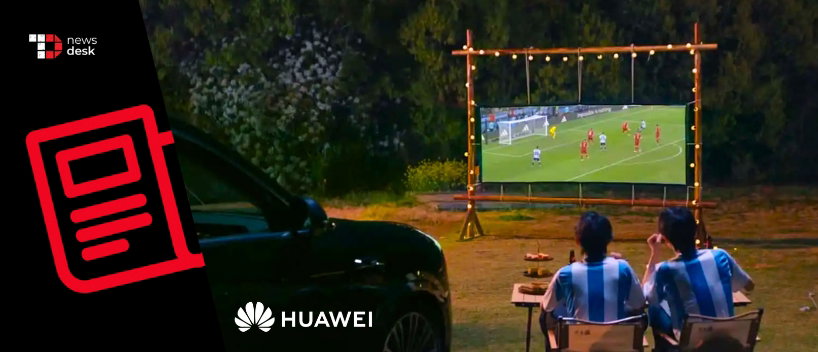
Users can project movies, video clips, and even live sports onto nearby walls or flat surfaces.
TL;DR
- Huawei’s XPixel headlights can project full-color movies, games, and navigation cues
- Tech integrates with driver assistance for safety and guidance
- Debuts in Aito M9 and other upcoming EVs
- Highlights China’s rapid EV innovation lead over global markets
Huawei Turns EV Headlights Into Full-Color Entertainment And Utility Systems
At the Beijing Auto Show, Huawei demonstrated how car headlights are evolving far beyond illumination. Its latest XPixel technology can project movies, video clips, and even live sports onto nearby walls or flat surfaces, effectively transforming a parked vehicle into a mobile outdoor theater.
The system supports full-color projection, marking a significant upgrade from earlier iterations that were more limited in visual capability. Designed primarily for use when the car is stationary, it enables users to create shared entertainment experiences during gatherings or outdoor events.
Huawei’s push into this space reflects a broader shift where electric vehicles (EVs) are no longer defined just by range or battery efficiency. Instead, they are becoming immersive digital platforms that merge lifestyle and mobility.

XPixel Technology Integrates Navigation, Gaming, And Real-Time Assistance
Beyond entertainment, Huawei’s XPixel system introduces practical, real-world applications. The headlights can project turn-by-turn navigation arrows directly onto the road, helping drivers follow routes without relying solely on dashboard displays.
The system also enables interactive features such as projecting games like hopscotch onto pavement when the vehicle is parked. This adds a layer of engagement, particularly for families, while showcasing how automotive interfaces are expanding into physical environments.
Notably, the technology ties into the vehicle’s driver assistance systems. It can guide lane changes by displaying directional paths, and even assist pedestrians by signaling safe crossing cues. These integrations highlight how projection-based interfaces could reduce cognitive load for drivers while improving situational awareness.
Safety Features Extend Into Low-Visibility Driving Conditions
Huawei is positioning XPixel as more than a novelty feature by embedding safety enhancements into the system. The headlights can highlight lane markings, illuminate pedestrian crossings, and display speed limits in challenging conditions such as fog or heavy rain.
Additionally, the broader ecosystem includes advanced LiDAR sensors capable of detecting small obstacles, along with improved traction control systems for difficult terrains like snow. Together, these features aim to enhance driver confidence and reduce risks in unpredictable environments.
The technology is expected to debut in upcoming models including the Aito M9, with further rollout planned across vehicles such as the Qinjing GT7 and Luxeed V9.
Chinese EV Innovation Signals A Shift In Global Automotive Leadership
Huawei’s advancements underscore a wider trend in the global EV market. Chinese automakers are rapidly pushing boundaries by integrating cutting-edge technologies at a faster pace than many Western counterparts.
This momentum is particularly evident in areas like smart lighting, autonomous features, and user experience design. As the world’s largest EV market, China continues to set new benchmarks that are likely to influence the future direction of mobility worldwide.
Topics For More Insights
US Comparison: Adaptive Headlights Still Catching Up
While Huawei and other Chinese manufacturers are experimenting with full-color projection systems, the United States is still in the early stages of adopting adaptive headlight technologies.
Recent regulatory updates have allowed headlights to adjust brightness and beam patterns to avoid blinding oncoming drivers, but they remain limited to functional lighting improvements. Compared to projection-based systems capable of entertainment and real-time road interaction, US headlight technology is still several steps behind.
First published on Mon, May 4, 2026

Liked what you read? That’s only the tip of the tech iceberg!
Explore our vast collection of tech articles including introductory guides, product reviews, trends and more, stay up to date with the latest news, relish thought-provoking interviews and the hottest AI blogs, and tickle your funny bone with hilarious tech memes!
Plus, get access to branded insights from industry-leading global brands through informative white papers, engaging case studies, in-depth reports, enlightening videos and exciting events and webinars.
Dive into TechDogs' treasure trove today and Know Your World of technology like never before!
Disclaimer - Reference to any specific product, software or entity does not constitute an endorsement or recommendation by TechDogs nor should any data or content published be relied upon. The views expressed by TechDogs' members and guests are their own and their appearance on our site does not imply an endorsement of them or any entity they represent. Views and opinions expressed by TechDogs' Authors are those of the Authors and do not necessarily reflect the view of TechDogs or any of its officials. While we aim to provide valuable and helpful information, some content on TechDogs' site may not have been thoroughly reviewed for every detail or aspect. We encourage users to verify any information independently where necessary.
Loading comments...