
Artificial Intelligence
Google Launches Gemini Decision 1 API To Evaluate 1,000 Questions At $0.10 Per Million Tokens
Updated on Thu, Nov 12, 2026
Share
Google has launched the Gemini Decisions API, powered by its new Gemini Decision 1 model, to help developers make faster, more cost-effective artificial intelligence (AI) decisions across text, images, audio, video, and PDFs.
The new API can evaluate up to 1,000 independent questions in a single request, returning probabilities and confidence scores in as little as 150 to 250 milliseconds, with pricing starting at $0.10 per million input tokens and no charges for output tokens.
TL;DR
- Google launched the Gemini Decisions API on November 11, 2026, powered by Gemini Decision 1.
- The API evaluates up to 1,000 independent questions across multimodal inputs in one request.
- Google reports 150 to 250 milliseconds of end-to-end latency and pricing of $0.10 per million input tokens.
- Developers can access it through Google AI Studio, with a no-cost prototyping tier.
Google announced the new API in an official report authored by Google DeepMind Product Manager Min Choi and Principal Scientist Felix Yu.
Unlike conventional generative AI models that produce text responses token by token, Gemini Decision 1 is designed to evaluate predefined options and return probability-based results.
The API targets tasks such as selecting tools, checking policies, routing requests to different AI models, and evaluating contextual information.
As Marktechpost reported, the specialized model focuses on decision-making tasks that AI agents frequently perform, allowing developers to use structured results rather than generating and parsing text responses.
How Does Google's Gemini Decisions API Work?
The Gemini Decisions API processes a shared input and evaluates multiple independent questions in a single forward pass.
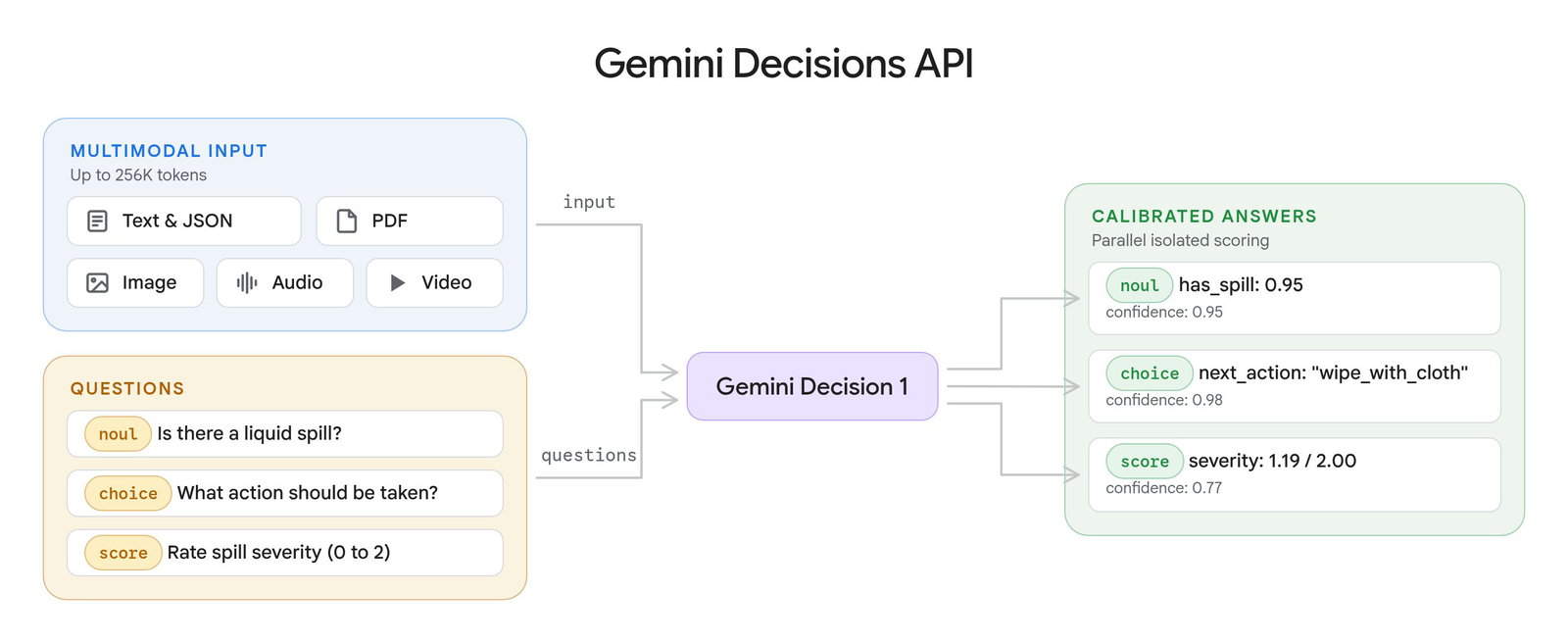
Developers can provide text, images, audio, video, and PDF files as inputs, with support for a context window of up to 256K tokens.
The model supports three types of decisions:
- Noul (Yes/No): Evaluates whether a condition is true or false and returns the estimated probability.
- Choice (Multiple Choice): Selects the most suitable option from 2 to 255 predefined choices, returning probabilities for each option.
- Score (Ordered Rubric): Evaluates information against an ordered scoring scale and returns a weighted score alongside probabilities.
Each response also includes a confidence score between 0 and 1, allowing developers to determine whether a decision can be automated or requires additional review.
For example, a business could submit customer information alongside a recorded conversation and ask the model to evaluate whether a request meets specific criteria, determine the appropriate department, and assess its priority.
According to Apidog, the API exposes a dedicated v1beta endpoint and uses the model identifier gemini-decision-1.
The approach allows developers to build automated decision-making workflows without relying on a traditional chatbot to generate written answers.
Google Claims Faster AI Decisions And Lower Processing Costs
Google says Gemini Decision 1 delivers median model computation times of 50 to 100 milliseconds, with total end-to-end latency between 150 and 250 milliseconds under its reported test conditions.
The company also claims latency remains nearly unchanged when evaluating between 1 and 100 questions per request for inputs of up to 16K tokens.
Google highlighted the model's performance across benchmarks covering agent routing, reasoning, ranking, and multimodal understanding.
According to the company, Gemini Decision 1 achieved the lowest calibration error among the models evaluated in its benchmark comparison.
Calibration refers to how closely a model's predicted confidence corresponds to the likelihood of its answer being correct, making it particularly important when businesses rely on AI systems for automated decisions.
Google also claims that Gemini Decision 1, when used through the Decisions API, is nearly five times cheaper than Gemini 3.5 Flash-Lite through the Interactions API across its shared benchmark suite.
As Techzine reported, the model's ability to handle multiple input formats and evaluate predefined choices is central to Google's effort to make AI decision-making faster and more efficient.
However, the benchmark results and cost comparisons are based on Google's published testing, and performance may vary depending on application requirements.
Gemini Decision 1 Pricing And Availability
Google has introduced a pricing structure that charges developers $0.10 per million input tokens, with no output-token charges.
Since the model evaluates predefined options rather than generating conventional text responses, Google says developers will not incur additional charges for output tokens or variable thinking tokens.
The shared input is billed once per request, regardless of how many questions are evaluated, although each question contributes its own instruction and criteria tokens.
The company also says there are no separate audio transcription or optical character recognition (OCR) charges for the supported multimodal inputs.
Developers can begin experimenting with the API through Google AI Studio, which includes a no-cost tier for prototyping.
Google has also published Python, JavaScript, and REST guides to help developers integrate Gemini Decision 1 into their applications.
Support is rolling out across platforms and frameworks such as OpenRouter, LangChain, Vercel, LiteLLM, Pydantic AI, Pipecat, LiveKit, and OpenCode.
Meanwhile, support for Gemini in Google Cloud is expected to arrive later, although Google has not provided a confirmed launch date.
Google Is Already Using Gemini Decisions API Across Its Products
Google revealed that several of its own teams are already using the Decisions API in production applications.
For instance, Gemini Notebook uses the API to route incoming requests to suitable model tiers and reasoning levels, helping reduce latency for everyday queries while reserving more advanced processing for complex tasks.
Topics For More Insights
According to Google, the implementation has helped deliver up to 40% lower latency for everyday queries.
Google Labs' CC also uses the technology to select suitable emoji reactions from more than 200 available options.
Meanwhile, Google's Stitch design platform uses the API to support rapid product-flow design and iterations, while Google Search uses it to detect adversarial behavior involving Model Context Protocol (MCP) tools.
These applications highlight how Google envisions Gemini Decision 1 operating alongside larger generative AI models rather than replacing them.
While traditional AI models remain useful for generating content, answering open-ended questions, and performing complex reasoning, Gemini Decision 1 focuses on constrained tasks where applications need to select, classify, or score predefined options.
The introduction of Gemini Decisions API could therefore offer developers another way to manage repetitive AI decisions, particularly in applications where response time, predictable outputs, and operating costs are important.
However, the model's effectiveness for individual businesses will depend on the complexity of their workflows, the quality of their decision criteria, and how reliably its confidence scores perform in real-world applications.
First published on Thu, Nov 12, 2026

Liked what you read? That’s only the tip of the tech iceberg!
Explore our vast collection of tech articles including introductory guides, product reviews, trends and more, stay up to date with the latest news, relish thought-provoking interviews and the hottest AI blogs, and tickle your funny bone with hilarious tech memes!
Plus, get access to branded insights from industry-leading global brands through informative white papers, engaging case studies, in-depth reports, enlightening videos and exciting events and webinars.
Dive into TechDogs' treasure trove today and Know Your World of technology like never before!
Disclaimer - Reference to any specific product, software or entity does not constitute an endorsement or recommendation by TechDogs nor should any data or content published be relied upon. The views expressed by TechDogs' members and guests are their own and their appearance on our site does not imply an endorsement of them or any entity they represent. Views and opinions expressed by TechDogs' Authors are those of the Authors and do not necessarily reflect the view of TechDogs or any of its officials. While we aim to provide valuable and helpful information, some content on TechDogs' site may not have been thoroughly reviewed for every detail or aspect. We encourage users to verify any information independently where necessary.
Loading comments...