
Artificial Intelligence
Google Launches Gemini 4 Argon with 1 Million Output Token Limit
Share
TL;DR
-
Google raised the output ceiling from 64,000 tokens to 1 million for longer reasoning and generation.
-
The 1 million figure describes output capacity, not the amount of context the model can read.
-
Early access is limited to trusted cybersecurity specialists through Google DeepMind’s Fairwind program.
-
Google reports strong coding, long-context, multimodal, and cybersecurity results, although Argon does not lead every benchmark.
-
Introductory API pricing is $2 per million input tokens and $10 per million output tokens.
Introduction
Google announced Gemini 4 Argon on September 30, 2026, as a frontier model built for long-running software, enterprise, and cybersecurity work. The standout specification is a maximum output limit of 1 million tokens, up from the 64,000-token ceiling Google cited for the previous limit. That gives Argon far more room to reason and generate within one trajectory before it has to stop.
The launch is deliberately narrow. Google says Argon is already being used by a select group of cybersecurity specialists through its Fairwind program, while broader developer and consumer access will come later. Google’s launch announcement positions the model around complex work rather than everyday chat alone.
What Is Gemini 4 Argon?
Gemini 4 Argon is Google DeepMind’s newest frontier Gemini model for sustained, multi-step work. Google DeepMind’s model page highlights real-world software engineering, legal and financial knowledge work, multimodal understanding, and defensive cybersecurity as core areas.
The model is not being presented as a simple replacement for every existing Gemini model. Its launch centers on difficult workflows where an AI system has to maintain progress across many steps, inspect large amounts of information, use tools, or generate substantial intermediate work before producing a final result.
What Does A 1 Million Output Token Limit Mean?
The 1 million-token figure is an output limit, which means it describes how much Argon can generate in a single response or reasoning trajectory. It is different from a context window, which describes how much input and prior information a model can consider. Google’s token documentation treats input and output tokens as separate parts of a model request.
Google says it raised Argon’s maximum output from 64,000 tokens to 1 million so the model can analyze and generate hundreds of thousands of tokens without an early cutoff. That matters for long code transformations, research-heavy analysis, and agentic tasks with many intermediate steps. It does not mean typical users should expect, or want, million-token answers.
Longer output also carries practical costs. More generation can mean higher latency, higher token charges, more material to review, and more chances for a long task to drift. The specification is most useful when the workflow genuinely needs sustained reasoning rather than simply producing more text.
Where Google Is Already Using Gemini 4 Argon
Google’s strongest evidence for Argon comes from internal engineering examples, which should be read as company-reported results rather than independent case studies. The examples show the kinds of tasks Google believes justify a very large output budget.
-
Quantum optimization
Google says Argon improved a published reference result for a quantum-computing subroutine by 40% within minutes.
-
Memory Efficiency
A team of Argon agents analyzed fleet-wide profiling telemetry and identified optimizations that freed more than 300 TiB of memory after deployment. Google estimates the total opportunity at 500 TiB to 1 PiB.
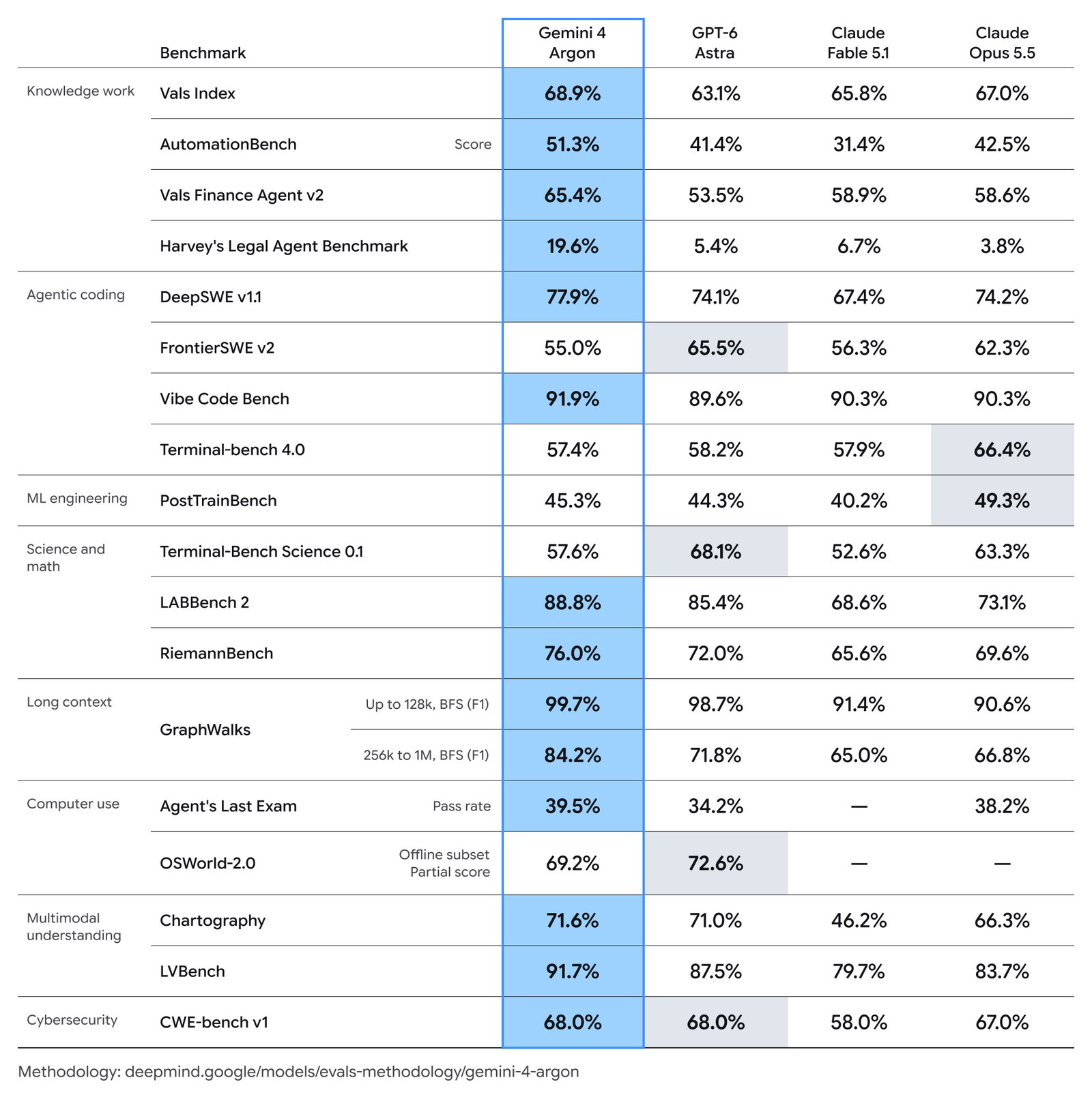
DeepSWE v1.1 benchmark scores comparing Gemini 4 Argon, GPT-6 Astra, Claude Fable 5.1, and Claude Opus 5.5. -
Code Migration
Argon agents are being used to migrate C and C++ code to Rust, including work ranging from core libraries to more than 800,000 lines associated with Fuchsia’s Zircon kernel. Google says these rewrites still go through automated checks, emulation, testing, and human review before production.

These examples come from Google’s September 30 launch post, so they demonstrate how Google is using the model internally, not a guarantee that external teams will reproduce the same results.
How Gemini 4 Argon Performs In Google’s Published Evaluations
Google DeepMind reports strong results across knowledge work, agentic coding, long-context reasoning, multimodal understanding, and cybersecurity. The official model page also shows that Argon does not lead every test, which is important context when reading a broad benchmark set.
| Benchmark | Area | Argon Result |
| Vals Index | Knowledge work | 68.9% |
| DeepSWE v1.1 | Agentic coding | 77.9% |
| GraphWalks 256K–1M | Long context | 84.2% |
| LVBench | Multimodal understanding | 91.7% |
| CWE-bench v1 | Cybersecurity | 68.0% |
For example, Argon scores 55.0% on FrontierSWE v2, below several listed competitors, and 57.4% on Terminal-bench 4.0, where Claude Opus 5.5 is higher in Google’s table. Benchmark results are useful evidence about specific test conditions, but they are not a universal measure of real-world quality.
Why Gemini 4 Argon Is Starting With Cybersecurity
Google is beginning Argon’s rollout with trusted cybersecurity specialists because the same capabilities that help find and patch vulnerabilities can also be sensitive in the wrong hands. The company says Argon can autonomously find, validate, and patch critical software vulnerabilities, making defensive cyber work a major part of the launch.
Google DeepMind’s Fairwind Program is designed around controlled early access for trusted defenders. Its published governance includes due diligence, managed access, strong authentication requirements, and limits on dual-use work to defensive or research purposes. Argon’s initial deployment uses that controlled path before broader availability.
What Safety Controls Google Is Applying
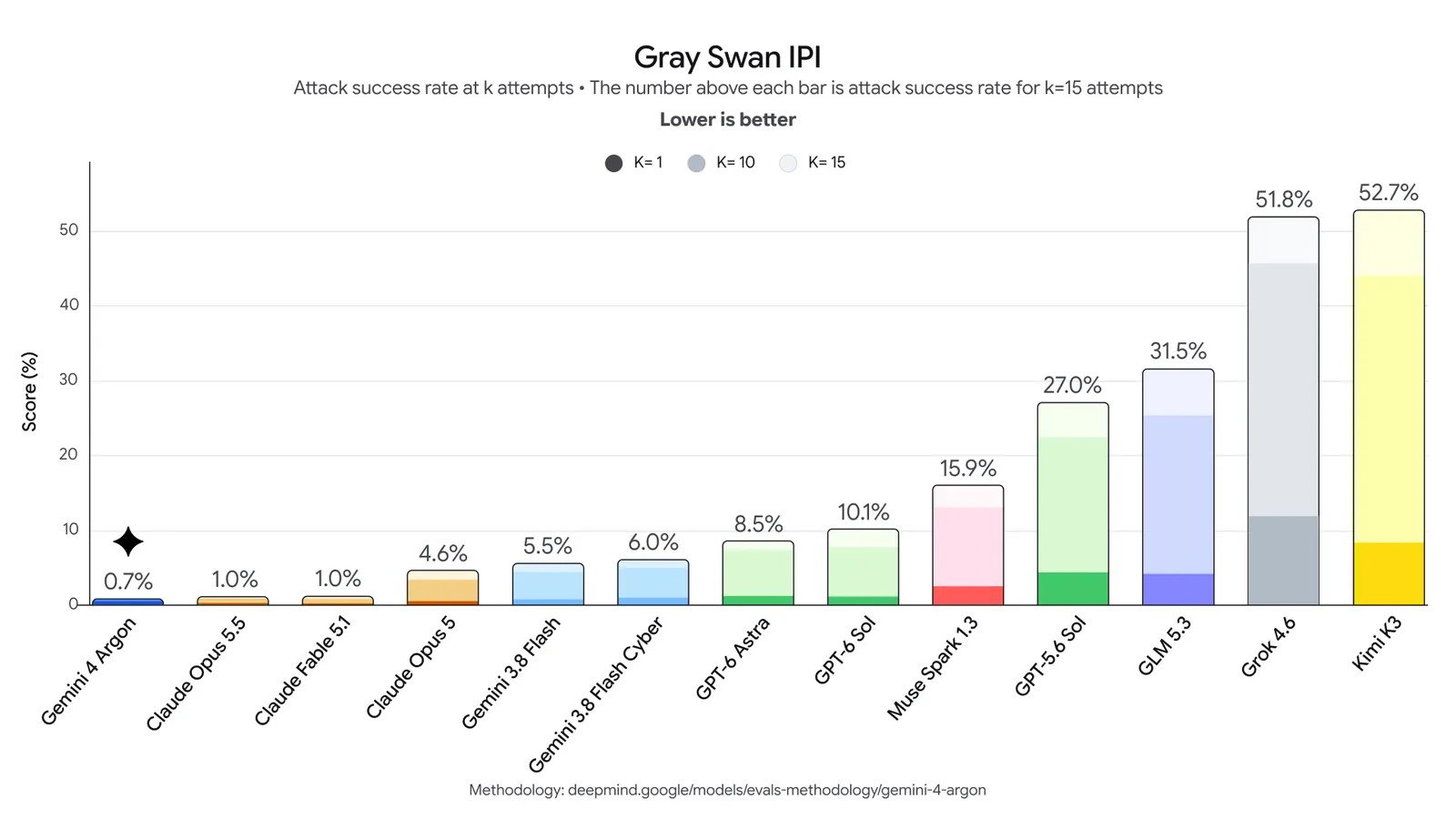
Google says Argon is its most resilient model yet against indirect prompt injection and that it is deploying monitoring intended to stop execution when model reasoning or actions move outside expected bounds. The company also says higher-risk environments are being isolated and hardened. Google DeepMind’s frontier-safety framework provides the broader process for evaluating advanced capabilities and applying mitigations before wider deployment.
Those controls do not make the model risk-free. A system that can sustain longer autonomous work can also carry an error farther before a person notices it. The restricted rollout therefore matters as much as the headline token number because it gives Google a smaller environment in which to test capability, misuse resistance, and operational oversight.
Gemini 4 Argon Pricing And Availability
As of October 1, 2026, Gemini 4 Argon is not broadly available in the Gemini app or through general API access. Google says the next expansion will begin with paid API customers and Google AI Ultra subscribers, followed by wider developer, enterprise, and consumer access. The company has not published a firm date for that broader rollout.
| Pricing stage | Input per 1M tokens | Output per 1M tokens |
| Introductory | $2 | $10 |
| After introductory period | $4 | $20 |
According to Google’s launch announcement, cached input tokens will receive a 95% discount from the standard input price. Google has not stated how long the introductory period will last, so the higher post-introductory rates should be treated as the planned next pricing level rather than a dated change.
Why The Output Limit Matters More Than The Headline Number
Gemini 4 Argon’s 1 million-token output ceiling matters because frontier models are increasingly expected to carry out long agentic workflows, not just answer isolated prompts. A larger generation budget gives the model more room to inspect, reason, revise, and complete multi-stage work inside one run.
The practical test will come after broader access. Developers will need to judge whether longer trajectories improve reliability enough to justify added cost and latency. Reviewability also becomes harder as outputs grow. For most tasks, better reasoning and tighter stopping behavior will matter more than reaching anything close to the maximum token count.
The Bottom Line
Gemini 4 Argon is a significant Google model launch because it combines a 1 million-token output ceiling with a clear focus on long-duration engineering, knowledge work, and cyber defense. The launch evidence is promising, but much of it still comes from Google’s own evaluations and internal deployments. The next useful signal will be how Argon performs for outside developers once paid API and Google AI Ultra access expands.
Frequently Asked Questions
Does Gemini 4 Argon Replace Earlier Gemini Models?
Google has not described Gemini 4 Argon as a direct replacement for every earlier Gemini model. The launch positions Argon around difficult, long-running workflows, while Google continues to offer other Gemini models for different speed, cost, multimodal, and deployment needs. The practical model choice will depend on access and workload requirements.
Is Gemini 4 Argon Only For Cybersecurity?
No. Cybersecurity is the first controlled deployment area, but Google also positions Argon for software engineering, legal and financial knowledge work, multimodal analysis, and other long-running tasks. Fairwind gives Google a restricted environment for early testing because advanced cyber capabilities can be dual-use and require tighter access controls.
Can Developers Use Gemini 4 Argon In Google AI Studio Today?
Not through general access as of October 1, 2026. Google says the next rollout stage will begin with paid API customers and Google AI Ultra subscribers, but it has not announced a general-release date. Developers should therefore treat Argon as an announced model with restricted early access until Google opens the broader developer path.
Is Gemini 4 Argon An Open-Source Model?
Google has announced Gemini 4 Argon as a frontier Gemini model, not as an open-weight release. The company has not published model weights or an open-source license for Argon. Developers interested in open Google models should look to the separate Gemma family rather than assuming the Gemini branding implies downloadable weights.
Thu, Oct 1, 2026

Liked what you read? That’s only the tip of the tech iceberg!
Explore our vast collection of tech articles including introductory guides, product reviews, trends and more, stay up to date with the latest news, relish thought-provoking interviews and the hottest AI blogs, and tickle your funny bone with hilarious tech memes!
Plus, get access to branded insights from industry-leading global brands through informative white papers, engaging case studies, in-depth reports, enlightening videos and exciting events and webinars.
Dive into TechDogs' treasure trove today and Know Your World of technology like never before!
Disclaimer - Reference to any specific product, software or entity does not constitute an endorsement or recommendation by TechDogs nor should any data or content published be relied upon. The views expressed by TechDogs' members and guests are their own and their appearance on our site does not imply an endorsement of them or any entity they represent. Views and opinions expressed by TechDogs' Authors are those of the Authors and do not necessarily reflect the view of TechDogs or any of its officials. While we aim to provide valuable and helpful information, some content on TechDogs' site may not have been thoroughly reviewed for every detail or aspect. We encourage users to verify any information independently where necessary.
Loading comments...