
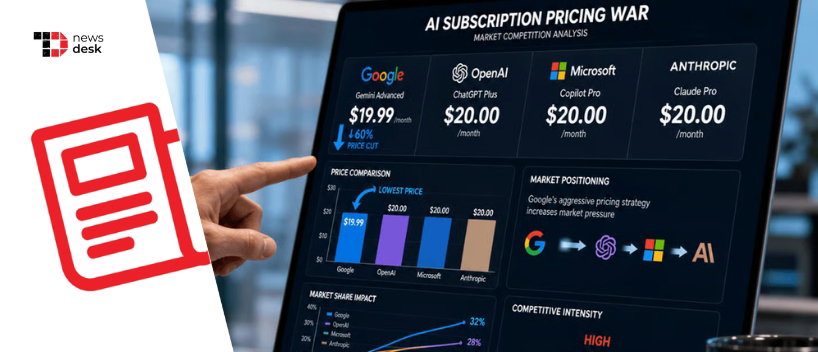
Google has lowered the price of its Google AI Plus subscription in the U.S. from $7.99 to $4.99 per month, while doubling included storage from 200GB to 400GB. The move signals a sharper pricing battle in consumer AI subscriptions.
TL;DR
- Google AI Plus now costs $4.99 per month in the U.S.
- The plan includes 400GB of cloud storage, up from 200GB.
- Google is using pricing, storage, and ecosystem bundling to challenge rivals.
- The move could pressure OpenAI, Anthropic, and other AI providers as AI tools become more commoditized.
The company cut the monthly price of Google AI Plus from $7.99 to $4.99, while doubling the included cloud storage from 200GB to 400GB. The update was announced on Monday, June 8, 2026, and is expected to roll out to users over several days, according to Vikas Kansal, Product Lead for Gemini AI subscriptions.
Google AI Plus was launched in the U.S. in January 2026 as the company’s most affordable paid AI subscription. At the time, Google said the plan was designed to help people do more with Google AI for less, while making AI Plus available across markets where Google AI plans were supported.
The plan gives users access to Google’s consumer AI ecosystem, including Gemini features, Google Flow, NotebookLM, and cloud storage benefits. Users looking for higher usage limits or more advanced features can move up to Google AI Pro or Google AI Ultra, which Google positions as higher-tier plans for more intensive AI users.
What makes this move more notable is the timing. Until now, AI subscription pricing in the U.S. has not been the loudest part of the competition between Google, OpenAI, Anthropic, and other major AI firms. Much of the battle has centered on model performance, coding, agents, multimodal features, and enterprise adoption.
Topics For More Insights
Google’s latest cut changes that conversation. It makes affordability a direct weapon.
The company has clear advantages here. It can bundle AI access with storage, productivity tools, search, Gmail, Drive, Photos, YouTube, and Android distribution. That makes Google’s subscription strategy different from pure-play AI providers that rely more directly on paid chatbot or API revenue.
That is why investors are watching the move closely. Chi-Hua Chien, co-founder and managing partner at Goodwater Capital, told TechCrunch that the AI infrastructure market is entering a commoditization phase. His view is that companies such as OpenAI, Anthropic, backend infrastructure providers, chip companies, hosting firms, and energy providers may remain valuable for a period, but could face margin pressure as AI access becomes cheaper and more bundled.
The logic is simple. As users begin to see AI as a utility, they may care less about which model powers the experience and more about price, convenience, and where the tool already lives.
That could put Google in a strong position. The company does not need to win only on model quality. It can win by making Gemini cheaper, more accessible, and deeply attached to services consumers already use every day.
The pattern has already played out in markets such as India. OpenAI launched ChatGPT Go there in 2025 at a much lower price than its standard Plus plan, while Google followed with its own sub-$5 AI Plus offering for Indian users. Now, Google appears to be bringing the same playbook to the U.S. market.
Anthropic has not yet introduced a comparable budget consumer AI tier. That may become harder to sustain if Google and OpenAI continue to chase mass adoption with lower-priced plans.
For consumers, the immediate takeaway is simple: paid AI tools are getting cheaper.
For the industry, the message is bigger. Google is signaling that the next phase of the AI race may not only be about who has the smartest model. It may be about who can package AI at the lowest price, with the broadest distribution, and the fewest reasons for users to leave.
