

The update introduces dynamic visual explanations that allow users to manipulate formulas, variables, and relationships in real time.
The feature shifts ChatGPT from simply answering questions to helping learners actively explore concepts. Instead of reading about equations or studying fixed diagrams, users can now experiment with visual modules that react instantly to their inputs.
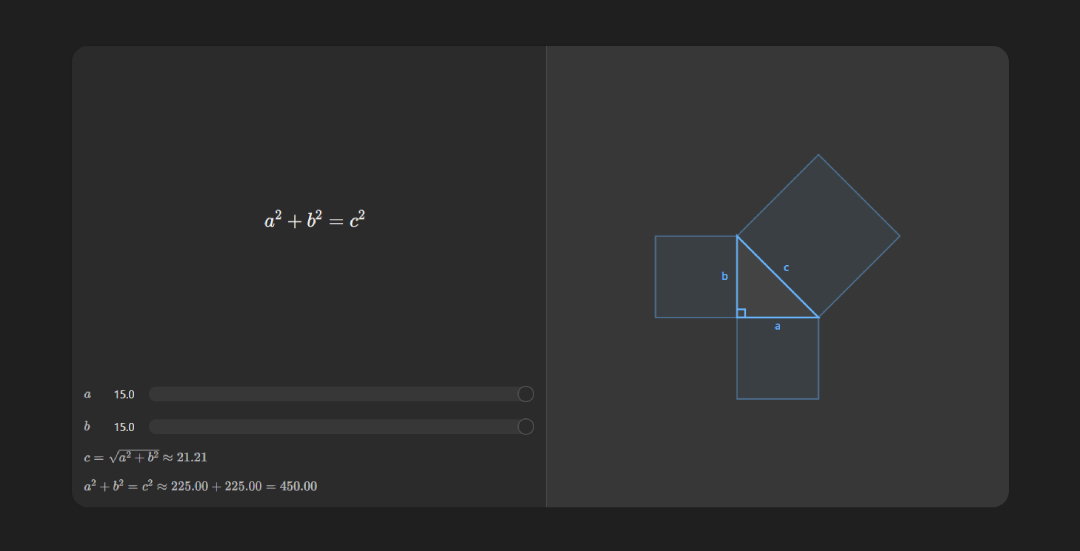
For example, someone exploring the Pythagorean theorem can adjust the triangle’s sides and watch the hypotenuse change automatically. Similarly, users examining equations or scientific laws can modify variables and immediately see how graphs or results evolve.
This capability is available to anyone logged into ChatGPT and currently supports more than 70 math and science topics.
TL;DR
- OpenAI launched dynamic visual explanations in ChatGPT for math and science learning.
- Users can manipulate variables and formulas to see real time visual changes.
- The feature supports more than 70 core concepts such as Ohm’s law and compound interest.
- More than 140 million people already use ChatGPT weekly for math and science help.
ChatGPT Introduces Interactive Visual Modules To Explain Math And Science Concepts
The new feature allows ChatGPT to present interactive modules alongside traditional explanations when users ask about certain topics.
For example, a user asking about a lens equation or the area of a circle will receive written guidance along with a visual module that responds to adjustments. Numbers, variables, and parameters can be modified directly, helping users see the effects instantly.
OpenAI says the tool begins with more than 70 core math and science concepts.
These include topics such as the binomial square, circumference of a circle, surface area of a cone, Coulomb’s law, difference of squares, trig angle sum identities, exponential decay, graphable function, Hooke’s law, Charles’ law, Ohm’s law, compound interest, kinetic energy, period–frequency relation, potential energy, slope formula, lens equation, mirror equation, Pythagorean theorem, ideal gas law, and more.
By turning equations into interactive experiences, the platform aims to make abstract concepts easier to grasp.
Interactive Learning Could Help Students Understand Concepts Faster
According to OpenAI, visual and interaction based learning can improve conceptual understanding for many students compared with traditional instruction methods.
When learners can adjust variables and see results immediately, they may better understand how mathematical or scientific relationships work. Instead of memorizing formulas, they can observe how those formulas behave under different conditions.
Early testing also suggested positive responses from different user groups. High school and college students reported that manipulating variables helped them understand relationships between values more clearly.
Parents said the feature gave them a more engaging way to work through problems with their children, while educators indicated that such tools could help students focus on how concepts work rather than simply remembering equations.
"The real power of AI in education isn’t replacing instruction, rather it is the ability to amplify it. By adding interactive tools, it is a step towards empowering students to independently explore abstract concepts to see patterns emerge, and build deeper understanding," said Raquel Gibson, a high School algebra teacher.
Topics For More Insights
OpenAI Pushes ChatGPT Further Into The Learning Ecosystem
The update also highlights how widely ChatGPT has already been adopted for educational support.
OpenAI notes that more than 140 million people use ChatGPT every week specifically to help them understand math and science concepts. Many learners also use the tool to prepare for exams, work through homework problems, and explore subjects they previously found difficult.
Interest in AI powered learning tools has grown rapidly, although their rise has sparked debate within the education community. Some educators worry students may become overly dependent on AI systems, while others see them as powerful supplements to traditional teaching.
OpenAI says the rollout is only the beginning and plans to expand visual explanations to additional topics and subjects over time. The company will also continue studying how AI tools influence learning outcomes as adoption grows across classrooms and independent learners.
