
Artificial Intelligence
ChatGPT Can Now Learn Your Writing Style From Gmail, Slack, And Google Drive
Updated on Tue, Sep 8, 2026
Share
OpenAI is giving ChatGPT Work a more personal voice, allowing it to learn users’ writing styles from connected workplace tools such as Gmail, Google Drive, Slack and SharePoint, then carry those patterns into future drafts.
TL;DR
- ChatGPT Work can learn writing patterns from emails, messages and files in connected workplace apps.
- OpenAI says it can pick up preferred phrases, sign-offs and capitalization habits.
- Gmail, Google Drive, Slack and SharePoint are among the services highlighted by OpenAI.
- The feature requires users to connect relevant accounts and grant access, making permissions and data controls an important consideration.
OpenAI announced the feature through the official ChatGPT account on X, saying ChatGPT Work can pick up on what makes a person’s writing sound like them, including their “favorite phrases,” specific sign-off and capitalization quirks.
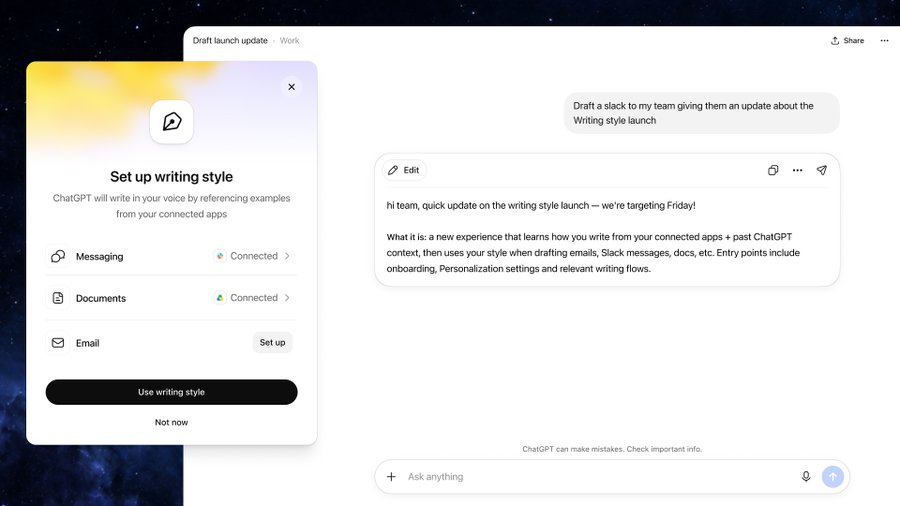
The company said users can connect tools they already use, including Gmail, Google Drive, Slack and SharePoint, allowing ChatGPT Work to learn from emails, messages and files and apply that style to whatever they write next. Business Today reported that the feature is designed to recognize elements such as word choice, phrases, tone, sentence construction and other recurring writing habits.
Instead of repeatedly prompting ChatGPT to make an email or document “sound like me,” the system can use existing workplace writing as a reference. Business Today said eligible users can find the feature through ChatGPT’s Settings and Personalization options under Writing Style, and that after it is configured on the web, the learned style can be reflected in future ChatGPT Work drafts, including when users access the service on mobile.
From Limited Test To An OpenAI Announcement
The rollout followed reports that OpenAI had been testing the capability with a smaller group of users.
PCMag, whose report was also published by Yahoo Tech, previously found a “Reference my writing style” option under ChatGPT’s personalization settings. The early interface allowed writing examples to come from messaging, documents and email, with Slack, Notion, Google Drive and Gmail appearing among the connected services.
At the time of PCMag’s report, OpenAI had not formally announced the capability and PCMag said it could not activate the feature during its own testing. Firstpost subsequently reported that ChatGPT Work could learn a user’s writing style and carry it into future drafts, while Business Today reported the wider OpenAI announcement on September 8.
The timeline indicates that the early experiment moved into a broader introduction for eligible ChatGPT Work users.
Connecting Your Inbox Comes With A Data Consideration
The feature also makes the permissions granted to connected workplace applications more important.
Connected apps operate through the permissions available to the connected account and can be managed or disconnected by users or workspace administrators, depending on the environment.
For connected Google services specifically, OpenAI says it does not train its generalized models directly on data retrieved from connected Google apps or derivatives of that data, except in specified situations such as submitted feedback or content that is manually copied into a conversation.
Topics for more insights:
That distinction matters because “learning your writing style” does not necessarily mean OpenAI is training its underlying general-purpose model on an entire Gmail inbox. Instead, the new capability uses authorized workplace content as personalization context for producing drafts that more closely resemble the user’s existing writing.
The approach also differs from earlier AI writing-style tools. PCMag noted that Anthropic’s Claude Styles allows users to create a personalized style from writing samples, while OpenAI’s approach can draw directly from material stored across connected workplace services.
For users who spend their day rewriting AI-generated emails, reports and internal messages to sound more natural, that could reduce one of the most repetitive parts of using generative AI at work.
First published on Tue, Sep 8, 2026

Enjoyed what you've read so far? Great news - there's more to explore!
Stay up to date with the latest news, a vast collection of tech articles including introductory guides, product reviews, trends and more, thought-provoking interviews, hottest AI blogs and entertaining tech memes.
Plus, get access to branded insights such as informative white papers, intriguing case studies, in-depth reports, enlightening videos and exciting events and webinars from industry-leading global brands.
Dive into TechDogs' treasure trove today and Know Your World of technology!
Disclaimer - Reference to any specific product, software or entity does not constitute an endorsement or recommendation by TechDogs nor should any data or content published be relied upon. The views expressed by TechDogs' members and guests are their own and their appearance on our site does not imply an endorsement of them or any entity they represent. Views and opinions expressed by TechDogs' Authors are those of the Authors and do not necessarily reflect the view of TechDogs or any of its officials. While we aim to provide valuable and helpful information, some content on TechDogs' site may not have been thoroughly reviewed for every detail or aspect. We encourage users to verify any information independently where necessary.
Loading comments...