
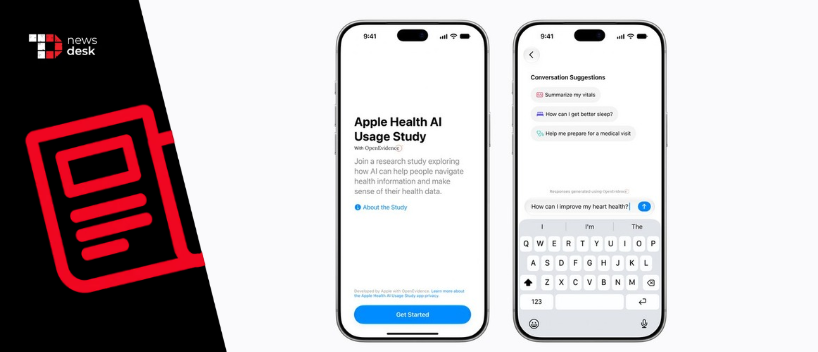
Apple wants to explore how artificial intelligence (AI) can help people understand their health, but first, it wants to know whether users can trust the answers they receive.
The technology giant has launched the Apple Health AI Usage Study in partnership with OpenEvidence, inviting up to 200,000 eligible Americans to explore conversational health AI tools while researchers examine their reliability, usefulness, and influence on everyday health decisions.
Here's what Apple's latest healthcare AI initiative involves.
TL;DR
- Apple has launched a US-based research study to understand how people interact with conversational healthcare AI.
- The study partners with OpenEvidence and will recruit up to 200,000 eligible participants.
- Participants can optionally share Apple HealthKit data for more personalized responses.
- Apple says study data won't be used to train AI models.
Apple Partners With OpenEvidence To Study How People Use Healthcare AI
According to Apple's official announcement, the new virtual study combines an Apple-designed research app with medical AI technology developed by OpenEvidence.
OpenEvidence uses established medical publications, including The New England Journal of Medicine, the Journal of the American Medical Association, and Nature, to support its AI-generated responses.
Participants can ask everyday health questions, receive explanations of complicated medical information in accessible language, and review linked peer-reviewed clinical citations supporting the answers.
The app also allows participants to voluntarily share HealthKit information, including resting heart rate, physical activity, sleep patterns, and laboratory results.
Researchers will examine whether integrating personal health information makes AI responses more relevant and understandable.
The initiative also explores whether conversational AI could help people prepare more effectively for appointments with healthcare professionals.
Apple's research comes as other technology companies explore personalized medical AI, including OpenAI's ChatGPT Health and Anthropic's expansion of Claude into healthcare.
Apple Health AI Study Prioritizes Privacy, Clinical Safety And User Trust
One of the more significant aspects of Apple's announcement is its approach to personal medical information.
Apple says participants will control whether they share HealthKit metrics or survey responses, while information collected through the study will not be used to train AI models.
The company has also incorporated security measures and clinical safeguards, including features intended to identify certain concerning questions and recommend professional medical assistance when appropriate.
This matters because, as Apple acknowledges, large language models (LLMs) can sometimes produce incomplete or unclear medical responses.
Sumbul Desai, Apple's vice president of Health and Fitness, said, "Health is deeply personal, and conducting a dedicated research study is the most thoughtful way to understand how people engage with, comprehend, and evaluate health AI in everyday life."
The central objective is not simply to evaluate AI-generated answers, but to understand how people interpret those answers and whether they influence health-related actions.
Topics For More Insights
- Apple Health App Adds Menopause And Perimenopause Support To Cycle Tracking
- OpenAI Launches ChatGPT Health For Safer, Smarter Medical Guidance
- Anthropic Expands Claude To Healthcare And Life Sciences
- Health Minister Announces AI Healthcare Framework Concept, Introduces SAHI And BODH At AI Impact Summit 2026
Apple Health AI Study Eligibility And Enrollment Requirements
The study is open to up to 200,000 eligible participants across the United States who are at least 21 years old.
Interested participants must own an Apple Intelligence-enabled iPhone, specifically an iPhone 15 Pro or later, running iOS 26 or newer.
Eligible users can download the Apple Health AI Usage Study app to learn about participation and enroll.
Importantly, Apple clarifies that the research app cannot diagnose or treat medical conditions and is not intended to replace professional medical advice.
For Apple, the findings could help shape the responsible design of future healthcare AI experiences. However, the company has not announced a consumer product launch or a timeline for applying the findings to its broader health ecosystem.
