
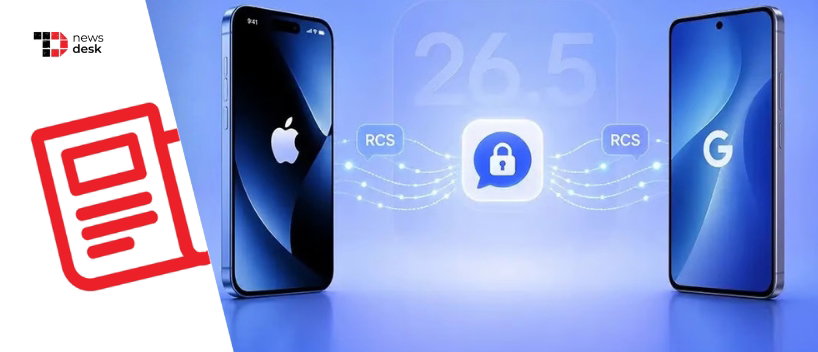
Apple and Google have begun rolling out end-to-end encrypted RCS messaging between iPhone and Android users, marking a major privacy upgrade for cross-platform texts that previously lacked the same protection as iMessage or Google Messages chats.
TL;DR
- End-to-end encrypted RCS is rolling out in beta for iPhone users on iOS 26.5 and Android users on the latest Google Messages app.
- The feature is enabled by default and will appear through a lock icon in supported RCS chats.
- The update follows years of pressure for Apple to support richer and more secure Android-iPhone messaging.
Android and iPhone users can finally send each other end-to-end encrypted text messages, as Apple and Google begin rolling out encrypted RCS messaging across the two platforms.
The update is available in beta for iPhone users running iOS 26.5 with supported carriers and Android users running the latest version of Google Messages. Apple said users will see a new lock icon in RCS chats when conversations are end-to-end encrypted.
For years, messaging between iPhone and Android users has lagged behind the privacy protections available inside the same ecosystems. Apple’s iMessage has offered end-to-end encryption between Apple devices since launch, while Google Messages has supported encrypted RCS conversations between Android users for years. However, cross-platform conversations between iPhones and Android phones did not have the same protection.
That gap is now beginning to close.
Apple said it worked with Google on a cross-industry effort to bring end-to-end encryption to Rich Communication Services, better known as RCS, which is the modern messaging format designed to replace traditional SMS. Unlike SMS, RCS supports richer features such as high-resolution photos and videos, typing indicators, read receipts, and longer messages.
“When RCS messages are end-to-end encrypted, they can’t be read while they’re sent between devices,” Apple said in its announcement. “Users will know that a conversation is end-to-end encrypted when they see a new lock icon in their RCS chats.”
Google echoed the announcement, saying encryption will be enabled by default and will be automatically activated over time for new and existing RCS conversations. Google also said Android users will see the same lock icon previously used in encrypted RCS chats to confirm that a cross-platform conversation is protected.
The rollout is still in beta, which means not every user will see it immediately. Users will need the latest required software, carrier support on iPhone, and an updated version of Google Messages on Android.
The move also marks another step in the long-running shift away from SMS. Traditional SMS remains limited by lower-quality media sharing and weaker security, while RCS adds app-like messaging features directly inside the default messaging experience. TechCrunch noted that the change helps reduce one of the biggest privacy and usability gaps between green bubble and blue bubble conversations.
Topics For More Insights
It also comes after years of pressure on Apple to adopt RCS. Google had repeatedly pushed Apple to support the protocol, arguing that cross-platform messaging should be more secure and reliable. Apple added RCS support to iOS earlier, but end-to-end encryption between iPhone and Android users was still missing until this rollout.
The GSMA, which oversees the RCS Universal Profile standard, described the update as a milestone for secure cross-platform messaging. As reported by The Hacker News, GSMA Chief Technology Officer Alex Sinclair said the progress came from collaboration across the GSMA RCS Working Group, including Apple, Google, and the wider mobile ecosystem.
For users, the change is simple but significant. If a chat shows the lock icon, the conversation is protected from being read while it travels between devices. If it does not, users should assume that the conversation may not yet have full end-to-end encryption.
The update does not erase the difference between iMessage and RCS, and Android texts will still appear as green bubbles on iPhones. However, for everyday privacy, it is one of the biggest messaging upgrades yet for people who communicate across Apple and Android devices.
