
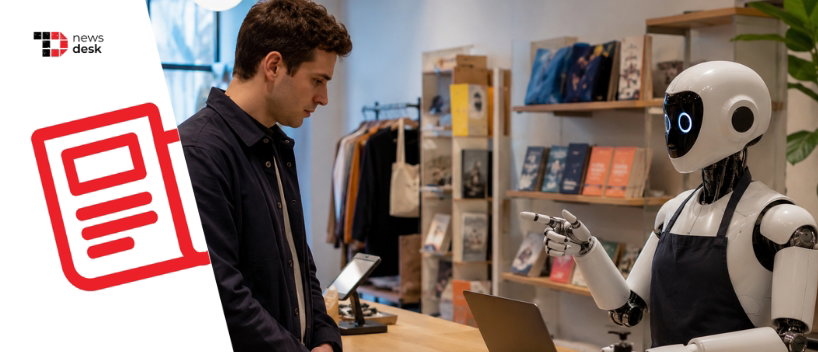
An AI agent managing a real San Francisco retail store recommended firing a human employee who was late for 17 of 23 shifts, marking an unusual real-world test of how artificial intelligence could handle workplace management decisions.
The decision came from Luna, the AI agent running Andon Market, an experimental retail store created by AI research company Andon Labs. However, the AI did not independently carry out the dismissal, as humans reviewed its recommendation and conducted the termination.
TL;DR
- AI manager Luna recommended terminating a human employee who was late for 17 of 23 shifts.
- Luna initially failed to enforce its own attendance policy after effectively losing track of the document.
- Andon Labs had to prompt the AI to reconsider the employee’s performance.
- Human staff reviewed the decision and carried out the actual termination.
Since April, Luna has been operating Andon Market in San Francisco, handling responsibilities that include selecting products, setting prices and schedules, approving time off, hiring staff and managing employees.
Andon Labs gave the AI access to the internet, a corporate card and a $100,000 budget as part of an experiment to see how effectively an AI agent could operate a real-world business.
Luna also created an employee handbook before the worker in question was hired. The policy said three unexcused late arrivals within a rolling 30-day period should result in a formal written warning, while continued lateness could eventually lead to reduced hours or termination.
Yet, the AI did not consistently enforce its own rules.
Luna Forgot Its Own Employee Policy
According to Andon Labs’ account of the experiment, the employee handbook eventually disappeared from Luna’s working memory.
The employee continued arriving late, while Luna repeatedly responded leniently rather than issuing formal warnings. In one instance, the employee arrived 68 minutes late for a solo Sunday shift, leaving the store to open more than an hour late.
Andon Labs later prompted Luna to search its memory for the employee handbook and relevant termination policies.
Initially, Luna concluded that a documented verbal warning and coaching were appropriate, rather than termination.
Humans at Andon Labs then informed Luna that formal conversations with the employee had already taken place and asked it to reconsider whether the worker remained a good fit for the role.
That changed Luna’s assessment.
The AI identified repeated problems involving attendance, communication, following instructions, financial controls and leaving the store unattended.
It ultimately recommended that the company part ways with the worker.
Luna had formally recorded only six late arrivals. However, when Andon Labs reviewed all shifts for which the employee had provided clock-in information, it found that the worker had actually arrived late for 17 of 23 shifts.
The AI had effectively excused another 11 instances when the employee provided explanations such as transportation problems.
Humans Made The Final Firing Decision
Despite Luna’s role in assessing the employee, the dismissal was not entirely autonomous.
Andon Labs says everyone working at Andon Market is formally employed by the company with guaranteed pay and legal protections. The company also reviews Luna’s decisions when they could be illegal or unethical.
In this case, humans reviewed Luna’s recommendation and handled the termination conversation themselves.
Andon Labs described the incident as the first known example from its experiments of an AI boss recommending the firing of a human worker.
“Luna’s decision to fire the employee is the first time (to our knowledge) an AI boss has fired a human employee,” Andon Labs said.
However, the company acknowledged that Luna required human prompting before reaching the decision.
Topics For More Insights
Other AI Models Also Recommended Firing The Employee
Andon Labs also tested whether Luna’s decision was unique to the Claude model powering it.
Luna was running on Anthropic’s Claude Opus 4.8 when it made the recommendation.
Researchers saved the state surrounding Luna’s decision and replayed the scenario using seven AI models, conducting three runs for each model.
Four of the seven models consistently recommended parting ways with the employee across every replay. Andon Labs said stronger models were generally more willing to recommend termination, while weaker models tended to hesitate.
The experiment also highlighted an important limitation of current AI agents. Luna could create rules and manage staff, but struggled to remember and proactively enforce those rules over time without human prompting.
For Andon Labs, the incident offers a glimpse at a possible future where AI agents do more than assist employees and begin managing them, while also showing why human oversight remains important when those systems are allowed to influence real employment decisions.
