

Artificial Intelligence
A Third Of Web Pages Published Since ChatGPT’s Launch Show Signs Of AI Authorship, Study Finds
Updated on Fri, Aug 21, 2026
Share
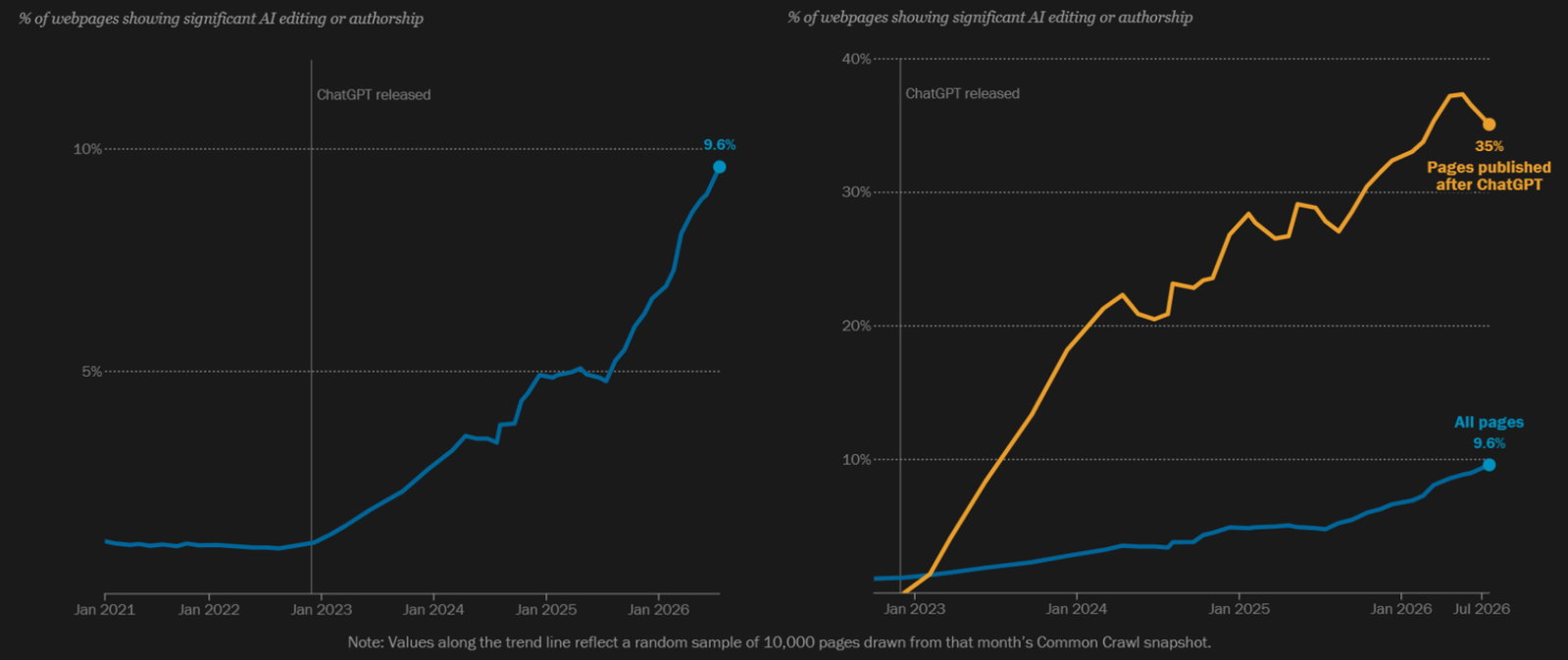
The irony is getting harder to ignore. Just as bot traffic has reportedly overtaken human traffic on the web, Pew Research says more than one-third of pages published since ChatGPT’s launch show signs of AI authorship.
TL;DR
- Pew found signs of AI authorship in 35% of web pages published after ChatGPT launched in November 2022.
- A broader July 2026 sample, which included older pages, put the rate at about 10%.
- .com pages showed AI authorship signs at roughly 10 times the rate of .edu and .gov pages.
- AI-detection tools can still misclassify content.
Pew Finds AI Authorship Signs On 35% Of Post-ChatGPT Web Pages
Pew Research analyzed nearly half a million English-language web pages from the Common Crawl archive, covering roughly five years and beginning before ChatGPT arrived in November 2022. It used Open Pangram’s technology to identify pages likely written or substantially edited by AI (artificial intelligence).
At first, the numbers looked much lower. In a random sample of 10,000 web pages collected in July 2026, around 10% showed “significant signs of AI authorship.”
That sample also included older pages published before AI writing tools existed. Once Pew removed pages published before ChatGPT’s release, the picture changed sharply: 35% of the remaining pages showed signs of AI authorship.
The finding adds another layer to a web increasingly shaped by automation. Cloudflare recently reported that bot traffic had overtaken human web traffic, meaning automated systems are producing more online material while also accounting for a growing share of the traffic accessing it.
.Com Domains Show Much Higher AI Authorship Rates Than .Edu And .Gov Sites
Pew also found major differences by website type. Pages on .com domains showed signs of AI authorship at roughly 10 times the rate seen on .edu and .gov domains, where the rate was around 1%.
For .org domains, the rate stood at 4.6%. The figures suggest AI-generated or heavily AI-edited writing is not evenly distributed across the web, with commercial websites showing substantially higher rates than educational, government, or nonprofit domains.
Topics For More Insights
AI Detection Is Imperfect, But Web Writing Patterns Are Changing
The analysis comes with an important limitation. Pangram, like other AI-detection systems, can incorrectly classify human-written pages as AI-generated, so the findings indicate broad patterns rather than proving the origin of every page.
Still, Pew found that other supposed signs of AI authorship have become more common over time. These included increased use of em dashes, Oxford commas, and constructions such as “it’s not X, it’s Y.”
Taken together, the findings point to a web where AI is becoming more visible not only in the tools people use, but in the language filling the pages themselves.
First published on Fri, Aug 21, 2026

Liked what you read? That’s only the tip of the tech iceberg!
Explore our vast collection of tech articles including introductory guides, product reviews, trends and more, stay up to date with the latest news, relish thought-provoking interviews and the hottest AI blogs, and tickle your funny bone with hilarious tech memes!
Plus, get access to branded insights from industry-leading global brands through informative white papers, engaging case studies, in-depth reports, enlightening videos and exciting events and webinars.
Dive into TechDogs' treasure trove today and Know Your World of technology like never before!
Disclaimer - Reference to any specific product, software or entity does not constitute an endorsement or recommendation by TechDogs nor should any data or content published be relied upon. The views expressed by TechDogs' members and guests are their own and their appearance on our site does not imply an endorsement of them or any entity they represent. Views and opinions expressed by TechDogs' Authors are those of the Authors and do not necessarily reflect the view of TechDogs or any of its officials. While we aim to provide valuable and helpful information, some content on TechDogs' site may not have been thoroughly reviewed for every detail or aspect. We encourage users to verify any information independently where necessary.
Loading comments...