
Artificial Intelligence
What Is AI Agent Swarm? Inside Kevin Mandia's $2.5B Bet On Armadin
Share
TL;DR
As those tasks grow, one agent may not be enough, which is where AI agent swarms come in.
By coordinating multiple specialized agents toward one goal, they turn AI from a solo worker into a digital team.
-
An AI agent swarm is a group of autonomous or semi-autonomous AI agents that coordinate to achieve a shared objective.
-
Swarms divide complex work into smaller tasks that specialized agents can handle sequentially or simultaneously.
-
AI agent coordination may be centralized through an orchestrator or distributed among agents themselves.
-
Agent swarms are a type of multi-agent system, but the term “swarm” generally emphasizes collaboration and coordinated behavior.
-
Potential benefits include parallel processing, specialization, adaptability, scalability, and cross-checking between agents.
Introduction: From One AI Agent To A Team Of AI Agents
In Money Heist, the plan works because no single person is expected to do everything. Each member of the crew brings a specific skill to the operation, while the Professor coordinates the larger strategy and keeps everyone working toward the same goal.
That idea maps surprisingly well to AI agent swarms. Instead of relying on one AI agent to research, analyze, verify, and execute every step, a swarm distributes the work across multiple specialized agents.
Each agent can have its own role, tools, memory, instructions, and access to data, while still collaborating with others. Together, they form a coordinated system capable of tackling complex tasks more efficiently, reflecting the broader evolution of agentic AI systems.
What Is An AI Agent Swarm?
An AI agent swarm is a collection of AI agents that coordinate their actions to complete a shared objective.
Rather than giving the entire job to one system, the swarm decomposes it into smaller responsibilities. Different agents can then perform those tasks based on their skills, available tools, instructions, or access to data.
For example, imagine a company researching whether to enter a new market. One agent could collect competitor information, another could analyze customer demand, another could study pricing, while a separate agent evaluates risks. A final agent might combine the findings into a recommendation.
This illustrates how multiple AI agents work together without requiring every agent to understand or perform every task.
However, there is no single universal architecture that every system labeled an “agent swarm” must follow. Some swarms are centrally controlled, while others rely heavily on decentralized AI agents communicating directly with one another.
The defining idea is coordination. The real value of an AI agent swarm lies in how its agents coordinate, divide work, and turn a shared goal into action.
How Do AI Agent Swarms Work?
Understanding how AI agent swarms work starts with task decomposition.
Suppose a user asks an AI system to evaluate 100 potential suppliers and recommend the five best options. Instead of one agent working through every supplier one after another, the system can distribute the work across multiple agents.
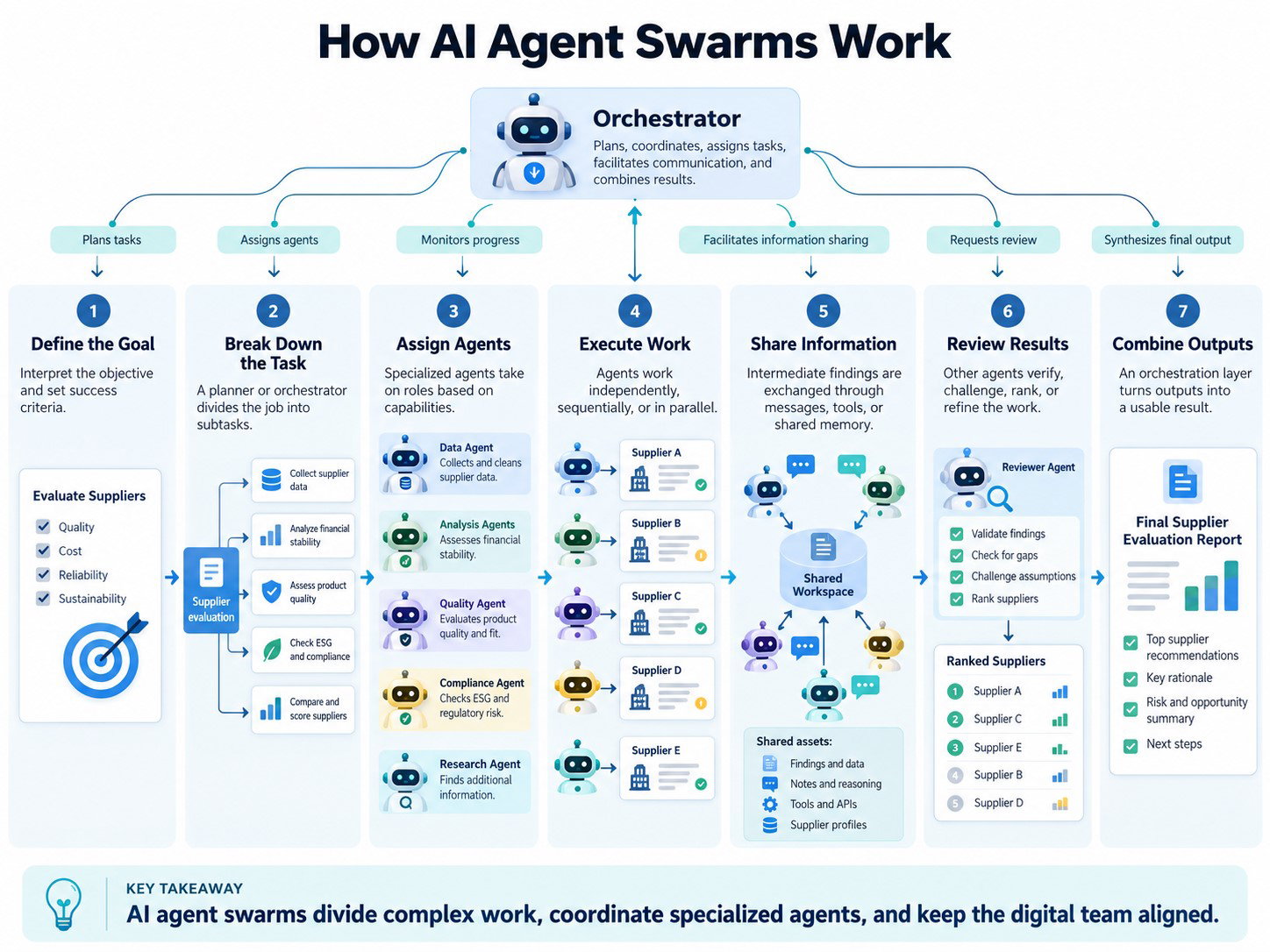
Define the goal: The system interprets the main objective and establishes success criteria.
Break down the task: A planner or orchestrator divides the objective into manageable subtasks.
Assign agents: Specialized agents receive responsibilities based on their capabilities.
Execute work: Agents perform tasks independently, sequentially, or in parallel.
Share information: Intermediate findings are exchanged through messages, shared memory, tools, or common workspaces.
Review results: Other agents may verify, challenge, rank, or refine the outputs.
Combine outputs: A final agent or orchestration layer turns the individual contributions into a usable result.
This ability to divide cognitive workload is one of the main reasons collaborative AI agents can be useful for complicated or high-volume operations.
Yet, splitting the work is only half the problem. Someone, or something, must keep the digital team aligned by properly orchestrating and coordinating the entire task.
AI Agent Coordination And Orchestration
AI agent coordination determines who does what, when they do it, what information they receive, and how their outputs affect other agents.
In a hierarchical architecture, a lead agent or AI agent orchestration layer acts much like a manager. It assigns tasks, monitors progress, handles dependencies, and determines how results are combined.
A decentralized swarm works differently. Agents may exchange information directly and adjust their behavior according to what other agents are doing. This approach draws inspiration from swarm intelligence in AI, where collective behavior emerges from interactions among multiple relatively independent participants.

In practice, agent swarms can use several collaboration patterns.
Some work sequentially, where one agent’s output becomes another agent’s input. Others work in parallel, with several agents handling separate tasks simultaneously. More sophisticated systems can use feedback loops in which reviewer agents send work back for refinement.
As these systems become more complex, shared state management, communication protocols, policy enforcement, observability, and governance become increasingly important.
That makes the underlying agent swarm architecture critical.
What Does Agent Swarm Architecture Look Like?
There is no single blueprint, but most implementations contain a combination of several components.
A planner or orchestrator interprets the objective and coordinates tasks. Specialized worker agents perform individual jobs. A communication layer enables agents to exchange information.
Shared memory or state can preserve useful context. Tools and APIs give agents access to external systems. Finally, evaluators or reviewer agents can check whether results meet the required standard.
Some architectures also include resource management that controls model usage, compute, API calls, and workload allocation.
Agents themselves may have clearly defined roles. A research swarm, for example, might contain a search agent, data extraction agent, analysis agent, fact-checking agent, and synthesis agent.
The architecture can also change dynamically. Instead of permanently assigning jobs, distributed AI agents may select or receive roles based on what the current situation requires.
This flexibility separates agent swarms from multi-agent systems, but it also introduces additional complexity.
AI Agent Swarm Vs. Multi-Agent System
The terms AI agent swarm and multi-agent system are closely related, but they are not interchangeable. A multi-agent system is the broader category, while an AI agent swarm typically involves tighter collaboration and coordinated behavior toward a shared objective.
| Parameter | AI Agent Swarm | Multi-Agent Swarm |
| Core Concept | A coordinated group of AI agents working toward a shared goal | A system containing multiple agents operating within the same environment |
| Primary Objective | Collective completion of a common task | Can involve shared, separate, or even competing objectives |
| Coordination Level | Usually high, with agents actively coordinating actions | Coordination can range from minimal to highly structured |
| Collaboration | Collaboration is typically central to the architecture | Agents may collaborate, compete, or work independently |
| Task Distribution | Tasks are often divided among specialized agents | Tasks may be predefined, distributed, or handled independently |
| Information Sharing | Agents commonly exchange findings, context, or intermediate outputs | Information sharing may or may not be required |
| Agent Behavior | Agents often react dynamically to one another and changing conditions | Agents can follow fixed workflows or operate independently |
| Architecture Style | Often decentralized, hierarchical, or orchestrated around a common goal | Can include a wider range of centralized and decentralized architectures |
| Best Fit | Complex tasks requiring coordination, specialization, and collective intelligence | Broader applications involving multiple interacting or independent agents |
In short, an AI agent swarm can be considered a collaborative form of multi-agent system, distinguished mainly by its stronger emphasis on coordination, shared objectives, and collective behavior.
While a multi-agent system comparison helps explain where swarms fit within the broader AI landscape, another useful distinction is how they compare with a single autonomous agent. This highlights when coordinated specialization offers an advantage over having one agent manage an entire task alone.
AI Agent Swarm Vs. Single AI Agent
The AI agent swarm vs single AI agent comparison is easier to visualize.
A single agent may receive a goal, use available tools, reason through multiple steps, and deliver a result. That simplicity can make it easier to understand, monitor, and control.
A swarm divides those responsibilities among multiple agents.
This can be valuable when tasks contain independent components that can run simultaneously or require different forms of expertise. Instead of forcing one agent to switch constantly between roles, the swarm can assign specialists.
However, adding agents does not automatically improve performance.
More agents also create more moving parts, including additional communication, handoffs, conflicts, and potential costs. The best architecture therefore depends on the task rather than on the number of agents available.
The difference also explains why organizations are exploring swarms for more demanding AI workloads. When multiple agents can divide responsibilities and collaborate effectively, the model opens several advantages that a single agent may struggle to provide.
Key AI Agent Swarm Benefits
One of the biggest AI agent swarm benefits is parallelism.
If ten independent research tasks need to be completed, several agents can potentially work on them at the same time rather than waiting for one agent to finish each step sequentially.
Specialization is another advantage. Different agents can be configured with specific tools, instructions, models, or permissions suited to particular jobs.
Swarm architectures can also support additional checking. One agent can create an output, while another critiques it and a third validates important claims.
Other potential advantages include scalability, adaptability, modularity, and resilience when work can be redistributed after an agent fails.
These strengths explain why AI agent collaboration is attracting attention, but the same interconnectedness that makes a swarm powerful can also magnify problems.
What Are The Risks Of AI Agent Swarms?
The major AI agent swarm risks begin with complexity.
When several autonomous AI agents communicate, use tools, access data, and take actions, organizations must understand not only what each individual agent can do but what the entire system can produce collectively.
Errors can cascade. Incorrect information produced by one agent may be accepted by others and eventually influence the final decision.
Topics For More Insights:
Security is another concern. Agent-based systems can be exposed to risks such as indirect prompt injection, unsafe tool use, excessive permissions, memory poisoning, goal manipulation, data leakage, and unintended autonomous actions.
Multi-agent environments can amplify some of these risks because agents may trust, repeat, or act on information supplied by other agents. A compromised or poorly configured agent could therefore affect the behavior of the wider swarm.
Cost is another practical challenge. A swarm may trigger multiple model calls, tool requests, evaluations, and retries for a single user task.
Despite certain demerits, businesses are already exploring agent swarms in scenarios where coordination, specialization, and parallel execution can outweigh the added complexity. That brings us to where this approach is beginning to find practical use.
Where Are AI Agent Swarms Being Used?
Potential AI agent swarm use cases span any workflow where a complex objective can be divided into coordinated tasks.
In research and analytics, agents can collect information, examine different datasets, test assumptions, and synthesize conclusions.
In software engineering, separate agents can plan architecture, write components, run tests, review code, resolve conflicts, and document changes.
Customer service swarms could use different agents for intent detection, knowledge retrieval, response generation, escalation, and follow-up.
Manufacturing environments could deploy agents to monitor separate quality signals and combine them into production decisions.
Cybersecurity is also emerging as a notable use case.
In October 2026, cybersecurity veteran Kevin Mandia’s startup Armadin raised $255.5 million at a valuation of more than $2.5 billion. The company is building always-on agentic swarms designed to test enterprise defenses by chaining weaknesses together and identifying attack paths before malicious actors can exploit them.
These AI agent swarm examples show that the technology is moving beyond experiments, although real-world effectiveness will depend heavily on how swarms are designed, governed, and evaluated.
Conclusion
Agent swarms could become a crucial part of the future of agentic AI, especially for tasks that benefit from specialization, parallel execution, and collaborative decision-making. However, they also introduce added complexity, cost, security risks, and coordination challenges.
Their long-term value will depend on how effectively organizations design, govern, and monitor them. If those foundations are strong, an AI agent swarm could evolve into a flexible digital workforce capable of handling complex tasks that are difficult for a single AI agent to manage alone.
Frequently Asked Questions
How Do AI Agent Swarms Maintain Coordination Without Creating Bottlenecks?
AI agent swarms can coordinate through centralized orchestrators, shared memory, message-passing systems, or decentralized rules. The most effective approach depends on the task. Centralized orchestration offers greater control, while decentralized coordination can improve flexibility and scalability. In both cases, clear task ownership, communication protocols, and conflict-resolution mechanisms are essential to prevent duplicated work or inconsistent outputs.
Can AI Agent Swarms Become More Reliable Than A Single Autonomous AI Agent?
Potentially, yes. A swarm can improve reliability by assigning different agents to generate, verify, critique, and refine outputs. This creates opportunities for cross-checking and error detection. However, reliability is not guaranteed because errors can also spread between agents. Strong validation layers, independent review agents, access controls, and human oversight are still important for high-stakes use cases.
What Makes Scaling An AI Agent Swarm Technically Difficult?
Scaling an AI agent swarm requires more than simply adding additional agents. As the swarm grows, communication overhead, model costs, latency, memory management, tool conflicts, and security risks can increase. Organizations must also manage how agents share context, prioritize tasks, resolve disagreements, and prevent cascading failures. Effective AI agent orchestration therefore becomes increasingly important as multi-agent systems expand.
Published on Tue, Oct 13, 2026

Enjoyed what you've read so far? Great news - there's more to explore!
Stay up to date with the latest news, a vast collection of tech articles including introductory guides, product reviews, trends and more, thought-provoking interviews, hottest AI blogs and entertaining tech memes.
Plus, get access to branded insights such as informative white papers, intriguing case studies, in-depth reports, enlightening videos and exciting events and webinars from industry-leading global brands.
Dive into TechDogs' treasure trove today and Know Your World of technology!
Disclaimer - Reference to any specific product, software or entity does not constitute an endorsement or recommendation by TechDogs nor should any data or content published be relied upon. The views expressed by TechDogs' members and guests are their own and their appearance on our site does not imply an endorsement of them or any entity they represent. Views and opinions expressed by TechDogs' Authors are those of the Authors and do not necessarily reflect the view of TechDogs or any of its officials. While we aim to provide valuable and helpful information, some content on TechDogs' site may not have been thoroughly reviewed for every detail or aspect. We encourage users to verify any information independently where necessary.
Loading comments...