
Artificial Intelligence
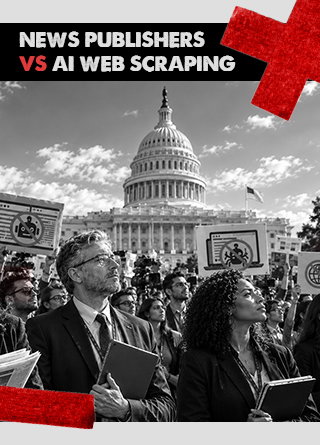
Publishers Take Their Fight Against AI Web Scraping To Washington
Share
TL;DR
That question is now at the center of a growing fight in Washington, where hundreds of publishers want Congress to set clearer rules for AI scraping and stealth bots.
-
More than 300 news publishers are pushing Congress to address deceptive AI crawling and stealth scraping practices.
-
The Stealth Bot Prohibition Act targets bots that conceal or misrepresent their identity rather than banning AI web scraping outright.
-
Publishers argue that hidden crawlers weaken their ability to enforce access controls, protect infrastructure, and negotiate licensing agreements.
-
The lobbying campaign comes alongside ongoing copyright lawsuits and broader disputes over how AI companies use publisher content.
-
The debate could shape future rules around crawler transparency, AI data access, and how websites control automated use of their content.
Introduction
In Mission: Impossible, getting past security often comes down to one thing: looking like someone you are not. A convincing disguise can turn a heavily guarded entrance into an open door, at least until someone realizes the identity does not match the visitor.
Publishers say something similar is happening on the web.
For years, the relationship was relatively straightforward. Publishers made content available online, search engines crawled it, and readers were directed back to the original websites. Generative AI has disrupted that arrangement by creating far more demand for online content, while some automated systems can obscure who they are, what they are collecting, or why they are accessing a site.
That has transformed AI web scraping from a technical issue into a wider debate over permission, transparency, copyright, traffic, and the value of journalism.
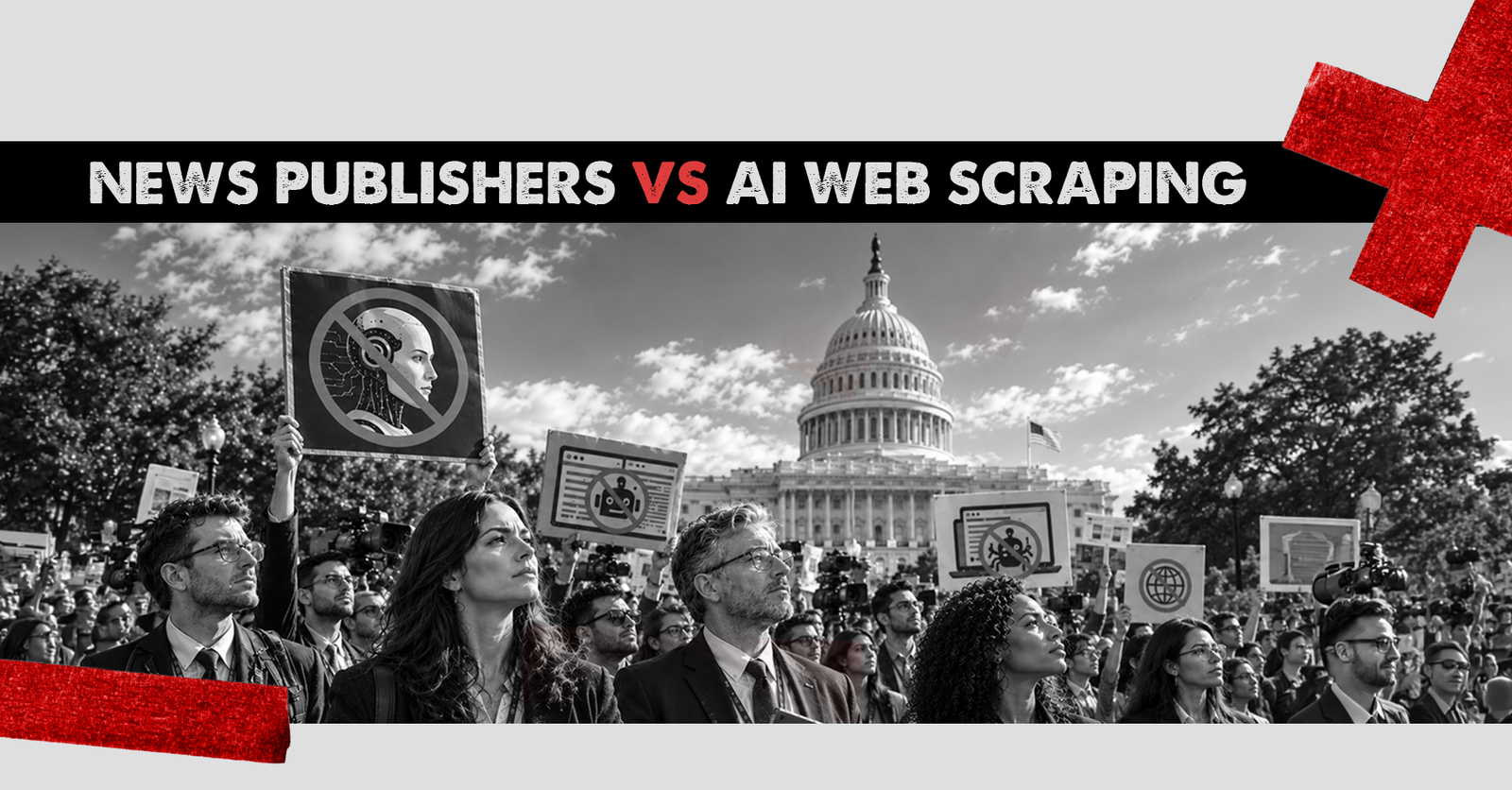
Now, the dispute has reached Washington. More than 300 news publishers are urging Congress to address deceptive crawling practices, with the Stealth Bot Prohibition Act emerging as a central part of that push. The proposal does not seek to ban web crawlers outright. Instead, it targets bots that disguise their identity or attempt to appear human while accessing online content.
For publishers, that brings the issue down to a surprisingly simple principle: if an automated system wants to enter, should the website at least know who is knocking?
Besides, what began as a technical problem for publishers has now become a policy issue. As blocking tools and licensing talks prove insufficient on their own, the industry is turning to Washington for clearer rules around how AI crawlers identify themselves and access online content.
Why Are News Publishers Lobbying In Washington Against AI Web Scraping?
To understand the concern, it helps to separate ordinary crawling from the behavior publishers are challenging.
Web crawlers have existed for decades. Search engines send automated programs across websites to discover and index webpages. Site owners can use tools such as robots.txt to communicate whether particular crawlers should access certain parts of their sites.
AI created new incentives for collecting content.
A news article might now be useful not only for traditional search indexing but also for training AI models, grounding chatbot answers, powering AI search products, or supplying information to autonomous agents.
Many publishers have responded by blocking identified AI crawlers, changing their terms of service, installing bot-management systems, or entering licensing negotiations with AI companies.
The problem, publishers argue, is that not every crawler clearly identifies itself.
Some automated systems can rotate IP addresses, use residential proxy networks, obscure their origin, or otherwise appear more like ordinary human traffic. That makes it much harder for a publisher to determine whether a visitor is a reader, a search crawler, an AI crawler, or another automated service.
The publishers fighting AI scrapers in Washington therefore are not simply asking Congress to settle every copyright question surrounding artificial intelligence. Their immediate legislative target is narrower: they want automated crawlers to be transparent about what they are doing.
That distinction is central to understanding the proposal.
As publishers push for clearer rules around AI crawling, their concerns are beginning to translate into concrete legislative proposals, led by the Stealth Bot Prohibition Act.
What Is The Stealth Bot Prohibition Act?
The Stealth Bot Prohibition Act, introduced as H.R. 9915 in July 2026, is a bipartisan House bill sponsored by Representative Laurel Lee, with Representatives Valerie Foushee and Gus Bilirakis among its original co-leads. As of October 1, 2026, the bill has been introduced and referred to the House Committee on Energy and Commerce. It has not become federal law.
So, what is the Stealth Bot Prohibition Act actually designed to do?
The proposal focuses on automated crawlers that conceal or misrepresent their identity.
It would prohibit deploying a stealth bot in ways reasonably likely to damage, impair, or burden the technical or commercial operation of a website or online service. It would also prohibit intentionally hiding or misrepresenting a bot's nature so that it appears to be a human user when collecting information for use with a generative AI model or service.
In practical terms, the legislation attempts to make one principle enforceable: if an automated system is crawling a website, it should not pretend to be something else.
The bill would give the Federal Trade Commission enforcement authority and also provides a role for state attorneys general under specified conditions. Civil penalties could be pursued against violators.
Significantly, the proposal should not be read as a prohibition on all AI crawling.
A properly identified crawler would not automatically become illegal merely because it is collecting online information. The bill instead concentrates on deceptive behavior and attempts to create clearer visibility into automated access.
That may sound like a technical distinction, but for publishers, it has major commercial implications.
The act’s emphasis on disclosure may sound technical, but for publishers, knowing who is accessing their content can directly affect how they protect, license, and monetize it.
Why Does Bot Identity Matter So Much To Publishers?
Imagine installing a security system that can block unwanted visitors, only to discover that those visitors can simply change clothes and walk through the front door again.
That is roughly the problem publishers describe with stealth crawling.
A publisher can decide that a known AI crawler should not access its website. But that choice becomes difficult to enforce if automated requests arrive through changing infrastructure or appear indistinguishable from human visitors.
The consequences are not limited to copyright.
Large volumes of automated traffic can consume bandwidth, increase infrastructure costs, complicate analytics, and force publishers to invest heavily in bot detection and website security.
Industry groups also argue that unidentified scraping weakens publishers' ability to negotiate licensing agreements because an AI company or intermediary may obtain similar material through other channels.
This is why transparency has become such a central part of the AI lobbying in DC.
Publishers want to know which automated services are accessing their websites and why. Once that identity is visible, they can decide whether to allow access, block it, negotiate terms, or pursue other remedies.
The Stealth Bot Prohibition Act does not itself settle what a fair licensing price should be. Instead, supporters view crawler identification as a prerequisite for any functioning licensing market.
When bot identity becomes difficult to verify, the problem stops being something publishers can solve with technical controls alone. That is why hundreds of media companies are now turning to Congress for a broader solution.
Why Are 300 Publishers Taking Their Fight Against AI To Congress?
The Washington campaign is notable not simply because publishers are lobbying but because of its scale.
Executives representing more than 300 news organizations traveled to Washington in late September 2026 as part of an industry campaign organized around the legislation.
Participants included executives connected with major magazine groups, newspaper companies, and local publishers, who met lawmakers and congressional staff to discuss AI scraping and automated access to journalism.
The coalition reflects how widely the issue now cuts across publishing.
Large national outlets may have substantial legal teams and technology resources, but local newspapers face many of the same crawling questions with fewer resources available to monitor automated traffic.
For publishers of every size, the concern is increasingly economic.
Journalism costs money to produce. Reporters, editors, photographers, designers, developers, legal teams, subscriptions, servers, and reporting infrastructure all require investment.
AI companies, meanwhile, benefit from access to high-quality, current information.
Publishers are therefore asking whether a digital ecosystem remains sustainable if AI products can derive value from journalism while reducing the need for users to visit the original site.
The answer is far from settled, but the trip to Washington shows that publishers no longer view the issue as something that can be solved entirely through technical blocking.
For publishers, the issue is no longer simply about detecting unwanted bots, but about whether they can meaningfully control who accesses their content, on what terms, and for what purpose.
The Bigger Battle Is About Permission, Not Just Bots
Stealth crawlers are only one part of a much larger disagreement between publishers and AI companies.
For years, news organizations have argued that AI developers should obtain permission before using copyrighted journalism for model training and other commercial AI applications.
Some AI developers have entered content-licensing agreements with publishers. At the same time, lawsuits continue to test whether the use of copyrighted material for AI development can qualify as fair use under US law.
That legal uncertainty has produced a patchwork of strategies.
Some publishers license their archives. Others block AI crawlers. Some do both. Others have turned to litigation.
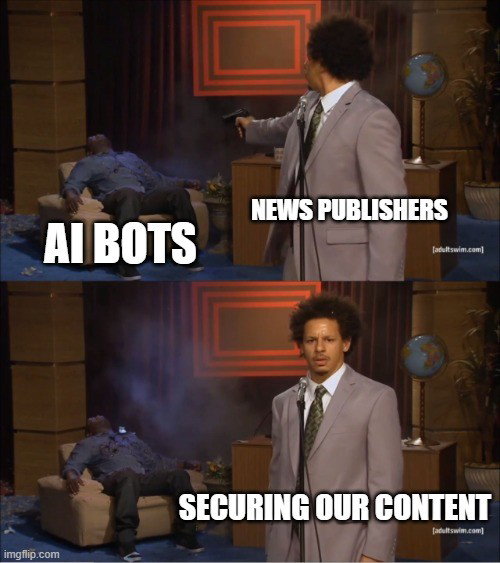
The result is that AI web scraping now sits at the intersection of at least three separate questions: whether content can legally be copied, whether technical restrictions should be respected, and whether publishers should be paid when AI businesses derive commercial value from their work.
The Stealth Bot Prohibition Act addresses only part of that puzzle.
Yet its narrower scope could also explain why publishers have rallied around it. Congress would not need to resolve the entire copyright debate to establish that an automated bot should accurately identify itself.
Once the dispute moves from bot behavior to who has the right to access and reuse publisher content, the next battleground naturally becomes legal. That is where lawsuits against AI companies enter the picture.
Publishers Are Also Taking AI Companies To Court
Washington is only one front in the dispute.
Several publishers have already pursued copyright cases involving AI companies, arguing that their journalism was copied without authorization for AI training or used in ways that compete with the original publications.
In September 2026, The Seattle Times and Newsday filed a federal lawsuit accusing OpenAI and Microsoft of copyright infringement connected with the alleged use of their journalism in AI systems.
The case joined a growing collection of disputes involving publishers, authors, technology companies, and AI developers over how copyrighted works can be used in model development.
The lawsuits against OpenAI and Microsoft are part of a much broader legal fight over AI scraping and publisher content.
Topics For More Insights:
Courts are still developing the boundaries of fair use in AI-related cases, and outcomes can depend heavily on how material was copied, what it was used for, whether the use was transformative, and how the AI product affects the market for the original work.
A separate 2026 appellate ruling involving Thomson Reuters and Ross Intelligence has also drawn attention because a federal appeals court rejected Ross Intelligence's fair-use defense over its use of Westlaw headnotes in developing a competing legal research tool.
However, that case involved a different type of AI system and different facts, so it does not automatically resolve disputes involving generative AI models.
Legislation and litigation are therefore advancing in parallel.
Courts are being asked what copyright law already permits, while publishers are asking lawmakers to create additional rules for how automated crawlers behave.
The lawsuits may define what AI companies can legally do with publisher content, but the next question is more practical: how could those legal and legislative pressures change the way AI firms access the open web in the first place?
Could This Change How AI Companies Access The Open Web?
Potentially, but not overnight.
If legislation such as the Stealth Bot Prohibition Act eventually becomes law and is effectively enforced, AI developers and data providers could face greater pressure to identify automated crawlers clearly.
That could make publisher blocking more effective.
It could also make licensing more attractive. If circumventing access controls becomes legally riskier and technically expensive, negotiating direct access to publisher content may become the simpler option for some companies.
However, AI companies obtain information through numerous channels, including licensed datasets, direct partnerships, public databases, search infrastructure, third-party data providers, user requests, and openly accessible webpages.
One crawler-transparency law would not determine the entire future of AI training or AI search.
What it could do is establish a clearer baseline for automated behavior on the web.
That is ultimately what the publishers in Washington are asking for: before the industry debates who gets paid, how much content AI can use, or whether a particular use qualifies as fair use, website owners should at least be able to tell when a machine is at the door.
Conclusion
The fight over AI web scraping is no longer just about content access. It now touches copyright, licensing, crawler transparency, infrastructure costs, and control over how journalism is used by AI systems.
The Stealth Bot Prohibition Act may address only one part of that debate, but the push from hundreds of publishers shows how quickly the issue has moved from technical defenses to federal policy. The bigger question now is not whether bots will crawl the web, but whether they should be required to clearly identify themselves when they do.
Frequently Asked Questions
How Is Stealth AI Scraping Different From Regular Web Crawling?
Regular crawlers typically identify themselves through a user agent and may follow website instructions such as robots.txt. Stealth scraping involves bots concealing or misrepresenting their identity, rotating infrastructure, or behaving like human visitors to avoid detection. That difference matters because it can prevent publishers from enforcing access preferences or distinguishing legitimate users from automated systems.
Could The Stealth Bot Prohibition Act Affect AI Training Even If It Does Not Ban Scraping?
Yes, indirectly. If AI companies and data providers are required to identify crawlers more clearly, publishers could enforce blocking rules more effectively and gain greater leverage in licensing negotiations. The bill would not determine whether AI training itself is lawful, but it could change how easily companies collect content from websites without direct agreements.
Why Are Publishers Pursuing Legislation When Copyright Lawsuits Are Already Underway?
Copyright lawsuits and crawler-transparency laws address different problems. Litigation asks whether specific uses of copyrighted material are legally permitted, while legislation such as the Stealth Bot Prohibition Act focuses on how automated systems access websites. Publishers are pursuing both because even a favorable copyright ruling would not necessarily solve issues involving disguised bots, server load, or enforcement of website access preferences.
Tue, Oct 13, 2026

Liked what you read? That’s only the tip of the tech iceberg!
Explore our vast collection of tech articles including introductory guides, product reviews, trends and more, stay up to date with the latest news, relish thought-provoking interviews and the hottest AI blogs, and tickle your funny bone with hilarious tech memes!
Plus, get access to branded insights from industry-leading global brands through informative white papers, engaging case studies, in-depth reports, enlightening videos and exciting events and webinars.
Dive into TechDogs' treasure trove today and Know Your World of technology like never before!
Disclaimer - Reference to any specific product, software or entity does not constitute an endorsement or recommendation by TechDogs nor should any data or content published be relied upon. The views expressed by TechDogs' members and guests are their own and their appearance on our site does not imply an endorsement of them or any entity they represent. Views and opinions expressed by TechDogs' Authors are those of the Authors and do not necessarily reflect the view of TechDogs or any of its officials. While we aim to provide valuable and helpful information, some content on TechDogs' site may not have been thoroughly reviewed for every detail or aspect. We encourage users to verify any information independently where necessary.
Loading comments...