
Artificial Intelligence
Jio TeleFrame: The New Voice-First AI Operating System For Indian Smart Homes
Share
TL;DR
-
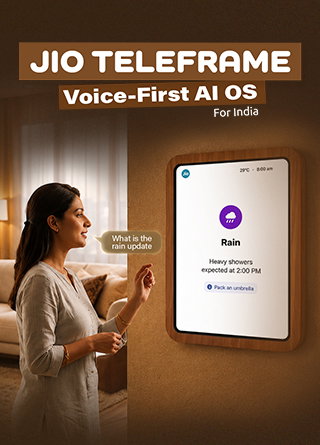
Jio TeleFrame aims to bring AI agents, voice commands, and smart home control into one connected home experience.
-
Unlike traditional smart home hubs, Jio TeleFrame focuses on outcomes such as planning, reminders, entertainment, and family routines.
-
Its voice-first AI approach could make smart homes more accessible for India’s multilingual and multi-generational households.
-
TeleFrame connects with Jio’s wider ecosystem, including JioHome, JioHotstar, MyJio.AI, and AI-powered services.
-
If executed well, Jio TeleFrame could redefine Indian smart homes by making AI feel less like an app and more like a family assistant.
Introduction
In the movie Back to the Future Part II, Marty McFly steps into the year 2015 and finds a home that feels strangely ahead of its time. Doors respond automatically, screens blend into daily life, and everyday routines feel shaped by technology that understands what people need before they ask too much. The movie imagined a future where the home was not just a place to live, but a space that reacted, assisted, and adapted.
Real smart homes, however, have not always reached that level of ease, especially for many Indian households. One app controls the lights, another manages entertainment, another handles shopping lists, while reminders, payments, calls and family routines sit somewhere else entirely.
Instead of feeling futuristic, the experience can feel scattered across more screens, more menus, and more minute tasks. This is the gap that Reliance Jio appears to be targeting with Jio TeleFrame, its new voice-first AI home hub introduced during the Reliance AGM 2026 announcements.
Rather than presenting it as another smart speaker or a basic connected-home controller, Jio is positioning TeleFrame as a shared home for AI agents inside Indian households, where family care, commerce, entertainment, and home automation can work together with user permission.
On that note, let’s understand what it is and how it works.
What Is Jio TeleFrame And How Does It Work?
Jio TeleFrame is being positioned as a Jio smart home operating system, built around voice-first and agentic AI. In simple terms, it is designed to act as a central home interface where different AI agents can coordinate everyday tasks. These agents may assist with family care, entertainment, shopping, guest planning, and smart home control from one shared place.
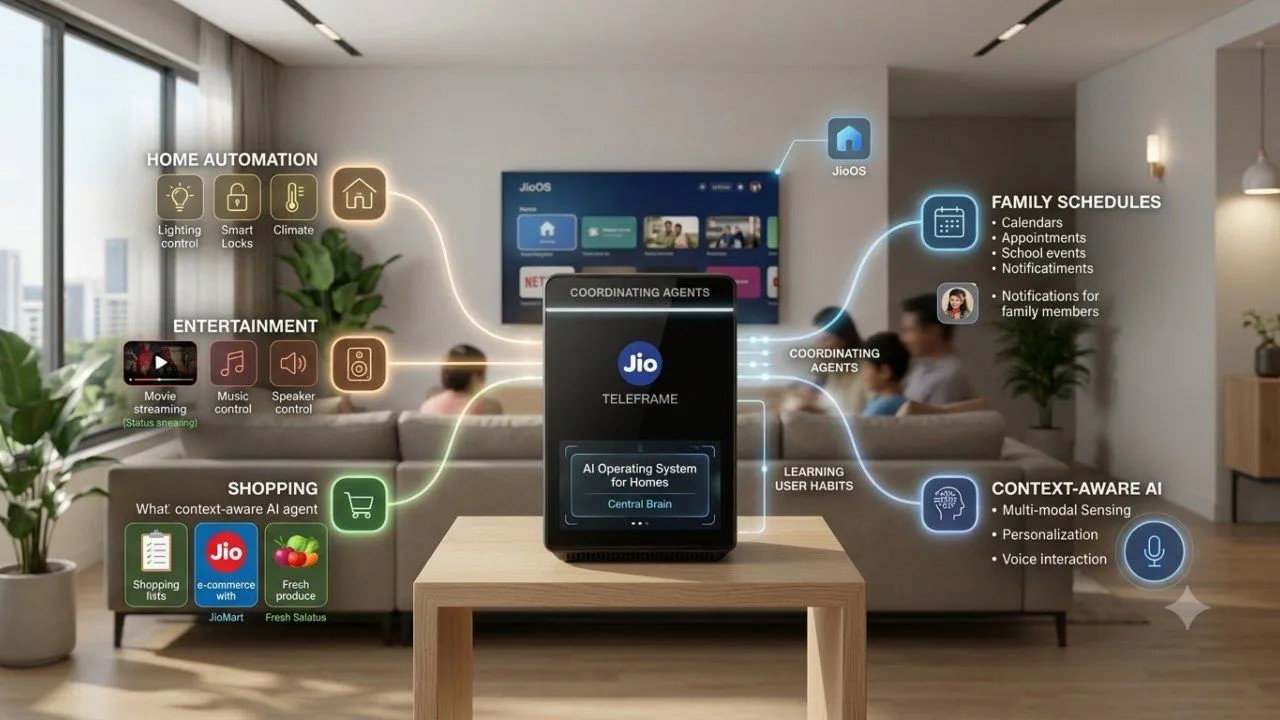
The crucial idea here is not just “AI in the home.” People already have smart speakers, smart TVs, connected appliances, and voice assistants. The bigger idea is orchestration. TeleFrame is meant to bring specialized AI agents together so they can act in context, with consent, instead of waiting for users to jump between apps or repeat instructions on loop.
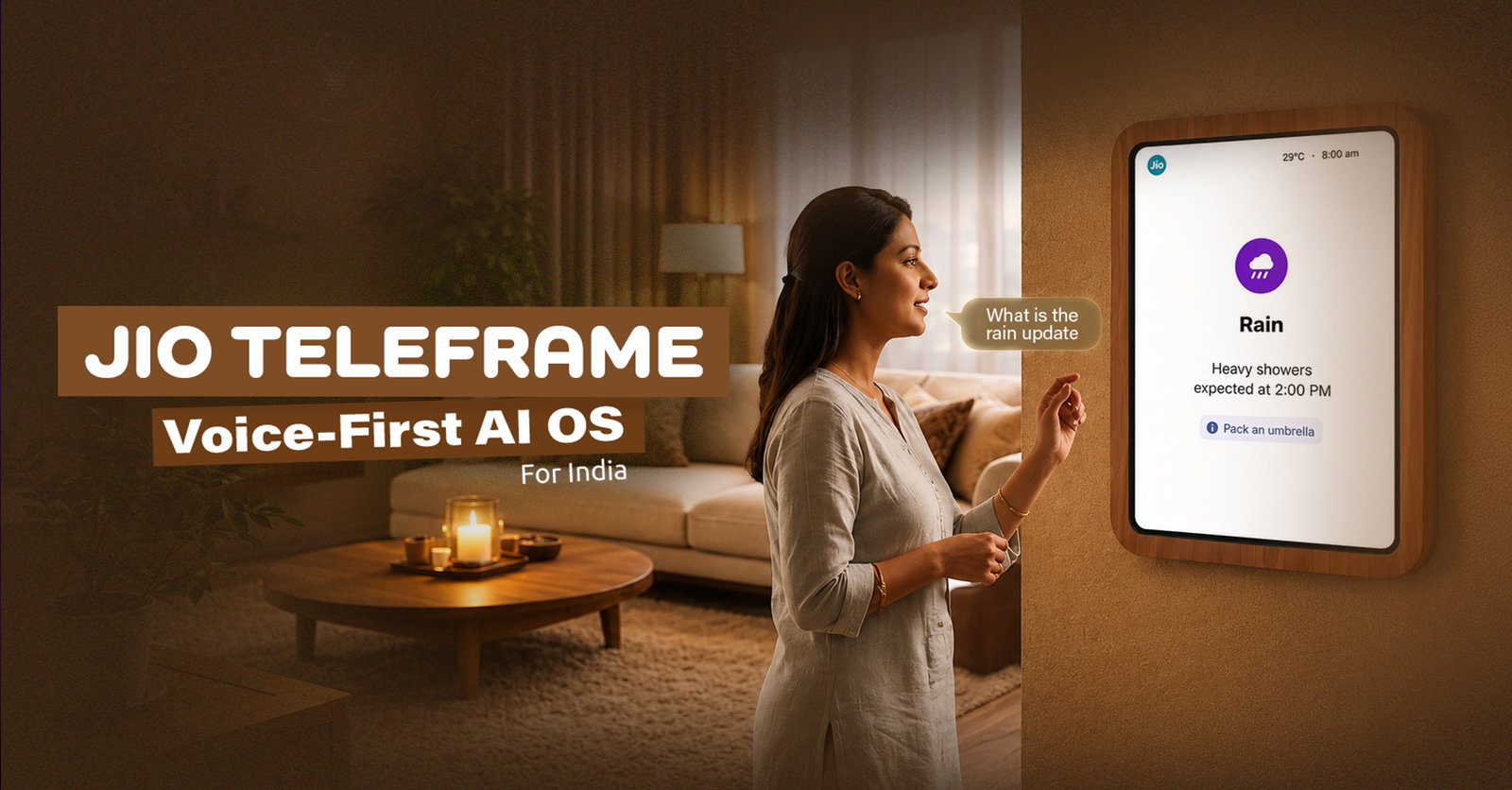
For example, Jio’s demo showed TeleFrame reminding a family about a doctor’s appointment, suggesting umbrellas because of possible rain, and helping plan a festival lunch by checking preferences, preparing a grocery list, and calling the market. It also showed an entertainment use case where an agent could open JioHotstar, adjust lights and volume, and keep score during viewing.
That is how Reliance Jio TeleFrame uses voice-first AI. It listens to natural requests, understands the family context, connects that context to relevant agents, and helps complete tasks without users manually navigating through multiple services.
That is where Jio TeleFrame’s real value appears: making smart homes easier for everyone through voice-powered AI.
Why Voice-First AI Matters In Indian Homes?
India is not a one-language market. A truly mass-market smart home product in India has to work across languages, age groups, comfort levels, and digital habits. That is where a voice-first AI home hub becomes more practical than a screen-first smart home dashboard.
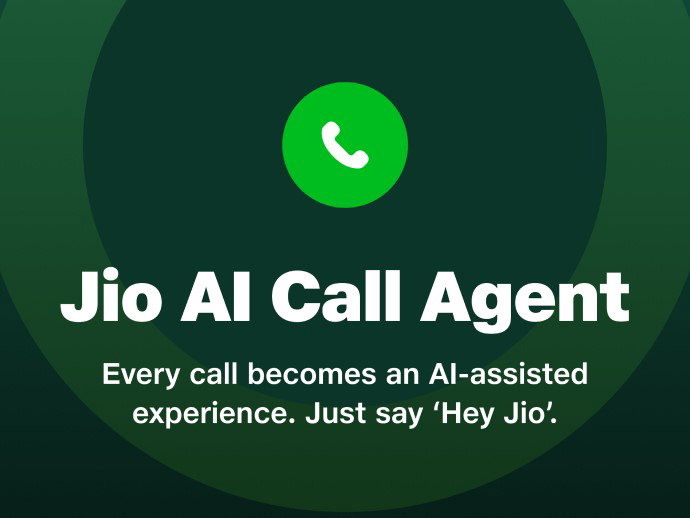
Jio says its newer AI experiences are being built with Indian languages in mind. Its AGM demos also highlighted consent-based AI interactions, including Jio AI Call Agent and MyJio.AI, both designed to work through natural language rather than traditional menus.
This matters because the smart home has often been designed for tech-savvy users. TeleFrame appears to be aimed at the family unit instead. A child, parent, grandparent, or guest need not remember the correct app, device name, or command structure. They should be able to ask in their own words.
That makes voice the real interface and AI the invisible layer behind it. Instead of “open app, select device, adjust settings,” the interaction could become “Hey Jio, set the living room for movie night” or “help me plan lunch for guests tomorrow.” If the system understands context, permissions, and household preferences, it can turn those simple requests into multiple coordinated actions.
As voice becomes a more natural way for families to interact with technology, the real test is whether smart home systems can move beyond simple commands and start coordinating everyday needs with context. That is where Jio TeleFrame begins to stand apart from conventional smart home gadgets.
The Difference Between Jio TeleFrame And Traditional Smart Home Hubs
The distinction between Jio TeleFrame and traditional smart home hubs comes down to purpose. Conventional hubs usually connect and control devices. They are useful for switching lights on and off, managing thermostats, setting routines, or linking appliances. However, they are mostly device-centered.
Jio TeleFrame is being positioned as agent-centered. That means the focus is not just on controlling hardware but on helping with outcomes. Planning, reminders, entertainment, shopping, household routines, and family care are not single-device tasks. They require context, coordination, and decision-making.
A traditional smart home hub may know that the living room light exists. A voice-first AI system should know that the family is watching a cricket match, the volume is too low, the lights need dimming, and someone may want snacks ordered. That is a very different experience.
TeleFrame also sits inside Jio’s broader ecosystem, which includes JioHome broadband, JioHotstar, MyJio.AI, and other Reliance Intelligence services. Besides, JioHome is being upgraded with up to 5 Gbps download and 1 Gbps upload speeds on Jio AirFiber, while JioHotstar is adding features such as AI Snapshot, content commerce, and Multiview.
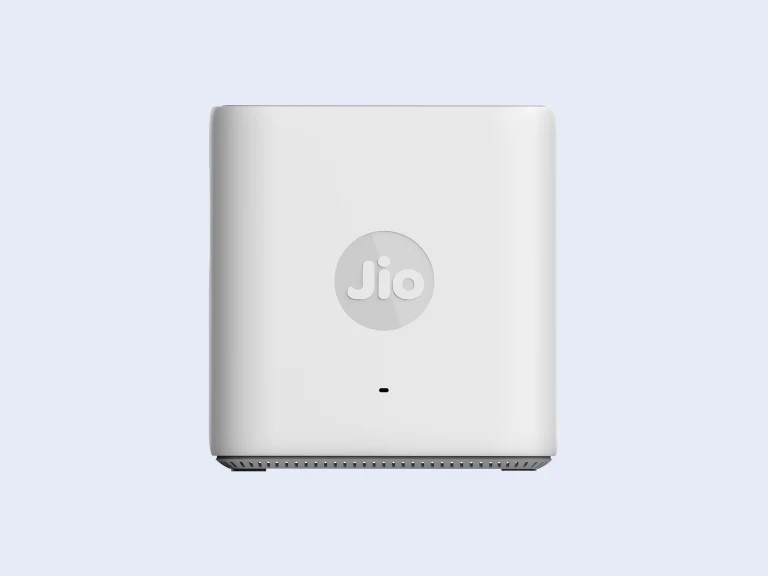
That ecosystem approach could give TeleFrame an advantage. It is not trying to be only a smart home controller. It is trying to become the AI layer across connectivity, content, commerce, and household assistance.
The shift from device control to outcome-based assistance is where AI agents come in, helping TeleFrame understand intent, connect tasks, and become part of everyday home routines.
The Role Of AI Agents In Daily Home Life
The phrase “AI agent” can sound technical, but in a home context, it simply means software that can understand a goal and take steps toward completing it. Instead of only answering a question, an AI agent may create a list, check preferences, call a service, trigger a device, summarize information, or suggest a next step.
Jio has described TeleFrame as a shared home for multiple agents that can support care, commerce, entertainment, and family routines.
Imagine a morning routine. A care agent could remind someone about medicine or an appointment. A weather-aware assistant could suggest carrying an umbrella. A commerce agent could add groceries to a list. An entertainment agent could later recommend content based on family viewing preferences. A home automation agent could adjust lights, screens, or connected devices.
The real value appears when these agents stop working in silos. A smart home becomes more useful when it understands that “guests are coming” may involve grocery planning, cleaning reminders, recipe suggestions, lighting, music, and entertainment. TeleFrame promises to give these agents one place to coordinate, with user access.
For AI agents to work smoothly at home, they need fast responses, connected devices, and reliable access across services. That makes strong home connectivity just as significant as the intelligence behind TeleFrame.
Why JioHome Connectivity Matters For TeleFrame
A powerful home AI system needs strong connectivity. That is why TeleFrame should not be seen separately from JioHome.
During the AGM demos, Jio highlighted next-generation JioHome broadband with suitable download and upload speeds, designed for multi-device households, 8K streaming, cloud gaming, spatial computing, and interactive online experiences. This is significant because the future smart home will not be limited to one phone and one TV. It may include multiple screens, cameras, appliances, wearables, entertainment devices, video calls, cloud gaming sessions, and AI assistants operating at the same time. A voice-first AI home hub needs low-friction connectivity to feel instant and reliable.
If TeleFrame is the brain of the AI-powered home, JioHome is the nervous system. Without fast and stable connectivity, even the smartest AI assistant becomes frustrating.
With reliable bandwidth, TeleFrame can support richer experiences such as multi-screen entertainment, real-time communication, and responsive home automation.
With that connectivity in place, TeleFrame’s impact becomes easier to see in everyday experiences, especially entertainment.
TeleFrame And Entertainment: More Than Just Watching TV
One of the most interesting parts of Jio’s broader home strategy is entertainment. JioHotstar is not just being presented as a streaming service. Jio highlights AI Snapshot for personalized recaps, content commerce for shopping what users see on-screen, and Multiview for watching sport, entertainment, and news side by side on one screen.
TeleFrame could make these features feel more natural. Instead of opening menus, searching for content, changing settings, and adjusting devices separately, a user could simply ask. The AI agent could bring up a match, dim the lights, switch audio focus, recommend a recap, or help shop something visible in the content experience.
This is where TeleFrame moves beyond the idea of a smart speaker. It becomes a control surface for the home’s digital life. Entertainment is no longer just content playback. It becomes interactive, personalized, and connected to commerce, family preferences, and the room environment.
Entertainment may be the easiest way to experience TeleFrame, but it also points to Jio’s larger goal: making AI the connective layer across the digital home.
What TeleFrame Reveals About Jio’s Larger AI Strategy
The Reliance AGM 2026 announcements show that Jio is not treating AI as a single product feature. It is trying to build AI across calls, customer service, broadband, streaming, and home experiences.
Jio AI Call Agent can join calls, take notes, identify up to ten speakers, create summaries, and even help with tasks such as booking food or cabs, with consent. Moreover, MyJio.AI is being positioned as a conversational advisor for Jio services.
TeleFrame fits into this bigger picture. It brings AI from the phone and app layer into the physical home. That is a meaningful change. For years, telecom companies focused mainly on connectivity. Jio’s new direction suggests that connectivity may become the base layer, while AI-powered services become the everyday experience above it.
In other words, Jio does not want to only connect the Indian home; it wants to operate the intelligent layer inside it.
Conclusion: Is Jio TeleFrame The Future Of Indian Smart Homes?
Jio TeleFrame is still an emerging product concept, but the direction is clear. The Indian smart home is moving from connected devices to coordinated intelligence. The next phase may not be defined by how many devices a home has but by how well those devices, services, and agents work together.
That is why TeleFrame is worth watching. It combines three major shifts: voice-first interaction, AI agents, and ecosystem-level home connectivity. It also reflects Jio’s larger ambition to move from telecom services to AI-driven digital infrastructure for everyday life.
For users, the appeal is simple. Instead of opening apps, searching menus, or manually controlling everything, they may be able to speak naturally and let the home respond intelligently. For the market, the bigger question is whether Jio can turn that vision into a reliable, affordable, and privacy-conscious experience at scale.
If it succeeds, Jio TeleFrame may not be remembered as just another device from an AGM stage. It could become an early blueprint for how Indian households interact with AI: not through isolated apps, but through a shared, voice-first, family-aware operating system for the home.
Frequently Asked Questions
How Is Jio TeleFrame Different From Regular Voice Assistants In Smart Homes?
Jio TeleFrame is positioned as a voice-first AI home hub that can coordinate multiple AI agents, not just answer commands.
Instead of controlling one device at a time, it aims to connect routines, entertainment, commerce, and family care into one shared home experience.
Why Does Jio TeleFrame Matter For India’s Smart Home Market?
India’s homes are multilingual, multi-generational, and often shared by users with different levels of digital comfort.
A voice-first AI system could make smart home control more accessible than app-heavy setups that require constant screen navigation.
Can Jio TeleFrame Become The Operating System For Indian Smart Homes?
It has the potential to act like a home-level AI layer if it successfully connects JioHome, JioHotstar, MyJio.AI, and smart devices.
However, its success will depend on reliability, privacy controls, language support, device compatibility, and user trust.
Mon, Aug 10, 2026

Liked what you read? That’s only the tip of the tech iceberg!
Explore our vast collection of tech articles including introductory guides, product reviews, trends and more, stay up to date with the latest news, relish thought-provoking interviews and the hottest AI blogs, and tickle your funny bone with hilarious tech memes!
Plus, get access to branded insights from industry-leading global brands through informative white papers, engaging case studies, in-depth reports, enlightening videos and exciting events and webinars.
Dive into TechDogs' treasure trove today and Know Your World of technology like never before!
Disclaimer - Reference to any specific product, software or entity does not constitute an endorsement or recommendation by TechDogs nor should any data or content published be relied upon. The views expressed by TechDogs' members and guests are their own and their appearance on our site does not imply an endorsement of them or any entity they represent. Views and opinions expressed by TechDogs' Authors are those of the Authors and do not necessarily reflect the view of TechDogs or any of its officials. While we aim to provide valuable and helpful information, some content on TechDogs' site may not have been thoroughly reviewed for every detail or aspect. We encourage users to verify any information independently where necessary.
Loading comments...