
Hospitality Technology
Hospitality Technology Trends Elevating Guest Experiences In 2026
Share
TL;DR
-
AI-Driven Hyper-Personalization: 45.2% of guests will consent to sharing information in exchange for better service (Oracle Hospitality 2025). Booking.com reports 67% of guests now use AI for travel planning, raising the personalization baseline across the industry.
-
Hospitality Robotics: 76% of hotels are struggling to fill staff roles (AHLA), making robotic automation an operational necessity, not a novelty.
-
Composable Hospitality Tech Stacks: Hospitality tech startups raised $1 billion+ across 40 companies between April 2025 and March 2026, with PMS and AI-led platforms capturing the largest share.
-
Immersive and Mixed Reality: 68% of hotel operators expect VR for staff training to be mainstream. Consumer demand for virtual tours is accelerating pre-booking engagement.
-
Wellness and Health Tech: The global wellness tourism market is projected to reach $2.1 trillion by 2030, with hotels capturing a growing share through embedded health-tech integrations.
Introduction
Monsieur Gustave H. ran the Grand Budapest Hotel on a principle most modern hotels cannot match: he knew every guest's name, their preferred perfume, their favourite table, and what they needed before they asked. Not because he had a system, but because he paid attention. In 2026, hospitality technology is building the algorithmic version of Monsieur Gustave: a hotel that knows you before you arrive, adapts while you stay, and remembers you for next time.
Remember when a smart hotel room meant the TV remote had dedicated buttons for OTT platforms? Yeah, we've come a long way from there!
If you read the Hospitality Tech Trends of 2025, you will remember a strong focus on smart energy and sustainability initiatives, bleisure-based accommodations, IoT-enabled rooms, data-driven loyalty programs, and early-stage digital integrations in hotel rooms. Most trends were in their pilot or early adoption modes. In 2026, experimentation becomes infrastructure. Hospitality leaders are no longer looking to try new technologies; they are focused on how quickly they can integrate existing ones to elevate the experience.
From robotics and wellness tech to unified cloud systems, these five emerging trends are set to redefine hospitality technology. While some feel incremental, others are disruptive. All of them answer the same question: how do we delight guests before they even ask?
Trend 1: AI-Driven Hyper-Personalization Will Support Predictive Guest Journeys
Monsieur Gustave operated on intuition, but intuition at scale does not exist. In 2026, AI-powered personalization is what fills that gap. Instead of reacting to guest requests, AI models ingest guests' data, previous stay history, in-hotel behavior, routines, and external signals to anticipate their needs before they surface.
In 2025, personalization was everywhere and beginning to become a buzzword. In 2026, we will see predictive personalization. This allows staff to offer an in-house service, recommend an activity, or upgrade amenities based on a guest's actual needs. Hospitality leaders are combining first-party guest data with real-time AI analytics to deliver personalized experiences, including micro-moment predictions and relevant actions.
How Is The Industry Responding?
Booking.com's latest Global AI Sentiment Report found that 67% of guests now use AI for travel planning, raising the personalization baseline that guests expect when they arrive. We're already seeing hotel groups and hospitality vendors lean into this. For instance, Otonomus Hotel in Las Vegas promotes itself as 'the world's first true AI-powered hotel', integrating predictive guest preferences into room setup and service touchpoints. Its AI tool collects guest preferences through a gamified onboarding questionnaire and, with consent, can scrape publicly available data to understand and anticipate individual preferences throughout the stay.
Moreover, hoteliers are using predictive AI insights to adjust pricing, inventory, marketing campaigns, and booking offers. This aligns with customer expectations: the Oracle Hospitality 2025 report notes that 45.2% of guests would consent to sharing information if it leads to better service during their stay.
Philippe Ziade, founder and CEO of Otonomus Hotel, says: "Our AI-driven system learns and adapts to individual preferences, allowing us to anticipate needs before they arise. Imagine walking into a hotel where everything is customized just for you. We are not just meeting guest expectations; we are exceeding them at every turn."
The shift is clear: in 2026, personalization is no longer a differentiator; it is becoming the expected baseline. The hotels that operate without predictive AI are not just missing an upgrade; they are falling behind a standard that guests already experience in every other digital interaction.
Challenges To Watch
A key challenge for many hotel systems is effectively unifying and leveraging fragmented guest data to deliver accurate predictions. Privacy and regulatory constraints make it risky to use personal information without undermining guest trust. Predictive models can also misinterpret data signals and make suggestions that feel irrelevant or intrusive, leading to higher time and cost investments in training AI models.
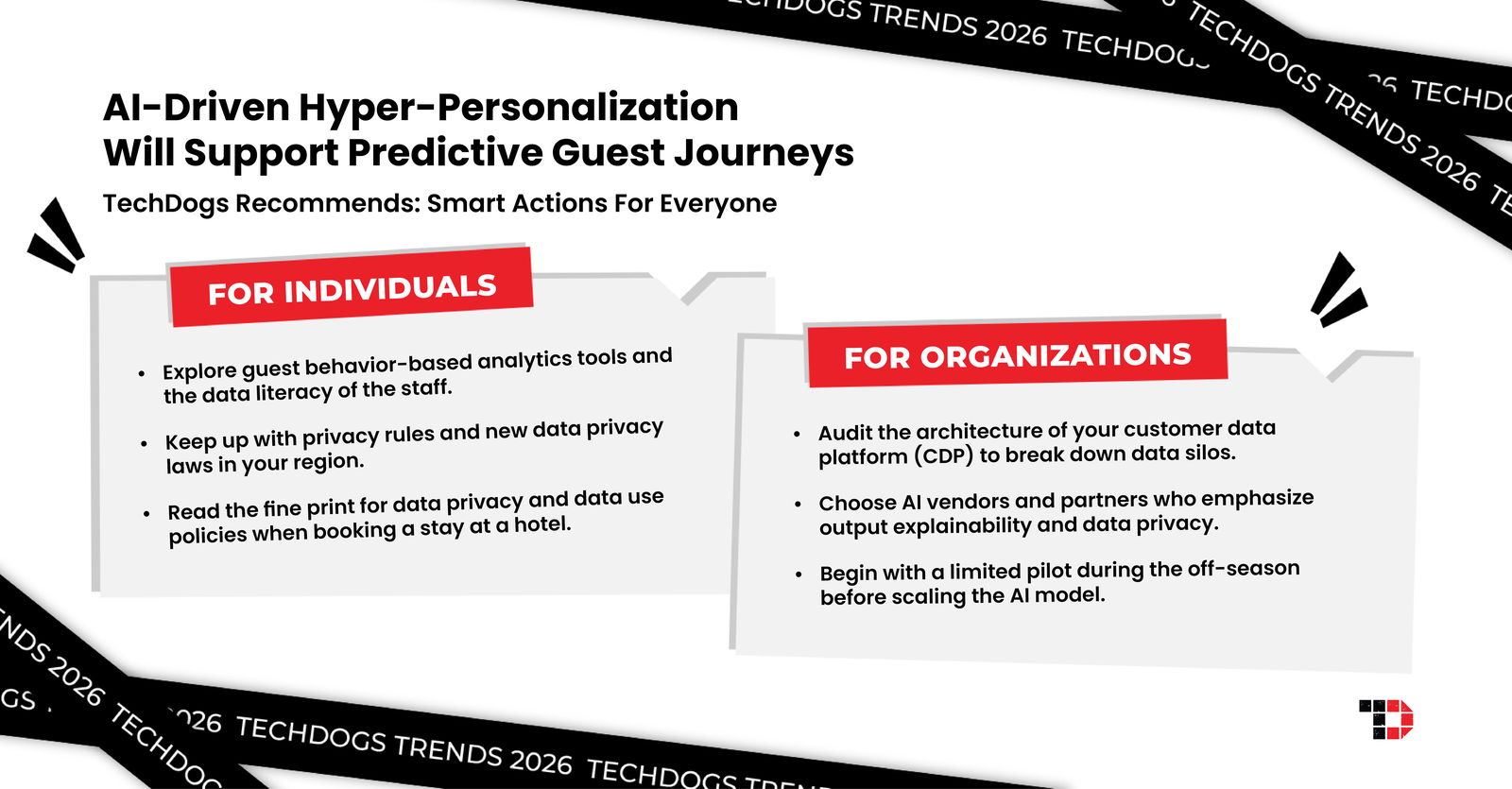
TechDogs Recommends: Smart Actions For Everyone
Trend 2: Hospitality Leaders Will Adopt Autonomous Robots For Operations
Even until last year, robots were often limited to novelty applications in hospitality. In 2026, robots are part of housekeeping, logistics, deliveries, and internal support workflows. Labor shortages are making this shift more urgent, and soon, robotic helpers will be a routine sight in operational zones, not just guest-facing settings.
How Is The Industry Responding?
The global hospitality robot market is projected to grow from $20.6 billion to $126.4 billion over the next decade, according to recent market analysis. That scale reflects a structural shift, not a niche trend. The American Hotel & Lodging Association reported that 76% of hotels are struggling to fill staff roles, leading to increased demand for robots and automated systems.
Hospitality leaders have begun testing robots for room deliveries, corridor cleaning, and internal logistics, with clear process design, integration planning, and incremental deployment resulting in successful operations. Many vendors and operators now view robotics as operational leverage, with Future Hospitality Ventures striking a partnership with Bear Robotics, saying: "As the hospitality industry grapples with labor shortages, rising operational costs, and an increasing demand for seamless guest experiences, FHV, in partnership with Bear Robotics, is taking proactive steps to address these needs. The introduction of AI-powered service robots, including Bear Robotics' flagship 'Servi' robot, will optimize operations in hotels, restaurants, and event spaces, allowing staff to focus on enhancing the guest experience."
What this means in practice: robots are not replacing hospitality staff; they are enabling them. The cobotics model that WorldVue and others are piloting in 2026 sees robots handle the physically demanding, repetitive tasks while human staff focus entirely on the judgment-dependent, personalization-oriented work that guests actually remember.
Challenges To Watch
Key challenges include high upfront capital and maintenance costs, while partnering with a vendor for hardware updates and infrastructure adaptation also remains a barrier. Structural constraints, stairs, narrow corridors, and ramps often limit robot usability. Hospitality staff may also resist robotic deployment due to fears of job displacement, making change management and training critical.
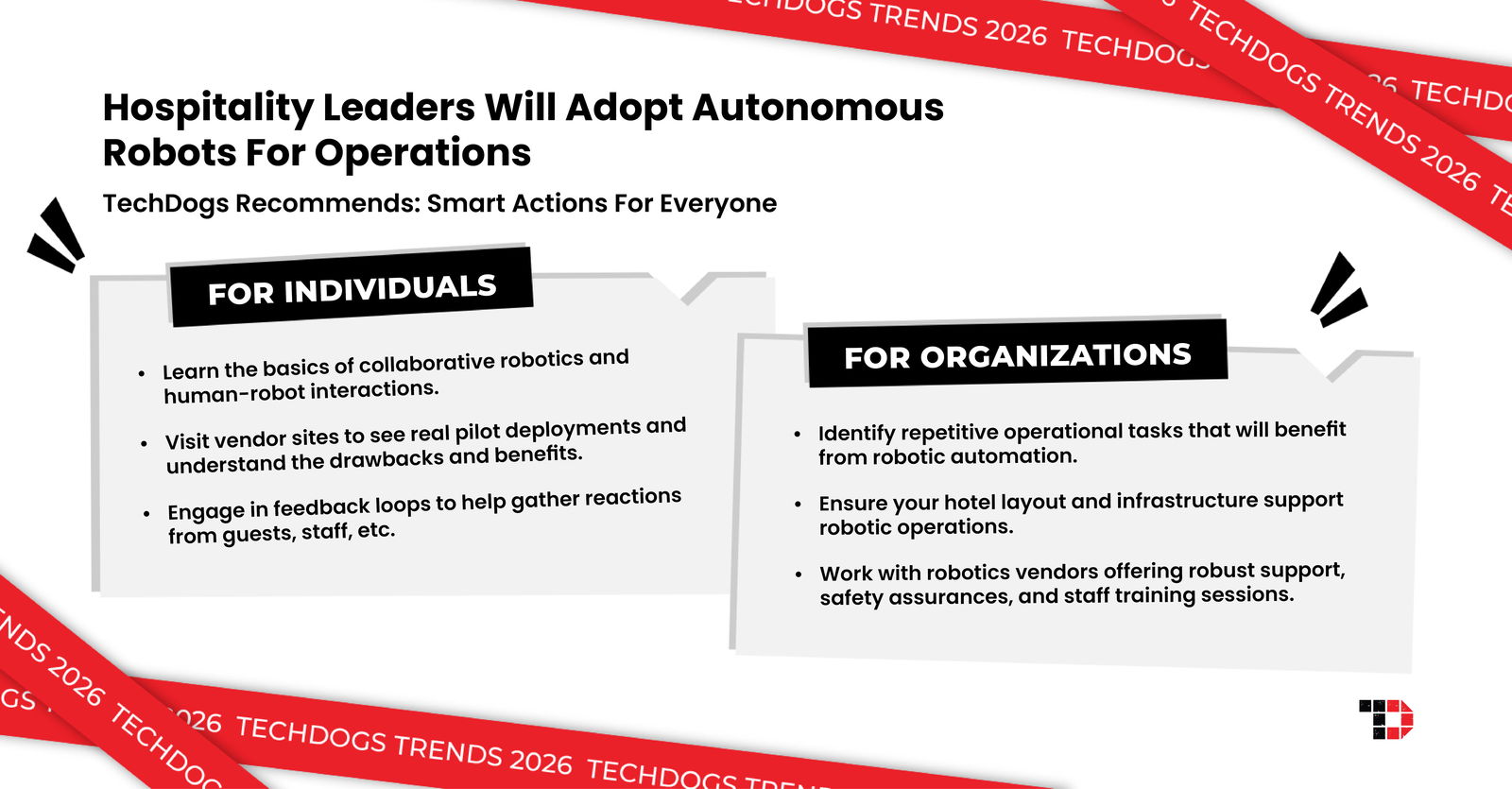
TechDogs Recommends: Smart Actions For Everyone
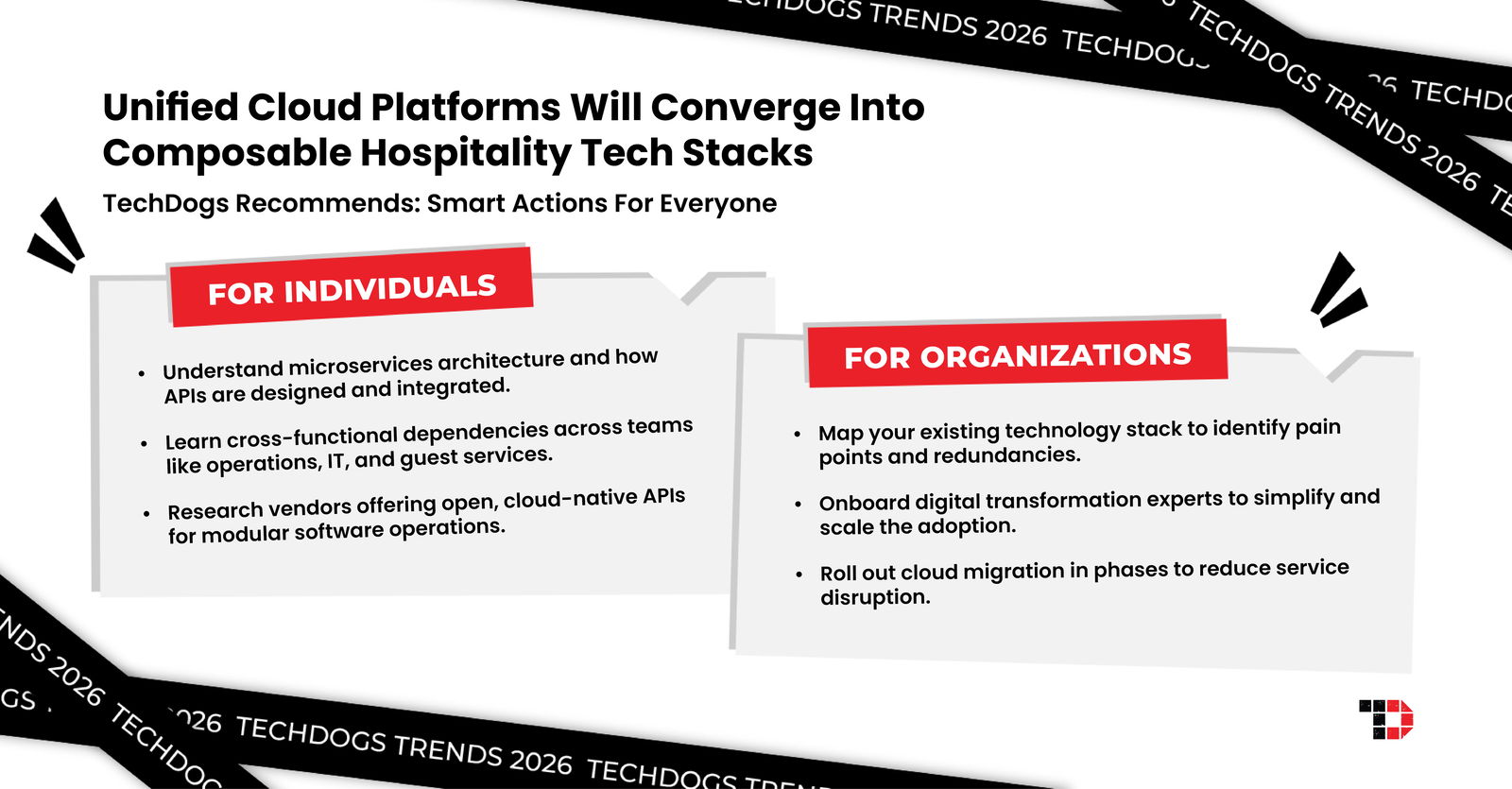
Trend 3: Unified Cloud Platforms Will Converge Into Composable Hospitality Tech Stacks
In 2025, most hospitality vendors juggled and struggled with separate systems: Property Management System, Customer Relationship Management Software, booking engines, workforce management tools, and more. Apart from a frustrating user experience, this led to fragmented data, lag in information transfer, and loss of context for decision-making.
In 2026, the appeal of unified cloud platforms and composable systems is stronger than ever. With modular, API-first, cloud-native stacks, each component can be swapped, scaled, or integrated swiftly as needs change. We expect more hospitality operators to adopt cloud-based architecture to enable agility, reduce friction between touchpoints, and boost innovation.
How Is The Industry Responding?
Investment signals the shift. Hospitality technology startups raised more than $1 billion across 40 companies between April 2025 and March 2026, with PMS and AI-led platforms capturing the largest share, a clear signal that investors are backing the core operational infrastructure that connects everything else.
Spending on the hospitality management software market is expected to grow from $7.52 billion in 2025 to over $10.52 billion by 2030, according to Mordor Intelligence. Yet this spending has created software sprawl that is getting harder to manage, so vendors are pivoting to modular, API-based models to help consolidate software footprints.
According to a 2025 industry survey, three in four hotel operators reported issues during the integration of multiple applications, causing friction and operational drag. This incentivizes operators to deploy interconnected cloud platforms for staff and guests alike, a single cohesive dashboard for managing bookings, in-stay services, feedback, and billing.
Martin Reichenbach, the founder of Apaleo, highlights in a blog: "The concept of composable hospitality allows hotel operators to continuously evolve their services and stay competitive, regardless of their size. We're already seeing some of the 'new kids on the block' apply composable hospitality at the very core of their businesses, ultimately giving them a competitive edge."
The advantage is shifting to operators who treat their tech stack as a living architecture rather than a fixed installation. The composable model means a new revenue management tool, loyalty engine, or AI-personalization layer can be added in days, not a six-month integration project.
Challenges To Watch
The primary challenge is the complexity of migrating from legacy systems to a cloud-based modular architecture. This can cause data migration errors, downtime, or compatibility issues. Modular systems can also be vulnerable to vendor lock-in, especially those using proprietary APIs, making interoperability a challenge.
TechDogs Recommends: Smart Actions For Everyone
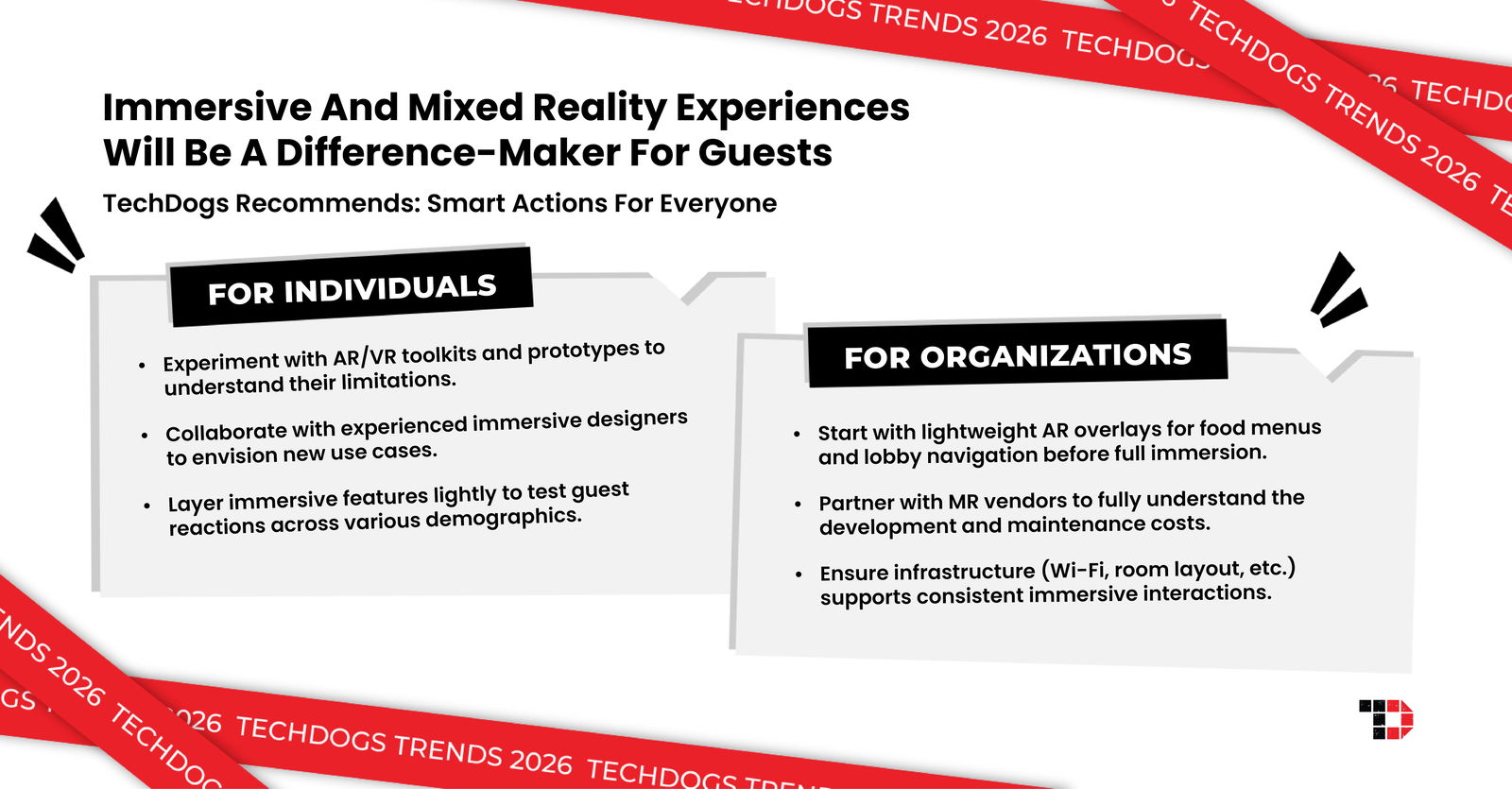
Trend 4: Immersive And Mixed Reality Experiences Will Be A Difference-Maker For Guests
Hotels and brands boasting about experimental VR tours, AR room previews, and immersive lobby features used to feel like a scene from a sci-fi flick. Not anymore. Today, immersive and mixed reality (MR, a combination of AR/VR) experiences are real game-changers for hospitality. In 2026, MR and immersive content are being embedded directly into the guest experience: AR overlays inside hotel rooms, interactive VR environments tailored to each individual, and context-aware storytelling layered across physical spaces.
How Is The Industry Responding?
The AR/VR share in hospitality markets is expected to grow at a CAGR of 34.2% by 2028, according to BlueWeave Consulting, driven by rising demand for virtual tourism and 360-degree immersive interactions. Hotel properties and venues have deployed MR previews and immersive installations, while testing AR-based overlays for menus, signage, and art guides.
Oracle Hospitality's 'HOTEL 2025' report showed that 68% of hotel operators believe virtual reality for staff training would be mainstream or in mass adoption by 2025. Plus, 66% of consumers said virtual reality tours of properties enhanced their experience, with 45% saying they would visit more often if hotels offered this service.
Joseph Pierce, Director of Appraisal & Consulting Services with Hotel & Leisure Advisors, mentions: "Immersive experiences are not entirely new to hospitality and leisure; theme parks, destination hotels and resorts, and cultural attractions have long found ways to draw guests into unique worlds. What is changing is how properties are increasingly using technology to push those experiences further, creating spaces that blur the lines between the physical and digital and redefine what guests expect from leisure destinations."
The reality is this: immersive technology is no longer primarily about novelty. Pre-arrival VR tours reduce booking hesitation. In-room AR overlays replace static menus and signage. Post-stay, the emotional connection created by immersive experiences directly drives repeat bookings. The investment case is clearer in 2026 than it has ever been.
Challenges To Watch
Immersive hardware requires significant upfront investment, making it an expensive and risk-prone decision. Network latency and connectivity issues can degrade the experience, especially when real-time rendering or overlays are involved. Some guests may prefer low-tech stays and might find immersive media irrelevant or uncomfortable.
TechDogs Recommends: Smart Actions For Everyone
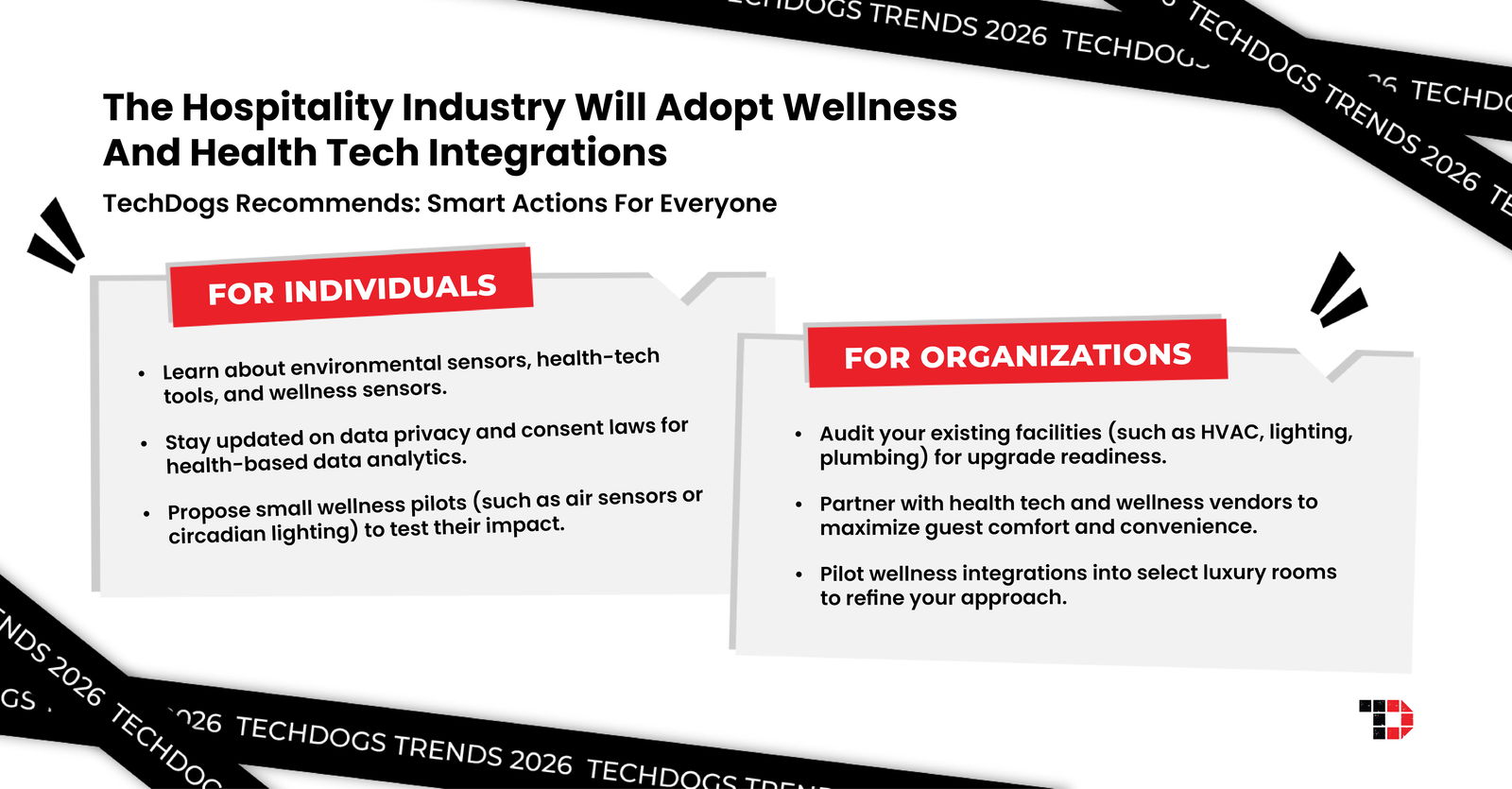
Trend 5: The Hospitality Industry Will Adopt Wellness And Health Tech Integrations
Wellness has long been associated with hospitality, and in 2026, it is becoming a core aspect of the overall infrastructure, not a spa add-on. Environmental sensors, sleep-tracking technology, circadian lighting, and air quality monitoring are now entering the room. To meet evolving guest expectations, wellness tech is creating spaces that respond to their occupants' well-being rather than just their service requests.
How Is The Industry Responding?
The scale of the opportunity is hard to overstate. The global wellness tourism market is projected to reach $2.1 trillion by 2030, with accommodation capturing a growing share. The wellness hotel market, worth $18.16 billion, has continued its upward trajectory in 2026 and is on track to reach a valuation of $34.2 billion by 2033-2034. Some luxury hotels have started marketing 'healthy stay' rooms fitted with health sensors, personalized lighting, and filtered water to cater to this fast-growing segment of travelers.
A survey by FreshAir Sensor showed that over 90% of respondents found value in being able to choose a room with a guaranteed higher standard of air quality. According to the Global Wellness Institute, sleep, spa, and wellness-focused amenities are expected to contribute over 10% to hotel revenue by 2028.
Sal Capizzi, SVP of Spa & Wellness at Agilysys, validates: "Traditional spa and fitness services are evolving into wellness journeys, driven by technological innovation and changing guest expectations. Today's travellers seek personalized wellness experiences that integrate with every aspect of their stay."
The takeaway for organizations: wellness technology is not a luxury tier add-on anymore. With the global wellness tourism market approaching $2.1 trillion by 2030, properties that build wellness into their infrastructure, not just their brochures, will command premium positioning and measurably higher guest satisfaction scores.
Challenges To Watch
Integrating wellness hardware is a key challenge, as maintaining and calibrating sensors, devices, and networks can be resource-intensive. Misreadings can damage guest trust, while collecting biometric or health data raises privacy concerns. Retrofitting legacy infrastructure for advanced wellness features can be prohibitively expensive.
TechDogs Recommends: Smart Actions For Everyone
Conclusion
Monsieur Gustave H. would recognize something familiar in 2026's hospitality technology: the goal has never changed. Know the guest. Anticipate the need. Make the experience feel effortless. What has changed is the scale at which it is now possible. Where Gustave needed a singular, brilliant instinct, today's operators have AI, cloud-native architecture, robotics, immersive experiences, and wellness tech working together to deliver the same result: a guest who never has to ask, because the hotel already knows.
Together, these five trends, AI-driven predictive personalization, autonomous robotic operations, composable cloud-native systems, immersive and mixed reality adoption, and wellness-embedded integrations, represent what's at the forefront of hospitality technology in 2026.
These trends apply to hotels, restaurants, lodges, event venues, theme parks, and every other business that accommodates guests. Start with a pilot adoption, refine with planning and iteration, and scale with pragmatism. After all, hospitality has always been about making guests feel like staying longer.
Frequently Asked Questions
What Are The Top Hospitality Technology Trends Shaping 2026?
The top hospitality technology trends of 2026 include AI-driven predictive personalization, autonomous robots for hotel operations, unified cloud platforms converging into composable tech stacks, immersive and mixed reality guest experiences, and wellness-focused technology integrations.
How Are Hotels Using AI And Robotics To Improve Guest Experiences In 2026?
In 2026, hotels are using AI to predict guest preferences and personalize every aspect of the stay, from room temperature to dining recommendations, while robotics are being deployed to automate tasks like cleaning, deliveries, and logistics. Booking.com reports 67% of guests already use AI for travel planning, raising the personalization standard hotels must meet. The global hospitality robot market is projected to grow from $20.6 billion to $126.4 billion over the next decade, reflecting the structural role automation is playing in addressing widespread labor shortages.
Why Are Immersive Technologies And Wellness Integrations Becoming Critical In Hospitality?
Immersive technologies like AR and VR enable hotels to create engaging, interactive guest experiences, from virtual tours to personalized digital environments. Meanwhile, wellness integrations, such as sleep-tracking systems, air-quality sensors, and circadian lighting, cater to the growing demand for health-conscious travel. With the global wellness tourism market projected to reach $2.1 trillion by 2030, the wellness-integrated property is no longer a niche category, it is an emerging standard.
Thu, Nov 20, 2025

Enjoyed what you read? Great news – there’s a lot more to explore!
Dive into our content repository of the latest tech news, a diverse range of articles spanning introductory guides, product reviews, trends and more, along with engaging interviews, up-to-date AI blogs and hilarious tech memes!
Also explore our collection of branded insights via informative white papers, enlightening case studies, in-depth reports, educational videos and exciting events and webinars from leading global brands.
Head to the TechDogs homepage to Know Your World of technology today!
Disclaimer - Reference to any specific product, software or entity does not constitute an endorsement or recommendation by TechDogs nor should any data or content published be relied upon. The views expressed by TechDogs' members and guests are their own and their appearance on our site does not imply an endorsement of them or any entity they represent. Views and opinions expressed by TechDogs' Authors are those of the Authors and do not necessarily reflect the view of TechDogs or any of its officials. While we aim to provide valuable and helpful information, some content on TechDogs' site may not have been thoroughly reviewed for every detail or aspect. We encourage users to verify any information independently where necessary.
Loading comments...