

Digital Marketing
Top 5 Web Analytics Tools Of 2026
Share
TL;DR
Web analytics tools provide essential data-driven insights to optimize website performance, enhance user experience, and drive measurable business growth.
-
Google Analytics 4: Offers powerful AI-driven predictive insights and seamless integration across the entire Google marketing ecosystem.
-
Amplitude: Specializes in deep event-driven behavioral analytics and retention tracking for product-led growth and optimization.
-
Adobe Analytics: Delivers a sophisticated, unified ecosystem for large enterprises requiring complex cross-channel customer journey modeling.
-
Plausible Analytics: Provides a privacy-first, lightweight alternative with cookie-free tracking and a clean, user-friendly interface.
-
Mixpanel: Excels at real-time product analytics, offering granular operational intelligence through advanced funnel and cohort segmentation.
Introduction
Remember the childhood anxiety of waiting for exam results? Those grade reports and parent-teacher meetings were often stressful, yet they remained vital for understanding our academic progress and identifying where we needed to improve. Just as those early evaluations shaped our growth, today’s digital landscape uses metrics to define success and guide development. This analytical mindset ensures we aren't just guessing but actually moving toward our goals with precision. In the modern era, the numbers haven't disappeared; they have simply evolved into sophisticated website metrics.
Businesses now rely on these digital report cards to track everything from reader origins to newsletter conversion rates. By acting like a digital Sherlock Holmes, web analytics tools uncover essential clues about what resonates with an audience and what falls flat. These platforms allow organizations to optimize performance, enhance user experiences, and boost overall sales through informed, data-driven decisions. Explore these 5 premier Web Analytics Tools to gain a competitive edge in 2026. Read on!
What Are Web Analytics Tools?
Web Analytics Tools are platforms designed to collect, report, and analyze data about user interactions with a website. They help businesses measure user behavior, optimize website performance, and achieve goals like boosting conversions and sales. They are like a digital Sherlock Holmes, discovering clues about what is working for your audience and what isn’t.
With these tools, you can track traffic volume, bounce rates, time spent on pages, and visitor demographics. Want to know which users are spending the most time on the meme page and who isn’t? Well, these tools have got you covered, helping you spot improvement opportunities and enhance your website’s experience.
For this year, we’ve refined the list, keeping some fan favorites and adding exciting new players.
Ready to understand your website performance? Dive in as we explore the best Website Analytics Tools of 2026.
Top 5 Web Analytics Tools Of 2026
Listing down the top Web Analytics Tools for 2026, each with superpowers. They’re listed in no specific order because playing favorites is not our style!
 |
 |
 |
 |
 |
Google Analytics 4: Best for Integration
Google Analytics 4 (GA4) remains the flagship analytics platform for Google LLC in 2026, empowering millions of organizations to measure web and app engagement with precision. Used by over 14.2 million websites across 190 countries, GA4 continues to dominate the analytics landscape. It earned recognition in G2’s Best Marketing Analytics Software Awards 2025 and TrustRadius Top Rated Awards 2024 for analytics excellence.
Why We Chose Google Analytics 4 In 2026
Its standout strengths lie in its event-based measurement model, AI-powered predictive insights, and native integrations with Google Ads, BigQuery, and Data Studio. Its ability to unify data from web and app sources provides organizations with a complete picture of customer experience.
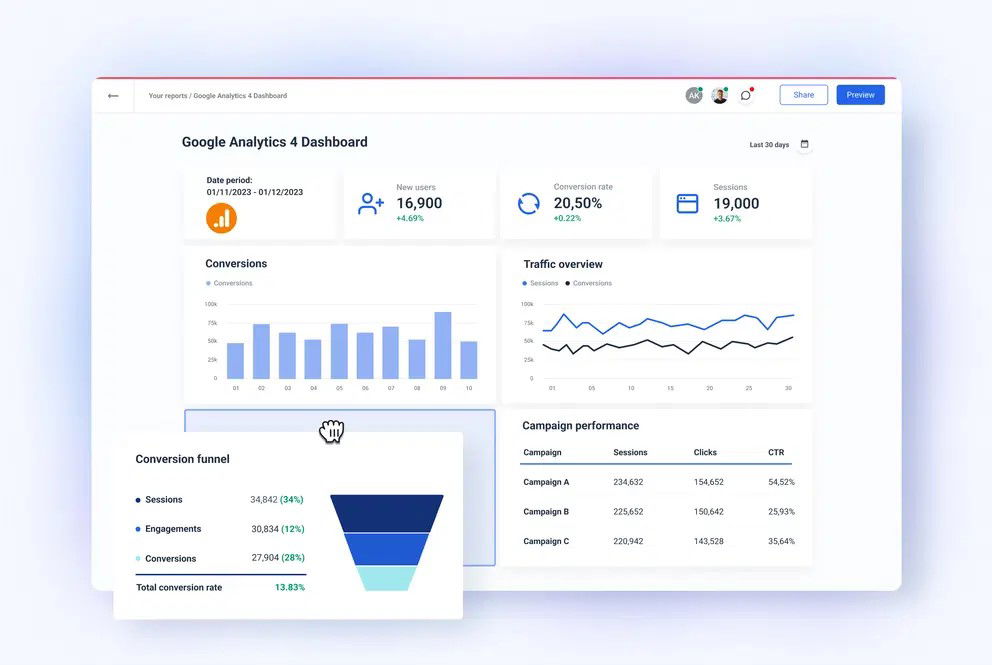
Designed for scalability, Google Analytics 4 supports small businesses to global enterprises alike. It integrates with the whole Google Marketing Platform, provides real-time dashboards, and adheres to GDPR and CCPA standards through Google’s data-handling frameworks. Google Cloud infrastructure ensures enterprise-level security through ISO 27001 and SOC 2 compliance, along with robust data encryption both at rest and in transit.
Pricing
The standard Google Analytics 4 platform is entirely free. Google Analytics 360, the enterprise edition, is available on an annual contract for $50,000, with pricing based on usage volume.
What Works And What Doesn’t
| Pros | Cons |
| Offers integrations across Google’s ecosystem | Can be difficult for beginners to configure |
| Accessible free plan to all users | Provides limited flexibility in custom reporting |
| Provides strong marketing insights through predictive analytics | Rises privacy and data ownership concerns in some regions |
Our Final Take
Google Analytics 4 is a great Web Analytics Platform for digital marketers and data teams looking for a powerful, integrated analytics platform tied to Google’s ecosystem. Less suitable for privacy-centric organizations that require complete data control. A top-tier choice for scalable, insight-driven growth.
Amplitude: Best for Scalability
Amplitude enters our 2026 list as a leading product analytics and behavioral-intelligence platform from Amplitude Inc., empowering organizations to understand digital experiences in depth. It serves over 4,000 customers globally, including 27% of Fortune 100 enterprises. Recognized with the AWS Global Partner of the Year Award 2024 for Innovation in Digital Experience and ranked #1 in Product Analytics in G2’s Fall 2025 Report, Amplitude continues to redefine data-driven growth.
Why We Chose Amplitude In 2026
Amplitude stands out for its deep event-driven analytics, funnel analysis, and retention tracking that highlight user behavior trends beyond surface-level metrics. Its AI-powered predictive analytics and in-platform experimentation tools give product teams an edge in testing, measuring, and optimizing user experience. Its rich data modelling and integration flexibility make it one of the most insightful analytics tools in 2026.

Built for scale, Amplitude integrates seamlessly with major data warehouses and marketing stacks, including Snowflake and Segment. It ensures robust data governance through SOC 2 Type II and ISO 27001/27018 certifications, as well as compliance with the GDPR, CCPA, and HIPAA. Designed for cross-functional collaboration, it provides secure, role-based access, real-time updates, and enterprise-grade performance.
Pricing
Amplitude offers a free Starter plan for individuals with paid models. A Plus plan starts from $49/month, and custom Growth and Enterprise tiers are for advanced analytics, experimentation, and large-scale behavioral data needs.
What Works And What Doesn’t
| Pros | Cons |
| Offers rich behavioral insights | Complex implementation for non-technical teams |
| Meets high enterprise standards with strong security certifications | Can be expensive due to the event-based pricing |
| Provides AI-powered predictions | Offers limited value for basic website traffic tracking |
Our Final Take
Amplitude is best for SaaS, mobile apps, and digital product teams aiming to understand user behavior and improve retention. It may not suit organizations needing only basic analytics. For product-led growth and data-driven decisions, it’s a clear front-runner.
Adobe Analytics: Best for Enterprise
Adobe Analytics maintains its strong presence in 2026 within Adobe Experience Cloud, offering advanced, enterprise-grade insights into customer journeys across digital channels. In 2025, Adobe was named a Leader in the IDC MarketScape: Worldwide Retail Customer Data Platform Software Providers 2025 report for its Real-Time CDP’s unified data capabilities. Additionally, Adobe Analytics played a pivotal role in several winning projects at the 2025 Adobe Experience Maker Awards, including Lenovo’s Ambassador Award and Air India’s Experience Maker of the Year success.
Why We Chose Adobe Analytics In 2026
Adobe Analytics stands out by delivering a unified analytics ecosystem across marketing, content, and product teams, tying web/mobile behavior, content performance, and customer-journey measurement into a single platform. Its seamless integration with the Adobe Experience Cloud and advanced segmentation, attribution modelling and real-time insights make it particularly suited to large organizations operating across geographies and channels.
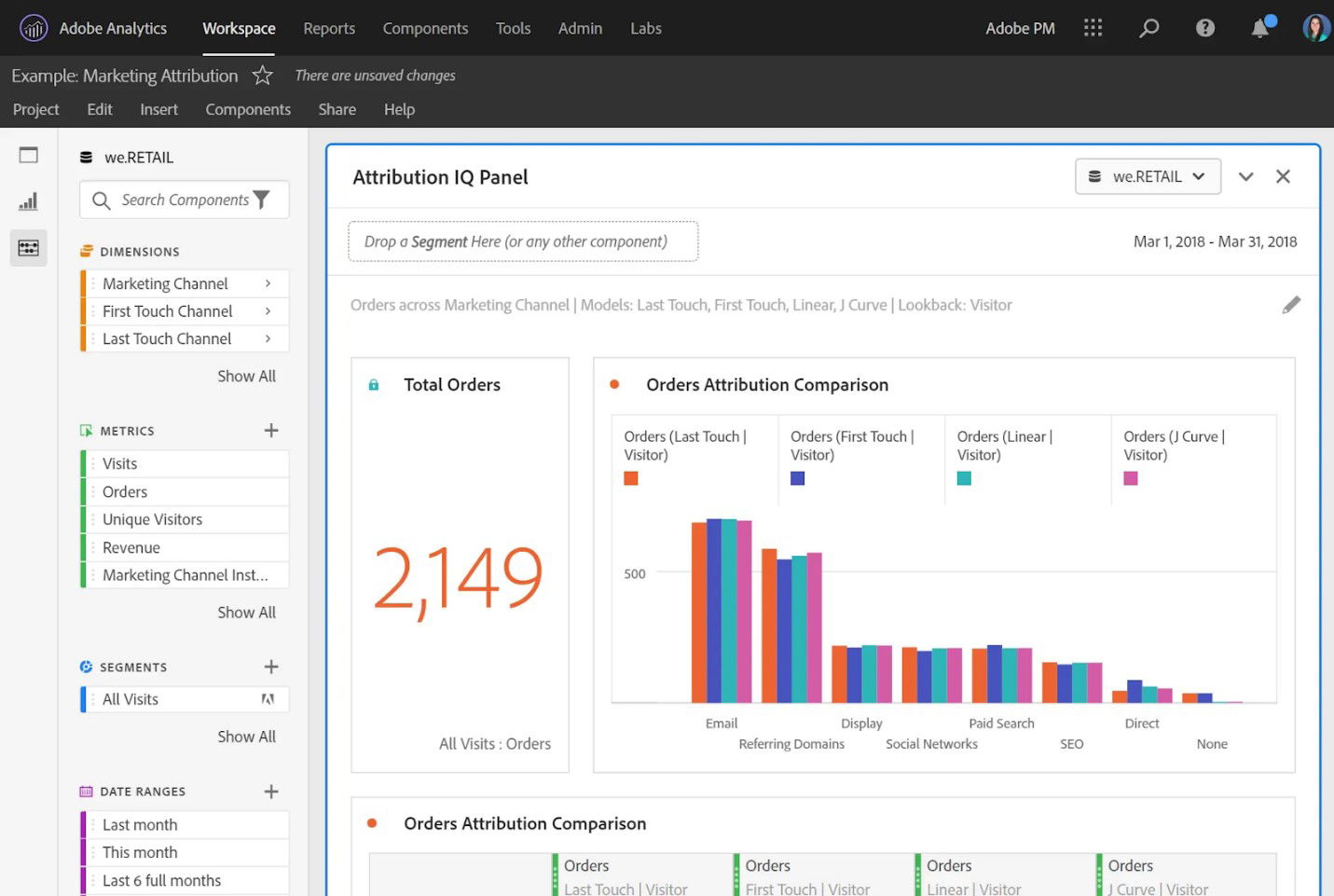
Adobe Analytics scales to meet the needs of global enterprises with complex digital footprints. It supports real-time data ingestion, cross-channel stitching, AI-powered anomaly detection, and deep customization. In terms of security and compliance, Adobe emphasizes enterprise governance, data encryption, and role-based access controls. It is widely used in heavily regulated industries (finance, retail, healthcare) where data sovereignty and audit readiness are critical.
Pricing
Adobe does not publicly show pricing for Analytics. Industry estimates suggest Adobe Analytics annual costs typically range from $50,000 to $350,000, depending on usage volume, data scale, and implementation complexity.
What Works And What Doesn’t
| Pros | Cons |
| Offers enterprise-grade analytics with advanced segmentation and journey insights | Comes with a steep implementation curve |
| Great for organizations using the full Adobe Experience Cloud stack | Can be costly for small businesses |
| Strong integration, governance and cross‐channel measurement capabilities | Confusing and complex customization and scalability functionalities |
Our Final Take
Adobe Analytics is best suited for large enterprises or global organizations that need deep, cross-channel analytics, detailed journey modelling, and integration across marketing and content platforms. It may not be ideal for smaller teams or budget-constrained organizations needing simpler traffic analytics. For a full-scale analytics ambition, it remains a top choice.
Plausible Analytics: Best Value
Plausible Analytics makes its debut in our 2026 list as a privacy-first, lightweight web analytics solution designed for simplicity and speed. Founded in 2018 and used by thousands of users globally, it quickly gained recognition through consistent user praise and media coverage. Positive reviews on Product Hunt, TrustRadius, and Reddit highlighted its GDPR compliance, clean UI, and ease of use. In October 2024, Plausible reported $3.1 million in annual recurring revenue, underscoring its growing global adoption.
Why We Chose Plausible Analytics In 2026
Plausible stands out for its minimal footprint, cookie-free tracking, and compliance with GDPR, CCPA, and PECR. It’s designed for clarity, showing essential metrics on a single page without requiring extensive configuration. For organizations that prioritize privacy, site performance, and ease of use, this tool offers a distinctive alternative to full-featured analytics.
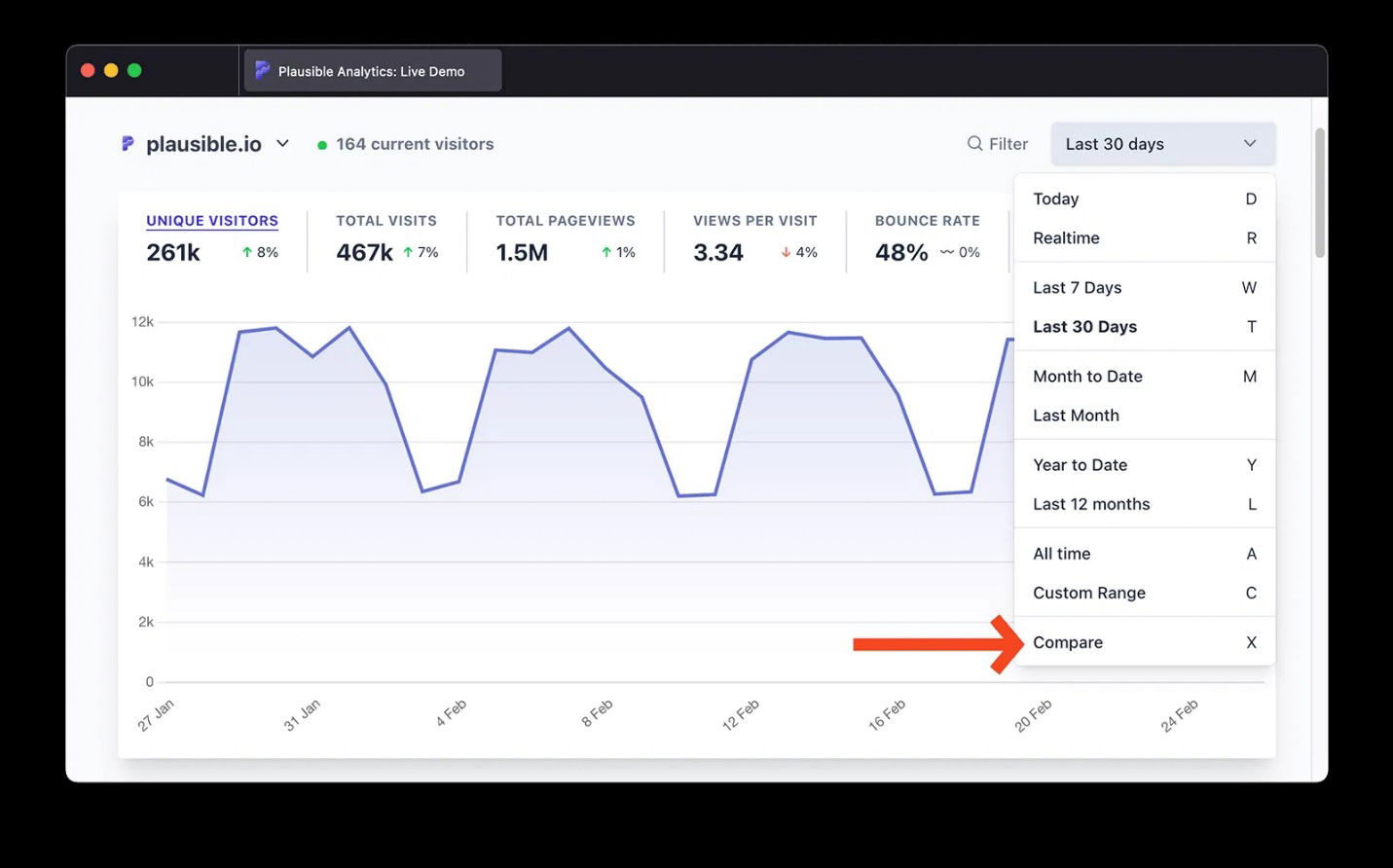
Plausible supports both hosted and self-hosted deployment, giving teams complete control over their data. Its platform scales from small to mid-sized sites, offers simple insights, and is especially well-suited for bloggers, agencies, and privacy-conscious businesses. The tool’s open-source transparency and lightweight architecture reduce implementation overhead and support fast adoption.
Pricing
Plausible Pricing starts at $9 per month for up to approximately 10,000 pageviews and rises with usage. A detailed view of subscription tiers is provided on the official website.
What Works And What Doesn’t
| Pros | Cons |
| Prioritizes user privacy and uses a minimal-footprint script | Lacks some advanced analytics features |
| Quick to implement and easy for non-technical users | Limited support for complex event tracking and product-analytics workflows |
| Data ownership and transparency with an open-source option | Limited segmentation and integration capabilities |
Our Final Take
Plausible Analytics is best suited for small to medium-sized websites, blogs, agencies, or privacy-focused teams looking for simple, fast, and transparent traffic analytics. It may not be ideal for large enterprises needing advanced behavioral tracking or deep customization. For a lightweight, cost-efficient solution, it’s an excellent choice.
Mixpanel: Best User Experience (UX)
Mixpanel, founded in 2009, retains its position in 2026 as one of the most trusted platforms for product and behavioral analytics. The company helps teams measure user engagement across web and mobile applications. In 2025, Mixpanel published its State of Product Analytics benchmark reports across industries such as fintech and media, analyzing over 3 trillion events and 14 billion unique users. Consistently rated highly on G2 and SoftwareReviews, it remains a preferred analytics tool for data-driven product teams.
Why We Chose Mixpanel In 2026
Mixpanel’s advanced features include an event-based tracking model, advanced funnel and retention analysis, and cohort segmentation tools, which provide detailed insights into how users navigate and engage with digital products. Its ability to integrate web and app data in real time and surface feature-usage and drop-off points provides product, growth, and UX teams with granular operational intelligence beyond conventional traffic reports.
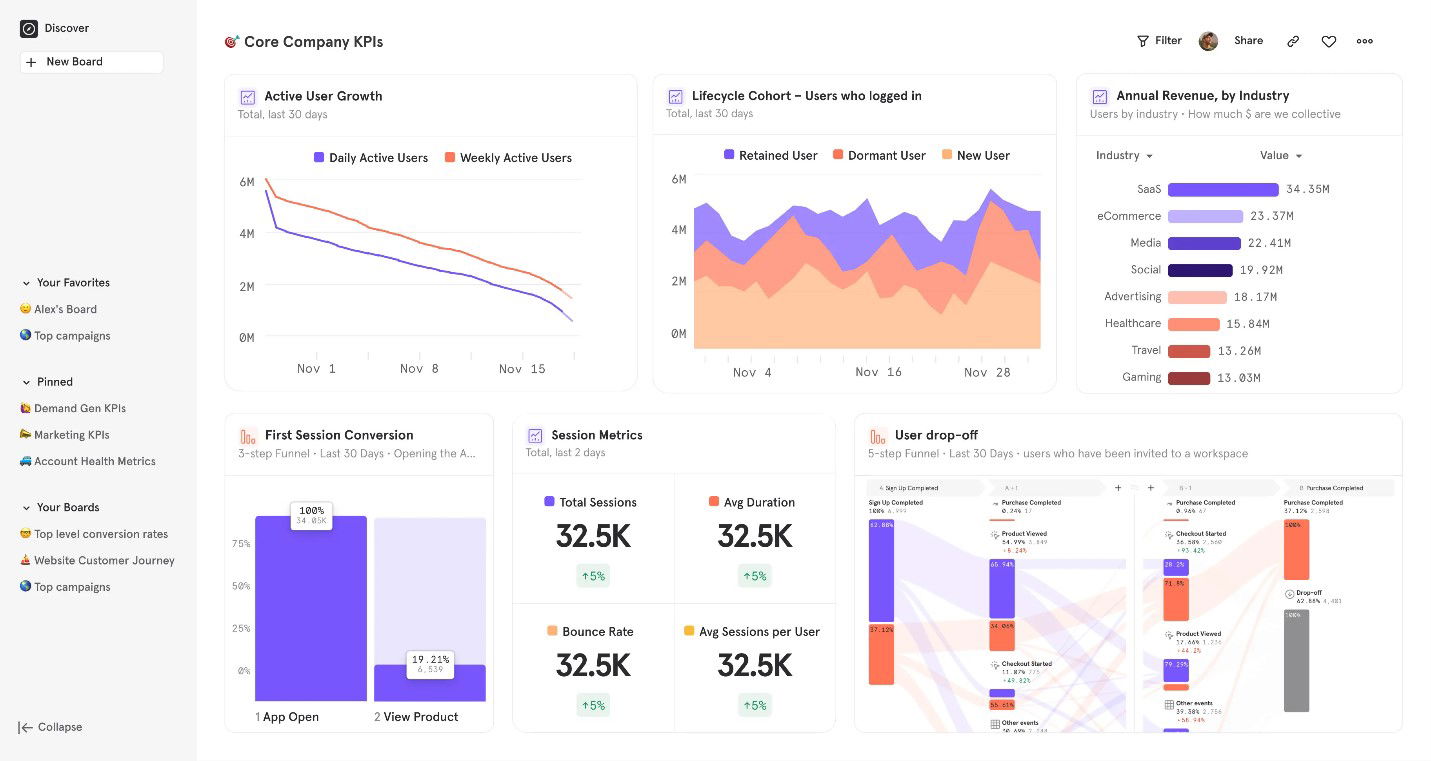
Designed for scalability, Mixpanel supports event-granular data modelling, unlimited collaborators, and integration with data warehouses and BI tools. Its security and governance features align with enterprise needs, though teams should plan for implementation time and analytical maturity. The platform is supported by strong user-review ratings and a high likelihood of recommendation among product-driven organizations.
Pricing
Mixpanel has a tiered, event-based pricing structure comprising a Free plan, a Growth plan, and a custom-priced Enterprise plan. Pricing is based on the number of tracked events, not on monthly tracked users (MTUs), and averages $0.28 per 1,000 events after the free threshold.
What Works And What Doesn’t
| Pros | Cons |
| Delivers deep behavioral analytics with powerful funnel/cohort capabilities | Requires technical setup and discipline to implement event taxonomy |
| Real-time event tracking and intuitive dashboards | Pricing escalates quickly as event volumes grow |
| Supports strong data governance and security certifications. | Comes with a steep learning curve for non-technical users |
Our Final Take
Mixpanel is best suited for SaaS and product-led organizations seeking detailed behavioral analytics, retention and conversion insights, even across mobile and web platforms. It may not be ideal for simple website-slot traffic tracking or organizations with limited analytics resources. For teams serious about product-use intelligence, it’s a perfect choice.
Top 5 Web Analytics Tools Comparison
P.S.: Always remember to visit the vendor’s site for the latest information!
| Criteria |  |
 |
 |
 |
 |
| Starting Price | NA | $49/month | NA | $9/month | NA |
| Avg. User Rating | 4.4 | 4.6 | 4.3 | 4.8 | 4.5 |
| Trial Period / Demo | Free Demo | Free Demo | Free Demo | 30-Day Free Trial | Free Demo |
| Key Features | Event-based tracking, AI insights, and Cross-platform data model | Behavioral analytics, cohort & retention analysis, and experimentation & feature flagging | Cross-channel journey analysis, AI attribution, and Adobe Sensei insights | Lightweight script, cookie-free tracking, and open-source option | Event-based tracking, funnel & retention analysis, and session replays |
| Integrations | Google Ads, BigQuery, Firebase, and more | Segment, Snowflake, AWS, and more | Adobe Experience Cloud, Marketo, CRM & BI tools, and more | WordPress, Ghost, Netlify, and more | Snowflake, Redshift, Segment, and more |
Conclusion
The web analytics landscape in 2026 reflects a clear shift toward privacy compliance, AI-powered insights, and flexible scalability. Tools like Google Analytics 4 and Adobe Analytics dominate enterprise ecosystems with powerful integrations and deep data capabilities, while Amplitude and Mixpanel empower product-led teams through behavioral analysis and experimentation. Plausible Analytics, meanwhile, continues to rise as the go-to choice for privacy-conscious users seeking transparency and simplicity.
Choosing the right website analytics software depends on organizational goals. Across all five tools, the trend is clear: 2026 rewards analytics platforms that combine ethical data practices with actionable intelligence for smarter, faster, and more responsible digital decision-making.
Frequently Asked Questions
What Are The Top 5 Web Analytics Tools Of 2026?
In 2026, the leading web analytics tools are Google Analytics 4, Amplitude, Adobe Analytics, Plausible Analytics, and Mixpanel—selected for their scalability, depth of behavior tracking, privacy-first design, and enterprise-grade integrations.
What Are The Features Of Web Analytics Tools?
Web analytics tools collect, analyze, and visualize data on user behavior across sites and apps, including page views, events, conversion funnels, acquisition sources, retention, and real-time engagement.
What Is The Best Web Analytics Tool Of 2026?
The “best” tool depends on your goal: Google Analytics 4 suits broad traffic measurement; Amplitude or Mixpanel excel at behavioral analytics; Adobe Analytics fits enterprise needs; and Plausible is ideal for privacy-conscious teams. Choose based on your analytics, maturity, and business focus.
Fri, Dec 26, 2025

Enjoyed what you read? Great news – there’s a lot more to explore!
Dive into our content repository of the latest tech news, a diverse range of articles spanning introductory guides, product reviews, trends and more, along with engaging interviews, up-to-date AI blogs and hilarious tech memes!
Also explore our collection of branded insights via informative white papers, enlightening case studies, in-depth reports, educational videos and exciting events and webinars from leading global brands.
Head to the TechDogs homepage to Know Your World of technology today!
Disclaimer - Reference to any specific product, software or entity does not constitute an endorsement or recommendation by TechDogs nor should any data or content published be relied upon. The views expressed by TechDogs' members and guests are their own and their appearance on our site does not imply an endorsement of them or any entity they represent. Views and opinions expressed by TechDogs' Authors are those of the Authors and do not necessarily reflect the view of TechDogs or any of its officials. While we aim to provide valuable and helpful information, some content on TechDogs' site may not have been thoroughly reviewed for every detail or aspect. We encourage users to verify any information independently where necessary.
Loading comments...