
Data Management
Top 5 Open-Source Database Software Of 2026
Share
TL;DR
-
PostgreSQL: Best for complex SQL workloads, geospatial data, and AI-ready vector search at zero licensing cost.
-
MySQL: Top choice for web-scale reliability, powering billions of deployments with a proven dual-track release model.
-
MariaDB: The AI-first MySQL alternative with built-in RAG pipelines and AI copilots on a unified database platform.
-
MongoDB: Ideal for flexible, schema-free document storage with horizontal scaling and native vector search in the Community Edition.
-
Redis: The fastest open source in-memory store, back under AGPLv3 with Redis 8 delivering up to 87% faster commands.
Introduction
Remember Moneyball (2011)?
The film follows how the Oakland Athletics rebuilt their team using data-driven decisions instead of competing with wealthier franchises for expensive star players. While bigger teams relied on larger budgets, they found smarter ways to stay competitive by making better use of available resources.
Businesses face a similar challenge when choosing database software. Managing growing volumes of data often requires strong performance, security, and scalability, but not every company wants to commit to expensive licensing costs tied to proprietary platforms.
That is where open-source database system continues to gain momentum. These platforms offer flexibility, strong community support, and enterprise-grade performance while giving development teams greater control over how their data infrastructure evolves.
We have curated the Top Open-Source Database Software of 2026 to help you find a platform that balances scalability, performance, and cost efficiency.
What Is Open-Source Database Software?
Open-source database software is a database management system (DBMS) whose source code is freely available to inspect, modify, and distribute. Unlike proprietary databases, these platforms give businesses more flexibility to customize deployments, avoid vendor lock-in, and reduce long-term licensing costs.
Depending on business needs, they can support SQL-based relational databases, document storage, distributed workloads, or in-memory processing for faster performance. Many modern platforms also support newer use cases such as vector search, AI applications, and retrieval-augmented generation (RAG) workflows.
As data infrastructure becomes more complex, businesses need platforms that can scale without creating unnecessary costs. That is why we have got some of the best Open-Source Database Software of 2026.
Top 5 Open-Source Database Software Of 2026
From relational databases to document storage and AI-ready platforms, each solution on this list serves different data needs. Here are the top open-source database software platforms businesses should consider in 2026.
 |
 |
 |
 |
 |
PostgreSQL: Best Overall
PostgreSQL has been actively developed since 1986 and is maintained by the volunteer-led PostgreSQL Global Development Group. It remains one of the most widely adopted open-source relational databases globally.
Its latest major release, PostgreSQL 18, continues to strengthen its market position, with version 18.3 launching in February 2026 and PostgreSQL 19 expected later in the year.
Why We Chose PostgreSQL In 2026
PostgreSQL earns its place for balancing reliability, flexibility, and modern scalability. It supports full ACID compliance and multi-version concurrency control (MVCC), making it a dependable option for businesses handling complex transactional workloads.
Its extension ecosystem remains one of its biggest strengths. Tools like PostGIS support geospatial workloads, while pgvector helps organizations build AI and retrieval-augmented generation workflows.
PostgreSQL 18 also introduced improvements such as asynchronous I/O for faster scans, OAuth authentication, temporal constraints, and virtual generated columns.
Pricing
PostgreSQL is completely free under the PostgreSQL License. Businesses that need managed services or enterprise support can use providers such as Amazon Web Services, Microsoft, or EnterpriseDB.
What Works & What Doesn't
| Pros | Cons |
| Full ACID compliance | Steep learning curve |
| Strong extension ecosystem | Vacuum tuning complexity |
| No licensing costs | A high-availability setup can require expertise |
Our Final Take
PostgreSQL works well for organizations that need a dependable database for transactional workloads, analytics, and newer AI use cases. Its flexibility makes it difficult to ignore for teams that want enterprise-grade capabilities without licensing costs.
MySQL: Best User Experience (UX)
MySQL was created in 1995 by Michael Widenius, Allan Larsson, and David Axmark. It is now owned by Oracle Corporation and remains one of the most widely used databases powering applications across the LAMP stack.
It continues to maintain strong adoption through both its free Community Edition and paid Enterprise Edition.
Why We Chose MySQL In 2026
MySQL earns its place as one of the most accessible databases for development teams. Businesses often choose it because it is familiar, well-documented, and compatible with nearly every major programming language, framework, and cloud platform.
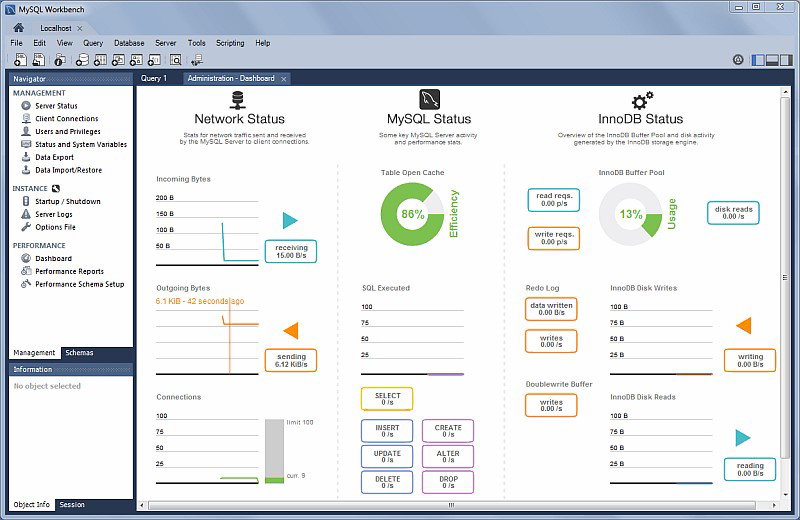
InnoDB storage engine supports ACID compliance, crash recovery, foreign key support, and row-level locking for high-traffic workloads. Oracle’s dual-track release model also gives businesses more flexibility by offering long-term stability through LTS releases while still introducing new features through quarterly innovation updates.
MySQL 9.x introduces features such as JSON Duality Views, JavaScript support through the MySQL Multilingual Engine, WebAssembly library support, and stronger Group Replication capabilities.
Pricing
MySQL Community Edition is free under the GNU GPL license. Enterprise subscriptions begin at approximately $5,000 annually and include additional backup, monitoring, auditing, and security features.
What Works & What Doesn't
| Pros | Cons |
| Easy to use | Oracle ownership concerns |
| Huge ecosystem | Advanced features behind paywalls |
| Strong compatibility | Performance tuning required at scale |
Our Final Take
MySQL remains a practical choice for businesses that want a familiar database with broad compatibility and a lower learning curve. It works especially well for web applications and teams that value simplicity over deep customization.
MariaDB: Best AI Features
MariaDB was launched in 2009 by Michael Widenius after Oracle Corporation acquired Sun Microsystems. It remains a community-driven alternative to MySQL and is managed by the MariaDB Foundation with backing from companies such as Amazon, Intel, and ServiceNow.
Its enterprise credibility is reinforced by customers such as Deutsche Bank, Nasdaq, Verizon, and Walgreens.
Why We Chose MariaDB In 2026
MariaDB earns its place for adapting quickly to AI-focused workloads. While many databases are still layering AI tools on top of existing systems, MariaDB has moved more aggressively into native AI capabilities.
Its Enterprise Platform 2026 combines transactional, analytical, and AI workloads in one platform. Its biggest differentiator is RAG-in-a-Box, which helps businesses build retrieval-augmented generation workflows without needing separate vector databases or complex orchestration layers.
It also includes embedded AI copilots, natural language capabilities, native vector search, UUIDv7 support, and system-versioned tables.
Pricing
MariaDB offers a free Foundation tier powered by its open-source Community Server. Its Power plan starts at $0.16 per hour and is designed for businesses running mission-critical workloads. Its PowerPlus plan starts at $0.21 per hour and includes geo-distributed resilience, real-time analytics, and unified AI capabilities.
What Works & What Doesn't
| Pros | Cons |
| Native AI and RAG tools | Growing compatibility differences with MySQL |
| Built-in clustering | Documentation can feel heavy |
| Familiar MySQL foundation | Cluster setup complexity |
Our Final Take
MariaDB makes sense for teams that want familiar relational database foundations while exploring newer AI use cases. Businesses focused purely on traditional workloads may not need all of their newer AI-focused capabilities.
MongoDB: Best For Scalability
MongoDB was launched in 2009 by MongoDB Inc. and has grown into one of the most widely used NoSQL databases globally. It now serves more than 50,000 customers across 100 countries and has recorded hundreds of millions of downloads.
Its cloud platform, MongoDB Atlas, continues to drive significant adoption and accounts for a large share of the company’s revenue.
Why We Chose MongoDB In 2026
MongoDB earns its place for handling rapidly growing datasets without forcing rigid database structures. Businesses working with dynamic applications often struggle when traditional schemas become restrictive, and MongoDB’s document-based model offers more flexibility.
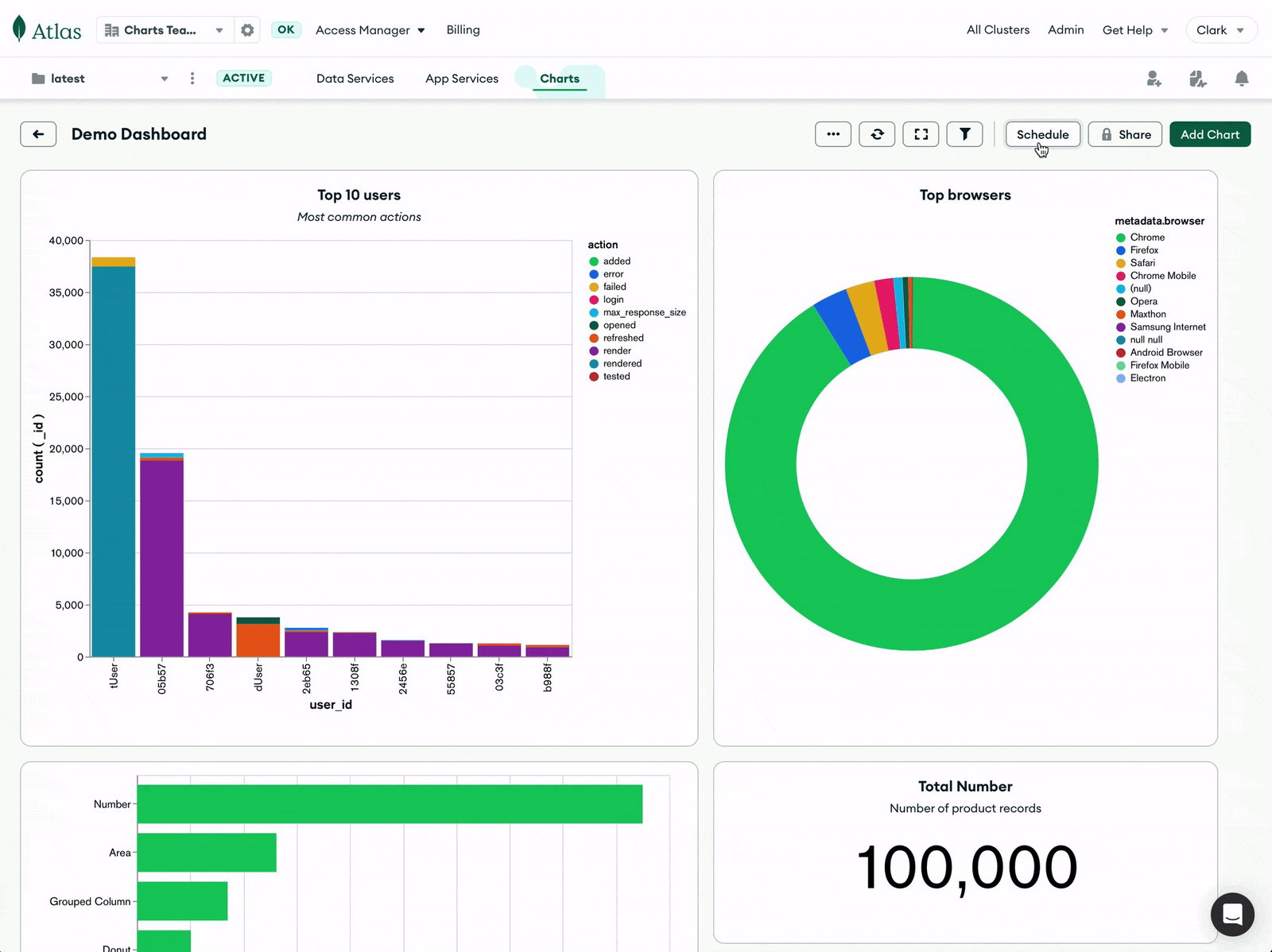
Its BSON document model works well for hierarchical and fast-changing data environments such as content platforms, IoT systems, and mobile applications. MongoDB 8.0 also delivers faster query performance for larger datasets while maintaining strong scalability through horizontal sharding.
Its recent updates also strengthen AI use cases. MongoDB now includes vector search capabilities and automated embeddings that help businesses build retrieval workflows without adding separate vector databases.
Pricing
MongoDB offers a Free tier at $0 per hour, making it useful for learning and smaller development projects. Its Flex plan starts at $0.011 per hour and scales based on usage. The Dedicated plan starts at $0.08 per hour and is designed for production workloads that need more dedicated resources.
What Works & What Doesn't
| Pros | Cons |
| Flexible schema design | Complex relationship handling |
| Strong horizontal scaling | Higher storage overhead |
| Built-in vector search | Atlas setup can be challenging |
Our Final Take
MongoDB works well for development teams managing fast-changing applications that need flexibility at scale. Organizations running highly structured relational workloads may still prefer more traditional database systems.
Redis: Best Value
Redis was created by Salvatore Sanfilippo and launched in 2009. After briefly shifting to stricter licensing models, Redis returned to open-source licensing in 2025 under AGPLv3 with the release of Redis 8.0. That move was closely watched by the developer community, especially after licensing concerns led to the creation of Valkey.
Why We Chose Redis In 2026
Redis earns its place for delivering extremely fast performance without adding licensing costs. Businesses handling real-time workloads often cannot afford latency issues, and Redis remains one of the fastest options available.
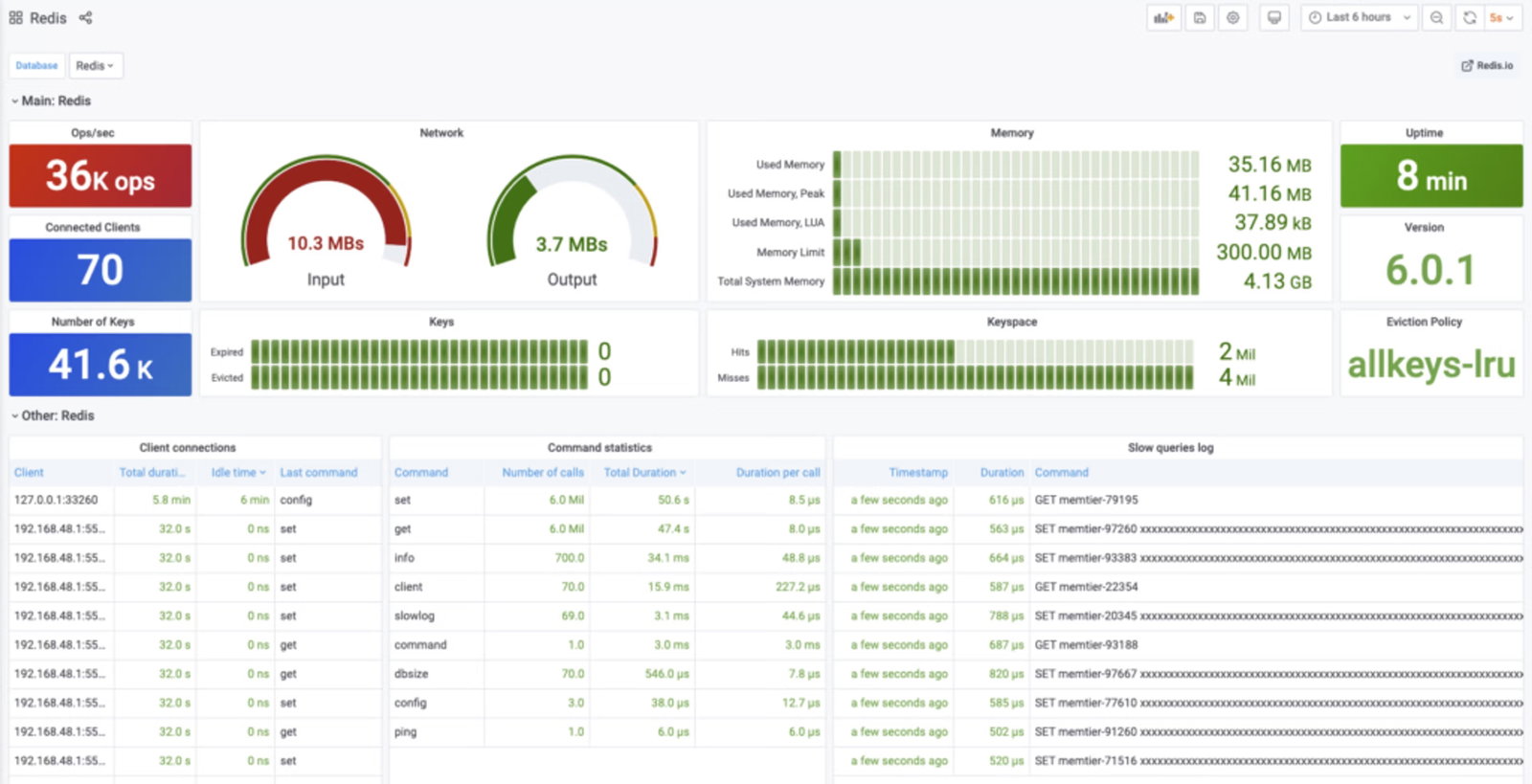
Since it stores data entirely in memory, it delivers sub-millisecond response times that traditional disk-based databases struggle to match. Redis 8.0 also improved command execution speeds, replication performance, and overall throughput.
Its latest release also folds Redis Stack modules into the open-source core, bringing full-text search, JSON storage, vector search, and secondary indexing into free deployments. That is a meaningful upgrade for teams trying to do more without increasing infrastructure costs.
Pricing
Redis offers a Free plan at $0, supporting up to 30 MB of storage for smaller deployments and testing environments. Its Essentials plan starts at $0.007 per hour and includes larger storage capacity, encryption, and basic support. The Pro plan starts at $0.014 per hour with a minimum monthly spend of $200, adding dedicated cloud deployments, multi-region capabilities, private connectivity, and higher scalability for enterprise workloads.
What Works & What Doesn't
| Pros | Cons |
| Extremely fast performance | RAM limitations at scale |
| More features in the open-source core | Limited relational querying |
| Easy setup | Licensing concerns in recent years |
Our Final Take
Redis works particularly well for caching, session management, messaging systems, leaderboards, and real-time applications where speed matters. Teams managing heavily relational workloads may need more traditional database platforms.
Top 5 Open-Source Database Software Comparison
Not every open-source database management system is built for the same workload. Some prioritize relational reliability, others focus on speed, scalability, or AI-ready capabilities. This comparison breaks down pricing, features, ratings, and integrations to help you choose the right platform.
| Criteria |  |
 |
 |
 |
 |
| Starting Price | Free | Free | Free | Free | Free |
| Avg. User Rating | 4.4/5 | 4.4/5 | 4.7/5 | 4.5/5 | 4.8/5 |
| Trial Period/Demo | Free tier | Free tier | Free tier | Free tier | Free tier |
| Key Features | ACID compliance, custom extensions, and geospatial support | InnoDB engine, crash recovery, and JSON support | AI copilots, Galera clustering, and vector search | flexible document schema, horizontal sharding, and ACID transactions | full-text search, JSON storage, and vector search |
| Integrations | AWS RDS, PostGIS, pgvector, and more | Microsoft Azure, Google Cloud SQL, Oracle, and more | Salesforce, Azure, Google Cloud, and more | Atlas Search, Kafka, and more | AWS ElastiCache, Azure Cache, Python, and more |
Conclusion
In the end, the best open-source database depends on what your team values most. Some businesses prioritize the reliability of relational databases, while others need the flexibility of document storage or the speed of in-memory systems.
As AI workloads become more common, platforms that combine storage, search, and intelligence in one ecosystem are gaining momentum. Much like Moneyball showed that smarter decisions can outperform bigger budgets, the right database is often the one that helps your team scale efficiently without unnecessary infrastructure costs.
Choose the platform that aligns with your workloads today while giving your data architecture enough flexibility for what comes next.
Frequently Asked Questions
What Is Open-Source Database Software And How Does It Work?
Open-source database software is a DBMS whose source code is publicly available to inspect, modify, and distribute. It works by providing a structured system to store and retrieve data using either SQL-based relational models or alternatives such as document stores, key-value pairs, or in-memory structures. Organizations can deploy these databases on their own hardware or in the cloud, retaining full control over configuration and data ownership. Unlike proprietary systems, community editions carry no per-core license fees or usage restrictions.
Which Are The Top Open-Source Database Software Tools In 2026?
Some of the top open-source database software tools in 2026 include PostgreSQL, MySQL, MariaDB, MongoDB, and Redis. PostgreSQL leads for SQL compliance and extensibility; MySQL dominates for web-scale reliability; MariaDB differentiates with its native RAG and AI copilots; MongoDB excels for flexible document storage with vector search; and Redis delivers unmatched in-memory performance as a cache, database, and message broker. Each addresses a distinct primary use case and workload type.
How Do I Choose The Right Open-Source Database Software For My Business?
Choosing the right open-source database depends on your data model, performance requirements, and team expertise. For structured transactional data with complex queries, PostgreSQL or MySQL are strong starting points. For AI-native applications on a unified platform, MariaDB's 2026 Enterprise release is worth evaluating. For dynamic or hierarchical data common in modern web applications, MongoDB's flexible schema is the natural fit. For extreme read and write speed in caching or real-time workloads, Redis is the clear choice. Cloud-native readiness, community support, and managed hosting availability should also factor into your final decision.
Thu, Apr 30, 2026

Enjoyed what you've read so far? Great news - there's more to explore!
Stay up to date with the latest news, a vast collection of tech articles including introductory guides, product reviews, trends and more, thought-provoking interviews, hottest AI blogs and entertaining tech memes.
Plus, get access to branded insights such as informative white papers, intriguing case studies, in-depth reports, enlightening videos and exciting events and webinars from industry-leading global brands.
Dive into TechDogs' treasure trove today and Know Your World of technology!
Disclaimer - Reference to any specific product, software or entity does not constitute an endorsement or recommendation by TechDogs nor should any data or content published be relied upon. The views expressed by TechDogs' members and guests are their own and their appearance on our site does not imply an endorsement of them or any entity they represent. Views and opinions expressed by TechDogs' Authors are those of the Authors and do not necessarily reflect the view of TechDogs or any of its officials. While we aim to provide valuable and helpful information, some content on TechDogs' site may not have been thoroughly reviewed for every detail or aspect. We encourage users to verify any information independently where necessary.
Loading comments...