
Cloud
Top 5 Cloud Management Platforms Of 2026
Share
TL;DR
-
HPE Morpheus Software: Provides vendor-agnostic orchestration and deep integration for hybrid cloud modernization.
-
CloudBolt: Offers policy-driven automation and helpful tools for rightsizing Kubernetes container workloads.
-
Flexera One: Delivers comprehensive visibility across cloud, SaaS, and on-premises assets to reduce waste.
-
VMware Tanzu CloudHealth: Excels at multi-cloud cost allocation and advanced financial governance for large enterprises.
-
CloudZero: Uses an engineering-led approach to map cloud spend directly to specific business dimensions.
Introduction
What do two live snakes, a $37,000 diamond ring, water buffalo horns, and a deer skull have in common? They are all bizarre items discovered in unclaimed luggage at airport security. While most travelers worry about a bottle of lotion exceeding the 100 ml limit, the real risk is lost baggage, that sinking feeling when your suitcase full of holiday essentials vanishes into the airline void. Even if your favorite shorts find a second life at a clearance counter, the hassle of carrying physical baggage remains a burden. In the IT world, this is the equivalent of maintaining clunky, on-premises data centers that weigh down your operations with digital baggage.
Cloud management platforms act as the ultimate logistics solution, much like the famous Dabbawalas of Mumbai who deliver thousands of meals with flawless precision. These platforms take responsibility for carrying, delivering, and rerouting your data baggage to make your business more agile. By centralizing control over resource allocation, they ensure you always have access to your digital assets without the heavy lifting. Explore these 5 Cloud Management Platforms of 2026 to streamline your infrastructure and master your multicloud strategy. Read on!
What Is A Cloud Management Platform?
A Cloud Management Platform is a software solution that allows businesses to manage their cloud resources, assets, and services effectively. It enables users to view and manage their cloud operations through a single interface across the organization. This streamlines cloud deployment management across environments, provides visibility into resource usage, and ensures compliance with cloud policies and regulations.
Now that you know what Cloud Management Platforms are, let’s discuss some of the best cloud management software of 2026!
Top 5 Cloud Management Platforms Of 2026
Here are the top Cloud Management Platforms of 2026.
 |
 |
 |
 |
 |
HPE Morpheus Software: Best For Integration
Retained on our 2026 list from last year, HPE Morpheus Software (previously Morpheus) continues to strengthen its position as a leading hybrid-cloud management platform after being acquired by Hewlett Packard Enterprise in 2024. The platform was recognized in The Forrester Wave™: Cloud Cost Management and Optimization Solutions (2024) for its automation-driven architecture and broad multicloud orchestration capabilities. Morpheus serves hundreds of enterprise customers globally and supports deployments across more than 100 countries through its extended partner ecosystem.
Why We Chose HPE Morpheus Software In 2026
HPE Morpheus stands out for its genuinely vendor-agnostic approach, offering deep integration across VMware, Nutanix, KVM, AWS, Azure, GCP and Kubernetes within a unified control plane. Its strength lies in automated provisioning, extensive policy governance, and advanced hybrid orchestration that enables enterprises to consolidate tooling. Not just that. The integration into the HPE GreenLake portfolio further enhances its strategic positioning for private and hybrid cloud modernization.
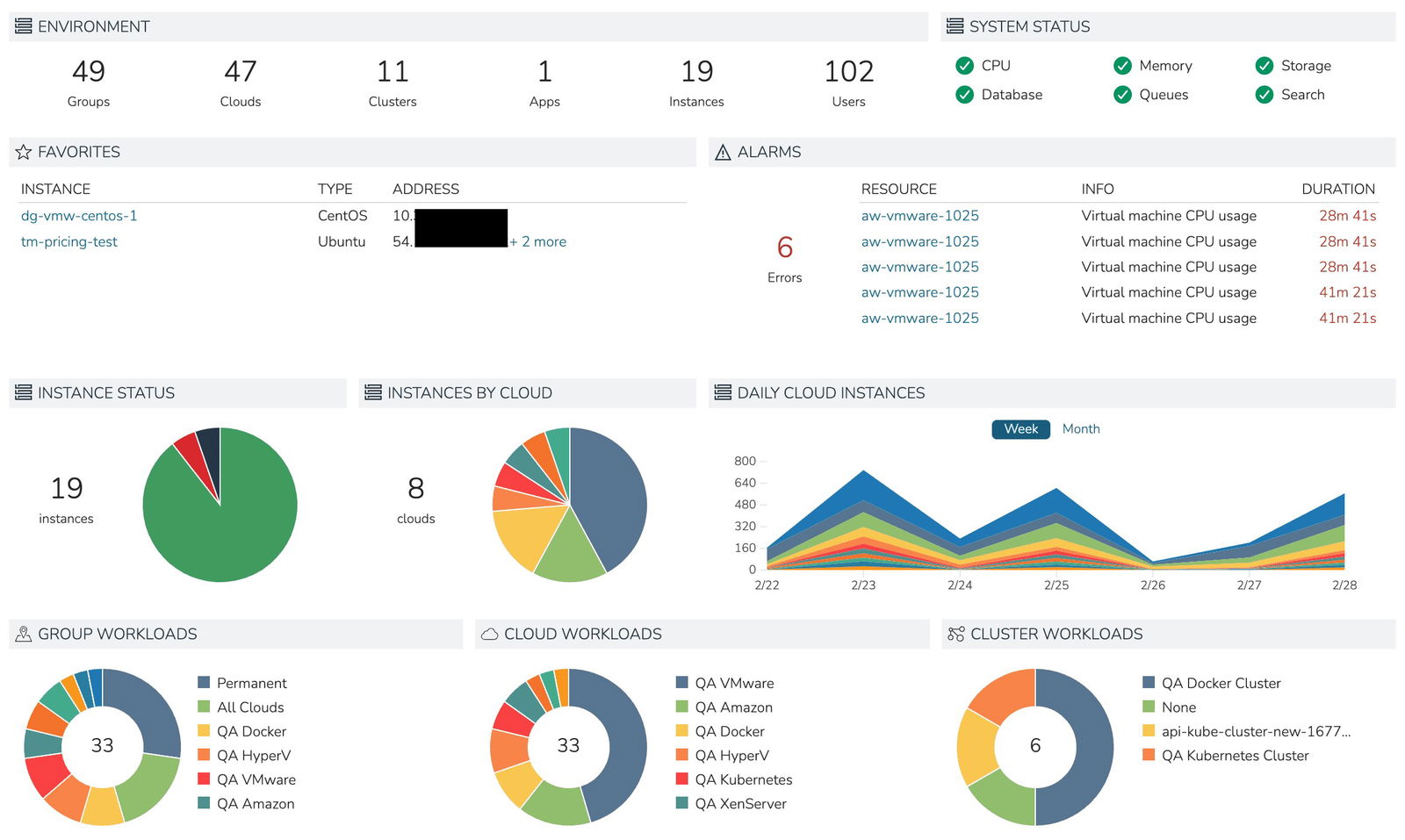
If we talk about operational environments, Morpheus enables persona-specific workflows tailored for platform teams, DevOps, developers and FinOps units. It supports a complete lifecycle management through integrations with Terraform, Ansible, ServiceNow and Kubernetes. Security is reinforced through enterprise-grade standards, including ISO and SOC-aligned controls, robust role-based access governance, encryption across data flows and adherence to major compliance frameworks such as GDPR and PCI.
Pricing
HPE Morpheus uses subscription and GreenLake consumption models with quote-based pricing. While the platform primarily targets enterprise clients with complex hybrid cloud environments, it does not disclose pricing details publicly.
What Works And What Doesn’t
| Pros | Cons |
| Broad hybrid/multicloud orchestration with extensive automation capabilities | Steeper learning curve and configuration complexity for new teams |
| Strong self-service catalog and policy engine suited for platform engineering | Advanced cost planning may require pairing with dedicated FinOps tools |
| Excellent fit for HPE GreenLake and VMware-alternative strategies | Brand and packaging shifts post-acquisition may create short-term uncertainty |
Our Final Take
HPE Morpheus Software is ideal for medium- to large-sized enterprises seeking unified, automation-driven control over hybrid and multicloud estates. It may not be suitable for small teams that need a lightweight SaaS solution. For organizations with platform engineering maturity and hybrid ambitions, Morpheus remains a robust, future-ready choice.
CloudBolt: Best For Enterprise
A new entrant on our 2026 list, CloudBolt has gained strong industry momentum due to its rapid innovation in hybrid cloud orchestration and automation. The platform was recognized as a Leader and Fast Mover in the 2025 GigaOm Radar Report for Cloud Management Platforms and earned the 2024 “Technology of the Year” award from InfoWorld for excellence in cloud cost management.
Why We Chose CloudBolt In 2026
CloudBolt’s strength lies in its ability to unify hybrid and multicloud environments through policy-driven automation, deep integration with major cloud providers, and a modern orchestration approach. It offers capabilities such as self-service provisioning, environment templating, Kubernetes rightsizing and FinOps alignment. Plus, its flexible architecture appeals to engineering-led teams seeking agility without compromising governance.
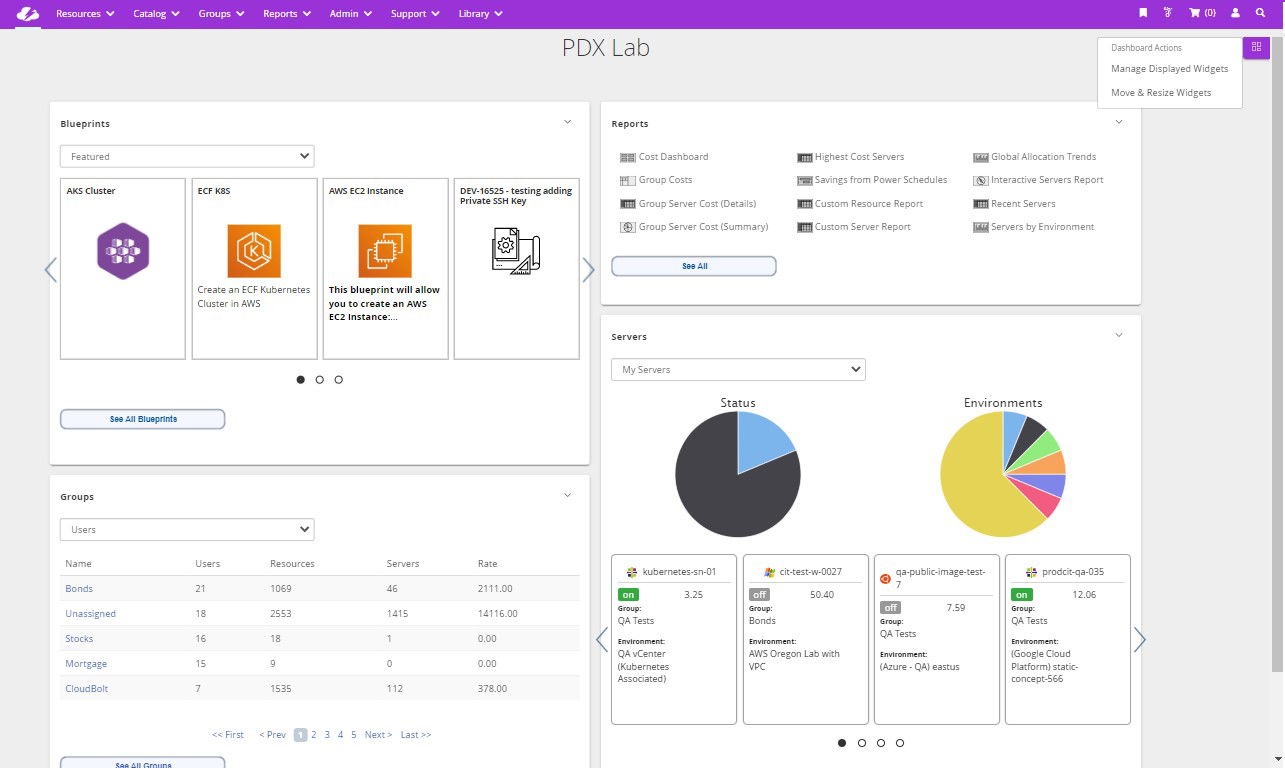
CloudBolt delivers extensive automation, governance controls and cost-optimization insights suited for enterprises operating across diverse clouds. The platform supports broad integrations, including Kubernetes, Terraform, ServiceNow and CI/CD pipelines. Security considerations include role-based access, encryption standards, and alignment with widely adopted frameworks such as GDPR and SOC-type controls. The system is built to scale with complex hybrid environments while maintaining operational clarity.
Pricing
CloudBolt follows a customized enterprise pricing model. Pricing details are not publicly listed because the platform primarily serves organizations with large, hybrid-cloud footprints requiring tailored deployment scopes.
What Works and What Doesn’t
| Pros | Cons |
| Easy orchestration across multiple clouds | Time-consuming for large and complex environments |
| Clear policy-based automation | Overwhelming automation features |
| Helpful Kubernetes tools for rightsizing and managing container workloads | Require extra monitoring tools for deeper Kubernetes visibility |
Our Final Take
CloudBolt is best suited for mid-to-large enterprises seeking modern automation, strong governance, and built-in cost optimization. It may not be suitable for smaller teams. For organizations prioritizing agility, automation, and innovation, CloudBolt stands out as the best platform in 2026.
Flexera One: Best Overall
Flexera One retains its position on our 2026 list thanks to its strong track record in cloud financial management, IT asset optimization, and enterprise-wide visibility. The platform earned recognition in 2024 and 2025 through major analyst reports for its leadership in cloud cost management and SaaS management categories. Known for serving global enterprises, Flexera One supports organizations operating across multiple regions and complex hybrid cloud ecosystems.
Why We Chose Flexera One In 2026
Flexera One stands out by combining cloud cost management, SaaS management, IT asset insights, and hybrid-cloud visibility into a single platform. This unified approach allows organizations to understand their full technology footprint, reduce waste, and optimize spending. Moreover, its ability to map cloud usage to business outcomes makes it especially effective for large enterprises with distributed teams and diverse technology stacks.

Not just that. The platform also helps you optimize cost with detailed resource-level visibility and automated policy-based governance. It integrates with major clouds, containerized environments, and on-prem assets, giving users a holistic view of their infrastructure. Flexera One also supports enterprise security and compliance practices through role-based access, data encryption, and alignment with frameworks such as SOC and GDPR.
Pricing
Flexera One uses custom enterprise pricing that is not disclosed. This is because the platform is designed for organizations with large, complex technology estates that require tailored configurations.
What Works and What Doesn’t
| Pros | Cons |
| Strong visibility across cloud, SaaS and on-prem assets | Could be overwhelming due to the large number of features and options |
| Effective cost-optimization tools | Requires dedicated internal owners to manage and tune the platform well |
| Integrates well across cloud providers, enterprise systems, and IT management tools | Involves additional setup or learning time. |
Our Final Take
Flexera One is ideal for large enterprises managing complex hybrid environments and seeking deep visibility across cloud, SaaS and IT assets. It may be less suitable for small teams with simpler setups. For organizations that need a unified view of their technology landscape, Flexera One remains one of the most capable platforms available.
Topics For More Insights
VMware Tanzu CloudHealth: Best For Scalability
New to our 2026 list, VMware Tanzu CloudHealth earns recognition for its strong multi-cloud cost, usage and governance capabilities. It was acknowledged as a participating platform and continues to receive positive analyst and partner feedback for its depth in cost visibility and governance controls. The platform is used by more than 20,000 organizations worldwide and is still widely adopted, especially among VMware-focused enterprises.
Why We Chose VMware Tanzu CloudHealth In 2026
Tanzu CloudHealth excels because it offers rich visibility into cloud consumption across public, private, and hybrid environments. It uses dynamic business groupings (“Perspectives”) and a policy engine to align cloud usage with organizational business structure. Its strong FinOps toolkit includes cost allocation, forecasting, anomaly detection, and rightsizing.

In day-to-day use, VMware Tanzu CloudHealth enables budget-versus-actuals monitoring, charge-back/show-back to business units, and automated actions. It integrates broadly with major clouds and on-prem environments via APIs and supports governance, security and compliance frameworks with role-based access, encryption and audit-ready reporting. The platform is designed to scale for complex, distributed operations.
Pricing
Tanzu CloudHealth uses custom enterprise pricing with quote-based models for large environments; publicly listed pricing is not available due to its tailored deployment approach.
What Works And What Doesn’t
| Pros | Cons |
| Comprehensive cost-visibility across multiple clouds and hybrid environments. | Adds complexity due to high feature |
| Strong policy engine and automation for governance, budgeting, and anomaly detection | Overwhelming for smaller teams due to advanced features |
| Advanced cost-allocation and show-back/charge-back capabilities | Less intuitive Kubernetes-level cost monitoring |
Our Final Take
VMware Tanzu CloudHealth is ideal for mid-to-large enterprises that require deep cloud financial management, strong governance, and multicloud transparency. It is not suitable for smaller teams or those with limited cloud complexity. If you need enterprise-grade FinOps and multi-cloud alignment, Tanzu CloudHealth is a premium choice.
CloudZero: Best Value
Retained in our 2026 list, CloudZero is recognized for its engineering-centric cloud cost intelligence and optimization platform. It won the 2025 Stratus Award for Cloud Innovation and was also recognized as a Strong Performer in the 2024 Forrester Wave for Cloud Cost Management and Optimization. The platform serves a broad spectrum of customers, including digital-native and enterprise firms, and handles high volumes of cloud and AI spend across multiple providers.
Why We Chose CloudZero In 2026
CloudZero stands out because it takes an engineer-led, business-metric-driven approach to cloud cost: mapping spend to features, customers, teams and products rather than generic cost buckets. It supports rapid cost allocation even in poorly tagged environments, real-time anomaly detection and drill-down to unit economics. This makes it especially suitable for organizations where cloud spend is a major business cost, and teams need actionable visibility.

In practice, CloudZero offers granular cost data by product, customer, and team, hourly cost-tracking across AWS, Azure, GCP, and Kubernetes, anomaly alerts powered by machine learning, and “CostFormation”- type allocation that works even when tagging is inconsistent. It supports FinOps workflows and engineering operators alike, with role-based views, dashboards, and integration into developer and finance tools. It scales well for businesses with heavy cloud/AI usage and where costs directly impact margins.
Pricing
CloudZero follows a customized enterprise pricing model with quotes tailored to customers’ scale, cloud spend and required modules; public list pricing is not provided.
What Works And What Doesn’t
| Pros | Cons |
| Granular cost visibility mapped to business dimensions | Requires mature cloud tagging, data pipeline and analytics maturity |
| Supports real-time or near-real-time cost allocation and anomaly detection | Requires initial setup or specialist skill for advanced features |
| Strong engineering-led design that integrates with developer workflows | A wide range of features adds complexity for small-scale teams |
Our Final Take
CloudZero is ideal for organizations, particularly digital-native, product-led or AI-intensive companies. If your cloud spend is a key business driver, and you need engineering and finance teams aligned with cost efficiency, CloudZero is a compelling choice.
Top 5 Cloud Management Platforms Comparison
P.S.: Always remember to visit the vendor’s site for the latest information!
| Criteria |  |
 |
 |
 |
 |
| Starting Price | N/A | N/A | N/A | N/A | N/A |
| Avg. User Rating | 4.0 | 4.7 | 4.3 | 4.1 | 4.6 |
| Trial Period/Demo | 60-Day Free Trial | Free Demo | Free Demo | Free Demo | 14-Day Free Trial |
| Key Features | Hybrid/Multicloud orchestration, policy-based governance, and self-service catalog | Hybrid/multicloud orchestration, Kubernetes rightsizing, and FinOps alignment | Unified cloud visibility, cost optimization, and asset management | Multi-cloud cost, rightsizing, and FinOps reporting | Cloud cost intelligence, anomaly detection, and multicloud + Kubernetes focus |
| Integrations | AWS, Azure, GCP, and more | Terraform, Ansible, ServiceNow, and more | SaaS tools, Azure, AWS, and more | Cloud and Kubernetes container environments, APIs, and more | AWS, Slack, GCP, and more |
Conclusion
Choosing the right cloud management platform in 2026 depends heavily on the scale of your environment, your FinOps maturity, and the level of automation your teams need.
HPE Morpheus Software and CloudBolt lead in hybrid-cloud orchestration, appealing to platform-engineering teams seeking strong governance and self-service workflows. Flexera One remains the most comprehensive solution for enterprises that need full visibility across cloud, SaaS, and on-prem assets. VMware Tanzu CloudHealth offers deep multi-cloud financial controls for organizations prioritizing FinOps and cost governance at scale. CloudZero stands out for companies where cloud spend directly impacts margins and where engineering teams need actionable, business-aligned cost insights.
Each platform serves a different level of complexity, and the best choice ultimately comes down to matching your operational goals with the platform’s strengths.
Frequently Asked Questions
What Are The Top 5 Cloud Management Platforms Of 2026?
The leading platforms of 2026 are HPE Morpheus Software, CloudBolt, Flexera One, VMware Tanzu CloudHealth and CloudZero. Each excels in different areas, from hybrid-cloud orchestration to deep FinOps visibility, giving organizations strong control across modern multicloud environments.
What Are The Features Of Cloud Management Platforms?
Cloud management platforms typically offer multicloud visibility, automated provisioning, cost optimization, governance policies, workload orchestration, integrations with DevOps tools, security controls and performance monitoring. These features help organizations manage cloud operations efficiently while maintaining compliance, cost discipline, and operational consistency.
Which Is The Best Cloud Management Platform In 2026?
The best platform depends on your needs: Morpheus for hybrid orchestration, CloudBolt for automation, Flexera One for broad visibility, Tanzu CloudHealth for FinOps governance and CloudZero for business-aligned cost intelligence. Each excels in different environments and organizational priorities.
Fri, Jan 9, 2026

Enjoyed what you've read so far? Great news - there's more to explore!
Stay up to date with the latest news, a vast collection of tech articles including introductory guides, product reviews, trends and more, thought-provoking interviews, hottest AI blogs and entertaining tech memes.
Plus, get access to branded insights such as informative white papers, intriguing case studies, in-depth reports, enlightening videos and exciting events and webinars from industry-leading global brands.
Dive into TechDogs' treasure trove today and Know Your World of technology!
Disclaimer - Reference to any specific product, software or entity does not constitute an endorsement or recommendation by TechDogs nor should any data or content published be relied upon. The views expressed by TechDogs' members and guests are their own and their appearance on our site does not imply an endorsement of them or any entity they represent. Views and opinions expressed by TechDogs' Authors are those of the Authors and do not necessarily reflect the view of TechDogs or any of its officials. While we aim to provide valuable and helpful information, some content on TechDogs' site may not have been thoroughly reviewed for every detail or aspect. We encourage users to verify any information independently where necessary.
Loading comments...