

Digital Assets
Stablecoins Explained: Why Banks Are Racing To Launch Them
Share
TL;DR
-
Stablecoins combine the relative stability of traditional currencies with blockchain technology, making digital transactions more predictable.
-
Banks are increasingly exploring stablecoins to make cross-border payments faster, reduce costs and improve financial efficiency.
-
Blockchain-based stablecoin payments can operate around the clock, enabling quicker settlements and automated financial transactions.
-
Unlike central bank digital currencies, stablecoins are generally issued by private organizations and depend on their underlying reserves and redemption mechanisms.
-
Growing regulatory clarity is encouraging institutional interest, although security vulnerabilities, reserve management and market risks remain key concerns.

Introduction
Remember how, in Harry Potter, the wizarding world had its own banking system?
Gringotts Wizarding Bank was where witches and wizards stored their gold, silver and bronze coins, protected by goblins, underground vaults and some rather intimidating security measures. While the magical world had flying broomsticks, teleportation and spells for almost everything, money still had to be physically stored, withdrawn and transferred.
Sounds a little familiar, doesn't it?
Even in our technology-driven world, moving money, especially across borders, can involve multiple intermediaries, processing fees and lengthy settlement times. Sure, digital banking has made transactions easier, but what if transferring money internationally could be as simple as sending a message?
Enter stablecoins!
Combining the relative price stability of traditional currencies with the flexibility of blockchain technology, stablecoins are attracting attention from banks and financial institutions worldwide. In fact, major global banks are exploring their own digital currencies to make payments faster, more efficient, and accessible around the clock.
So, what's driving this financial transformation? Let's get stablecoins explained, explore how they work and understand why banks are racing to launch them.
What Is A Stablecoin?
A stablecoin is a type of cryptocurrency designed to maintain a relatively consistent value by linking its price to another asset, usually a traditional currency such as the US dollar.
Unlike Bitcoin or Ethereum, whose prices fluctuate based on market demand, a dollar-pegged stablecoin aims to maintain a value of approximately $1.
For example, if you own 100 units of a dollar-backed stablecoin, those tokens are intended to represent around $100 in value. Popular examples include Tether (USDT) and USD Coin (USDC), both designed to track the US dollar.
However, not all stablecoins maintain their value in the same way. Their stability depends on how they're backed and managed. The most common categories include:
-
Fiat-backed stablecoins: Supported by reserves such as cash and short-term government securities.
-
Crypto-backed stablecoins: Secured by other cryptocurrencies, often using additional collateral to manage price fluctuations.
-
Commodity-backed stablecoins: Linked to physical assets such as gold.
-
Algorithmic stablecoins: Attempt to maintain their price through automated supply mechanisms rather than conventional reserve backing.
Fiat-backed stablecoins are particularly relevant to banks because they closely resemble existing financial arrangements while introducing blockchain-based transactions. Understanding their underlying structure also explains how stablecoin payments work.
How Do Stablecoin Payments Work?
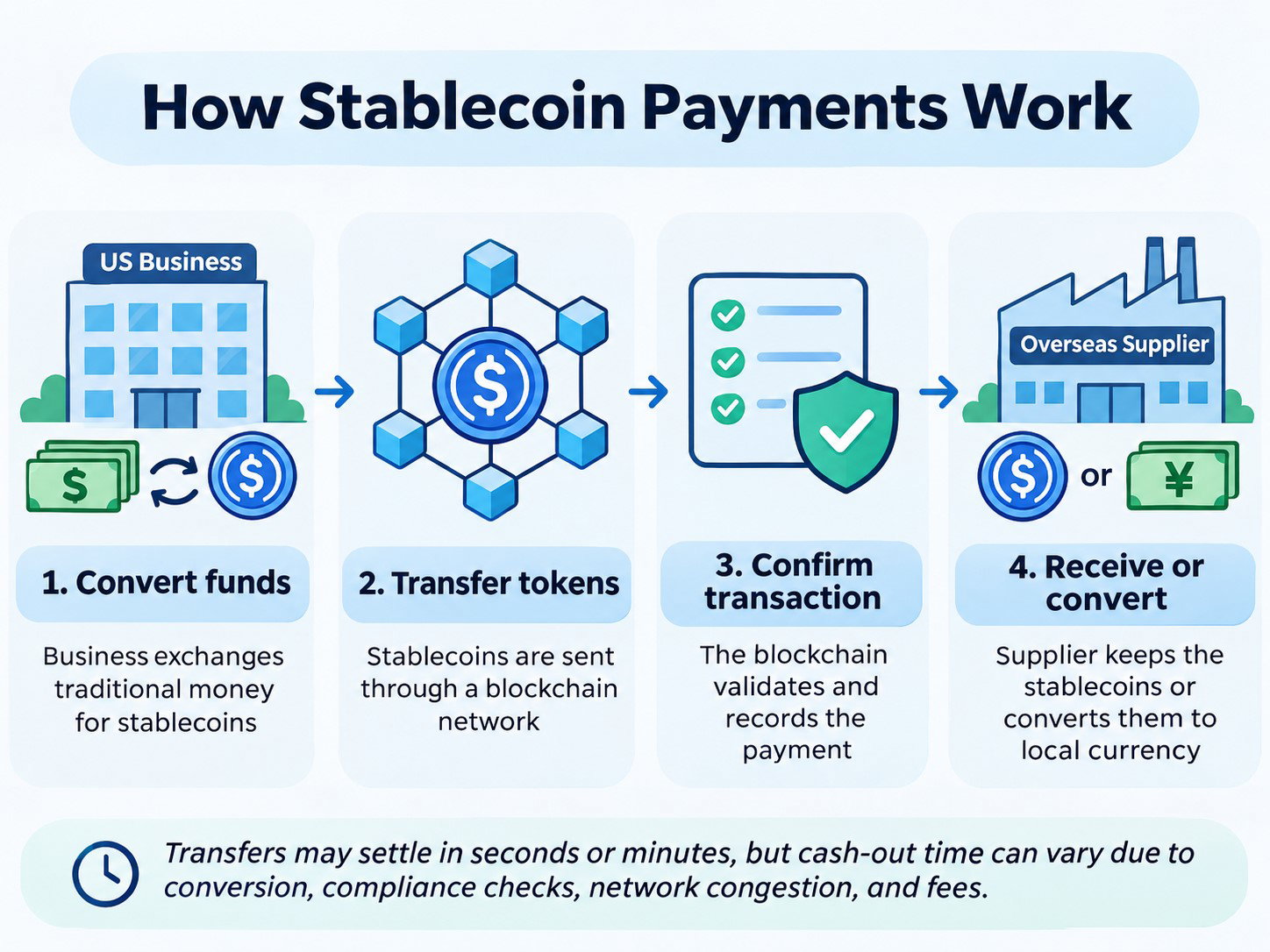
Stablecoin payments use blockchain networks to transfer digital tokens between participants. Instead of relying entirely on conventional banking infrastructure, transactions are recorded on a shared digital ledger.
-
Convert funds: The business exchanges traditional money for an equivalent value of stablecoins through a supported provider.
-
Transfer tokens: The stablecoins are sent to the supplier's digital wallet using a compatible blockchain network.
-
Confirm the transaction: The blockchain validates and records the transfer.
-
Receive or convert: The supplier keeps the stablecoins or converts them into local currency through an exchange or payment provider.
Depending on the network, transfers may settle within seconds or minutes, even outside normal banking hours. Still, faster blockchain settlement doesn't automatically mean instant access to local cash. Currency conversion, compliance checks, network congestion and service-provider fees can affect the overall experience.
Even with these limitations, stablecoin payments offer an opportunity to simplify money movement, particularly for international commerce. That opportunity is attracting traditional financial institutions.
Why Are Banks Launching Stablecoins?
Banks have spent decades building trusted financial networks. However, emerging blockchain-based payment systems could change how businesses and consumers store and transfer money.
Rather than allowing technology companies and cryptocurrency providers to shape this market alone, banks are developing their own solutions.
Here are the major reasons why banks are launching stablecoins:
-
Faster Cross-Border Payments
International payments can pass through several institutions before reaching their destination. Each intermediary may introduce processing time, fees, or operational complexity.
Bank stablecoins could support more direct transfers across compatible digital networks, potentially reducing settlement delays. For businesses managing international suppliers or customers, faster payments can improve liquidity and make cash flow more predictable. -
Around-The-Clock Transactions
Traditional banking systems often operate around business hours, holidays, and settlement schedules. Blockchain networks can function continuously.
With appropriate infrastructure, stablecoins could allow financial institutions to offer payment and settlement services 24/7, supporting businesses that operate across time zones. -
Better Payment Automation
Stablecoins can also support programmable payments through smart contracts. For example, a company could arrange for a supplier payment to execute automatically once agreed conditions are verified.
This creates opportunities for automated invoices, treasury transfers, and digital asset settlements. However, implementing such systems requires reliable data, security controls, and clear contractual arrangements. -
Competition From Financial Technology Companies
Fintech companies and cryptocurrency platforms have introduced digital payment alternatives that operate beyond traditional banking networks. As these services expand, banks face the possibility of losing payment activity, customer relationships, and associated revenue opportunities.
Issuing stablecoins or providing related services could help banks remain relevant in a changing financial ecosystem. -
New Institutional Financial Services
Beyond consumer payments, stablecoins could improve corporate treasury management, digital asset trading and settlement operations. Banks may also generate revenue through custody, transaction services, conversions, and other regulated financial activities.
The opportunity extends beyond launching a digital currency. It involves developing the infrastructure supporting tomorrow's financial transactions.
The Rise Of Bank Stablecoins And Digital Dollars
The competition is already taking shape. In September 2026, a group of 21 financial institutions, including Bank of America, Citi, Goldman Sachs and Deutsche Bank, announced plans to establish a venture supporting a US dollar-pegged stablecoin.
The group is targeting a launch in the first half of 2027, with potential expansion into other major currencies.
Meanwhile, JPMorgan has introduced JPM Coin (JPMD), a blockchain-based deposit token that allows eligible institutional clients to transfer digital representations of bank deposits.
Importantly, deposit tokens aren't identical to conventional stablecoins. They represent claims on commercial bank deposits and operate within a different financial and legal structure. These initiatives demonstrate how banks are exploring multiple approaches to digital money rather than relying on one universal model.
They also highlight growing interest in the digital dollar, a broad term often used for dollar-denominated digital money, including private stablecoins and tokenized deposits. However, private digital dollars shouldn't be confused with central bank-issued currencies.
Stablecoins Vs. CBDC: What's The Difference?
Although stablecoins and central bank digital currencies (CBDCs) both represent digital forms of money, their issuers and underlying structures differ.
A stablecoin is generally issued by a private organization, such as a financial technology company or a regulated financial institution. Its value typically depends on reserves, collateral, and redemption arrangements. A CBDC, meanwhile, is issued by a country's central bank and represents a direct liability of that institution.
Topics For More Insights
This distinction matters because a privately issued stablecoin doesn't automatically carry the same guarantees or protections as central bank money. While stablecoins may operate across public or permissioned blockchains, CBDCs can use different technical architectures depending on national requirements.
Ultimately, stablecoins vs CBDC isn't necessarily a competition with one winner. Both could serve different purposes within future payment systems.
Are Stablecoins Safe? Understanding The Risks
Despite their name, stablecoins aren't entirely risk-free. A stablecoin's reliability depends on the quality of its reserves, the issuer's financial condition and the safeguards protecting users.
Key risks include:
-
Reserve risk: Insufficient or poorly managed backing assets can undermine confidence in a stablecoin.
-
Depegging risk: Market disruptions may cause its trading price to move away from the intended value.
-
Cybersecurity risk: Wallet compromises, smart contract vulnerabilities and fraudulent transactions can lead to financial losses.
-
Redemption risk: Users may encounter restrictions or delays when converting stablecoins into traditional money.
-
Regulatory risk: Different jurisdictions impose varying rules on issuance, payments, and consumer protection.
Stablecoins also generally lack the deposit insurance protections associated with eligible traditional bank deposits. For individuals and businesses asking are stablecoins safe, the practical answer depends on the issuer, reserves, redemption rights and regulatory framework. These concerns explain why stablecoin regulation is becoming increasingly crucial.
How Stablecoin Regulation Is Shaping The Market
Governments are developing clearer rules as stablecoins become more connected to mainstream finance.
In the United States, the GENIUS Act, enacted in July 2025, established a federal framework for payment stablecoin issuance. Its implementation includes requirements covering reserve assets, redemption, risk management, and regulatory supervision, with key provisions taking effect in January 2027.
The European Union has also introduced stablecoin requirements through its Markets in Crypto-Assets (MiCA) framework. These regulations aim to improve transparency, financial stability and accountability while creating clearer operating conditions for eligible issuers.
For banks, regulatory clarity could encourage investment and wider institutional adoption. However, compliance requirements may also increase operating costs and limit how stablecoins can be offered across jurisdictions.
Conclusion: What Does The Future Hold For Stablecoins?
Stablecoins are gradually moving beyond their original role in cryptocurrency trading toward broader payment and settlement applications. Banks could increasingly integrate blockchain-based money transfers into corporate banking, international commerce, and digital financial services.
Still, widespread adoption isn't guaranteed. Stablecoins must demonstrate meaningful advantages over existing payment networks while addressing interoperability, security, regulation and customer trust. Their long-term success will depend less on launching new tokens and more on making financial transactions genuinely easier.
Stablecoins are changing the conversation around digital payments by bringing traditional currency values onto blockchain networks.
For banks, the appeal goes beyond faster transactions. Stablecoins offer opportunities to modernize financial infrastructure, automate payments and compete in an increasingly digital economy.
However, technological innovation alone won't determine their success. Reliable reserves, regulatory oversight, and practical customer benefits will matter just as much.
The race to launch bank stablecoins is underway. The bigger question is which institutions can turn this technology into a trusted, everyday financial service.
Frequently Asked Questions
How Could Stablecoins Impact Traditional Banking Liquidity And Deposit Management?
Widespread stablecoin adoption could shift deposits away from traditional bank accounts, affecting liquidity and lending capacity. Banks may respond by issuing regulated stablecoins or tokenized deposits to retain customer funds and improve capital efficiency.
Can Stablecoins Enable Real-Time Settlement In Institutional Financial Markets?
Stablecoins can support near-instant settlement of tokenized assets through blockchain-based payment systems, potentially reducing counterparty risk and settlement delays. However, interoperability, regulatory compliance, and reliable liquidity remain essential for institutional adoption.
How Could Stablecoin Regulation Influence The Future Of Decentralized Finance (DeFi)?
Stricter stablecoin regulation could improve reserve transparency, redemption reliability and institutional confidence in DeFi ecosystems. However, compliance obligations may restrict access to certain stablecoins and reshape how decentralized platforms integrate regulated digital assets.
Thu, Nov 12, 2026

Liked what you read? That’s only the tip of the tech iceberg!
Explore our vast collection of tech articles including introductory guides, product reviews, trends and more, stay up to date with the latest news, relish thought-provoking interviews and the hottest AI blogs, and tickle your funny bone with hilarious tech memes!
Plus, get access to branded insights from industry-leading global brands through informative white papers, engaging case studies, in-depth reports, enlightening videos and exciting events and webinars.
Dive into TechDogs' treasure trove today and Know Your World of technology like never before!
Disclaimer - Reference to any specific product, software or entity does not constitute an endorsement or recommendation by TechDogs nor should any data or content published be relied upon. The views expressed by TechDogs' members and guests are their own and their appearance on our site does not imply an endorsement of them or any entity they represent. Views and opinions expressed by TechDogs' Authors are those of the Authors and do not necessarily reflect the view of TechDogs or any of its officials. While we aim to provide valuable and helpful information, some content on TechDogs' site may not have been thoroughly reviewed for every detail or aspect. We encourage users to verify any information independently where necessary.
Loading comments...