
Content Management
Learn All About Content Delivery Networks (CDN)
Share
Overview
If you've ever streamed a movie or show recently without any buffering or delays, then you can thank a content delivery network (CDN). They are responsible for delivering content quickly and efficiently to users around the world on several devices. In this blog, we'll look at how they work and why we need them. So, whether you're interested in the inner workings of the internet or just want to know why your content always loads quickly, read on!
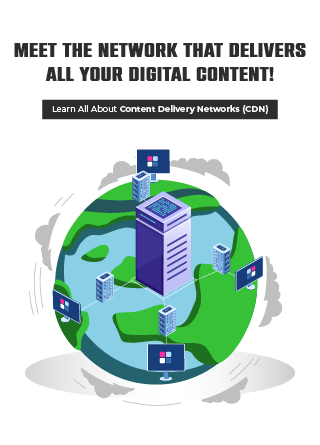
-01-(2).png.aspx "TechDogs-\"Learn All About Content Delivery Networks (CDN)\" Meet The Network That Delivers All Your Digital Content!")
No one likes waiting, especially when it comes to surfing the web or streaming their favorite show. Plus, let's face it, we use the Internet for much more than surfing and binge-watching Resident Evil. The Internet powers our shopping trips and helps us manage our finances. It's our all-in-one source for entertainment (we're looking at you Netflix, Hulu, YouTube, Spotify and Apple Music). The list goes on and on!
The average person spends about 40% of their waking life doing “stuff” on the Internet. That's just under 7 hours a day! People can't stick around when a website takes forever to load because there are simply too many cat videos to watch in a day. Seriously, it's the 21st Century- no one has time to wait for your slow website to catch up to our high expectations.
Slow loading times are frustrating for users but they're also costly for businesses. The stakes are high – a delay of just one second in page loading time reduces conversion rates by 7% and customer satisfaction by 16%. That may not seem like much, yet, it can add up to millions of dollars in lost revenue for businesses that rely on web pages to generate leads or drive sales.
Luckily, there's a technology solution that many businesses are using to speed up their websites, reduce bandwidth costs and keep their organizations safer. Content Delivery Networks (CDNs) speed up website load times and make everyone happier by improving website performance (thus, user experience.) In this introduction to CDNs, we'll look at what they are, how they work and why they're so important for businesses and web users.
What Are Content Delivery Networks?
A CDN is a collection of servers that are globally distributed so they can quickly deliver content to users based on their geographic proximity to the server. CDNs help improve performance by reducing the distance between the web user and whatever it is they're trying access online - this means faster load times for images, music, shopping pages, apps (and of course, cat videos!).
Some Key Features Of CDNs Include:
-
Application load balancing
The content is dynamically routed to the server that can best handle the request
-
Caching
The content is cached on servers close to users, so it can be quickly delivered
-
Origin offload
The content is stored and served from the CDN, reducing the load on the origin server
-
Security
The content is secured with SSL/TLS encryption and distributed denial of service (DDoS) protection (protection from DDoS attacks is done by scrubbing traffic and filtering bad requests)
-
Bot detection/protection
The detection of non-human users (bots) and protection against the overuse of resources by bots.
We realize that none of the above sounds particularly awesome but this is important stuff, folks! CDNs are the backbones of the internet, supporting and delivering the massive amount of content we are all endlessly consuming!
A Brief History Of Content Delivery Networks

The first content delivery network was developed in the late 1990s by a company called Akamai. Akamai's mission was to improve the performance of web content and applications by delivering them from the server that was closest to the user.
From the end user's perspective, content loaded more quickly - an important need twenty years ago as people began consuming more content and larger files over their internet connections.
Back in 1999, Akamai had about 3000 global servers and roughly $4 million in revenue. These days, they manage a global network of over 240,000 edge servers (edge servers are servers located close to Internet users).
Since Akamai introduced the CDN, many other companies have entered the CDN market, including Amazon, Google and Microsoft. In recent years, the use of CDNs has grown exponentially as more businesses have come to rely on the web to generate leads and drive sales. Today, the CDN market is valued at just over $2 billion and is predicted to exceed $8 billion by 2028.
Well, let’s get to the meat of the matter – how do CDNs work?
How Do Content Delivery Networks Work?
CDNs work by routing internet traffic through internet exchange points (IXPs) - that is, physical locations with a network switch that transfers traffic across different networks.
The main purpose of an IXP is to reduce the number of "hops" (or network connections) that data needs to make between different networks.
To achieve this, CDNs use Anycast routing, a type of IP routing that sends traffic to the closest server. With Anycast, each CDN server has a unique IP address and traffic is routed to the server that is closest to the user. CDNs also use point-of-presence (PoP) servers to store content in multiple locations around the world. These PoPs are connected to IXPs, which move the content between networks in ways that are delightfully efficient.
The end result: A user wants to watch the latest episode of Resident Evil. They open Netflix on their Smart TV and - BAM - The CDN is activated! It finds the server in their geographic network which is closest to them. It then sends the video to the user's Smart TV with minimal latency.
The user is happy because they can watch their favorite show without any buffering or delays. Netflix is happy because Resident Evil was delivered to their customer quickly and in terrifyingly high definition. And the CDN is happy because they just made a bunch of money from delivering content. Everybody wins!

We think CDN is the real good boy! Here’s why we say that.
Why Do We Need Content Delivery Networks?
The biggest problem that CDNs help solve is alleviating network congestion - a phenomenon that occurs when there's too much internet traffic going to one place at the same time. Internet Service Providers cause congestion by slowing down their users' connections to manage network traffic (e.g., "traffic shaping.")
Traffic shaping can be a major problem for content providers like Netflix, who need to deliver on their promise of sending high-quality video to their users with minimal (or no) latency. Since CDNs have multiple servers in different locations, they help solve the problem of congestion by rerouting traffic during times of high demand. So don’t worry - your scary Resident Evil episode will get delivered to your high-definition TV - even during peak traffic times (which is the real nightmare!).
It's not just content providers who can benefit from CDNs. If you have a high-traffic website, using a CDN can reduce your site's latency and protect it from traffic surges and DDoS attacks. In fact, many large companies like Facebook, Twitter and Google use CDNs to deliver content to their users. If you’re still not sold on the idea, reading about its future may change your mind!
What’s The Future Of CDNs?
The CDN market is expected to grow to by nearly 30% between 2022 and 2028. Several things are driving growth including the increased availability (and use) of cloud-based content delivery.
Content delivery clouds are a type of Content Delivery Network that is hosted on the cloud. This means that they can be quickly and easily scaled to meet the needs of content providers - no matter how big or small. As content providers increasingly move to the cloud, CDNs will likely follow suit. Some CDN providers are already offering cloud-based content delivery services.
The other major driver of CDN growth is the popularity of streaming video content. Nearly 90% of U.S. households use streaming video services like Amazon Prime Video, Paramount+, and HBO Max. While these players and others like Netflix and Hulu may change, the demand for streaming content will likely continue to grow in the coming years. That means that content providers will continue to rely on CDNs to deliver their content quickly, safely and without any latency.
In the future, the CDN space may be less concentrated on the three main players - Akamai, Cloudflare and Fast. Even large-scale CDNs like these can experience outages from high demand, so one key trend in the CDN space is the use of a multi-CDN approach. Basically, this means that content providers use more than one CDN to deliver content. This redundancy helps to ensure that content is always delivered, even if one CDN experiences an outage.
CDNs are also using technologies like Artificial Intelligence and Machine Learning to understand user behavior and predict traffic patterns. This enables them to do their job better (e.g., efficiently route content to users to eliminate latency).
Conclusion
As Content Delivery Networks continue to evolve, they will become an even more integral part of how we experience content online. So, the next time you're streaming your favorite show without any buffering or delays, be sure to give thanks to the content delivery network for making it all work behind the scenes. CDNs not only provide a speedier experience for your users but they also help minimize site crashes during traffic surges by distributing bandwidth across numerous servers rather than leaving one server to handle it all.
Frequently Asked Questions
What Are Content Delivery Networks?
Content Delivery Networks (CDNs) are collections of globally distributed servers designed to deliver online content quickly to users based on their geographic proximity. By reducing the distance between users and the servers hosting the content, CDNs ensure faster load times for various types of content, including images, videos, applications, and more.
How Do Content Delivery Networks Work?
CDNs operate by routing internet traffic through internet exchange points (IXPs) and utilizing Anycast routing, which directs traffic to the nearest server. These servers, known as point-of-presence (PoP) servers, store content in multiple locations worldwide. By doing so, CDNs efficiently deliver content to users with minimal latency, ensuring a seamless experience for accessing online content.
Why Do We Need Content Delivery Networks?
CDNs play a crucial role in alleviating network congestion and ensuring smooth content delivery, especially during peak traffic times. They reroute traffic to minimize congestion and protect against Distributed Denial of Service (DDoS) attacks. Not only do CDNs benefit content providers like Netflix by ensuring high-quality video streaming, but they also help high-traffic websites reduce latency and enhance user experience, making them essential for businesses relying on online presence and content delivery.
Thu, Oct 27, 2022

Enjoyed what you read? Great news – there’s a lot more to explore!
Dive into our content repository of the latest tech news, a diverse range of articles spanning introductory guides, product reviews, trends and more, along with engaging interviews, up-to-date AI blogs and hilarious tech memes!
Also explore our collection of branded insights via informative white papers, enlightening case studies, in-depth reports, educational videos and exciting events and webinars from leading global brands.
Head to the TechDogs homepage to Know Your World of technology today!
Disclaimer - Reference to any specific product, software or entity does not constitute an endorsement or recommendation by TechDogs nor should any data or content published be relied upon. The views expressed by TechDogs' members and guests are their own and their appearance on our site does not imply an endorsement of them or any entity they represent. Views and opinions expressed by TechDogs' Authors are those of the Authors and do not necessarily reflect the view of TechDogs or any of its officials. While we aim to provide valuable and helpful information, some content on TechDogs' site may not have been thoroughly reviewed for every detail or aspect. We encourage users to verify any information independently where necessary.
Loading comments...