
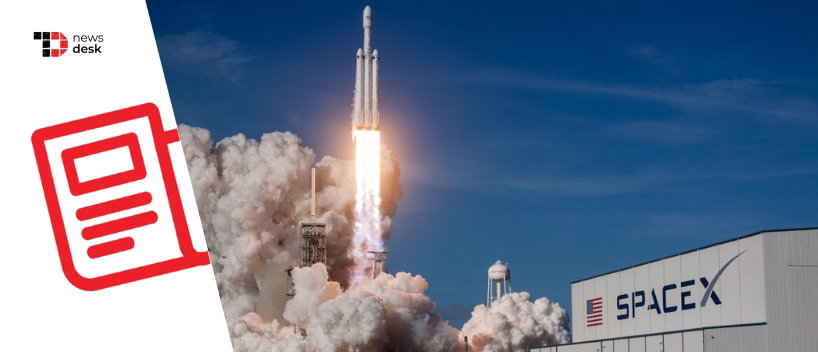
SpaceX has submitted one of the most ambitious satellite licensing requests ever seen, asking the U.S. Federal Communications Commission for permission to launch and operate up to 100,000 third-generation satellites in very-low-Earth orbit.
The proposed Gen3 constellation is designed to deliver ultra-low-latency, multi-gigabit symmetrical broadband to consumers, enterprises and government users, while supporting billions of AI-powered devices worldwide.
TL;DR
- SpaceX is seeking FCC approval for a 100,000-satellite Gen3 network.
- Each satellite could offer around 1 Tbps of downlink capacity and more than 10 times the bandwidth of Gen2 spacecraft.
- The satellites would operate between roughly 323 and 477.5 kilometres above Earth.
- Starship would be central to deploying the much larger spacecraft.
SpaceX filed application SAT-LOA-20260630-00264 with the FCC, describing Gen3 as the communications backbone needed for an AI-driven economy. The company said the network could eventually handle a majority of global internet traffic, while extending high-speed connectivity to underserved and remote regions.
“The Gen3 system will include 100,000 satellites operating in very-low-Earth-orbit to deliver extremely low-latency and multi-gigabit symmetrical throughput for consumers, enterprises, and government users and billions of AI-powered devices around the world,” SpaceX said in its application.
The company also argued that AI applications will require significantly more upload capacity to transmit high-definition visual, audio and sensor data for real-time decisions and industrial automation. SpaceX plans to combine its existing Ku, Ka, V and E-band spectrum with new frequency opportunities, including W and D bands between 92 GHz and 275 GHz, to expand backhaul capacity.
Each proposed Gen3 spacecraft would weigh between 2,000 and 2,500 kilograms, compared with around 800 kilograms for the V2 Mini satellites currently launched on Falcon 9. The satellites could also span 300 to 400 square metres after deploying their solar arrays.
Reports based on the application indicate that each satellite could deliver around 1 Tbps of downlink throughput, approximately ten times the capability of Gen2. Combined with a constellation far larger than Starlink’s current operational fleet, the plan could increase total network bandwidth by roughly 100 times, although actual performance would depend on deployment scale, spectrum approvals, ground infrastructure and user demand.
Topics For More Insights
The size of Gen3 means SpaceX will likely rely on Starship rather than Falcon 9 for large-scale deployment. Responding to news of the filing, SpaceX CEO Elon Musk wrote, “We’re gonna need a bigger rocket! (Starship).”
SpaceX proposes operating the satellites across very-low-Earth-orbit shells at approximately 323 to 327.5 kilometres and 473 to 477.5 kilometres. Lower altitudes can reduce signal travel time and allow failed spacecraft or debris to re-enter the atmosphere faster, but they also require satellites to counter greater atmospheric drag.
The filing remains a request, not an authorization. Earlier in January 2026, the FCC approved only 7,500 additional Gen2 satellites from a much larger SpaceX request, bringing its authorized Gen2 total to 15,000 and showing that regulators may approve large constellations incrementally.
SpaceX says Gen3 will meet or exceed the FCC’s orbital debris mitigation rules and continue using collision-avoidance technologies. Even so, a proposed fleet of 100,000 satellites is likely to intensify scrutiny around orbital congestion, astronomical interference and the environmental effects of manufacturing, launching and deorbiting spacecraft at unprecedented scale.
