

Emerging Technology
Google's Revolutionary AI Model Lumiere Set To Transform The Video Generation Landscape!
Updated on Fri, Jan 26, 2024
Share
In the same dynamic realm of generative AI, Google’s Lumiere, a groundbreaking space-time diffusion model, has emerged as a potential game-changer, presenting a formidable contender in the competitive arena of Artificial Intelligence (AI) driven video synthesis.

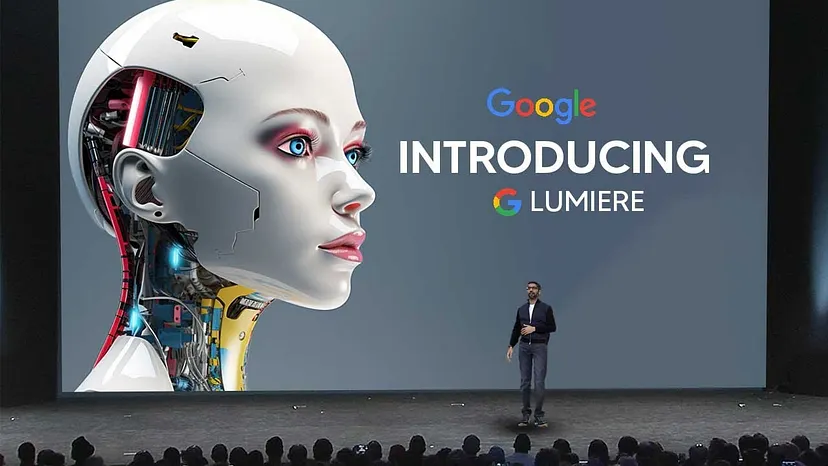
What Is Google’s Lumiere All About?
- Lumiere is the cutting-edge text-to-video diffusion model that tackles the challenge of infusing videos with realistic, diverse and coherent motion head-on.
- Unlike traditional approaches, Lumiere boasts a Space-Time U-Net architecture, capable of generating a video seamlessly in a single model pass.
- This sets it apart from existing AI models relying on distant keyframes and subsequent temporal super-resolution, a method that often stumbles in achieving global temporal consistency.
- By incorporating spatial and temporal down- and up-sampling, coupled with the prowess of a pre-trained text-to-image diffusion model, Lumiere takes a quantum leap in generating full-frame-rate, low-resolution videos across multiple space-time scales.

How Lumiere Is Different From Its Competitors?
-
In a head-to-head comparison with established AI video models such as Pika, Runway, Stability AI and ImagenVideo, Lumiere stands out! While competitors excel in per-frame visual quality, Lumiere produces 5-second videos with higher motion magnitude, maintaining temporal consistency and overall quality.
-
User surveys conducted on the perceived quality of these models favored Lumiere for text and image-to-video generation.
-
The researchers assert that Lumiere achieves state-of-the-art results in text-to-video generation, seamlessly facilitating various content creation tasks and video editing applications.
-
Notably, Lumiere distinguishes itself by addressing a common challenge faced by existing models in handling temporal data dimensions.
-
While competitors’ resort to poured approaches, Lumiere leverages a Space-Time U-Net architecture, generating the entire temporal duration of the video in a single pass.
-
This results in more realistic and coherent motion, avoiding the restrictions imposed by traditional methods in terms of video duration, visual quality and realistic motion.
-
Trained on a dataset comprising 30 million videos and their corresponding text captions, Lumiere can generate 80 frames at 16 frames per second.
However, despite its promising potential, Lumiere is not yet available for testing and its creators acknowledge certain limitations. Besides, the model cannot generate videos with multiple shots or transitions between scenes, leaving room for further exploration and refinement in future research endeavors.
Do you think Lumiere opens gates to boundless creativity through AI diffusion models? Would it be able to emerge as a tough competitor in the AI-video generation landscape?
Feel free to drop your thoughts in the comments section below!
First published on Fri, Jan 26, 2024

Liked what you read? That’s only the tip of the tech iceberg!
Explore our vast collection of tech articles including introductory guides, product reviews, trends and more, stay up to date with the latest news, relish thought-provoking interviews and the hottest AI blogs, and tickle your funny bone with hilarious tech memes!
Plus, get access to branded insights from industry-leading global brands through informative white papers, engaging case studies, in-depth reports, enlightening videos and exciting events and webinars.
Dive into TechDogs' treasure trove today and Know Your World of technology like never before!
Disclaimer - Reference to any specific product, software or entity does not constitute an endorsement or recommendation by TechDogs nor should any data or content published be relied upon. The views expressed by TechDogs' members and guests are their own and their appearance on our site does not imply an endorsement of them or any entity they represent. Views and opinions expressed by TechDogs' Authors are those of the Authors and do not necessarily reflect the view of TechDogs or any of its officials. While we aim to provide valuable and helpful information, some content on TechDogs' site may not have been thoroughly reviewed for every detail or aspect. We encourage users to verify any information independently where necessary.
Loading comments...