
China’s artificial intelligence (AI) race is getting bigger and cheaper at the same time.
Alibaba has unveiled its 2.4 trillion-parameter Qwen3.8-Max, while DeepSeek’s V4-Flash has emerged as the lowest-cost well-known model on benchmark tests.
The contrast is hard to miss. One company is pushing model scale, multimodal intelligence and autonomous work, while the other is applying fresh pressure to an industry already wrestling with the cost of running advanced AI.
TL;DR
- Alibaba unveiled Qwen3.8-Max with 2.4 trillion parameters and 95 billion active at once.
- The model climbed text and visual AI rankings, helping Alibaba shares rise 7%.
- Qwen3.8-Max supports coding, research, professional workflows and million-token multimodal tasks.
- DeepSeek’s V4-Flash averaged just $0.03 per benchmark test, undercutting major rivals.
Alibaba Qwen3.8-Max Scales To 2.4 Trillion Parameters And Climbs AI Rankings
Alibaba described Qwen3.8-Max as “the most capable model in the Qwen family to date,” with improvements across coding, work, research and long-horizon tasks.
The model is available through QwenCloud, while Alibaba plans to release its open weights next week. This will mark the first time the company has made the weights of a Qwen-Max-class model openly available.
Qwen3.8-Max contains 2.4 trillion parameters, placing it close to Moonshot AI’s recently launched Kimi K3, which has 2.8 trillion. Parameter counts do not determine model quality on their own, but they remain a closely watched indicator of the computing scale and data involved in building advanced AI systems.
The launch quickly drew attention on crowdsourced comparison platform Arena.AI. Qwen3.8-Max became the highest-ranked Chinese text model, although it remained behind Claude Fable 5 and three Anthropic Opus variants.
It also ranked second globally among models evaluated for understanding images and other visual content, behind a Claude Fable 5 variant. The strong results helped Alibaba shares jump 7% in Hong Kong trading.
Qwen3.8-Max Uses Million-Token Context And A Cost-Saving Expert Design
Qwen3.8-Max can process text, images and video, with a context window of up to one million tokens. That capacity allows it to handle large software repositories, lengthy legal files and hundreds of pages of documents within a single task.
Despite its overall size, the model activates only 95 billion parameters at a time. Its mixture-of-experts architecture routes requests through specialized parts of the system rather than using the entire model for every prompt, reducing operating costs and response delays.
This design is central to Alibaba’s effort to make the model useful beyond question answering. The company is positioning Qwen3.8-Max as an AI system capable of completing complex, multi-stage assignments and delivering finished work with less human intervention.
Qwen3.8-Max Targets Autonomous Coding And Complex Professional Workflows
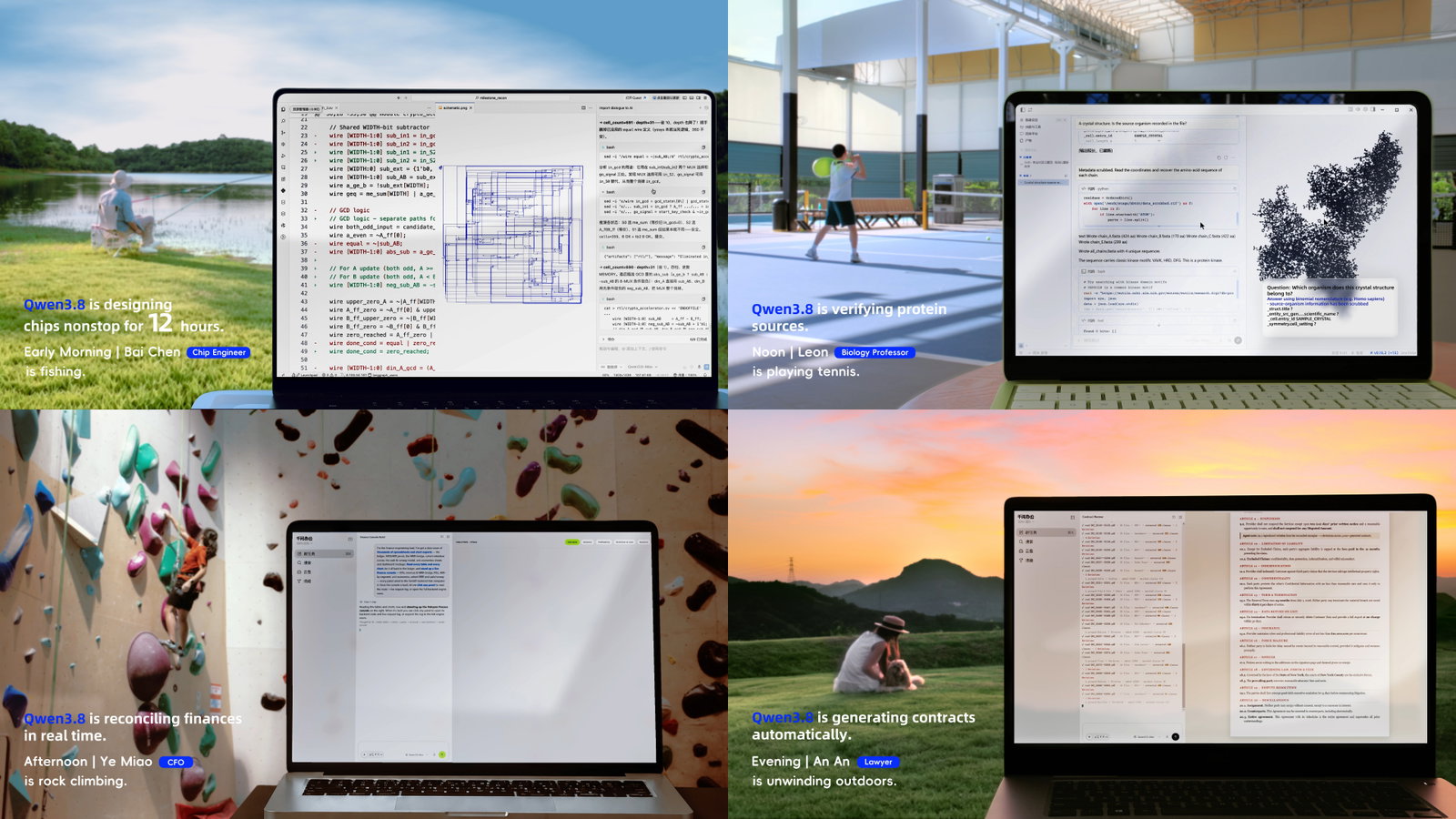
Alibaba tested the model on autonomous software projects that required it to write, execute and improve code without human assistance.
In one project, Qwen3.8-Max created the oh-my-cli project from scratch and operated a self-evolving engineering system for approximately 16 days. By July 30, 2026, the repository had accumulated 265 commits, 127 pull requests and 151 issues.
The system converted requirements into issues, assigned work to agents, ran tests and routed failed results back for further fixes. It also used feedback from users, developers and its own testing process to improve the project over time.
Alibaba said the model can also reproduce and improve research papers, compete against hundreds of human teams within 24 hours and build an end-to-end quantitative trading strategy in a single session.
Its capabilities extend into chip development, where the company said Qwen3.8-Max independently completed stages of a silicon design workflow involving logic restructuring, physical layout generation and multi-constraint optimization.
The model also supports multimodal agents that can understand images, documents and videos throughout a task, rather than treating visual analysis as a separate, one-time step.
DeepSeek V4-Flash Pushes AI Model Costs Down To Three Cents Per Test
While Alibaba is competing through scale and wider capabilities, DeepSeek is applying pressure through pricing.
DeepSeek released V4-Flash on Friday, and Artificial Analysis ranked it as the least expensive well-known model to run across its benchmark tests. The model charges $0.14 per million input tokens and $0.28 per million output tokens.
Artificial Analysis estimated that V4-Flash costs an average of $0.03 per completed test. That compares with $0.86 for Kimi K3, $1.86 for OpenAI’s GPT-5.6 Sol and $3.15 for Claude Fable 5.
The benchmark comparison measures more than the listed token price. It also considers how much information a model must process and generate before completing a task, since an inexpensive model can still become costly when it needs additional steps to produce a usable answer.
Topics For More Insights
Chinese Open-Weight AI Models Target Developers Seeking Lower Costs
Together, Qwen3.8-Max and V4-Flash highlight how Chinese AI companies are combining open-weight development with lower operating costs to attract developers worldwide.
Open-weight models allow developers to download the learned settings behind a system and run, modify or adapt it for their own requirements. This differs from the closed-source approach used by companies such as OpenAI, Anthropic and Google.
“Chinese AI companies have found an important market. Many business workflows do not need the industry's very best model,” said Lian Jye Su, chief analyst at Omdia.
“They need models that are good enough, affordable, transparent and accessible, and open-weight models help meet that demand.”
Alibaba and DeepSeek are now attacking that demand from opposite directions. Qwen3.8-Max offers greater scale and broader autonomous capabilities, while V4-Flash challenges how little companies may need to spend to put advanced AI into production.
