

Hiring
The Missing Rung: Why Entry-Level Tech Jobs Are Vanishing
Share
TL;DR
-
Entry-level tech jobs are shrinking as AI automation, tighter hiring budgets, and changing business priorities reshape recruitment.
-
AI is automating routine coding, testing, and debugging tasks, reducing demand for traditional junior developer roles.
-
Declining early-career tech hiring could weaken the talent pipeline, creating future shortages of experienced professionals.
-
Fresh graduates must prioritize practical experience, AI proficiency, and problem-solving skills to stay competitive in the job market.
-
Companies must rethink entry-level hiring through mentorship, AI-assisted apprenticeships, and structured training to develop future tech leaders.

Introduction
Remember The Devil Wears Prada? Andy Sachs enters the ruthless world of fashion with big ambitions, little experience, and a boss who expects her to know everything from day one. Despite having no background in fashion, she gets her foot in the door, learns through experience, and gradually finds her footing.
Now imagine Andy applying for that same assistant position today, only to discover that the job requires three years of experience, advanced technical skills, and the ability to work alongside AI. Sounds like a pretty different movie, doesn't it?
Well, that's increasingly the reality for fresh graduates entering the technology industry. For years, the career path seemed simple: learn to code, earn a degree, land an entry-level position, and work your way up. However, entry-level tech jobs are shrinking, even as demand for experienced professionals and specialized AI skills continues to grow.
Research using US payroll data through June 2026 found that employment among workers aged 22 to 25 in AI-exposed occupations was 19% below where it would have been had it followed the trend in less-exposed occupations.
While artificial intelligence is changing the nature of junior roles, tighter hiring budgets, shifting business priorities, and rising skill expectations are making the first career opportunity harder to secure.
So, why are entry-level tech jobs disappearing, and what happens when an entire generation of future tech leaders struggles to get its foot in the door?
The Entry-Level Hiring Decline Is Real
The technology hiring landscape has changed considerably since the recruitment boom of 2021 and early 2022.
During that period, companies expanded engineering teams rapidly, competing for graduates and offering attractive salaries. However, economic uncertainty, restructuring, and pressure to improve profitability subsequently pushed organizations toward leaner operations. By 2026, the entry-level hiring decline had become particularly concerning.
In India, the share of fresher recruitment within IT hiring fell from 32% to 24% in July 2026, despite overall technology recruitment growing 10% year over year. Meanwhile, US employment research suggests that young workers in occupations highly exposed to AI are experiencing greater challenges than experienced professionals in similar fields.
However, these trends do not mean every junior role is disappearing. Broader hiring slowdowns also affect experienced workers, and some technology specialties continue to expand.
What has changed is the willingness of companies to invest in employees who require extensive training before becoming productive. That shift becomes particularly crucial when considering the technology accelerating it.
While tighter budgets and changing hiring priorities explain part of this decline, another factor is quietly reshaping the need for junior talent. As AI takes on tasks once assigned to beginners, companies are reconsidering what entry-level developers bring to the table. But is AI really replacing them, or simply changing the nature of their roles?
Is AI Replacing Junior Developers?
Artificial intelligence has fundamentally changed the economics of software development. Tasks that previously occupied junior developers for hours, such as writing boilerplate code, generating tests, documenting functions, and identifying basic errors, can increasingly be completed with AI assistance.
For employers, this creates an attractive proposition: experienced engineers equipped with AI tools may accomplish more without expanding their teams. Consequently, some organizations are reconsidering whether they need the same number of junior developer jobs.
However, the AI impact on entry-level jobs is more complicated than direct replacement. AI can generate code, but generated code still requires validation, security checks, architectural understanding, and accountability. These responsibilities often demand experience that beginners have not yet developed.
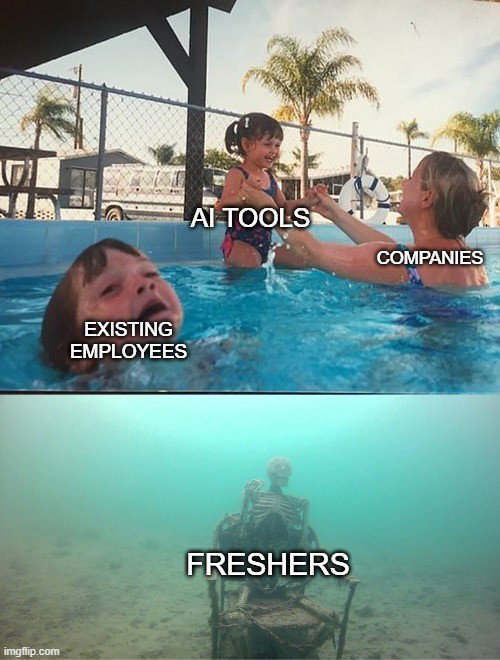
This creates a paradox. Companies increasingly want professionals capable of supervising AI-generated work, yet the assignments that once taught those capabilities are being automated.
Moreover, AI is not solely responsible for weaker recruitment. Economic conditions, reduced workforce expansion, and changing business models also contribute. The real transformation is therefore happening at the task level. As routine work becomes automated, the traditional responsibilities of entry-level employees are being rewritten.
Unfortunately, hiring expectations are not always adapting at the same pace.
As AI takes over routine corporate tasks, employers expect fresh graduates to contribute from day one, creating a familiar dilemma: how do you gain experience without getting hired first?
The Experience Trap For Fresh Graduates
One of the most frustrating aspects of early-career tech hiring in 2026 is the growing gap between what employers call entry-level and what they expect candidates to know.
A junior software engineering position might require proficiency in multiple programming languages, cloud infrastructure, deployment pipelines, databases, and AI-assisted development.
Some listings even demand professional experience despite being advertised as junior roles. This creates an uncomfortable question: how can graduates gain experience when employers hesitate to hire people without it?
The answer has traditionally been internships, apprenticeships, graduate programs, and supervised workplace assignments. Yet these pathways become less accessible when companies prioritize immediate productivity over long-term development.
Recruitment processes can create another challenge. As AI makes it easier to produce polished resumes and applications, employers may place greater emphasis on demonstrated abilities, technical assessments, and practical portfolios.
For candidates without professional connections or access to internships, proving those abilities becomes particularly difficult. Ultimately, the experience trap does more than delay individual careers. It creates a deeper problem for the industry's future workforce.
While the experience gap makes it harder for fresh graduates to enter the industry, its consequences extend far beyond individual career struggles. When fewer beginners get the opportunity to learn and grow, the industry risks losing the very professionals it will need to fill senior roles in the future.
The Hidden Cost Of A Broken Talent Pipeline
What happens when companies stop hiring juniors? Initially, the benefits might look convincing. Organizations reduce onboarding costs, improve short-term productivity, and rely on experienced employees supported by automation.
However, the long-term consequences could be considerably more expensive. Today's junior developers are tomorrow's senior engineers, technical architects, cybersecurity specialists, and engineering leaders.
Without consistent early-career recruitment, companies risk weakening the talent pipeline responsible for developing these professionals. Consider a software company that significantly reduces graduate recruitment for five consecutive years. Its immediate staffing costs might decline, but it could eventually struggle to find employees with the practical experience required for senior positions.
Competitors following similar strategies would face the same challenge, potentially increasing competition for a limited pool of experienced talent. There is also a workplace learning problem.
Junior employees develop judgment through debugging difficult systems, receiving feedback, collaborating with colleagues, and occasionally making mistakes under supervision. AI can accelerate parts of this learning process, but it cannot automatically replace the professional experience gained through real accountability.
The missing rung, therefore, threatens something bigger than employment numbers. It risks disrupting how technical expertise is developed and transferred between generations.
Fortunately, the same technology creating this disruption could also help redesign the first stage of a career.
Early-Career Tech Hiring Is Evolving
Despite concerns about disappearing opportunities, the technology industry is not experiencing a universal collapse in employment. Instead, demand is shifting toward professionals who combine technical fundamentals with emerging capabilities.
Topics For More Insights
AI engineering, cybersecurity, cloud computing, data engineering, and automation are becoming increasingly important areas of recruitment. In fact, entry-level AI engineer hiring grew 68% year over year in the United States and 55% in India during the third quarter of 2026.
This suggests that opportunities are not disappearing uniformly. They are becoming more specialized. For early-career professionals, familiarity with AI tools is increasingly useful, but simply knowing how to generate prompts is unlikely to provide a lasting competitive advantage.
Employers still need people who understand how systems function, recognize incorrect outputs, troubleshoot problems, and apply technology to meaningful business requirements. The opportunity lies in combining foundational knowledge with the ability to work effectively alongside intelligent tools.
This changes how graduates should approach their first job search.
How To Get An Entry-Level Tech Job In 2026
The traditional strategy of earning certifications and submitting hundreds of identical applications is becoming less effective in a crowded recruitment market. Candidates need stronger evidence that they can solve practical problems.
A few approaches can improve their prospects:
-
Build practical projects: Develop applications, automation workflows, or data solutions that demonstrate technical understanding and measurable outcomes.
-
Learn AI-assisted development: Use AI coding assistants while developing the ability to review, test, and improve their outputs.
-
Strengthen core fundamentals: Focus on programming logic, databases, system design basics, debugging, and cybersecurity awareness.
-
Gain practical exposure: Explore internships, open-source contributions, freelance assignments, and apprenticeship opportunities.
-
Expand job searches: Consider technology roles across healthcare, finance, manufacturing, and other industries rather than concentrating exclusively on major technology companies.
Most importantly, candidates should demonstrate how they approach problems, not simply present finished work.
A well-documented project explaining design decisions, challenges, and improvements can reveal more about someone's capabilities than an extensive collection of certificates.
However, graduates cannot solve a structural recruitment problem independently. Employers must also reconsider how they develop future talent.
Rebuilding The First Rung
Technology companies face an important choice. They can continue reducing junior recruitment to maximize immediate efficiency, or redesign entry-level positions around collaboration between humans and AI.
The second approach offers a more sustainable direction. Organizations could introduce AI-supported apprenticeships, structured mentorship, supervised automation projects, and progressive technical responsibilities.
Universities can contribute by integrating AI tools into coursework while ensuring students develop independent reasoning and practical judgment. Rather than eliminating beginner assignments entirely, employers can transform them into opportunities to evaluate AI-generated work, investigate failures, and understand real business systems.
Such changes would help preserve professional development while allowing organizations to benefit from automation.
Conclusion
The decline in entry-level tech jobs reflects a fundamental shift in how the technology industry values experience, productivity, and human expertise. AI is accelerating this transformation, but economic pressures and evolving recruitment expectations are also narrowing traditional career pathways.
For graduates, adapting means developing practical skills, embracing AI, and demonstrating genuine problem-solving abilities. For employers, the challenge is more consequential. Today's hiring decisions will shape the availability of experienced professionals for years to come. After all, an industry cannot keep demanding senior talent if it stops creating opportunities for beginners to become senior professionals.
Frequently Asked Questions
How Could The Decline In Entry-Level Tech Jobs Affect The Future Availability Of Senior Talent?
A sustained decline in junior hiring could create a shortage of experienced professionals as fewer employees progress through traditional career pathways. This may increase recruitment costs, intensify competition for senior talent, and weaken long-term workforce development.
Could AI-Driven Automation Create A Skills Gap Between Junior And Senior Developers?
Yes. When AI automates routine coding, debugging, and testing tasks, beginners may lose opportunities to develop foundational technical judgment. Without structured mentorship and hands-on experience, this could widen the gap between theoretical knowledge and real-world engineering expertise.
How Can Companies Balance AI-Driven Productivity With Long-Term Talent Pipeline Development?
Companies can redesign early-career tech hiring around AI-assisted apprenticeships, supervised projects, and competency-based progression. This approach allows organizations to benefit from automation while developing the technical expertise, critical thinking, and leadership capabilities needed for future roles.
Mon, Nov 16, 2026

Enjoyed what you've read so far? Great news - there's more to explore!
Stay up to date with the latest news, a vast collection of tech articles including introductory guides, product reviews, trends and more, thought-provoking interviews, hottest AI blogs and entertaining tech memes.
Plus, get access to branded insights such as informative white papers, intriguing case studies, in-depth reports, enlightening videos and exciting events and webinars from industry-leading global brands.
Dive into TechDogs' treasure trove today and Know Your World of technology!
Disclaimer - Reference to any specific product, software or entity does not constitute an endorsement or recommendation by TechDogs nor should any data or content published be relied upon. The views expressed by TechDogs' members and guests are their own and their appearance on our site does not imply an endorsement of them or any entity they represent. Views and opinions expressed by TechDogs' Authors are those of the Authors and do not necessarily reflect the view of TechDogs or any of its officials. While we aim to provide valuable and helpful information, some content on TechDogs' site may not have been thoroughly reviewed for every detail or aspect. We encourage users to verify any information independently where necessary.
Loading comments...