
Artificial Intelligence
Meta Launches Muse Code: New AI Coding Agent Challenges OpenAI & Anthropic
Share
TL;DR
-
Meta launched Muse Code on August 5, 2026, powered by the coding-focused Muse Spark 1.2 model.
-
The terminal agent can plan changes, edit code, run commands, validate results and coordinate persistent background subagents.
-
Its restart-safe local event log lets interrupted tasks resume without losing completed steps.
-
Meta reports an 82.9% Terminal-Bench 2.1 score, placing Muse Code between Claude Code and Codex in its evaluation.
-
Competitive pricing may attract developers, although its contributor tier raises data-use considerations for proprietary code.
Introduction
The Artificial Intelligence (AI) coding race has stopped being a two-company contest. On August 5, 2026, Meta launched Muse Code in beta, placing its terminal agent beside Anthropic’s Claude Code and OpenAI’s Codex. This is not an autocomplete feature that suggests the next line and waits. The Muse Code AI coding agent can inspect large repositories, plan changes, write code, run commands and verify results.
Meta is entering with an agent designed alongside its model and pricing intended to reduce the cost of long-running work. The launch matters because coding agents are evolving from programming assistants into operating layers for software teams. Here is what Meta Muse Code does, how it compares and whether it is a credible OpenAI Codex alternative.
What Is Meta Muse Code?
Meta Muse Code is a beta coding agent for terminal and Continuous Integration (CI) workflows. The Meta Muse Code beta launch date was August 5, 2026, when Meta released it with Muse Spark 1.2 for macOS and Linux.
The agent plans modifications, edits files, executes commands and validates outcomes. It also coordinates asynchronous background agents that remain active throughout a session. These workers can investigate a repository, prepare next steps and return findings without repeatedly restarting their research.
Muse Code records every model call, tool run, approval and edit in a local event log. If a task crashes, it can resume from the same point. Built-in skills such as /plan, /grill and /goal support planning, stress-testing and objective-driven execution.
Why Meta Released A Terminal-Based AI Coding Agent
Why Meta released a terminal-based AI coding agent becomes clear when the terminal is treated as a developer control room. It already connects source files, Git, test suites, build tools and CI commands. An agent working there can move from recommendation to execution without forcing developers to copy code between windows.
Claude Code began as a terminal tool, while Codex now spans the terminal, Integrated Development Environments (IDEs), the web, cloud tasks and desktop. Muse Code starts with a narrower surface but enters a workflow developers already understand.
Claude Code Vs Muse Code Vs OpenAI Codex
The Claude Code vs Muse Code comparison is not a simple winner-takes-all table.
| Aspect | Claude Code | Muse Code | OpenAI Codex |
| Core Strengths | Maturity and breadth. Works across the terminal, IDE, desktop and browser. | Persistent background agents, a restart-safe event log and co-training with Muse Spark 1.2. Meta says the pairing improves tool use and long-horizon work. | Expanded beyond its Command-Line Interface (CLI) into IDE integrations, cloud execution, code review, Slack and Software Development Kits (SDKs). |
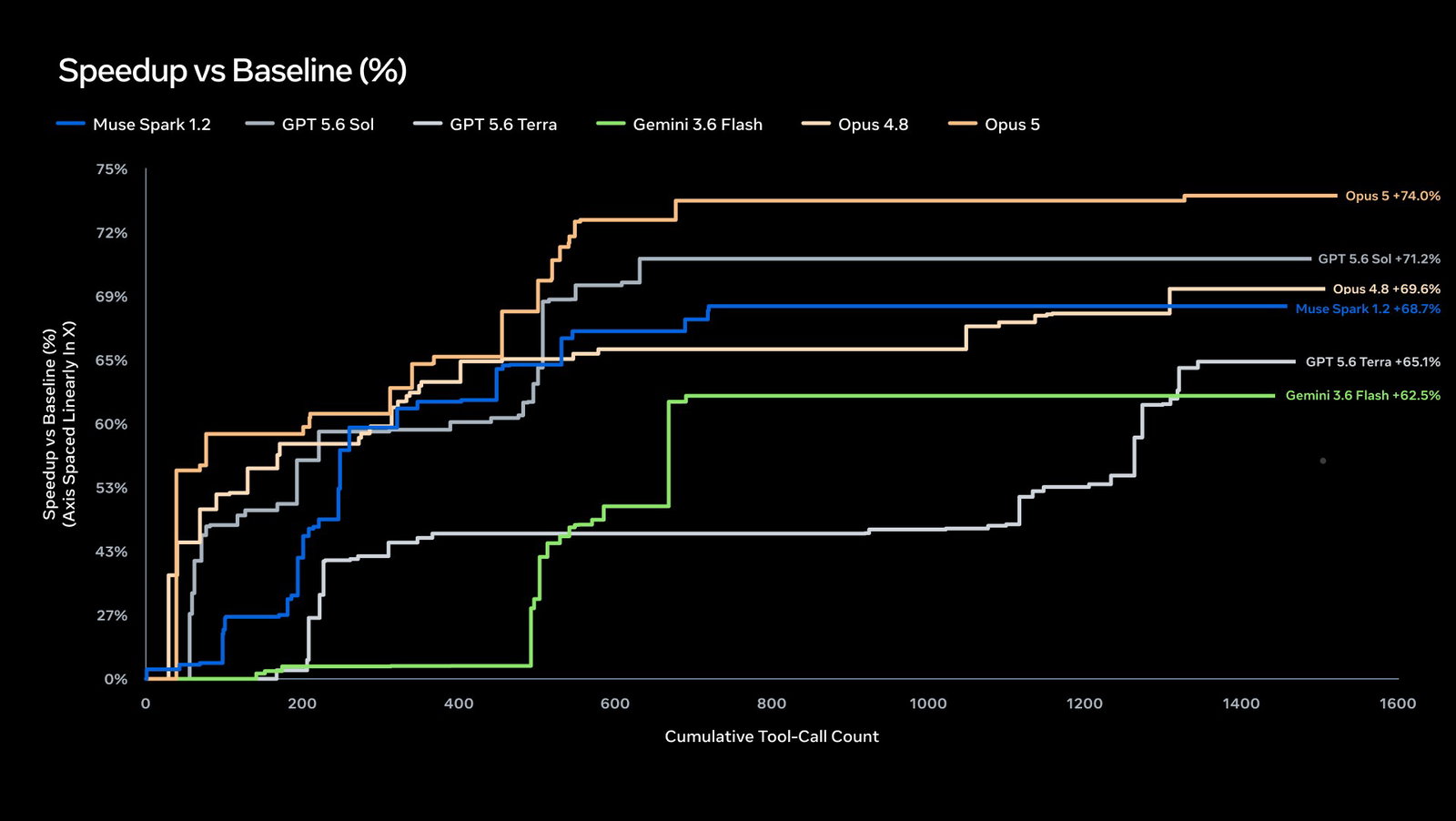
| Additional Capabilities | Supports checkpoints, background tasks, hooks, custom subagents, plugins and code-review workflows. | In one kernel-optimization test, the system completed more than 1,000 tool calls over as long as 24 hours while compiling, profiling and improving code for NVIDIA Hopper Graphics Processing Units (GPUs). | Desktop app can supervise multiple agents. That ecosystem may matter more to enterprises than one benchmark score. |
Meta is competing on cost. Standard Muse Spark 1.2 pricing is $1.25 per million input tokens, $0.15 per million cached input tokens and $4.25 per million output tokens.
Meta Chief AI Officer Alexandr Wang called Muse Code “one of the most affordable coding agents on the market.” A cheaper contributor tier is available but user activity may be used to improve Meta’s products. Teams handling proprietary code should examine that condition.
Is Meta Muse Code Better Than Anthropic Claude Code And OpenAI Codex?
There is no evidence yet that it is better overall.
In Meta’s Terminal-Bench 2.1 evaluation, Muse Code scored 82.9%. Claude Code with Opus 5 scored 86.7%, while Codex with GPT-5.6 Terra scored 81.8%. On DeepSWE 1.1, Muse Code scored 59.3%, behind Claude Code at 65% and Codex at 64.8%.
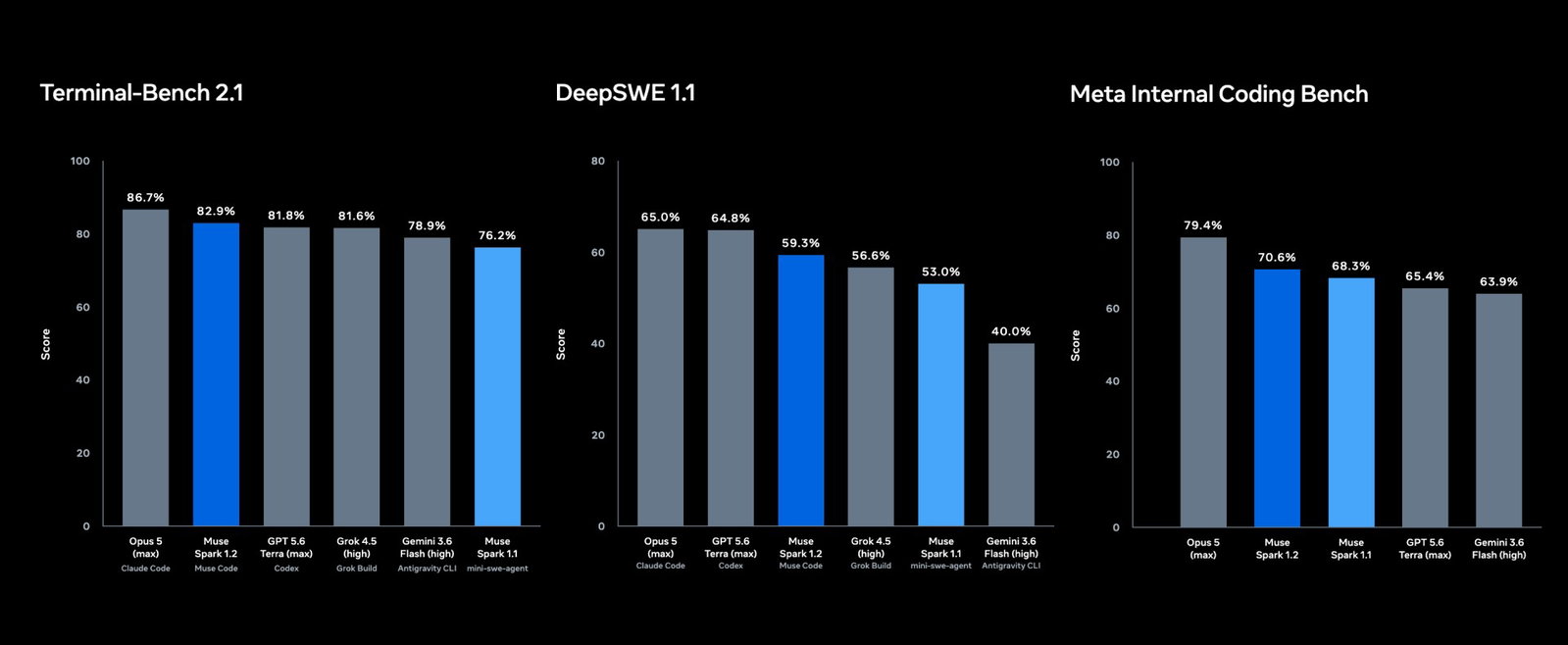
The results show that Muse Code is competitive, not dominant. Meta also notes that these are best-effort third-party comparisons and may not reflect rival models at their best because each product uses its own agent harness. Real-world reliability, security controls, review quality and total task cost will matter more than launch-day charts.
What Meta’s AI Coding Agent Means For The Market?
Meta’s AI coding agent adds price pressure where Anthropic and OpenAI are building strong developer businesses. Muse Code, Muse Spark 1.2 and the Meta Model API also give Meta a commercial developer stack rather than another standalone model release.
Compatibility with OpenAI and Anthropic SDKs may make Meta easier to test inside existing systems. Developers gain another capable option. Enterprises gain another vendor to assess for data handling, governance, auditability and deployment fit.
Conclusion
Muse Code does not arrive as the undisputed champion. It arrives as a credible challenger with a practical terminal design, restart-safe execution, persistent subagents and aggressive pricing.
The coding-agent race is now a three-way contest. Muse Code’s next test is whether developers trust it with real repositories after the beta excitement fades.
Frequently Asked Questions
How Can Developers Install Meta Muse Code?
Developers can install Muse Code on macOS or Linux by running a single command in the terminal:
curl -fsSL https://dev.meta.ai/install.sh | bash
Is Meta Muse Code Available For Windows?
Meta has not announced a native Windows version. The beta currently supports macOS and Linux, so Windows users must wait for official platform support.
Which Team Developed Meta Muse Code?
Muse Code was developed by Meta Superintelligence Labs, the AI organization led by Meta Chief AI Officer Alexandr Wang.
Thu, Aug 6, 2026

Enjoyed what you've read so far? Great news - there's more to explore!
Stay up to date with the latest news, a vast collection of tech articles including introductory guides, product reviews, trends and more, thought-provoking interviews, hottest AI blogs and entertaining tech memes.
Plus, get access to branded insights such as informative white papers, intriguing case studies, in-depth reports, enlightening videos and exciting events and webinars from industry-leading global brands.
Dive into TechDogs' treasure trove today and Know Your World of technology!
Disclaimer - Reference to any specific product, software or entity does not constitute an endorsement or recommendation by TechDogs nor should any data or content published be relied upon. The views expressed by TechDogs' members and guests are their own and their appearance on our site does not imply an endorsement of them or any entity they represent. Views and opinions expressed by TechDogs' Authors are those of the Authors and do not necessarily reflect the view of TechDogs or any of its officials. While we aim to provide valuable and helpful information, some content on TechDogs' site may not have been thoroughly reviewed for every detail or aspect. We encourage users to verify any information independently where necessary.
Loading comments...